
All images © by Roberto Piperno, owner of the domain. Write to romapip@quipo.it.


Notes:
Page revised in July 2026.
All images © by Roberto Piperno, owner of the domain. Write to romapip@quipo.it.
Notes:
Page revised in July 2026.
 Basilica di S. Sebastiano - part two
Links to this page can be found in Book 3, Day 5 and View C11.
In this page:
Circo di Massenzio, formerly known as Circo di Caracalla
Valle della Caffarella
S. Urbano, Catacombs of Pretestato and of Vigna Rondanini
Ninfeo di Egeria
Sepolcro di Annia Regilla
SS. Annunziata (Annunziatella) and Villa di Numisia e Munazia Procula
in the first page:
The plate by Giuseppe Vasi
The view today
S. Sebastiano
Catacombe della Via Appia
Cecilia Metella

(above) Western entrance to the circus; (below) the circus seen from its eastern end (photos taken during the preparation phases of a film-making session)
This Circus was made by the Emperor Caracalla,
and is the most entire of all the Circus that were in Rome. (..) You see how long it was, and the walls yet
show you what compass it carryed.
Richard Lassels' The Voyage of Italy, or a Compleat Journey through Italy in ca 1668.
Caracalla's Circus, as it is called, rests on very doubtful authority. There is a coin of Caracalla's, with a circus on the reverse side; - here is a circus that wants an owner; - how easy the inference then, that it must have been Caracalla's! It has suffered so little alteration from time, that the whole shape and extent, are as distinct as they could have been 1,500 years ago.
Henry Matthews - Diary of an Invalid - 1817/1818
Beyond the church of S. Sebastian to the left, is the villa of Maxentius.
The remains of the temple and portico of Romulus next present themselves to our left, as we descend. (..) From the temple we then pass to the circus of Romulus, the only remaining one that presents the component parts of an ancient Roman circus. It had
been long called the circus of Caracalla, but the discovery of three marble inscriptions on the spot, in 1825 has
established beyond all doubt its true designation. (..) Maxentius was defeated by Constantine and drowned near
the Milvian bridge A. D. 312; and the temple and circus were both dedicated by him to his deceased and deified son Romulus probably in the preceding year, on his triumphal return from Africa, where he had defeated the tyrant Domitius Alexander. (..) On entering the circus we observe that it is situate in a small valley, judiciously chosen for its construction in the suburban villa of Maxentius, and presenting an
oblong area circumscribed in the length by straight
walls, in the breadth of two curves, and running longitudinally from west to east.
Rev. Jeremiah Donovan - Rome Ancient and Modern - 1843
Maxentius was acclaimed emperor in Rome in 306; he ruled only over Italy and parts of northern Africa; he had no military experience and he relied on his personal wealth to buy out the troops of his enemies; he also made use of his money to retain popularity in Rome by promoting the construction of many buildings (e.g. an imposing basilica in the Forum): the villa and the circus were part of this policy.

Remains of the "carceres", the boxes from which the chariots started the race (see them in a mosaic in France), flanked by two towers; the image used as background for this page shows a view of one of them
The western extremity consists of the carceres, so called "a coercendo" to the rear of which the horses and chariots were ranged before they entered the area of the circus. The segment of a circle which they form was divided into two equal parts by an open passage, through which the circensian pomp entered the circus, and consisted of six arched passages at either side, through which the chariots entered to take their starting posts, and which communicated internally with one another but not with the central open passage. The central passage had no gate, but each of the carceres had, for the marble gate-posts existed in their places until carried off in 1831; and before each pillar stood a herma. (..) Each of the carceres measures fifteen feet in every direction. At the extremities of the carceres stand two towers, each 20 feet in front and 30 at the sides, of rectilinear form on three sides and curvilinear on the fourth, which looks to the west: in the northern tower are remains of the stairs that led up to a terrace, which surmounted the carceres. (..) The towers were intended for musicians, the intermediate terrace for the accommodation of the consuls and of other personages of high rank. (..) The gates of the carceres were thrown open on a signal given by the Praetor with a white cloth. Donovan

(above) Wall separating the circus from the area reserved to the imperial residence; (below) the circus from its western end
In the midst
of it stood that Guglia which now stands in the
midst of Piazza Navona; I saw it lye here broken
in three pieces, and neglected quite till (..) the Romans begin
to think that it was some fine thing. (..) At last it light
upon a good stone-setter who joyned it so well
together, that it now stands streight upon a rare
basis and adorns the very heart of Rome: Thanks
to that ingenious architect Cavalier Bernini, who
set it up there in the anno sancto. Lassels
December 1787. The race-course, which still has the name of that
Emperor, although now largely fallen into decay, still
gives us a conception of immense space. Were a draftsman
to place himself on the left wing of the competing charioteers as they start on their course, he would have to the
right, towering above the ruined seats of the spectators, the
grave of Cecilia Metella with its more modern surroundings, whence runs out ad infinitum the line of the old seats,
while in the distance notable villas and pavilions attract
the eye. Leaving those distant views the artist has no
difficulty in following, straight in front of him, the ruins
of the Spina, and if endowed with architectural fancy he
might in some measure realise the overweening pride of
those days.
J. W. Goethe - Italian Journey - Translation by Charles Nisbet.
An obelisk erected by Emperor Domitian near Iseo Campense was removed by Maxentius and placed on the spina (the raised strip in the middle of the circus); the obelisk returned to Rome in ca 1650 when Gian Lorenzo Bernini used it for Fontana dei Quattro Fiumi in Piazza Navona.

(above) Eastern end of the circus with its monumental entrance; (below) evidence of one of the three conical poles, which were placed at the two "metae", turning points
The metae consisted of three marble truncated cones united, each surmounted with a sort of egg, and rounded at the common base. At first the metae alone determined the course, but subsequently the intermediate space was decorated with columns, statues, obelisks, altars and even temples, which were erected on a common basement, called the Spina, from its analogy to the dorsal spine. (..) Fragments of statues of Venus, Apollo, Paris, Victory, Hercules, an Amazon, and a well executed headless statue of Proserpine, with Cerberus, were found there. (..) At the eastern extremity of the spina is the substruction of the second metae; and the distance between the first and second metae inclusively is 1000 feet. This distance, as Cassiodorus informs us, was run seven times in each chariot-race. (..) This extremity of the circus is, as we said, a perfect semicircle, and was so constructed to direct the course of the chariots round the second metae. At its centre stands the principal gate of the circus; and affixed to its interior walls are two inscriptions, one modern, the other ancient. Donovan

(above) Southern wall of the circus; (below) a detail of it and behind it ruins of the Imperial Palace
The entire arena is 1620
feet long by 240 feet broad. (..) The seats on either side were
sustained by an inner and outer wall and an intermediate vault, which formed a corridor that gave access to
flights of steps leading up to the benches, which afforded accommodation to 15,000 spectators. In the external walls are doors and windows; and in the internal one are vestiges of ten flights of steps and thirty vomitories. Donovan
You may wish to see a page covering Circus Maximus and the chariot races which took place there.

(left) Part of the imperial palace overseeing the circus; (centre-above) part of a dome in the imperial quarters; (right-above) copy of the inscription found in 1825; (right-below) detail showing the use of pottery to lighten the vaults supporting the seating section (see a page on Roman Construction Techniques)
In the mass of the vault were placed inverted
vases of terracotta, a mode of construction employed in
the decline to lighten the pressure. (..) Two ancient inscriptions had been found here in
the year 1825, both relating to Maxentius, and probably
thrown down after his defeat and death: of them one
was so mutilated as to present mere fragments and
the other was affixed here after its discovery, The modern inscription
records that in the year 1825 John Torlonia, Duke of
Bracciano, excavated the circus at his own expense under
the direction of A. Nibby, professor of Archaeology. Donovan
Antonio Nibby (1792-1839) was an Italian archaeologist who updated the guides to Rome written by Giuseppe Vasi and his son Mariano; in 1825 he discovered three inscriptions in this circus: they all made reference to Maxentius, but one in particular stated that the circus was completed in 311 AD and that it was dedicated to Romulus, the son of Maxentius who died in 309 in his teens. Because Maxentius was defeated in 312, it is thought that the circus was actually used only for the inauguration ceremonies. Until 1825 it was named after Emperor Caracalla owing to a statue of him which was found in the vicinity.

(above) Mausoleum of Romulus which was partially incorporated into a building of a farm; (below) the lower part of the mausoleum with the funerary chamber; the upper one where funerary rites were celebrated is lost
That Maxentius erected a temple to his son Romulus numerous medals of that cruel and licentious tyrant attest: on them appears a round temple preceded by a
portico of six columns, and inscribed by Maxentius to
his son, the deified Romulus; and its identity with the
circular ruin before us we know not only from their
identity of construction but also from
inscriptions found in the adjoining circus. The medals bear the words "aeternae memoriae", which warrant the inference that the temple had served also as his
mausoleum. It rises, as we see, in the centre of a quadrilateral area, enclosed by a ruined portico 360 feet
long by 300 feet broad and in front of the circular
substruction are vestiges of a square portico, so that
the plan was not unlike that of the Pantheon. (..) Behind the temple is seen a door, which communicated with the Imperial villa; scattered ruins of which
are still standing. Donovan

Vaulted hall leading to the funerary chamber
Between
the internal and external sections has been opened a
modern communication, which displays the enormous
thickness of the walls destined to sustain the portico. Donovan
The bare walls of the interior are another indication that the complex palace/mausoleum/circus was not finished when Maxentius drowned in the Tiber at Ponte Milvio. Constantine spent most of his life away from Rome; initially he resided often at Augusta Treverorum (Trier) and later on at Constantinople, so he was not interested in completing the decoration of buildings which were so closely associated with the memory of his rival.

(left) Funerary chamber with niches in the thick circular wall which were meant to house cinerary urns; (right) small paintings which were made in the XIXth century in the hall leading to the funerary chamber when it housed a tavern which catered for the foreigners who visited Via Appia Antica
The existing circular structure, which is 120 feet in diameter,
served as a sepulchral chamber: in its centre is a massive pillar with niches, supporting the vault; and around
the interior were eight niches alternately rectilinear and
curvilinear, one of which, to the south, served as an
entrance from the area, another as a door-way opening
on a flight of steps, leading up from the chamber to
the superimposed temple. The other six niches contained cinerary urns; and in each is a loop-hole for the
admission of light and air. Donovan
In the early XIXth century the area of the mausoleum and of the circus belonged to the Amendola family who eventually sold it to the Torlonia who owned many other properties along Via Appia Antica or in its proximity, e.g. Casale della Vaccareccia.
Having seen this interesting monument of antiquity, and resumed our places in our vehicles, we proceed by the road to the rear of the circus to visit the temple of Bacchus, the grotto of the nymph
Egeria, and the temple of the god Rediculus. (..) We now descend to the grotto and fountain of Egeria in the valle de' Caffarelli, so called from the dukes
of that name to whom it belonged. Donovan
The eastern end of the circus built by Maxentius borders on Valle della Caffarella (a reference to the family of Cardinal Scipione Caffarelli Borghese who owned it). At the time of Ancient Rome it was known as the valley of River Almo, a small stream which joined the Tiber south of the walls of Rome.

Views towards: (left) Cecilia Metella and S. Urbano; (right) dome of S. Pietro and Porta S. Sebastiano
The Valle della Caffarella is full of souvenirs of Herodes Atticus and Annia Regilla, who are brought to mind by their tombs, by the sacred grove, by the so called Grotto of Egeria, and by the remains of their beautiful villa. (..) Whatever may have been the origin of the wealth of Atticus it could not have fallen into better hands. His liberality towards men of letters, and needy friends; his works of general utility executed in Greece, Asia Minor, and Italy; his exhibitions of games and entertainments in the Circus and in the Amphitheatre, did not prevent him from cultivating science to such an extent that, on his arrival in Rome, he was selected as tutor of the two adopted sons of Antoninus Pius, - Marcus Aurelius and Lucius Verus. Here he married Annia Regilla, one of the wealthiest ladies of the day, by whom he had six children. She died in childbirth, and Herodes was accused, we do not know on what ground, of having accelerated or caused her death by ill-treatment or violence. Regilla's brother, Appius Annius Bradua, consul A.D. 160, brought an action of uxoricide against Herodes, but failed to prove his case. Still, the calumny remained in the mind of the public. To dispel it, and to regain his position in society, Herodes, although stricken with grief, made himself conspicuous almost to excess in honoring the memory of his departed wife. Her jewels were offered to Ceres and Proserpina; and the land which she had owned between the Via Appia and the valley of the Almo was covered with memorial buildings, and also consecrated to the gods. On the boundary line of the property, columns were raised bearing the inscription in Greek and Latin:- "To the memory of Annia Regilla, wife of Herodes, the light and soul of the house, to whom these lands once belonged."
Rodolfo Lanciani - Pagan and Christian Rome - 1892
The most elevated points of the valley offer views which are unspoiled by modern buildings, but few foreigners visit it.
Access from Via Appia Antica is not very easy to find: a winding alley, which begins at Cappella di Reginald Pole and is flanked by high walls protecting the privacy of secluded villas, leads to this area which was opened to the public in the 1990s.

Torre Valca
Valle della Caffarella is by no means an Italian garden and because parts of it are still farmed or used for pasture, in some areas it has a rather forlorn aspect which recalls description of the Roman Campagna by travellers of the past.
Of all kinds of country that could, by possibility, lie outside the gates of Rome, this is the aptest and fittest burial-ground for the Dead City. So sad, so quiet, so sullen; so secret in its covering up of great masses of ruin and hiding them.
Charles Dickens - Pictures from Italy - 1846
Torre Valca is the current name of a medieval tower built by the Caetani to protect their fortress at Cecilia Metella. The building is located
by the river and it was called Valca after gualchiera (fulling-mill), a process of the textile industry for which it was
used at a later period.

Colombario Costantiniano
It. colombario means dovecot, but archaeologists use this word to indicate an ancient tomb which has small niches for cinerary urns (see one at the necropolis of Porto). The brick tomb named after Emperor Constantine was actually built in the IInd century AD.
You may wish to walk your "virtual" dog at Valle della Caffarella and see more images of some of the ancient buildings shown in this page.

(left) S. Urbano alla Caffarella; (right) detail showing the ancient columns
On the brow of the hill that borders the Egerian valley on the south stands the little church of St. Urban, formerly a temple of Bacchus, or, as it is with more appearance of truth, denominated by others, the temple of the Muses, looking down upon the valley and the groves sacred to these goddesses. As the portico was taken in to enlarge the cella and adapt it better for the purposes of a church, the four marble pillars of fluted Corinthian are now incased in the wall.
John Chetwood Eustace - Classical Tour of Italy in 1802 (publ. 1813)
The temple consists of a cella of brick,
preceded by a tetrastyle portico, formed by four noble
Corinthian columns, enveloped, in part, in the modern
wall built across the intercolumniations, and differing
so much in proportion and style from the rest of the
building that they are supposed to have been taken
from some other edifice. Donovan
Higher up the valley, on a spur of the hill above the springs of Egeria, stands the Temple of Ceres and Faustina (the deceased wife of Antoninus Pius), now called S. Urbano alla Caffarella. It belongs to the Barberinis, who take good care of it, as well as of the sacred grove of ilexes which covers the slope to the south of the springs. The vestibule is supported by four marble pillars, but, the intercolumniations having been filled up by Urban VIII in 1634, the picturesqueness of the effect is destroyed. Lanciani
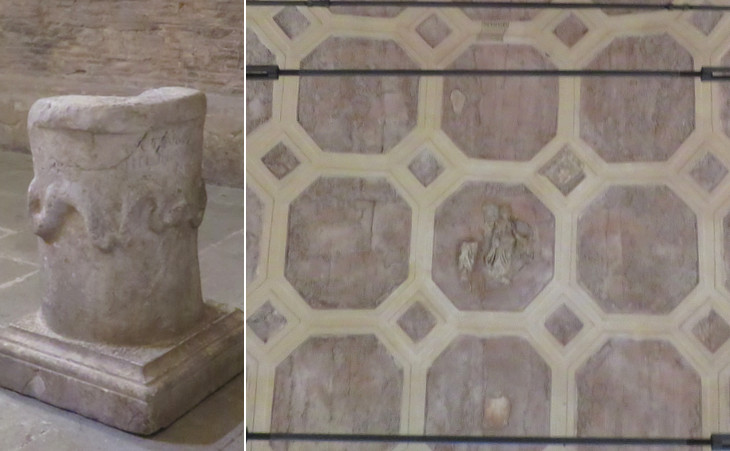
(left) Altar to Bacchus/Dionysus; (right) stucco ceiling with fragment of a relief
Its identity as a temple of Bacchus is established with certainty by the round altar of Bacchus, which we observe on entering its portico, and which, according to Holstein (Lucas Holstenius, librarian of Cardinal Francesco Barberini, nephew of Pope Urban VIII), was found, A D. 1616, in the subterranean part of the temple, and bears the Greek inscription: "At the hearth of Bacchus, Apronianus Hierophant", beneath which is the Dionysiac serpent, crested and coiled round the altar. The style of this altar is considered by the best antiquaries to belong to the third century of our era, as is also that of the temple. (..) The vaulted cieling preserves vestiges of the ancient stuccos, with which it had been adorned, divided into square and octangular compartments; and in its centre are remains of a bas relief with two figures, male and female, one of whom holds in the hand a bird. Donovan
The stucco relief at the centre of the ceiling is thought to depict the Apotheosis of Annia Regilla.
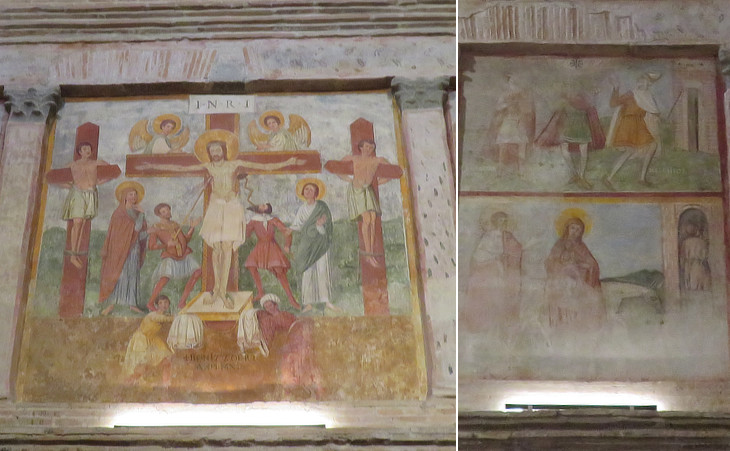
Frescoes in the cell: (left) Crucifixion; (right-above) the Magi; (right-below) Flight to Egypt
Since the XI century the temple has been converted into a Christian church, sacred to S. Urban I. martyr, created Pope in 223, and said to have officiated in the subjacent catacombs. Its interior is still adorned with paintings illustrative of the history of that sainted Pontiff, and bears an inscription recording that the artist was Fra Bonizone, and that the frescos were executed A.D. 1011. Donovan
Around the upper part of the interior are a series of frescoes attributed to Beno de Rapiza, to whom the pictures in the lower church
of S. Clemente are due - comprising the life of Christ from the Annunciation to the descent into Hades, and the life of S. Cecilia
and her husband Valerian, ending in the burial of Cecilia by Pope Urban in the Catacomb of Calixtus, and the story of the martyred Urban I. In the picture of the Crucifixion, the thieves bear their
names, "Calpurnius and Longinus". The frescoes were altered in the seventeenth century to suit the views of the Roman Church,
keys being placed in the hand of Peter, &c. Sets of drawings taken before and after the alterations, are preserved in the Barberini Library, and instructively show the difference.
Augustus J. C. Hare - Walks in Rome - 1874
In the year 1011 the panels between the pilasters of the cella were covered with paintings illustrating the lives and martyrdoms of Caecilia, Tiburtius, Valerianus and Urbanus. Lanciani
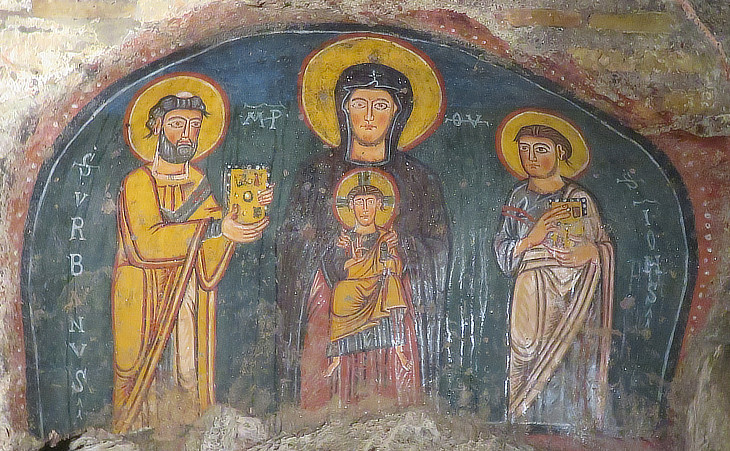
Fresco in the crypt: Virgin and Child between St. Urban and St. John the Evangelist; the posture of the Virgin and Child is very similar to that in a fresco in the lower church of S. Clemente
The descending flight of steps leads down to the subterranean oratory of S. Urban, which still retains its little altar and frescos, and communicated with the catacombs. Donovan
A chapel below the church is shown as that in which S. Urban
baptized and celebrated mass. A fresco here represents the Virgin between S. Urban and S. John. Hare
Pope Paschal I caused the Confession of the church to be decorated with frescoes representing the saint from whom it was named, with the Virgin Mary, and S. John. Lanciani
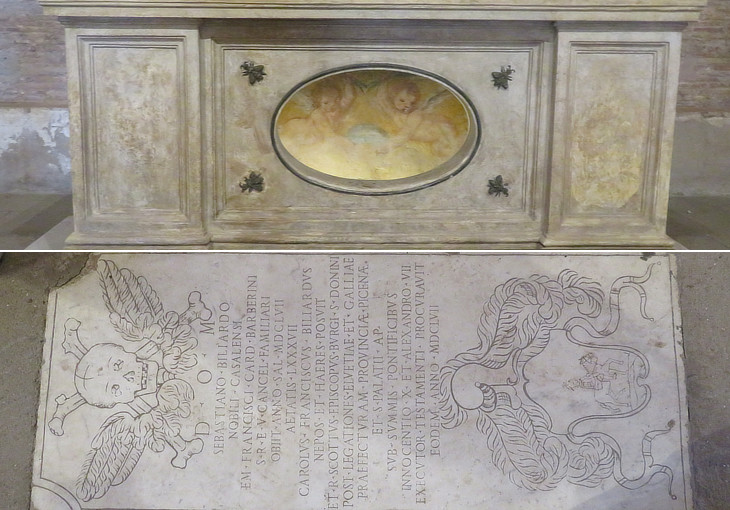
(above) XVIIth century altar with a decoration of bees, the heraldic symbol of the Barberini; (below) 1657 tombstone of Sebastiano Biliardo, a friend of Cardinal Francesco Barberini, who promoted the restoration of the church, with the typical "Memento Mori" references
We have therefore under one roof, and within the four walls of this temple, the names of Ceres, Faustina, Herodes and Annia Regilla, coupled with those of S. Caecilia and S. Valerianus, of Paschal I, and Pope Barberini; decorations in stucco and brick of the time of Marcus Aurelius; paintings of the ninth and eleventh centuries; and all this variety of wealth intrusted to the care of a good old hermit, whose dreams are surely not troubled by the conflicting souvenirs of so many events. Lanciani
The next turning to the left, Vicolo S. Urbano (private road), leads to a villa gate. A path (l.) signed "Per il tempio" leads to the lonely church of S. Urbano in a classical landscape. (..) Inside (apply at villa for key) are remains of stuccoes and frescoes.
1975 Blue Guide of Rome.
In the 1970s the villa became a location for wedding banquets and access to the church was very difficult to obtain. Eventually the church was detached from the private property and acquired by the City of Rome. The photos of its interior were taken on June 13, 2026 when the public was given access to it for the first time after a very long period.

Musei Vaticani: (above) Sarcophagus found at Catacomba di Pretestato near S. Urbano in ca 1854; (below) detail showing Psyche and Eros
Since the XI century the temple has been converted
into a Christian church, sacred to S. Urban I. martyr,
created Pope in 223, and said to have officiated in the
subjacent catacombs. Donovan
Early Christians took possession of the temple and consecrated it to the memory of Pope Urbanus, the martyr, whose remains were buried close by, in the crypta magna of the Catacombs of Praetextatus. Lanciani
Catacombs are usually associated with the Christian use of them, but these underground galleries were common in Rome. Catacomba di Pretestato, which was called after a name found on an inscription, began to be used as a burial ground in the early IIIrd century AD and only at a later time it became a Christian cemetery. The sarcophagus shown above is dated ca 370-380. It was decorated with scenes which can be seen on many other Christian sarcophagi, but the three good shepherds (see a sarcophagus at Porto) and the winged genii (or Cupids) working in a vineyard (see a fresco in Roman houses near SS. Giovanni e Paolo) appeared already in earlier non-Christian sarcophagi and paintings.

Musei Vaticani: replica of a fresco on a tomb with the sentence "Vibia's abduction and descent"
The older part of the catacomb housed some pagan tombs, one of which attracted the interest of archaeologists because it associated the myth of Kore/Persephone/Proserpina with Vibia, the woman buried in the tomb. In the right part of the painting is depicted Hermes/Mercury who according to a tradition which went back many centuries (see the Vth century BC Euphronios Krater) accompanied the souls of the dead to the Underworld. See the same subject in a fine Roman sarcophagus and the Rape of Proserpina by Gian Lorenzo Bernini.

Museo Nazionale Romano: sarcophagus of Faustina, most likely from the Jewish catacomb of Vigna Rondanini near that of Pretestato; beneath the name some Jewish symbols: the seven branched candelabrum (menorah), the ritual horn (shofar), the palm branch (lulav), alongside the Jewish term "shalom" (peace)
In the road leading to S. Urbano is the entrance to the Jewish Catacomb. It is entered by a chamber open to the sky, floored with black and white mosaic, which is supposed to have formed part of a pagan dwelling. The following chamber has remains of a well. Hence a low door forms the entrance of a gallery out of which open six cubicula, one of them containing a fine white marble sarcophagus, and decorated with a painting of the seven-branched candlestick. (..) The inscriptions found show that this cemetery was exclusively Jewish and they are in great part in Greek letters, expressing Latin words. Hare
The catacomb was discovered in 1859 below a triangular strip
of land. Its confines today are defined by the
Appian Way, via Appia Pignatelli and a secondary road. A suit was filed in 1870 against the Rondanini for their illegal sale of Jewish artifacts.

Ninfeo di Egeria
Not far from this Place is the Ascent to the little House call'd la Cafarella because it belongs to the Cafarelli. There under a great ancient Arch is a Fountain still in use. Hither many of the Romans repair in the Summer Months to divert themselves and spend the Day. I have been often at the Place, and seen an ancient Epitaph, which had been laid there in the latter Ages for a Pavement by the aforesaid Fountain; the inscription imported that the Fountain was dedicated to Egeria and the Nymphs.
Flaminius Vacca's 1594 account of discoveries of antiquities which took place in his lifetime, as quoted in "The Travels of the Learned Father Montfaucon from Paris thro' Italy - 1712"
We descended to the valley of Egeria and the grotto, or rather nymphaeum: but instead of the marble magnificence which offended Juvenal here, we found the vault fallen in, the walls mantled with maiden-hair, the statue which passes for the Nymph mutilated, the muses removed from their niches, and the fountain itself a mere trough. Its water, however, was delicious, and, finding a large split reed placed over the drip, I used it as a conduit.
Joseph Forsyth - Remarks on Antiquities, Arts, and Letters in Italy in 1802-1803
The grotto is hollowed
out of the depth of the hill, like a nymphaeum; is
lined with walls not older than the time of Vespasian;
had been covered with a vaulted roof, sustained by marble columns, the base of one of which still remains; and was entered and lighted from the front. At
either side of its entrance is a large recess with a niche,
of which that to the right has almost entirely disappeared: in its interior are seven more rectilinear and
curvilinear niches, making in all nine, the number of
the Muses; and across its central niche is laid a recumbent, mutilated marble statue, not of the Nymph Egeria,
but probably of some fountain god, near which pours
from the niche a streamlet, pure, limpid and wholesome,
to water the little valley, and unite with the acqua Ferentina and acqua Santa to form the gentle Almon, now
the acquataccio, once sacred to Cybele. (..) In the valley and grotto of Egeria, Numa held his nightly consultations with that
Nymph, whose converse poured wisdom into his soul;
and which he dedicated to the Muses, in order that they
might there hold counsel with Egeria. Donovan

Ninfeo di Egeria: details
I need not remind the reader that the name of Egeria, given to the nymphaeum below the temple, is of Renaissance origin. Lanciani
Valle della Caffarella was for many centuries associated with Numa Pompilius, the
second king of Rome. The sacred wood and
the grotto where he used to meet with Nymph Egeria, his patroness and
adviser were thought to be located near S. Urbano, but according to Livy, Numa and Egeria met at Valle delle Camene.
The grotto is actually an artificial cave, once adorned with statues
and used as a summer resort for the large suburban villa of Herodes Atticus
and then included into that of Maxentius. In the XVIIIth century a visit to the grotto was a must for the educated traveller: Goethe himself sketched it and Giovanni Battista Piranesi depicted it in a well known etching (it opens in another window). Lord Byron dedicated to Egeria five stanzas of Childe Harold's Pilgrimage. It was also the site of a yearly festival of the foreign artists in Rome.

Sacred Wood near Ninfeo di Egeria
As regards the Sacred Grove, there is no doubt that its present beautiful ilexes continue the tradition, and flourish on the very spot of the old grove, sacred to the memory of Annia Regilla. Lanciani
You may wish to learn more about sacred woods by visiting that at Ariccia or the sacred oak of Dodoni.

Sepolcro di Annia Regilla
There is a little temple, under the name of the God Rediculus. So fresh are its red and yellow bricks, that the thing seems to have been ruined in its youth; so close their adhesion, that each of the puny pilasters appears one piece, and the cornice is sculptured like the finest marble. (..) Whether it be a temple or a tomb, the rich chisselling lavished on so poor a design convinces me that it was fully as late as Septimius Severus. Forsyth
Advancing towards Rome in the valley of Egeria we meet, at a distance of about a mile, the temple ascribed to the god Rediculus. It rises on a high substruction and is stripped of its portico but its cella still
remains, and is extremely well built of red and yellow
bricks, as are also its architectural ornaments. Over its
door-way is a niche: on the northern and western sides
it is decorated with four pilasters; and on the southern
side, where a road passed, with two octangular, engaged,
brick columns. Its vaulted roof remains, and preserves
traces of the stuccos that adorned it; but the vault which
separated the subterranean part from the cella, and sustained the floor, has fallen. (..) The masonry of the temple, the close adhesion of
the bricks and the exquisite finish of the cornice indicate the best era of Roman architecture, that is the first
century of the empire; but its designation as the temple
of Rediculus is not so generally recognised nor perhaps
so clearly established. Donovan
Until the mid of the XIXth century the building was thought to be a temple to Rediculus, the Roman god who protected the safe return of travellers (Rediculus from Latin redire, to return), perhaps because of an ex-voto for a happy return which was found at not so far away Domine Quo Vadis.

Sepolcro di Annia Regilla: details of its elaborate brickwork decoration (see also those of tombs at Porto, of tombs along Via Appia and Via Latina and of Borromini's S. Andrea delle Fratte)
The lands of Herodes and Annia are described in epigraphic documents as containing a village named Triopium, wheat-fields, vineyards, olive-groves, pastures, a temple dedicated to Faustina the younger under the title of the New Ceres, a burial-space for the family, placed under the protection of Minerva and Nemesis, and lastly a grove sacred to the memory of Regilla.
Many of these monuments are still in existence. The first structure we meet with is a tomb of considerable size built in the shape of a temple, the lowest steps of which are watered by the Almo. (..) The Campagna abounds in sepulchral monuments of a similar design, but none can be compared with this in the elegance of its terra-cotta carvings, which give it the appearance and lightness of lace. The polychrome effect produced by the alternate use of dark red and yellow bricks is particularly fine. Lanciani
Herodes and his wife lived in a villa inside Pagus Triopius, but most often in Greece. In 160 Herodes built the Odeon of Athens in honour of Annia Regilla (but it is usually named after him).

(left) 1789 drawing by Carlo Labruzzi showing that the mausoleum was then used as a hayloft; (right) an octangular engaged brick column
Although no inscription has been found within or near this heroon, there are reasons to prove that it was the family tomb of Regilla, Herodes, and their six children. A more beautiful and interesting structure is hardly to be found in the Campagna, and I wonder why so few visit it. Perhaps it is better that it should be so, because its present owner has just rented it for a pig-pen. Lanciani

(left) The old church; (right-above) how to reach Annunziatella; (right-below) the new church
From S. Sebastiano the most pious pilgrims could expand their Visita delle Sette Chiese by reaching S.
Paolo alle Tre Fontane and (after 1744) Santuario del Divino Amore. On their way pilgrims rested at SS. Annunziata; because the building was small the church was called Annunziatella. In the 1765 Grand View of Rome by Giuseppe Vasi it can be seen at B12, number 228.
At that time the neighbourhood was almost unpopulated; today while the streets leading to the church (Via di S. Sebastiano, Via Ardeatina and Vicolo dell'Annunziatella) are included in an area where new buildings are forbidden, SS. Annunziata itself is outside this area and is surrounded by a new development: for this reason a new larger church was built behind the old one.

(left) Cosmati floor; (right) upper part of the apse
The original church is very old: it was renovated in the XIIIth century (the floor belongs to that period) and later on by Pope Urban VIII (decoration of the apse).

Musei Vaticani: Statue of Dionysus and small frescoes found at Tor Marancia, along Via Ardeatina
The excavations which led to finding a beautiful statue of Dionysus near Via Ardeatina were carried out in 1817-1823. Two Roman villas were found which were named after Numisia and Munazia Procula whose names were found on lead water conduits. The exhibits at Musei Vaticani are dated IInd century AD.

Musei Vaticani: details of the floor mosaics which were found at Tor Marancia and which were used for the decoration of Braccio Nuovo; the mosaic portraying Ulysses tied to the mast of a ship is very similar to a mosaic which was found along Via Cassia; it refers to a famous episode of the Odyssey (you may wish to see another floor mosaic from the Roman villa)
Return to page one.
You can see more of Via Appia Antica in the following pages:
Initial section from Sepolcro di Geta to Domine Quo Vadis
From Cecilia Metella to Torre in Selci and
From Torre in Selci to Frattocchie.
Read Charles Dickens's account of his walk along Via Appia Antica in 1845.
Next plate in Book 3: Basilica di S. Maria in Trastevere.
Next step in Day 5 itinerary: Chiesa di S. Paolo alle Tre Fontane.
Excerpts from Giuseppe Vasi 1761 Itinerary related to this page:
Circo di CaracallaRimane solamente di questo Circo, che da alcuni viene stimato per opera di Gallieno, un masso di materia laterizia, che era l’ingresso principale, ed il piantato d'intorno al Circo, in mezzo del quale fu ritrovato l'obelisco egizio, che ora si vede sul nobilissimo fonte da piazza Navona. Non molto lungi si vede, ancora laChiesa di s. Urbano alla CaffarellaFra le molte rovine, che si vedono in queste campagne, sono notabili quelle di un tempio creduto di Bacco, posto in un sito alto nella tenuta della Caffarella, che sino al Pontificato di Urb. VIII. stette coperto di spine, e siepi. E' questo fatto di mattoni, ed ha un portico con colonne marmoree scannellate: di sotto poi vi è l'oratorio ove s. Urbano catechizzava, e battezzava i nuovi fedeli. Nel basso di questo colle si crede essere stata la celebre Fonte di Egeria e delle Camene. Appresso al fonte era il bosco, e la spelonca, in cui Numa soleva segretamente trattenersi per dare a credere d'aver notturni congressi con quella Dea, e però i Sacerdoti vi andavano per sagrificarvi alla Fede.Chiesa della ss. NunziataNon molto discosto siede questa chiesa, presso cui ne' primi tempi del cristianesimo fu eretto un ospizio per li poveri pellegrini, che venivano in Roma a visitare i sagri Limini, acciocchè stessero lontani da' Gentili. Nell'an. 1270. essendo rinnovata, e consagrata la chiesa, fu poi conceduta alla Compagnia del Confalone. Quindi camminando per quelle campane inzuppate del sangue di tanti ss. Martiri, cioè di quei Cristiani, che lavorarono nelle terme Diocleziane, i quali in ricompensa, e per odio della santa Fede furono fatti morire, detto perciò da varj Scrittori Campus trucidatorum. |


