
All images © by Roberto Piperno, owner of the domain. Write to romapip@quipo.it.


Notes:
Page revised in July 2026.
All images © by Roberto Piperno, owner of the domain. Write to romapip@quipo.it.
Notes:
Page revised in July 2026.
 Ponte Mammolo
Links to this page can be found in Book 5 and Environs of Rome.
The page covers:
The plate by Giuseppe Vasi
Today's view
Nuovo Ponte Mammolo
Museo di Casale dei Pazzi
S. Alessandro
S. Francesco a Settecamini
Ponte Lucano and Sepolcro dei Plauzi
Tor Cervara

Giuseppe Vasi opened his 1754 book covering the monuments along the River Tiber with three etchings
showing the bridges which crossed the Aniene or Teverone, a tributary coming
from Subiaco and Tivoli and joining the Tiber north of Ponte Milvio. Via Tiburtina, the road leading to Tivoli, crosses the Aniene twice; Vasi chose to show Ponte Mammolo, the bridge nearer to Rome, although Ponte Lucano, the other bridge, offered a more evocative view because of a nearby ancient mausoleum. He showed the latter in a small etching in the opening page of the book.
In the description below the plate Vasi made reference to: 1) Via Tiburtina towards Rome;
2) Tavern and house of the custodian; 3) La Vannina (a farmhouse); 4) Via Tiburtina towards Tivoli; 5) Ruins of the tower protecting the bridge.
The small 1920 map shows the sites of 1) Ponte Mammolo; 2) S. Francesco a Settecamini; 3) Ponte Lucano; 4) Tor Cervara; 5) Casal de' Pazzi; 6) S. Alessandro. 4), 5) and 6) are near Ponte Mammolo, but not along Via Tiburtina.


The view in March 2019 (courtesy of Mauro Mura)
The ancient bridge, which already at Vasi's time was in a rather poor state, was so greatly damaged in 1849 during the events related to the Defence of the Roman Republic by Giuseppe Garibaldi that it was replaced by a new bridge a few hundred yards downstream.
The name of the bridge is usually thought to derive from Julia Mamaea,
mother of Emperor Alexander Severus, who restored it. Similar to Ponte Nomentano and Ponte Salaro, two other bridges over the Aniene, it was damaged during the Greek-Gothic War and rebuilt and fortified by the Byzantines at the end of it.

The Aniene River (left) near Casale la Vannina (right)
Casale la Vannina, the farmhouse shown in the etching, was not damaged by war events and it helps in exactly locating the site of the ancient bridge, the ruins of which are hidden by vegetation.
The bridge was described in detail by Rev. Jeremiah Donovan in Rome Ancient and Modern - 1844
The Ponte Mammolo presents two different constructions with several subsequent repairs. Originally it
had been constructed of quadrilateral blocks of tufa,
and consisted of a large central and two small lateral
arches, the curves of which are built of travertine, constructed in the last period of the Republic; but the central arch was rebuilt in the VI. century of our era, and presents the same masonry as the ponte Nomentano and
ponte Salario, whence it would appear to have been rebuilt, like them, by Narses, after its destruction by Totila, mentioned by Procopius. Traces of the marble battlements of Narses still remain; and on the side to the
right, by descending towards the river, we observe a
stone with the letters ENTVL well chiseled on it, a
fragment of some more ancient edifice, the use of which
is an additional proof that the arch was built at the period and under the circumstances just mentioned.

(left) Nuovo Ponte Mammolo; (right) 1867 celebratory inscription by Pope Pius IX
A new bridge was built by Pope Pius IX, but it was damaged on purpose in 1867 to prevent an attempt by Garibaldi to enter Rome; the current bridge is the result of later modifications.
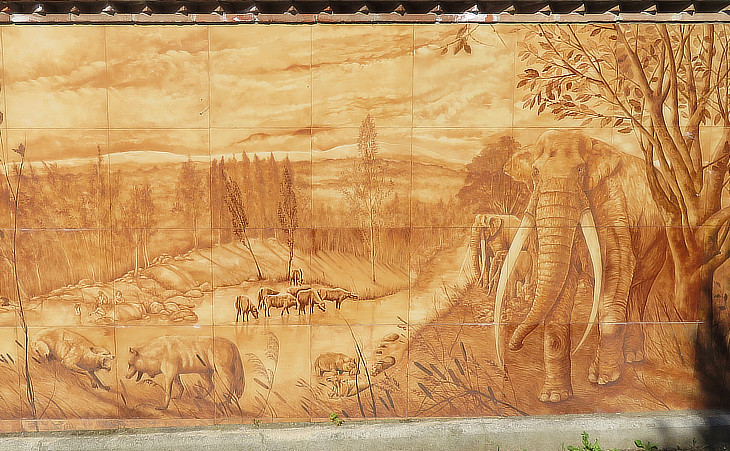
Panel at the entrance to the museum depicting a reconstruction of the Pleistocene environment of the site, Pleistocene being the geological epoch that lasted from ca. 2.5 million to 11,700 years ago
The road (Via Nomentana) then passed the Mons Sacer on the right; and beyond this the Casal dei Pazzi, a modern farm-house, on the same side. At five miles from Rome, the road descends into a valley with a brook, along which, to the left of the road, another way seems to have passed in ancient times. This brook, which was probably the Turia, falls into the Anio, at some little distance above the junction of this river with the Tyber.
Sir William Gell - The topography of Rome and its vicinity - 1834
Following the road beyond the bridge past the castle known as Casale dei Pazzi (once used as a lunatic asylum) we reach the remains of the unearthed Oratorio of S. Alessandro.
Augustus J. C. Hare - Days near Rome - 1875
The area near Casale dei Pazzi was developed in the early 1980s. Excavations meant to level the ground brought to light geological, paleontological and archaeological materials, through which it is possible to imagine a Pleistocene landscape characterized by massive fauna and groups of hunter-gatherers men (see a diorama of prehistoric Latium at Museo Civico di Zoologia).
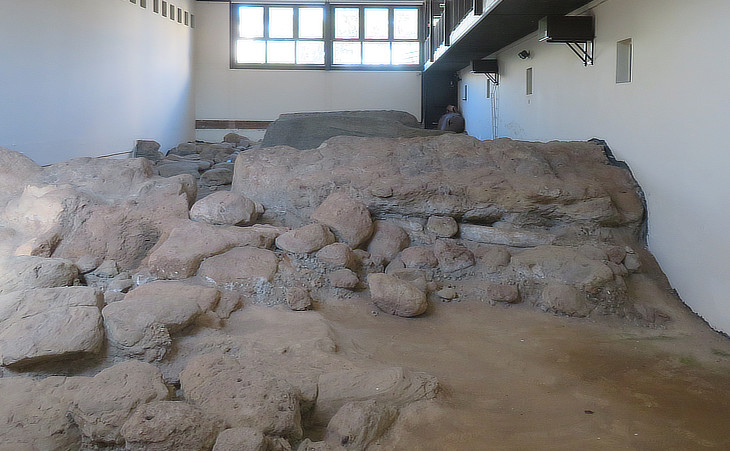
Section of the river bed deposits
When the site's preservation and protection efforts were completed in 2000, a museological path was set up to let visitors understand the highly complex findings. The museum covers an area of about 400 mq and preserves a portion of an ancient watercourse, that, approximately 200,000 years ago, flowed there. The layers of its bed contained fossils of animals typical of very different environments from the current one. Some of these are now extinct, others are still present on other continents, such as the African tropical and equatorial zones. Natural lighting shows big pinkish rocks and fossil remains: up to 4 meters of elephant tusks, teeth, vertebrae. It is the "archaeological" landscape, that has survived after excavation.
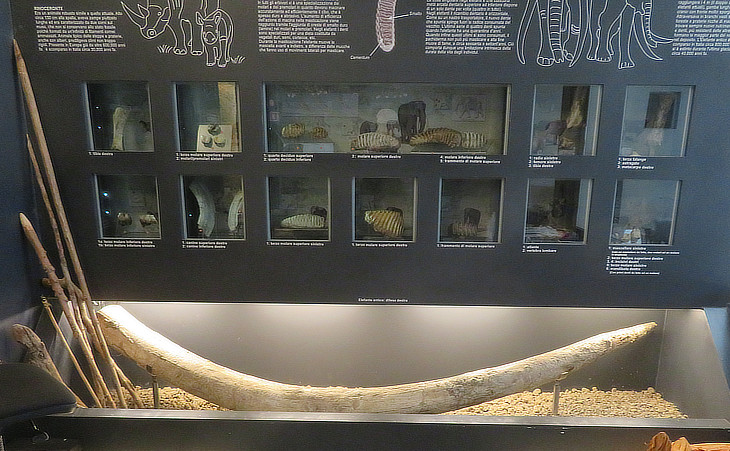
Bones of straight-tusked elephant (Palaeoloxodon antiquus), an extinct species of elephant that inhabited Europe and Western Asia
The museum belongs to the City of Rome and it houses over 4,000 items which were found during the excavations. The remains of the straight-tusked elephant attract the attention because of their size, as the tusks reach 4 m in length; there are also remains of rhino, hippo, aurochs, deer and fallow deer, hyenas, wolves, horses, wild boars and water birds.
Bones of a straight-tusked elephant were found in 1932 during excavations of the gardens of Palazzo Rivaldi in the very centre of Rome.
You may wish to see bones of straight-tusked elephants at Allumiere and at Ceprano and the skeleton of a dwarf elephant in Sicily.
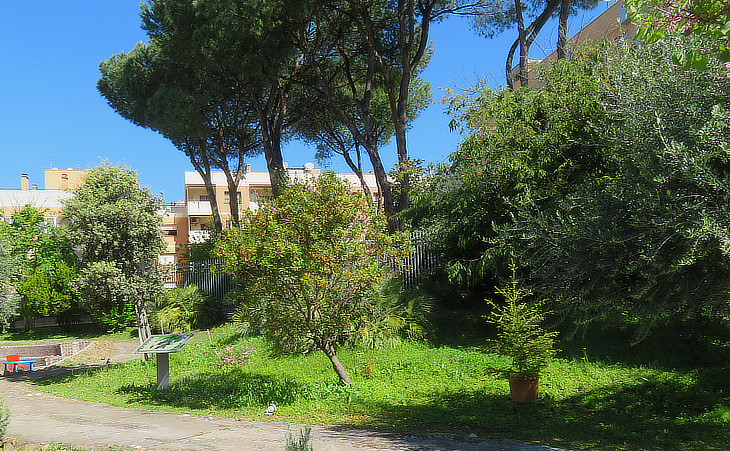
Pleistocene Garden
The Pleistocene Garden, based on the fossils which were found in the deposit is located outside the museum. It includes Sage, Tree Heath, Strawberry tree, Dwarf fan palm, Laurel, Olive, Caucasian Elm, Holm Oak, Field Maple, Judas Tree, Common Rush, Boxwood, White-leaf Rock-rose, Lavender, Ivy, Mugwort and Hazel. All of these plants are part of the current Italian flora, exception made for the Caucasian Elm (Zelkova Crenata) a type of elm now widespread in the Caucasian area, but at the time present also in the Italian peninsula. There are shrubs that can become small trees, fragrant and aromatic plants, which perhaps were known to our ancestors for their medicinal properties. And then there are true trees that, especially in hot and humid periods, expanded beyond the river valleys.
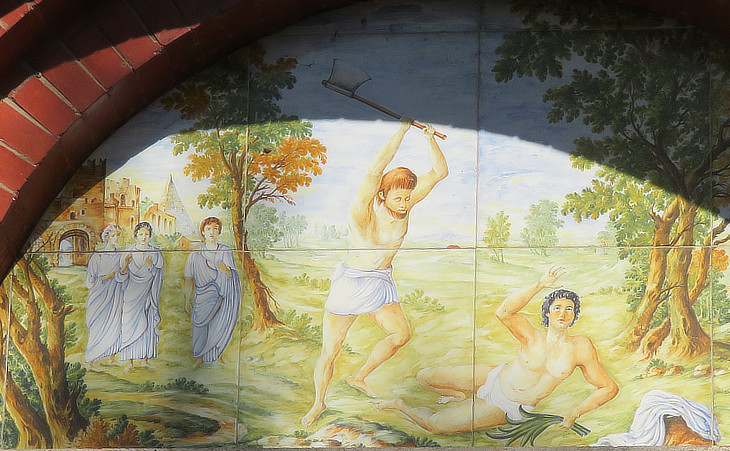
Tile panel at the entrance of the modern parish church of S. Alessandro opposite the ancient oratory
At the seventh milestone of Via Nomentana - we reach the remains of the unearthed Oratorio of S. Alessandro,
built on the site of the place where that Pope suffered martyrdom with his companions Eventius and Theodulus, and was
buried on the same spot by the Christian matron Severina. The "Acts of the martyrs Alexander, Eventius, and Theodulus," narrate that Severina buried the bodies of the first two martyrs
in one tomb, and the third separately - "Theodulum vero alibi
sepelivit." This is borne out by the discovery of a chapel opening from the nave, where the single word "martyri" is conjectured to point out the grave of Theodulus. Hare
Oratory and Catacombs of St. Alexander. In speaking of the catacombs in the more immediate vicinity of Rome, we have alluded to the discovery made here, in 1853, of an early Christian ch. ; it was well known from the History of the Martyrs, that Pope Alexander I. (the sixth Pope), who suffered in the reign of Trajan, a.d. 117, had been buried in this catacomb, with the Presbyter Eventius and the Deacon Theodulus, in a cemetery upon the estate of a Roman lady named Severina, recently converted to Christianity. (..) The foundations of a large ch. were laid in 1857 by Pius IX., and considerable progress in its erection made. It will enclose as a crypt the whole of the subterranean churches, and it was proposed to annex to it a confraternity of Trappists, with an Agricultural establishment under their guidance, an idea which now appears to be abandoned.
John Murray - A handbook of Rome and its environs - 1875
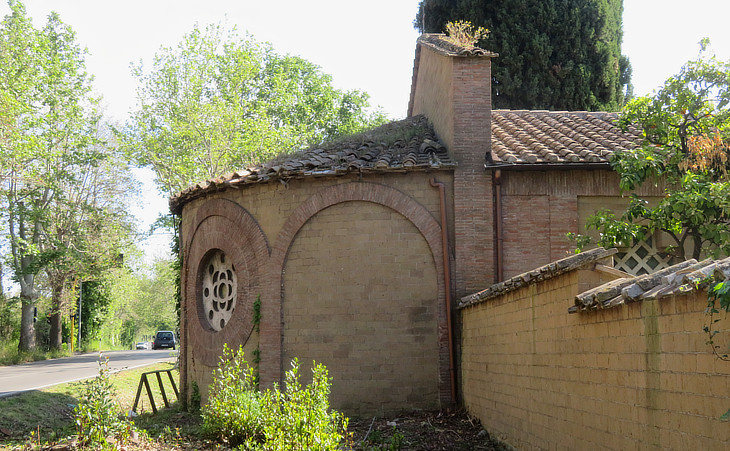
Apse of S. Alessandro along Via Nomentana
The plan, disinterred 1856-57, is still perfect. The tribune and high altar retains fragments of rich marbles and alabasters; the episcopal throne also remains in its place. Hare
On the site, indeed in the Catacomb itself was erected in the 2nd cent, an Oratory to St. Alexander, but after the Peace of the Church (the Edict of Tolerance in 313 AD), when larger space was required, the oratory, originally underground, was laid open, and a ch. built over, the ruins of which have been recently disinterred, and into which the bodies of the martyr pope and his companions had been removed. This ch., now below the general level of the Campagna, consists of 4 portions: descending by a flight of steps, we arrive in a kind of vestibule out of which opens on the rt. the principal oratory, the floor of which is paved with fragments of marble, with some early sepulchral inscriptions; in the centre stands the altar, the table consisting of a slab of porphyry, supported by 4 rude Corinthian pillars; beneath is a sarcophagus composed of slabs, in which lay the body of St. Alexander, enclosed within a marble screen, on which are engraved the words "ALEXANDRO DEDICATE VOT POSVIT."
The name that preceded the first word was probably that of Eventius. Behind this altar is a kind of apse containing a rude bishop's seat, for we are told that this ch. was served by an Episcopus by the inscription also on the screen round the altar, and by another, to an Episcopus Diodatus, in the Oratory of S. Theodulus. Opening out of the church on the l. is a chamber paved in marble, which is called, without any authority, the Oratory of S. Theodulus, near which a door leads into the catacombs or cemetery of S. Alexander, which resemble those we have seen about Rome: the graves, however, have been less disturbed, some with their inscriptions remaining being still closed. One has been opened, and all the objects found in it placed within a grating; on another is an inscription in large letters on the tiles which close it; and on a third, one of those glass cups so frequently seen in the collections of early Christian objects. The most important, however, of all the inscriptions in this catacomb marks the grave of a certain Sophia; another is a singular mixture of Greek and Latin words, but written entirely in Greek letters. These catacombs are of considerable extent, and as yet have been but partially examined. Returning to the vestibule which contains the remains of a marble vase found in the vicinity, but without authority called a baptismal font, and 2 Corinthian columns in granite, we enter on the l. a second ch. with a semicircular apse paved with sepulchral inscriptions: this building is supposed to have been destined for catechumens or females. Murray
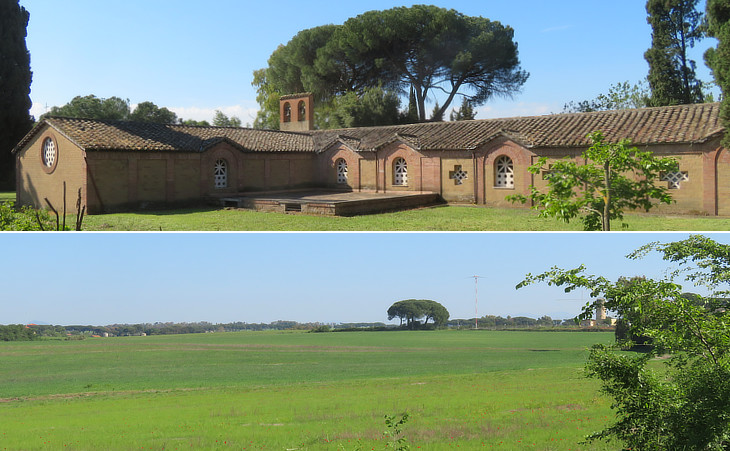
(above) The XIXth century building which protects the evidence of the ancient oratory and catacombs; (below) the countryside towards the Tiber and Tor di Quinto from the site of the oratory
Mass is solemnly performed here by the Cardinal Prefect of the
Propaganda on the festival of S. Alexander, May 3rd, when the
roofless basilica, backed by the blue Sabine mountains and surrounded by the desolate and wonderfully silent Campagna, is filled with worshippers, and presents a striking scene. Hare
Pope Pius IX personally visited the site of the excavations and promoted the worship of Pope Saint Alexander. He dedicated the new outer gate of Porta Pia to his predecessor, a statue of whom was placed at the side of the gate. The association of the martyr Alexander with the Pope was not corroborated by archaeological or historical elements. In the 1570 calendar the three saints were referred to "Saints Alexander, Eventius and Theodulus Martyrs" with no suggestion that any of them was a pope and nothing is known of them other than their names, together with the fact that they were martyred and were buried at the seventh milestone of the Via Nomentana on 3 May of some year. The attention paid by Roman guidebooks to the oratory and the catacombs shortly after their discovery greatly subsided and they were not mentioned in Rodolfo Lanciani's Pagan and Christian Rome (1893) and Wanderings in the Roman Campagna (1909). Pope John XXIII's 1960 revision of the calendar lists them as Eventius, Alexander and Theodulus, the order in which their names are given in historical documents.

Via Tiburtina at Settecamini with two farms at the sides of the road and S. Francesco a Settecamini in the background (Osteria del Fornaccio is on the right side)
Il Forno.
An osteria and church on the road to Tivoli, just
beyond the point where the old road to Monticelli
branched off to the left, at the distance of seven miles
and a half from Rome. (..) The road to Monticelli is ancient, as is proved by
the sepulchres still seen there, and other ruins too indistinct to decide upon. Gell
Today Settecamini is a modern borough of Rome along Via Tiburtina; its name (literally seven chimneys) is associated with the legendary martyrdom of seven Christian brothers by Emperor Hadrian in connection with the construction of his nearby villa. In the XVIth century the area belonged to the Cesi family who built a farm opposite a previous one; the farm became known as Osteria del Fornaccio as it housed an inn and a bakery. The Cesi had extensive possessions in Umbria; the property of Settecamini was eventually acquired by the Torlonia who in the last period of the Papal State owned almost all the countryside surrounding Rome.

(left) S. Francesco a Settecamini where a road leading to S. Angelo Romano, Mentana and Marcellina branches off Via Tiburtina; (right) coat of arms of the Cesi at Osteria del Fornaccio; (inset) coat of arms of the Torlonia above the church entrance
A small but elegant baroque church was built in 1728 for the inhabitants of the farm and for the travellers along Via Tiburtina.

Musei Capitolini: sarcophagus depicting an Amazonomachy (IInd century AD)
This fine sarcophagus was found in 1744 at Salone, south of Settecamini and it was donated to the City of Rome by Pope Benedict XIV. Consistent with the usage of the time missing parts were replaced by new ones. It shows three scenes of undecided fight, but the outcome of the battle is indicated by the bodies of the Amazons on the ground and by the decoration of the lid. The relief shows the pelta, the typical shield of the Amazons which eventually became a decorative pattern (e.g. at Ostia). You may wish to see other sarcophagi depicting an Amazonomachy at Musei Vaticani, at Volterra, at Brescia and in Turkey.

Museo Nazionale Romano: sarcophagus depicting Ulysses and the Sirens (late IInd century AD - VIth mile of Via Tiburtina - see the same subject in a cinerary urn at Volterra)

Museo Nazionale Romano: IIIrd century AD floor mosaic from Settecamini; it is based on a pattern which was very popular (see similar mosaics at Porta Ardeatina, Villa dei Volusii and at Constantine in Algeria)

Overall view
On the 7th May 1645. At about six miles
from Rome, we pass the Teverone, a bridge built by Mammea, the mother of Severus, and so by divers ancient
sepulchres, amongst others that of Valerius Volusi; and
near it pass the stinking sulphureous river over the Ponte
Lucano, where we found a heap, or turret, full of inscriptions, now called the Tomb of Plautius.
John Evelyn's Diary and Correspondence
Via Tiburtina crosses the Aniene again a few miles before reaching Tivoli. The bridge is named after Lucanus Plautius whose family mausoleum stands immediately after the river. Giovanni Battista Piranesi dedicated one of his etchings to Ponte Lucano (it opens in another window), but also many landscape painters loved this place (see an 1810 painting by Filippo Giuntotardi - it opens in another window).
Unfortunately the location, which once was very picturesque, today is spoiled by the industrial development of the area between Rome and Tivoli; in addition recent measures aimed at preventing the Aniene from flooding have surrounded the site with a bank which makes it very difficult to reach the bridge.

(left) Sepolcro dei Plauzi; (right) main inscription
M. Plautius M. F. A. N. | Silvanus | cos. VII vir epulon., | huic senatus triumphalia | ornamenta decrevit | ob res in Ilyrico |
bene gestas. | Lartia Cn. f. uxor. | A. Plautius M. F. | Urgulanius | vix. ann. IX, this long inscription is repeated twice and it says that Marcus Plautius Sylvanus, his wife Lartia and his son Aulus were buried in the mausoleum and that Marcus had been consul, septemvir of the Epulones (*) and was honoured by the Senate with the triumphal ornaments for having conducted well the affairs of Illyricum (**).
(*) Similar to Caius Cestius.
(**) A Roman province roughly corresponding to today's Croatia.

(left) Inscription in the upper part of the mausoleum; (right) coat of arms of Pope Paul II
The mausoleum was built in the Ist century AD and it resembles Sepolcro di Cecilia Metella, Mausoleo di Lucilio Peto and Mausoleo di L. Munatius Plancus at Gaeta; it was turned into a small fortress in the Middle Ages. You may wish to see Piranesi's etching showing the mausoleum (it opens in another window).

Active travertine quarries near Ponte Lucano; the three hills in the background are S. Angelo Romano, Poggio Cesio and Montecelio

(left) Tor Cervara; (right) Festa degli Artisti, sketch by Henri Regnault
Tor Cervara, a tall medieval tower near an abandoned tufa quarry near Via Tiburtina, was the site of a carnival which was celebrated by the German artists living in Rome on the 1st of May, a day of joy across the Rhine, where they solemnized the
new season. Initially the venue of the gathering was Ninfeo di Egeria. It was a sort of burlesque exhibition of pagan rites, to which most of the foreign artists gladly participated. It had its dignitaries, its militia, its corporations of musicians, of high priests, of cooks, of poets, of masters of ceremonies all dressed up in grotesque costumes.
Henri Regnault (1843-1871), a young French painter, took part with his fellow German friends in the ceremonies. Little did he know then that he would lose his life in January 1871, in the war which broke out between France and the German States led by Prussia.

Museo di Roma a Palazzo Braschi: Ippolito Caffi - Festa degli Artisti a Tor de' Schiavi - 1844
The Torre di Schiavi, on one day in the year, is disturbed from its usual propriety of solitude and silence. It is the custom of the German artists resident in Rome to make this spot the scene, or rather the starting point, of an annual spring festival; combining the character of a picnic and a masquerade. Here is their place of rendezvous in the morning, and of gathering for their return in the evening. Here their first and last songs are sung, and the edicts of their leader are promulgated. On these occasions, the waste region puts on the gayest aspect, and blossoms like a bed of tulips. Some of the artists come in carriages, some on horseback, and some on donkeys. The number and variety of the costumes surpass the wildest visions of an inspired tailor.
George Stillman Hillard - Six Months in Italy in ca 1847-1848
At daybreak the whole band went out by Porta Maggiore, and proceeded towards Tor de' Schiavi on the Via Prenestina, then the procession turned northwards to make its way to the grottos of Cervara. Asses furnished a heroic mount for the participants, they were harnessed in toys from Nuremberg and their riders were clad in garments which made them look like good-men of the woods. The day ended with everybody getting drunk.
You may wish to see one of the first Roman paintings by Caffi (it opens in another window) showing the fireworks at Castel Sant'Angelo and some of his paintings having a historical subject. He died in 1866 in a naval battle of the Third Italian Independence War.

Museo di Roma a Palazzo Braschi: Ludwig Haach - Festa degli Artisti - 1841
Here the "Festa degli Artisti" is held in May, which is well worth seeing, the artists in costume riding in procession, and holding games, amid these miniature Petra-like ravines. Hare
At the time of this edition of the book the festival had been already discontinued.
German artists used to live near S. Isidoro in a street which for this reason is called Via degli Artisti.
Ludwig Haach died in 1842 at the age of 28. This engraving is most likely one of his last works.

Museo Nazionale Romano: relief depicting Mithra slaying the bull which was found in 1964 near Tor Cervara (end of the IInd century AD - start of the IIIrd century)
The relief was found during work to remove wartime debris and it was orobably the explosion of a piece of ordnance that broke the relief into more than fifty pieces. In the meantime the fragment depicting Mithra's head had ended up in the Karlsruhe Museum, where at thed of the 1980s it was identified as belonging to this relief. As part of an agreement the Badisches Landesmuseum of Karlsruhe provided on loan the missing fragment and the relief was reconstructed in its entirety. See some other images of Mithra in reliefs, statues and paintings with explanations of their details.
Next plate in Book 5: Ponte Nomentano.
Next step in your tour of the Environs of Rome: Tivoli.
Excerpts from Giuseppe Vasi 1761 Itinerary related to this page:
Ponte MammoloQuattro miglia lungi dalla porta s. Lorenzo si vede questo ponte, il quale secondo alcuni, fu edificato da Alessandro Severo, o da Mammea sua madre, da cui facilmente porta il nome, e corrisponde colla via Tiburtina. Sul medesimo Aniene è il ponte Lucano. |


