All images © by Roberto Piperno, owner of the domain. Write to romapip@quipo.it.


Notes:
Page revised in November 2024.
All images © by Roberto Piperno, owner of the domain. Write to romapip@quipo.it.
Notes:
Page revised in November 2024.
 Palazzo Pontificio sul Quirinale
Links to this page can be found in Book 4, Map B2, Day 3, View B7, Rione Monti and Rione Trevi.
The page covers:
The plate by Giuseppe Vasi
Today's view
Palazzo del Quirinale
- Meaning of the Flags
Fontana e Obelisco del Quirinale
Palazzo della Consulta
Scuderie del Quirinale

Giuseppe Vasi opened his 1754 book on the finest palaces of Rome with a view of the Palace of the Pope on the Quirinal Hill.
Between the end of the XVIth century and 1870 the Popes usually lived in this palace.
The hill was also known as Monte Cavallo because of ancient statues which portrayed Castor and Pollux in the act of taming their horses (It. cavalli).
The view is taken from the green dot in the small 1748 map here below.
In the description below the plate Vasi made reference to: 1) Palazzo della Famiglia Pontificia aka Palazzo della Panetteria; 2) Tower of the Swiss Guard; 3) Palazzo della Consulta;
4) Scuderia e Corpo di Guardia (stables and barracks); 5) Strada Pia (the street opened by Pope Pius IV and leading to Porta Pia). 1) and 5) are shown in another page.
The dotted line in the small map delineates the border between Rione Trevi (left) and Rione Monti (right).

Rome, November 3, 1786. Yesterday was the Festival of All Souls. This commemoration is kept
by the Pope in his private chapel on the Quirinal. I hastened with Tischbein to the Monte Cavallo. The piazza
before the palace has something altogether singular - so irregular is it, and yet so grand and so beautiful! I now cast
eyes upon the Colossuses! neither eye nor mind was large
enough to take them in.
J. W. Goethe - Italian Journey - Translation by Charles Nisbet
The main change relates to the obelisk erected by Pope Pius VI in 1786.
It was placed between the two groups of statues which were slightly moved apart so that their bases diverge more than they did before (you may wish to see an etching by Giovan Battista Piranesi which shows their previous position - it opens in another window).

View over S. Pietro, Palazzo di Montecitorio and Colonna Antonina
Before the Pope's Palace where he now commonly resides stand the two Horses, each with a Figure. (..) These Noble statues standing upon high pedestals, and On the top of a Hill which over-looks Rome have an Appearance very Grand and Awful.
Jonathan and Jonathan Richardson - Account of Some of the Statues, etc. in Italy - 1722
In 1866, at the initiative of Pope Pius IX, the square was levelled in order to obtain a large terrace with a fine view over parts of Rome. Some houses on the western side of the square were pulled down to open a street which made it easier for coaches to reach the palace from Via della Dataria.

Overall view
The ancient Romans built stairways to facilitate the access to a Temple to Serapis which stood on the Quirinale; these were not
maintained and in 1348 their stones were used to build the steps leading to S. Maria in Aracoeli.
In the early XVIth century the landscape of the hill was marked by monasteries and medieval towers (two of which still exist i.e. Torre Colonna and Torre delle Milizie).
In 1550 a small villa on the right corner of today's Palazzo del Quirinale was rented by Cardinal Ippolito d'Este, who embellished it with gardens, although not to the extent he did at Villa d'Este in Tivoli. In 1566 Pope Pius IV spent the summer at the villa and Pope Gregory XIII did the same in 1572 and in 1573; the former improved the access to the area by opening Strada Pia, the latter enjoyed his stay so much that he decided to build a permanent summer residence for the popes.
Work started in 1583 and a new palace was designed by Ottavio Mascherino; in 1585 the right section of the palace and the loggia were almost completed. In 1589, during the pontificate of Pope Sixtus V,
Domenico Fontana enlarged the palace by extending it westwards. With Pope Clement VIII Palazzo del Quirinale became the papal residence for long periods.
Pope Paul V asked Carlo Maderno to design a portal and a balcony above it from which he could bless the crowds.
The portal was decorated with two fine statues (by Stefano Maderno and Guglielmo Berthelot) portraying St. Peter and St. Paul. They were not regarded as an example to follow because the two saints were shown in a relaxed attitude and in an informal position, unlike the statues at Ponte S. Angelo which portrayed the two saints on the Day of Judgement.

Heraldic symbols: (left) side entrance; (right) small columns at the main entrance
The Palaces are built rather for the spectator than for the tenant. (..) The gateway, with the balcony and its superstructure, generally forms an architectural picture at discord with the style of the palace, and breaks its front into unconnected parts. This is conspicuous at Monte Cavallo. (..) Sometimes the armorial bearings break even into the capitals of columns.
Joseph Addison - Remarks on several parts of Italy, in the years 1701, 1702, 1703
Palazzo del Quirinale was built by many popes, but Pope Paul V placed his heraldic symbols almost everywhere. Other heraldic symbols of his family were placed by Cardinal Scipione Borghese, his nephew, on a nearby villa. Pope Paul V built a hall inside the palace which has the same dimensions as Cappella Sistina so that ceremonies (e.g. audiences to foreign ambassadors) and conclaves could be held at Palazzo del Quirinale exactly in the same way they were held in the Vatican as described by Francis Mortoft in his 1659 Journal.
January the 6th, Being Twelfth Day, Mr. Hare,
Mr Stanley and my selfe went to the Pope's Pallace to
behold him in all his greatnesse, where wee saw some 35
Cardinals enter Into the Pallace one after another. Every
Cardinal having a Gentleman before him to carry a great
silver Mace, and many Gentlemen and attendants following, where followed 2 English Lords (My Lord Candisy
and my Lord Rosse Commons) Cardinal Barbarin,
in regard he is esteemed to be the Protector of the English
here in Rome. After this wee saw all the Cardinals enter in one after
another into the Pope's Publique Chappel to heare Masse,
and after all were entered then came the Pope (Alexander VII) with sound
of Trumpett, in the greatest state and Pomp that possibly
the greatest man uppon Earth can desire. He had a triple Crowne upon his head, but not that
where with he was crowned, and seemed to mee to be a very
handsome old man. He had a very great Diamant on
his finger and a great case of Diamonds hanging at his
Breast, his Robe was all of Cloath of silver imbroidered
with gold, he was brought into the Chappel upon 8 Men's
shoulders In his owne Chaire, which is of red Velvet
imbroidered all about with his armes in gold. And all
the way, as he was carryed from his owne Chamber to this
Chappel, which was some 3 or 4 Romes distant, the People
who were in Multitudes to behold him knelt all downe
as he passed along, and he in crossing himselfe made as if
he blest them. Afterwards, being set downe, he went
up to the high Altar, where he sat downe in A seate
which is there made for him, his Triple Crowne was taken
from his head and A mitre put on by A Cardinal; then
came all the Cardinals, one by one, and kissed his foote, and
a little after, when some of the Ceremony of the Masse
was performed, stood up a Jesuite and made An Oration
to the Pope in Latin concerning the observation of the day.
When the Masse was fully Ended, All the Cardinals went
out of the Chappel, and the Pope being again taken up
in the same pompous manner as formerly, was carryed
again into his own Chamber, where, all the way, he blessed
the people, and they crossing themselves as he passed by.
Without doubt the greatest King or Emperor in the world
could not be in a more splendid manner, and appeare
more outwardly glorious to the world then this man did
on this day.

Projecting tower built by Pope Urban VIII, similar to that which the Pope built at Castelgandolfo
In 1626 Pope Urban VIII fortified the palace by building a round tower near its entrance and high walls on its western side.
These defences proved insufficient in February 1798 and in July 1809 when the French assaulted the palace and arrested the pope.
After 1870 Palazzo del Quirinale became the Royal Palace and it is now the residence of the President of the Italian Republic. So the sentence salire al Quirinale (go up the Quirinal) in Italian political jargon means to go and see the President of the Republic and it is often utilized when the Prime Minister, whose residence at Palazzo Chigi is at a lower height, is about to resign.

Views from the western terrace: (left) dome of S. Carlo al Corso and in the background Monte Mario with Villa Mellini; (right) bell tower of S. Andrea delle Fratte
Palazzo del Quirinale and its gardens can be visited by small groups in guided tours. Owing to increased terrorist threats security measures have been taken which strictly forbid taking pictures in the palace and in the gardens (it was not so in 2000). The decoration of the building greatly suffered from the French pillages, especially that of 1809; the refurbishing/redesign which occurred in the late XIXth century also contributed to the interior of Palazzo del Quirinale losing its late XVIth/XVIIth century aspect.
In recent years the palace was repainted with the colours it had in the XVIIIth century; see a page showing how it was some years ago.

Loggia del Torrino (also in the image used as background for this page) with various settings of the flags: (upper left corner) before 2000; (lower left corner) after 2000; (right) when the President is away
The Italian flag is il Tricolore, the tricolour and it derives from the flag of the French Republic, with green replacing blue. On public buildings and since 1998 the Italian flag is accompanied by that of the European Union (twelve gold stars on a blue background).
A special flag indicates the presence of the President of the Republic in Palazzo del Quirinale: it is based on an early design of the Italian flag; it is surrounded by a blue band which represents the Italian Army (the President is its Chief) and it has at its centre the coat of arms of the Italian Republic. This special flag was introduced in 2000; before that date the "flag of the President" was blue.
On their day trip to the eternal city, the Queen and Philip met an old friend for lunch, Italian President Giorgio Napolitano at his official residence, the Quirinale palace. (..) The royal couple and the president and his wife Clio had lunch in the Sala Torrino in a tower, known as the Tower of the Winds, offering a panoramic view of Rome from inside the 16th century Quirinale complex, which stands on the highest of the city's seven hills.
Richard Palmer - Daily Express - April 3, 2014
The clock of Loggia del Torrino used to indicate the Italian hour. You may wish to see a page on the Loggias of Rome.

Changing the President's Life Guard in January 2011: Polizia Penitenziaria (Prison Guards) are replaced by Lancieri di Montebello (a cavalry regiment)

(left) View from Via XX Settembre; (right) detail of the obelisk which does not have hieroglyphs. It was made in the Ist century AD; you may wish to see a 1909 watercolour by Yoshio Markino depicting the fountain
The monument in the centre of Piazza del Quirinale consists of three elements: a) a fountain with an antique granite basin which was in front of
S. Maria Liberatrice in the Forum and was moved here by Pope Pius VII in 1818; b)
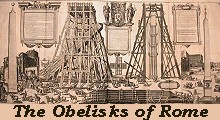
two colossal statues of Castor and Pollux with their horses; they were largely restored during the pontificate of Pope Sixtus V; c) an obelisk which originally stood in front of Mausoleo di Augusto, together with that which is now at S. Maria Maggiore. You may wish to see all the obelisks of Rome in one page.
They are very much alike, and vastly large: Of a Great
Taste, extremely Great! but not Delicate and have been much repaired, for they are now Complete; Whereas it appears by old prints,
that since they were set up there by Sixtus V (in whose Time they were found) they Were Very imperfect. Richardson
In the square before the palace, are the marble horses with their attendant figures, which some suppose to be Castor and Pollux; - while others tell you, that the one is a copy from the other, and that it is the representation of Alexander and Bucephalus. When there is so little to fix a story, it is more reasonable to suppose, that no story was intended. If we may believe the inscriptions (..) they are the work of Phidias and Praxiteles. They are full of spirit and expression; - but, are not the men out of proportion? They appear better able to carry the horses, than the horses them.
Henry Matthews - Diary of an Invalid - 1817/1818
Not all sources agree on the origin of the statues in Piazza del Quirinale:
a traditional opinion supports the idea that they decorated the baths built by Emperor Constantine on the sites of today's Palazzo Rospigliosi and Palazzo della Consulta; a more recent theory believes that they were placed at the entrance to the Temple to Serapis which was built by Emperor Caracalla; Serapis was the combination of two gods: the Egyptian Osiris and the Greek Zeus (Jupiter); many Roman emperors promoted its worship as a symbol of religious unity.
This second theory is used to explain why Castor and Pollux are not portrayed according to their traditional iconography which showed them wearing a felt cap (as in the statues in Piazza del Campidoglio). The two young men resemble Alexander the Great and we know that Caracalla so much admired that great commander that he tried to introduce the Macedonian phalanx formation in the Roman army; according to this theory the statues are a double portrait of Alexander the Great in the act of taming Bucephalus, his preferred horse (you may wish to see a gigantic head of Emperor Augustus as Alexander the Great).
One of the statues at Fontana di Trevi resembles those at Piazza del Quirinale.

Palazzo della Consulta
Pope Clement XII is known for the large monuments he built during his pontificate i.e. Fontana di Trevi, the new façade of S. Giovanni in Laterano and Palazzo della Consulta. All these works were financed by the reintroduction of Gioco del Lotto in 1732; in order to justify the game from a moral viewpoint the Pope established that its revenue
should be used for the construction of public facilities.
Palazzo della Consulta was designed by Ferdinando Fuga and it was built in 1732-1737.
The building served different purposes and this explains why it has three entrances in the main façade: the central one gave access to the offices of Tribunale della Consulta, a court in charge of ruling on non-religious matters, and of Segnatura dei Brevi, the Papal Chancery.
Lateral entrances were reserved to Cavalleggeri and Corazze,
two military corps in charge of the defence of the area. This explains why they were decorated with military symbols.

(left) Detail of the coat of arms by Paolo Benaglia (you may wish to see that which he designed for Fontana di Trevi); (right) detail of the decoration of a side entrance by Filippo della Valle
The palace is still used by a court, the Constitutional Court which establishes whether a law complies or not with the Constitution of the Italian Republic. It intervenes when the compliance of a law is challenged in the course of a court case and the judge deems that the request is not totally void of justification.

Main façade
Pope Clement XII built also new stables on the southern side of the square; these too were designed by Ferdinando Fuga, who however followed a previous project by Alessandro Specchi. The main entrance was linked to the square by two elliptical staircases which were pulled down in 1866, as shown in an early etching by Vasi (it opens in another window).

(left) Coat of arms of Pope Clement XII above the main entrance; (right) coats of arms of Pope Pius IX
The building is now used for temporary exhibitions. It enjoys nice views over Rome and in particular over some ancient walls inside Giardino Colonnese.

View towards the Vatican
Next plate in Book 4: Palazzo Rospigliosi.
Next step in Day 3 itinerary: Giardino Pontificio sul Quirinale.
Next step in your tour of Rione Trevi: Giardino Pontificio sul Quirinale.
Next step in your tour of Rione Monti: Chiesa e Monastero di S. Andrea al Quirinale.
Excerpts from Giuseppe Vasi 1761 Itinerary related to this page:
Palazzo Pontificio sul Quirinale
Prese un tal nome questo colle dal tempio di Quirino, di cui fra poco mostreremo il sito; ora si dice
Monte Cavallo dalle maravigliose statue che nella magnifica piazza si vedono voler frenare due gran
cavalli. Furono questi dalla Grecia portati a Roma da Costantino Magno, e posti nelle sue terme, che
furono qui presso, donde Sisto V. li trasportò per ornamento di questa piazza. Questi per l'iscrizione,
che vi sta da piede si comprende essere opere di Fidia e Prassitele fatti ad emulazione, per rappresentare
Alessandro Magno domante il suo Bucefalo: ma comecchè quelli scultori vissero molto tempo prima
di Alessandro, si crede o che non rappresentino Alelssandro, o che siano stati fatti da altri autori più
moderni di quelli, appropriandosene il nome, ed il credito.
|