All images © by Roberto Piperno, owner of the domain. Write to romapip@quipo.it.


Notes:
Page revised in March 2025.
All images © by Roberto Piperno, owner of the domain. Write to romapip@quipo.it.
Notes:
Page revised in March 2025.
 - Medieval Rome
In this page:
Pope Clement V and the Move to Avignon
Decline of the Roman Economy
Cola di Rienzo's Attempts to Restore the Roman Republic
Calls for the Return of the Pope
Cardinal Albornoz
Pope Gregory XI and his Return to Rome
Iconography
The circumstances which caused the death of Pope Boniface VIII in 1303 led to the obedience of the cardinals to the will of Philip the Fair, King of France.
At the end of a very long conclave which followed the short period in office of Pope Benedict XI, the king saw his efforts rewarded by
the election of his candidate, the Archbishop of Bordeaux, who was not even a cardinal. The new pope summoned the cardinals and the key members of the Curia, the papal court,
to Lyon where he was anointed as Pope Clement V on November 14, 1305. The ceremony was attended by King Philip, accompanied by the top members of the French aristocracy, but the day was marked by dire portents: in particular a wall collapsed on the Pope during the procession, he lost his balance
and his crown fell to the ground.
It was not the first time that a pope was conferred his office outside Rome, nor was it unusual for a
pope to spend long periods away from his diocese, so the decision of the new pope not to hurry to Rome and to stay for a while in several towns of southern France was not particularly odd. Things changed in 1313 when the Pope decided to permanently
settle at Carpentras, a small town in Provence which was a papal possession. In 1316 Pope John XXII, his successor, moved the papal court to Avignon, a nearby larger town which belonged to the Angevin King of Naples, in his capacity as Count of Provence.
In addition to choosing to stay in France, Pope Clement V appointed nine new French cardinals. At the request of Philip the Fair he excommunicated the powerful Order of the Knights Templar and gave the King a free hand in getting hold of their large possessions.

Musei Vaticani: details of the Stefaneschi Altarpiece painted by Giotto in 1320 for S. Pietro (Vecchio)
The French popes who resided in Avignon for seventy years did not care much about Rome, but some of the Italian cardinals did not immediately move to the papal court. Cardinal Jacopo Caetani degli Stefaneschi, of a Roman noble family, was deacon of S. Pietro and he commissioned Giotto, the leading painter of the time, a large altarpiece for the basilica. On one side was portrayed Christ enthroned flanked by angels and on the other St. Peter in a similar posture being presented the altarpiece by Cardinal Stefaneschi and a book by Saint Pope Celestine V who was canonized in 1313.

S. Giovanni in Laterano: new ciborium (1370) with the coat of arms of Pope Urban V
S. Giovanni in Laterano was partially destroyed by a fire in 1308 and again damaged by another fire in 1361. These fires caused a silver ciborium to melt down. It was only in 1370 that a new ciborium was erected. Its design, elegant but very similar to that of the ciboria erected eighty years earlier by Arnolfo di Cambio at S. Cecilia and at S. Paolo fuori le Mura, shows that Rome was lagging behind the artistic developments which in the meantime occurred in Tuscany and northern Italy.
The administration of Rome in the first half of the XIVth century was entrusted to a legate, a cardinal representing the pope, and to the Senator of Rome (also appointed by the pope),
who had jurisdiction over some municipal matters. These two key positions were in the hands respectively of
the Orsini and the Colonna. These two families were at loggerheads, but were united in the spoliation of Rome and in
particular of its countryside. During this period of time the small
villages around Rome were abandoned and replaced by casali, (farms) belonging to important families who rented their estates to owners of cattle who used the land as grazing ground.
The confrontation between the Colonna and the Orsini also led to a
reduction of the security level both in Rome and along the roads used by the pilgrims to reach the city (see a relief related to this confrontation at Porta S. Sebastiano).
The absence from Rome impacted on the authority of the pope: Pope John XXII tried to exert the traditional papal role in the appointment of the German emperor, but his excommunication of Emperor Louis IV of Bavaria had very little impact.
The Emperor invaded Italy and in January 1328 he was welcomed in Rome by Senator Sciarra Colonna.

S. Maria sopra Minerva: Monument to Cardinal Matteo Orsini
It would be inappropriate to assume a rivalry between the Dominicans and the Franciscans,
but there was a spirit of competition
between these two monastic orders.
Pope John XXII in 1323 proclaimed the sainthood of
Thomas Aquinas, a Dominican monk whose works had an enormous influence on the theology of the Roman Catholic Church.
In Rome the new church of S. Maria sopra Minerva was the Dominican response to the Franciscan church of S. Maria in Aracoeli. It was a very large church, the only one in Rome to have a
distinct Gothic design. Knowing that the Pope favoured the Dominicans, who, unlike some Franciscans, did not criticize the pomp of the papal court, the Orsini chose to build their family chapel in this church (which was not yet completed). Today's visitors however do not find any longer an Orsini chapel in the church: this is now known as Cappella Aldobrandini,
it has a lavish early Baroque marble decoration and it contains
the monuments to the parents of Pope Clement VIII Aldobrandini (you may see it in a page covering the colours of Baroque Rome). The chapel was sold by the Orsini to the Aldobrandini in 1587 and the new landlords
evicted the monument to Cardinal Matteo Orsini, the founder of the chapel.
It was placed (without its Gothic baldachin) in a dark corridor leading to the church rear entrance (sic transit gloria mundi - thus passes the glory of the world).
The vexations to which the people of Rome were subjected eventually led to a revolt against the Colonna and the Orsini.
(Ni)Cola di Rienzo, a notary who had spent some time at the papal court in Avignon, arranged a public meeting in the square below the Capitoline hill on Whit Sunday 1347.
There he spoke with eloquence about the need to redeem Rome and proposed new laws which were acclaimed by the crowd.
The enthusiasm was such that both Colonna and Orsini chose to leave Rome. Cola di Rienzo (or Rienzi) took the ancient title of Tribune of the People, an office of Republican Rome.
Cola went ahead with his ambitious plan to renovate the political role of Rome by calling an assembly of the representatives of the Italian towns during which
he proposed a federation under the leadership of Rome. He also wrote to
the sovereigns of Europe asking them to recognize the Republic of Rome.
With the fall of the first leaves, his words lost their appeal and both
the great families and Pope Clement VI started to plot against him. The Colonna led a small army to Rome to execute a papal order of arrest:
Cola fled the city and hid into a monastery. The short season of the new Roman Republic came to an end.

Steps to S. Maria in Aracoeli and monument to Cola di Rienzo by Girolamo Masini (see another of his works) between them and those leading to the palaces of Campidoglio (you may wish to see a 1909 watercolour by Yoshio Markino depicting the steps)
I descended from hence by the marble staires which are a hundred in all, and all so large, that twelve men in a breast may go up at once.
Richard Lassels - The Voyage to Italy - 1668
The Romans soon lost interest in the whereabouts of Cola di Rienzo because in 1348 a major pestilence spread throughout Europe. The Black Death, as this outbreak of bubonic plague became known,
is estimated to have halved the population of Europe. In Rome the disease was accompanied by another calamity: a strong earthquake damaged several buildings including Colosseo.
The end of the plague was celebrated by providing S. Maria in Aracoeli with steps which
allowed direct access to its main entrance: the church initially had the entrance facing the Roman Forum, then the Franciscans rebuilt the church and reversed its
orientation, but people continued to access the church from the Forum through a still existing side door.
The new steps were a clear indication that the centre of Rome had moved from the Forum to Campo Marzio, the flat area between the hills and the river.
Cola di Rienzo was eventually arrested and brought to Avignon. In 1353 however Pope Innocent VI thought the man could help him in restoring the
papal authority in Rome and he was sent back with a small military force. He was initially greeted by the Romans,
but the taxes he levied to maintain his troops and his personal greed soon made him unpopular. In addition, notwithstanding Cola's current role as papal envoy, the Colonna were less than enthusiastic about having him back in Rome. In September 1354 a hostile mob gathered at Palazzo Senatorio: Cola tried to speak, but he was soon interrupted and had to escape in disguise.
He was identified from the gold bracelets he wore and killed without a trial. The body was left for two days outside the houses of the Colonna.
Cola's role as a forerunner of the Italian nation and a victim of the theocratic power
was emphasized in the XIXth century and Richard Wagner wrote one of his first operas on a libretto based on his life. On September 20, 1887 (the anniversary of the 1870 entrance of the Italian troops in Rome through a breach near Porta Pia)
a monument to him was inaugurated between the two staircases of Campidoglio. He was portrayed in the act of haranguing the Romans: the statue was placed on a high base decorated with pieces of ancient lintels.
In June 1348 Pope Clement VI bought Avignon from the King of Naples; this act coupled with the construction of a very large palace indicated that the French popes were determined to establish their permanent residence in that town.
It was in a sense a forced choice. After the death of Philip the Fair,
a string of successors ruled France for short periods until the crown passed to Philip VI of Valois,
who in 1337 started the Hundred Years' War by declaring that Edward III, King of England had lost his rights over Aquitaine. With France weakened by the effects of the war, the popes felt relatively safe in Avignon while
Rome and in general the Italian regions under their formal authority were in a state of anarchy.
From a religious point of view however the decision to stay in Avignon
was highly criticized. Dante had harsh words for the papal reluctance to return to Rome. Francesco Petrarca (Petrarch), who had a direct
experience of the life at the papal court, described Avignon as a new Babylon:
| De l'empia Babilonia, ond'è fuggita ogni vergogna, ond'ogni bene è fori, albergo di dolor, madre d'errori, son fuggito io per allungar la vita... Canzoniere - CXIV |
From the impious Babylon, from which all shame has fled, all good is banished, the house of grief, the mother of error, I've also fled, to prolong my life.... Translation by A. S. Kline |
The comparison between Babylon and the papal court had more lasting effects than Petrarca could have imagined when he wrote his sonnet. It was used again by Martin Luther in a letter to Pope Leo X: "Your See, however, which is called the Court of Rome, and which neither you nor any man can deny to be more corrupt than any Babylon ..".

1962 Monument to St. Catherine of Siena by Francesco Messina in the gardens of Castel Sant'Angelo
Saint Catherine of Siena played a very important role in calling for the return of the popes. She was a Dominican Tertiary (a lay member of a monastic order) and in Rome she lived in a house near S. Maria sopra Minerva: after a series of visions, she felt she had to write to popes and kings begging for peace and for the return of the papacy to Rome.
In June 1376 she was sent to Avignon as ambassador of the Republic of Florence to settle a long dispute with the papacy and on that occasion
she so impressed Pope Gregory XI that he decided to move to Rome.
For the 500th anniversary of her canonization in 1462 a monument was dedicated to her in the gardens of Castel Sant'Angelo: she was portrayed on her way to S. Pietro where she used to go every day to pray for the return of the pope.
One of the reliefs shows Catherine asking the Pope to make a firm decision.
The popes were able to restore their authority over their Italian possessions due to the services of Gil Alvarez De Albornoz,
a Spanish cardinal, who had military experience because of the particular situation of his country where the
Christian kingdoms were trying to conquer the last Arab strongholds. Albornoz, as Archbishop of Toledo, personally led his troops in several battles.
In addition to his military skills, Albornoz had a shrewd knowledge of how to survive in the treacherous environment of the papal court. In 1353 he was sent to Italy
as papal legate and, apart from a short interval, he held this office until his death in 1367.
By following a systematic approach and by exploiting the rivalries among the various towns of the Papal State,
he gradually managed by force or by consent to restore the pope's authority.
He was so successful that in 1367 Pope Urban V decided to make an attempt to return to Rome;
he left the papal court at Avignon and escorted by ships sent by Venice, Naples, Pisa and Genoa, he landed at
Corneto where he was greeted by Albornoz.
The Pope set his residence in the Vatican, but soon he started
to regret his decision: Albornoz died of malaria, the Romans were not too happy about the first papal decrees aimed at reducing their municipal powers, the French cardinals who had accompanied the Pope missed the wines of Burgundy. Pope Urban V preferred to move his residence to Viterbo and
Montefiascone and in September 1370 he left Italy to return to Avignon, notwithstanding the fact that St. Bridget of
Sweden had warned him that he would die if he left Rome. In December of that same year he actually died.
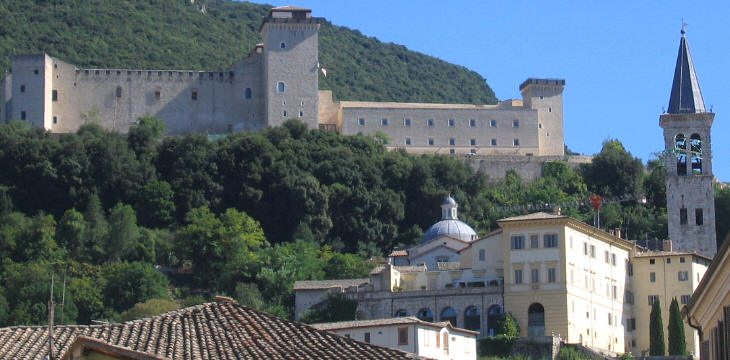
Cardinal Albornoz did not trust the unwilling professions of allegiance made by the citizens of the towns he forced to surrender. He therefore built fortresses in many of these towns; they were not meant to protect the town from external enemies, but to allow a small garrison to repel rebellions against papal decisions. These fortresses were usually called la Rocca because they were located on the rocky top of a hill in a commanding position. A major fortress was built in Spoleto; other fortresses built by Cardinal Albornoz can be seen at Viterbo, Narni, Assisi and other towns.
The new pope, Gregory XI, was the nephew of Pope Clement VI who in 1348 bought the town of Avignon. He did not seem very interested in leaving his French palace although he had committed to move to Rome in May 1372.
In the Italian papal possessions the absence of the firm grip of Cardinal Albornoz, was soon felt.
Florence and Milan supported the rebellion of many towns; the Pope excommunicated the city of Florence,
but that did not have a great impact on its inhabitants who were enjoying themselves
reading the Decameron, a book of tales where priests and monks were ridiculed. It was written by Giovanni Boccaccio and it described how a group of ten young men and women spent ten days in a countryside villa outside Florence where
they hoped to escape the 1348 pestilence: every day each member of the happy brigade told a tale so the book was also known as Centonovelle (100 tales).
Overall Boccaccio's tales portrayed a wealthy and active society which showed little interest in the teachings of the Church.

Galleria Nazionale d'Arte Antica di Palazzo Barberini (from Museo Kircheriano): early XVth ivory box for a bride by the Embriachi workshop (active in Florence and Venice); its reliefs depict scenes from Griselda, the last tale of the Decameron which describes the life of a patient and obedient wife
Other political initiatives of Pope Gregory XI met with similar failures to the point that he realized that
only the return to Rome could bring back his authority, both in spiritual and political matters.
He sent an army of 10,000 mercenaries led by Cardinal Robert of Geneva to restore order in the Papal State. In September 1376 he left Avignon and by moving at a very slow pace he reached Rome in January 1377.
In the meantime Cardinal Robert was unable to control the country without excessive use of force: the massacre of 4,000 inhabitants of Cesena, a town near Bologna, earned him the unflattering title of Boia (executioner) di Cesena. The Pope felt unsafe in the Vatican and spent several
months at Anagni. He returned to Rome only in November when Gomez Albornoz, nephew of Cardinal Albornoz, managed to improve the acceptance of the Pope, at least among the Romans. It was a short stay as Pope Gregory XI died a few months later.

S. Francesca Romana: Monument to Pope Gregory XI: relief portraying his arrival in Rome
In 1584 the municipality of Rome built a monument to celebrate Pope Gregory XI and his return to Rome;
the decision can be regarded as an indirect homage to the pope of the time, another Gregory (XIII). The monument was designed by Pietro Paolo Olivieri who in a
large relief portrayed the arrival of the Pope and of many cardinals at a gate of Rome where he was greeted by a personification of Rome. Olivieri was most likely influenced by a Roman relief portraying Hadrian entering Rome, which in 1573 was placed at Palazzo dei Conservatori.
During the period the popes spent in Avignon the role and power of the cardinals grew significantly:
they were in charge of the most important branches of the administration or they were sent as legate (governors) to the main towns of the
Papal State. The papal court became a very large body, not very different from that of a king of a major European nation.
Its maintenance required significant financial resources; the cardinals too had a
personal court and they exploited their
offices to find the means to maintain it. This development became particularly noticeable during the early Renaissance.
The following links show works of art portraying characters and events
mentioned in this page; they open in another window:
Rienzi (Cola di Rienzo) vowing to obtain justice for his brother's death by W. H. Hunt (1848).
Victims of the Black Death medieval miniature.
Decameron by J. W. Waterhouse (1849-1917).
Cardinal Albornoz medieval miniature.
Pope Gregory XI Returning from Avignon by Giorgio Vasari (1511-74).
The image used as background for this page shows a view of Avignon (Roma Gallica - French Rome). It is a small illustration taken from G. Palazzo - Gesta Pontificum Romanorum - Venice - 1688.
Next page: Part II: Medieval Rome
VI - From Chaos to Recovery
Previous pages: Part I: Ancient Rome:
I - The Foundation and the Early Days of Rome
II - The Early Republican Period
III - The Romans Meet the Elephants
IV - Expansion in the Eastern Mediterranean Sea
V - Pompey and Caesar
VI - Augustus
VII - From Tiberius to Nero
VIII - The Flavian Dynasty
IX - From Nerva to Marcus Aurelius
X - A Century of Turmoil (180-285)
XI - From Diocletian to Constantine
XII - The End of Ancient Rome
Part II: Medieval Rome:
I - Byzantine Rome
II - The Iron Age of Rome
III - The Investiture Controversy
IV - The Rise and Fall of Theocratic Power