
All images © by Roberto Piperno, owner of the domain. Write to romapip@quipo.it.


Notes:
Page revised in September 2024.
All images © by Roberto Piperno, owner of the domain. Write to romapip@quipo.it.
Notes:
Page revised in September 2024.
 Viterbo: Cathedral and Papal Palace
From Lago di Vigo after breakfast wee rode foureteene miles to a
little Citie Montefiaschoni, having passed by the way
the Citie Viterbo, where Pope Celestine the third placed
a Bishop, and made it a Citie. (..)
The way to Viterbo was through a fruitfull Plaine of
corne, and there were store of Olive
trees & Vines. Viterbo was of old called Faliscum, and
it hath 3 Cities within the wals: but we passing suddenly
through it, I observed nothing remarkeable but a faire
Fountaine in the Market-place.
Fynes Moryson- An Itinerary: Containing His Ten Years Travel - 1594
From Montefiascone we went down the Hill by an easy descent unto Viterbo. This is an Episcopal Seat, standing in a wholesome Air, and therefore called Viterbum, as it were Vita Urbium. Here
are excellent Fountains of Water, and store of them: but it's pity none of them run with good Wine, to make amends for the bad, which are most of them "Vini cotti".
Richard Lassels - The Voyage to Italy - 1668
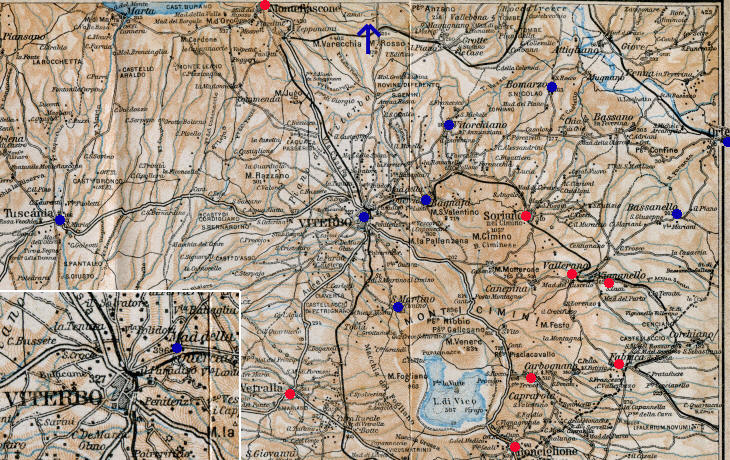
Map of the area surrounding Viterbo; the blue dots indicate the locations covered in this section with the exception of: a) Bagnoregio (blue arrow); b) Gallese, south of Orte; the red dots indicate towns which are covered in other sections: Montefiascone,
Soriano nel Cimino, Vallerano, Vignanello,
Fabrica, Caprarola, Ronciglione and
Vetralla
The area around Viterbo was the cradle of the Papal State (Donation of Sutri) to the point that it was called Patrimonium Petri; in the XIIIth century several popes preferred to reside in Viterbo, rather than in Rome and for this reason the local tourist board advertises the town as the City of the Popes,
similar to Avignon and Anagni. Viterbo was located along Via Francigena, the route followed by pilgrims from France to reach Rome, via Florence and Siena. Grand Tour travellers, e.g. Goethe, often preferred to reach Rome via Perugia, Spoleto and Civita Castellana.
The character of the towns covered in this section is medieval, but there also some fine Renaissance monuments at Bagnaia, Bomarzo and Madonna della Querce.
What more shall I say of Viterbo? It is the second city in the Papal State within the limits of ancient Etruria, and can boast of thirteen or fourteen thousand inhabitants, and in former times was often the residence of the Popes. I will say nothing of the remains of Santa Rosa, the holy patroness of the city - of the pulpit of San Bernardino of Siena - of the celebrated "Deposition" of Sebastian del Piombo, from the design of Michael Angelo - of the palace where Olimpia Pamfili held her revels - of the Gothic Cathedral, stained with the royal blood of England - are they not all written in the guidebooks of Starke and Murray? Yet I must testify to the neatness and cleanliness of Viterbo - to the Tuscan character of its architecture - to its well-paved, ever dry streets - to its noble fountains, proverbial for their beauty - all so many evidences of its vicinity to the frontier of the more civilised Dukedom - and above all in importance to the traveller, to the comfort and civility experienced in the spacious hotel of the Aquila Nera, which he should make his head-quarters while exploring the antiquities of the neighbourhood. (..)
The hill on which the cathedral stands, down to the thirteenth century was called Castellum Herculis. Its cliffs are pierced with sewers and caves, as are also two neighbouring heights. (..) The cathedral is dedicated to S. Lorenzo, (..) Orioli thinks the transfer of worship from Hercules to St. Laurence easy and natural enough, as both met their death in a somewhat similar manner; and he further suggests that some ancient picture of Hercules on the funeral pile may have given the idea of substituting for him this particular saint.
George Dennis - The Cities and Cemeteries of Etruria - 1848
The origin of Viterbo is linked to a Roman castrum (fortified site) on a small hill along
Via Cassia, the road which linked Rome to northern Italy;
the top of the hill housed a temple to Hercules, so it was a holy site even before the construction of the cathedral;
the walls of medieval Viterbo included two other hills where large churches were built.
The cathedral stands in a kind of close, and is almost surrounded by different fragments of the half-demolished Palace where the popes of the thirteenth century
resided. In the great hall which still exists, met the conclaves.
Augustus J. C. Hare - Days near Rome - 1875
The Cathedral was built in the XIIth century and the Papal Palace in the following one, but this entirely medieval complex was modified by Cardinal Gian Francesco Gambara who was appointed bishop and governor of Viterbo in 1566; he was a man imbibed with Renaissance culture and commissioned a new façade for the cathedral; a few years later he started the construction of an elegant villa at Bagnaia, five miles east of Viterbo; he was appointed cardinal at the age of 28 by Pope Pius IV because he was a
relative of Cardinal Carlo Borromeo, a nephew of the Pope, and also of the Farnese, the family of Pope Paul III.
The image used as background for this page shows a
detail of the Cardinal's coat of arms depicting a shrimp (It. gambero).

Papal Palace: Hall of the Conclaves (left) and loggia (right)
The Sicilian Question, i.e. the attempt by the popes to dislodge the German emperors of the House of Swabia from Sicily and southern Italy led to a period of unrest in Rome; in 1261 Pope Alexander IV sought refuge in Viterbo where he died in that same year; the seven cardinals who were with him at Viterbo elected Pope Urban IV who never set foot in Rome and who left Viterbo for Perugia which is more distant from Rome. He died in 1264 at Perugia where his successor Pope Clement IV was elected.

Papal Palace: "Sala del Conclave" (main hall)
Clement IV set his permanent residence at Viterbo, where with the support of the local rulers he started the construction of a proper papal palace. He died in November 1268. Gregory X was elected his successor on September 1, 1271, after a vacancy of one thousand six days - the longest in the history of the Church. In 1270 the access to the hall where the cardinals met was closed and the cardinals were locked inside; it was the first conclave (cum clave=with keys); the cardinals however were still unable to make a decision, so the magistrates of Viterbo broke the roof and supplied the cardinals with bread and water only in order to accelerate their decision.

Letter with the seals of the eighteen cardinals who asked the rulers of Viterbo to allow Cardinal Enrico da Susa, gravely hill, to leave the assembly with the commitment of not asking to come back
Cardinal Enrico da Susa, Bishop of Ostia and Dean of the Sacred College, resigned his rights as an elector and left the electoral meeting on June 8, 1270; old and ill, he lived to see the election of Gregory X, but died a few weeks later. Some sources consider him the most important and brilliant canonist of his time.
By the summer of 1271, there were only sixteen (out of twenty) cardinals who continued to participate in the election. The long delay was caused by wrangling between the French cardinals, most of whom were created by Urban IV, and the others, mostly Italian, who were enough to prevent a French candidate from receiving two-thirds of the votes. Finally, under mounting pressure from the newly-enthroned Philip III of France and other secular powers, the cardinals agreed to surrender the choice of a new pope to a committee of six who were drawn from both the French and Italian factions. Their choice, to whom the remaining ten cardinals gave their endorsement, was Tebaldo Visconti. He was not a cardinal and at the moment of his election, he was at Acre in Palestine. He reached Viterbo, on February 12, 1272 and he announced his acceptance of the election and was proclaimed Pope Gregory X. He was crowned in Rome in the following month.

(above) Popes elected at Viterbo in the Hall of the Conclave; (below) Cathedral: "gisant" of Pope John XXI, the only Portuguese pope; notice the large ring
Pope Gregory X died on January 1, 1276. His two immediate successors outlived their election for a very short time. In September the cardinals (only ten) elected Pedro Juliao (aka Pietro Ispano) who became Pope John XXI and was crowned in Viterbo. He was so fond of the town that he ordered the construction of a new papal apartment. Unfortunately in May 1277, the ceiling of his study room collapsed over him and he died of the injuries he suffered. He is the only pope Dante placed in Paradise in praise of his twelve treatises on logics «Pietro Spano, lo qual giù luce in dodici libelli» (Paradiso XII, vv. 134-135).
At his death, the number of electors stood at only seven: they finally chose the most senior of them, Cardinal Giovanni Gaetano Orsini, as Nicholas III on November 25, 1277. He greatly favoured the members of his family and Dante placed him in Hell. In the conclave which followed his death in 1280 two Orsini cardinals were removed from the conclave because they were said to be delaying the election of a new pope; actually this decision was due to the intervention of King Charles of Anjou who fostered the election of French Cardinal Simon de Brion, who was elected Martin IV in February 1281 (Dante placed him in Purgatory among the gluttonous).

Sala del Conclave: (above) detached fresco with the symbol of Viterbo; (below) decoration of a window
Martin IV placed the blame for the turbulences which occurred during the conclave on the citizens of Viterbo and he excommunicated the town. He and his successors resided in other towns, e.g. Orvieto, Anagni and Perugia until Pope Clement V moved the Papal See to France in 1305.
The papal palace of Viterbo largely exceeded the needs of the local bishop and parts of it collapsed because of poor maintenance. It is difficult to figure out how the main hall was decorated; it is possible that it resembled some halls of Palazzo di Bonifacio VIII at Anagni.

Loggia delle Benedizioni: the decoration is based on symbols of the pope (keys and mitres), of the emperor (eagle) and the coats of arms of Viterbo (lion) and of the Gatti family (stripes) who promoted the construction of the loggia
The loggia from which the popes blessed the crowds or made their most important statements (including excommunications) was covered, but the roof and the opposite side of the loggia collapsed in the second half of the XIVth century. The front towards the Cathedral was walled and only two arches were visible whereas the upper section with the coats of arms was almost entire. Travellers who visited Viterbo did not mention it, because of the poor state it was until 1903 when a complex restoration began, Today the loggia is the symbol of the town.
The elegant fountain was added towards the end of the XVth century by Cardinal Raffele Riario, nephew of Pope Sixtus IV, who is best known for having built Palazzo della Cancelleria in Rome; he was the administrator of the see of Viterbo in 1498-1506. The fountain was built with parts of a previous one; the upper basin has a decoration based on S-shaped parallel grooves (strigiles) and heads of lions which is typical of Roman sarcophagi.

(left) Detail of the fountain of the Papal loggia showing the coat of arms of Bishop Francesco Maria Visconti; (right) Fontana del Cardinale Brancaccio, next to the Cathedral
Francesco Maria Brancaccio, of a noble Neapolitan family, was created cardinal in 1633 by Pope Urban VIII and in 1638 he was assigned to the see of Viterbo which he held until 1670. He decorated a fountain with his heraldic symbol (four lion paws) and with the three bees of the Pope. Coats of arms of him or of his nephew Cardinal Stefano Brancaccio who succeeded him at Viterbo can be seen at Castello Brancaccio di S. Gregorio da Sassola.

Papal Palace - Sala Gualterio: (above) coats of arms of Bishop Sebastiano Gualterio and of Cardinal Tiberio Muti; (below) frescoes with the coat of arms of Pope Clement VIII and scenes with doves
The hall was designed and decorated at the initiative of Bishops Sebastiano Gualterio (1551-1566) and of Cardinal Tiberio Muti (1611-1638), but the frescoes are dated late XVIth century and they were most likely made for the Jubilee Year 1600. The scenes depicting landscapes with doves are quite unusual; one of the inscriptions "Ad candida tecta" is taken from Ovid - Tristia - Book I "ut veniant ad candida tecta columbae" (See how the doves fly to a white dovecote).

Cathedral and bell tower
The cathedral was built by Lombard masons who established themselves in Viterbo, but the bell tower stripes show the influence of monuments in Siena and Orvieto; it was built in the XIVth century and the pyramidal top was added at a later time. The bishopric see of Viterbo was created in 1196 by Pope Celestine III and it was united to that of Toscanella (Tuscania) aeque principaliter (equally important).

Cathedral: (left) interior; (right) medieval capital portraying sphinxes
Viterbo was heavily bombed during WWII and some of its historical monuments, including the rear part of the cathedral, were greatly damaged; the restoration of the interior has taken away most of the Renaissance and baroque additions; it has now a rather bare aspect apart from the fine Cosmati floor and the elaborate medieval capitals.

Cathedral - interior: (left) Madonna della Carbonara (original at Museo del Colle del Duomo) and old frescoes portraying St. Peter and St. Paul; (right) fragment of a fresco on the northern wall
The restoration of the cathedral after WWII led to the discovery of some XIVth century frescoes which had been whitewashed in the following centuries. Madonna della Carbonara is a much worshipped image of the late XIIth century of Roman school, but recalling Byzantine patterns. S. Maria della Carbonara is the name of the medieval church where the icon was kept and carbonara meant fortification.

Cathedral - interior: Renaissance works of art: (left/centre) baptismal font by Francesco da Ancona (1470); (right) repository for the Holy Oil (Chrism)
The name of Francesco da Ancona is mentioned in a payment record together with that of Nicola Bussi, of an important family of the town. Francesco came from a town where very fine marble portals, statues and reliefs were made towards 1450 by Giovanni Orsini and other sculptors. The payment record indicates that his assistants were from Florence and Carrara (where the marble was quarried).
Fine repositories for the Holy Oil can be seen in many towns near Viterbo, e.g. Capranica, Sutri, Vetralla and Soriano. In Rome the finest one is at S. Maria in Trastevere. They are typical of the late XVth century.

Cathedral - interior: (left) Cappella Bussi, a noble family of Viterbo or Santa Lucia restored in 1725; (right) monument to Cardinal Muzio Gallo by Agostino Penna which was attributed to Antonio Canova; it is placed above the entrance to the sacristy and it is dated 1794 when work for the new sacristy began
The side naves were less damaged than the central one and they retain some XVIIIth century works of art which decorated them and which show the influence of Roman patterns (see a chapel in S. Maria degli Angeli and a page about monuments showing the dead in a medallion). Cardinal Gallo restored the cathedral at his own expense and he completely rebuilt its sacristy where he wanted to be buried.

Cathedral: Sacristy (1795)
Cardinal Gallo was Bishop of Viterbo e Toscanella in 1785-1801, a very turbulent period for the Papal State. On December 29, 1797, when Joseph Bonaparte, who had been appointed French ambassador to Rome, passed through Viterbo, he was insulted and stoned. This was the pretext for the temporary abolition of the Papal State by the French. The last months of Gallo's life were marred by a disaster: the fall of the "Macchina" di Santa Rosa on the evening of September 3, 1801 which caused many casualties.

Museo del Colle del Duomo - portraits of bishops of Viterbo: (left) Cardinal Raniero Capocci; (right) Cardinal Gian Francesco Gambara
Museo del Colle del Duomo is a new entry among the museums of Viterbo; it is basically a Diocesan Museum with the Treasury of the Cathedral and works of art from lost or deconsecrated churches, but it includes also a small archaeological section and it allows access to some halls of the Papal Palace.
Cardinal Raniero Capocci was bishop of Viterbo for only one year, but as papal legate he ruled the town where he was born in the period 1234-1249. Although his XVIth century portrait depicts him holding a book and a pen, he was a military leader and a fierce adversary of Emperor Frederick II.

Museo del Colle del Duomo - Treasury: Processional Cross with symbols of the Evangelists by Judice Aurifice (Goldsmith) from Viterbo (1436). It was made for a church of Celleno, near Bagnoregio. The figure of Christ was added in the XVIIIth century

Museo del Colle del Duomo - Treasury: (left) Bust of Saint Pope Sixtus II (School of Siena - ca 1450) containing a fragment of his skull (see an elaborate reliquary at Siena): (centre/right) Reliquary of St. Lawrence by Domenico Aloisi (1489) containing a finger, a fragment of the skull and traces of blood

Museo del Colle del Duomo - Treasury: Reliquaries having the shape of busts (XVII-XVIIIth centuries)
Go to:
Viterbo - Walls, Gates and Towers
Viterbo - Medieval Monuments
Viterbo - Renaissance and Baroque Monuments
Viterbo - Museums
In and about Viterbo - other pages:
Bagnaia
Bagnoregio
Bomarzo
Orte, Vasanello and Gallese
S. Maria della Querce
S. Martino al Cimino
Tuscania
Vitorchiano


