
All images © by Roberto Piperno, owner of the domain. Write to romapip@quipo.it.


Notes:
Page revised in December 2025.
All images © by Roberto Piperno, owner of the domain. Write to romapip@quipo.it.
Notes:
Page revised in December 2025.
 - Anagni
German historian Ferdinand Gregorovius spent the summer of 1856 at Genazzano; on September 23, accompanied by a local peasant, he rode to Anagni via Paliano; Gregorovius was interested in seeing Anagni for the events which occurred there during the Middle Ages because he was working at a history of Rome during that period, which he eventually published in 1872.

View towards the valley of the River Sacco, Segni and the Volscian Mountains from Palazzo di Bonifacio VIII at the top of the town (see a view of Anagni from Ferentino)
Of this glorious Latian land I would now talk to my friends, many of whom may have chosen the route to Naples by Frosinone and San Germano, in preference to the lower road by Terracina, and so will remember how beautiful is that valley of the Sacco, with its encircling mountains. I will link two of the towns together in this sketch - namely, Genazzano, a celebrated place of pilgrimage at the opening of the valley, and Anagni, the abode of many of the mediaeval Popes. (..) Presently I came to the principal square, (..) from whence, as it lies on the slope of the hill, the valley of the Sacco is visible, and through it the Via Latina, winding up in graceful curves from Valmontone. This ancient road does not touch Anagni, but goes on its way, skirting the foot of the hill. (..) From this piazza the view is so fine that it may well enchant even those who have beheld the whole of Italy, from the Alps to the African and Ionian Seas. Just opposite rise the Volscian Mountains, their sunlit rocks clearly defined, the very windows in the towns set upon them being visible.
Gregorovius - About the Roman Campagna - translation by Dorothea Roberts

Museo Archeologico Ernico at Anagni: (above) tusk and jaw of an elephant (Palaeoloxodon antiquus) ca 400,000 bc which was found in 2008 at Fontana Ranuccio near Anagni; (below) head of an auroch (Bos primigenius), the wild ancestor of modern domestic cattle
The region around Anagni is home to numerous paleontological and archaeological sites that have provided insights into the faunal and early human occupation of the area over the last two million years. The valley of the River Sacco is a tectonic depression that resulted in the formation of lacustrine basins such as those of Anagni and Ceprano. Four human teeth have been unearthed at the site of Fontana Ranuccio in association with abundant faunal remains which attest to the presence of a complex environmental scenario. Human activity is confirmed by the presence of large and small stone tools. See a diorama at Museo di Zoologia in Rome, elephant tusks which were found in Rome and an auroch skull which was found in Essex.

(left) "Arcazzi" (big arches); (right) a phallus on one of the pillars; the relief had an apotropaic (averting bad luck) purpose (see similar ones at nearby Alatri)
It is only to the Middle Ages that Anagni owes its historical fame. Although capital of the Hernici, a powerful race in Latium, it was of no significance during the Roman epoch. After being conquered it remained merely a subject town. Very few fragments of old Roman work remain to recall the past, only some portions of walls, and, on the north side of the town, a row of colossal arches supporting the steep hillside. Yet these - the most conspicuous monuments of her older epoch - lend a great charm to the place. Gregorovius
The Romans did not hesitate to
build massive walls to prevent landslides, a real danger for Anagni which is located between two ravines.

Small antiquarium of Roman exhibits at Palazzo di Bonifacio VIII: (left) small votive statue perhaps Cybele; (centre) terracotta lamp with multiple nozzles; (right) votive statues
Wednesday, November 24 1790 Having dismissed my saddle horses, on account of the uncertainty of the weather, I pursued my journey, in a calasse, through a rich and well cultivated plain, to Anagni, which is the Compitum Anagninum. (..) I took up my lodging at a tolerable Osteria, about a mile and a half distant from Anagni. This town is built upon a lofty eminence, and was once the capital of the powerful nation termed the Hernici. (..) The modern city being built on the site of the ancient, few architectural remains are to be found, and not a single trace of the once celebrated circus.(..) I noticed some considerable remains of an ancient structure consisting of four arches, built with large square stones, and of the opus reticulatum. It was once apparently of great extent. (..) In the contrada of the Pescina part of the inscriptions placed under the Palazzo Publico were discovered.
Richard Colt Hoare - A classical tour through Italy and Sicily - publ. 1819
The lapidary collections of the City of Anagni are planned to be displayed at Museo Archeologico Ernico which in June 2024 was limited to a prehistoric section.

Main street (Strada Vittorio Emanuele II): (left) near Palazzo Pubblico; (right) near Casa Gigli with the Romanesque bell tower of S. Andrea
Anagni surprised me, accustomed as I had been to the dark streets and shabby houses of other Campagna towns. Here I rode in between rows of important-looking buildings and palaces which gave a certain well-to do air to the whole town. Its modern aspect set me wondering; I failed to understand it until I had made myself better acquainted with the history of the place. (..) The fact of her having been the nursing mother of no less than four Popes tended to enrich Anagni, and have been immensely to her advantage. She adorned herself with palaces and other great structures built in the Romano-Gothic style of architecture which prevailed so largely in many parts of Italy up to the fifteenth century. Gregorovius

Three views off the main street
Turning out of the main square, an entirely different view presents itself, and here we realise the position of Anagni for the first time. The hill on the outer edge of which it is built joins on to the Serra, or springs out from that range, in the form of a sickle. The brown rocks lie bare and rugged all around as you look out on a wilderness from which Monte Acuto springs up hard by, a dark castle which takes its name from the precipice on which it stands.
Seeing what its position is, it is no wonder that Anagni became the favourite place of retreat, or summer abode, of so many Popes during the Middle Ages - a country town raised above the Campagna, its air so health-giving, while it is sheltered and protected by those rocks and walls. Gregorovius
Anagni stands on a narrow ridge which does not leave much room between the main street and the ravines which protect it.

Casa Gigli aka Casa Barnekow
Anagni has not many medieval buildings to boast of now, however, besides the cathedral, her most remarkable Town Hall, and the Gigli Palace. (..) The house of the Gigli family, a small structure probably of the fourteenth century, reminded me of the houses in Palermo. It is built round a quadrangle, with a flat roof and an outer court. This latter consists of two round arches, resting where they join on a single pillar. A flight of stone steps leads up from these to the doorway, which is also circular. This architectural style is finely reproduced in the one window of this vestibule, with its round arches resting on pillars. (..) When I had discovered this Casa Gigli, I sat down on a stone to make a sketch of it in my notebook. Straightway a crowd of townsfolk gathered round me. While they watched my attempt to depict this monument of their palmy days, I could see how proud they were of their past. Gregorovius
The house is usually named after Baron Albert von Barnekow, a Swedish painter, alchemist and Hussar officer who settled in Anagni in the mid-XIXth century and married a local girl. He decorated the façade with architectural details, inscriptions, paintings, etc. which, although attracting the curiosity of the visitor, have robbed the house of its historic and venerable decay.

Anagni became an important place for the first time at the end of the thirteenth century. Then it had the unusual good fortune of seeing four of its citizens raised to the Papal Chair within one century. Gregorovius
Similar to Avignon and Viterbo, Anagni is called
the City of the Popes because several of them resided there in addition to those who were born within its walls; Pope Adrian IV, the only English pope (Nicholas Breakspeare),
died at Anagni in 1159.

Palazzo del Comune (Town Hall): (left) vaults supporting the building; (right-above) coat of arms of Anagni between those of the Orsini (most likely Teobaldo di Matteo Orsini who restored the building in 1306) and of another family; (right-below) coat of arms of a bishop
The Communal Palace possesses a great arcade, over which one storey is built. The street runs under this arcade, as through a long gateway. On its façade the stone is sculptured and adorned with many coats of arms of mediaeval days, including the arms of the town, a lion, in whose back an eagle has buried her talons. Gregorovius
Gregorovius was favourably impressed by the aspect of Anagni, where poverty was not as evident as in Genazzano; this limited prosperity was due to the fact that the town was not the fiefdom of a family, but a direct possession of the Church; its bishop directly reported to the Holy See and he was often also the governor of the province of Campagna e Marittima, e.g. Cardinal Benedetto Lomellini in 1572-1579.

Palazzo del Comune: windows on the rear façade and a small loggia for announcements (coat of arms of the Caetani above the windows)
The back of the arcade is still more remarkable from the ornamentation of its plinth, and its row of little double-columned windows. Gregorovius
Three of the four popes who were born in Anagni belonged to the same family, the Conti (Counts) di Segni, a town to the west of Anagni. The first one was Pope Innocent III who together with his relatives and successors Pope Gregory IX and Pope Alexander IV greatly lessened the power of the German emperors in
Italian affairs.

Cathedral: (left) Façade and bell tower; (centre) steps linking the southern to the eastern side; (right) statue of Pope Boniface VIII
In the rose red sunset rays (..) behind Paliano the last rays flicker still on the casements of a dark town, which may now be discovered miles away on its hill, and which from the mass of its buildings looks greater than any other town in the Campagna. So it seemed to me the first evening I ever saw it, and then I knew from the character of its surroundings it must be Anagni, the native town of Boniface VIII. I hailed the long-wished for sight in these words by Dante:
| veggio in Alagna intrar lo fiordaliso, e nel vicario suo Cristo esser catto. (Dante, Purgatorio, Canto XX vv. 86-87) | I see the flower-de-luce Alagna enter, And Christ in his own Vicar captive made. Translation by Henry Wadsworth Longfellow |

Cathedral: (left) the three apses; (right) southern side
The cathedral stands on the highest level in the town, but on a site rather enclosed by buildings, so that only its façade and its bell-tower, which stands by itself, produce any effect. It is one of the oldest cathedrals in Latium, older than most those in the States of the Church. It dates from the First Crusade. Peter, the then Bishop of Anagni, of the family of the Lombard Prince of Salerno, built it in 1074. He himself took part in that Crusade, in company with Boemund of Tarentum. (..) Though frequently restored by the Bishops of Anagni and the Popes, it still retains its original Romano-Gothic style. Gregorovius
The cathedral orientation on an east-west axis
could be reminiscent of an ancient temple; the construction began in the XIth century in Romanesque style, but Gothic elements
were added in the XIIIth century.
The plan of a Greek church was completed
by three apses, which were concealed by the iconostasis
or screen with three gates in it. In the middle were the
holy gates, admitting to the principal apse, where was
the altar, and the two side gates admitted to the
lesser apses, where the elements
for the sacrament were prepared, and where the church vessels
were kept.
Thomas Graham Jackson - Byzantine and Romanesque Architecture - 1920
The cathedral has three apses, a feature which indicates the influence of Byzantine architecture (see also the three apses of S. Claudio al Chienti, the apse of S. Pietro in Albe and the apse of SS. Giovanni e Paolo in Rome which were built at approximately the same time); the central apse was decorated with a gallery of ancient columns of granite and
cipollino and it shows a rare feature in the sense that each column alternates with a
sort of capital portraying an animal; the decorative effect of the gallery is increased by porphyry inlays.

(left) Lintel of the main portal; (right) reliefs of prior buildings on the walls of the façade
The façade is rude in character. (..) The doorway - it has only one - has a tasteless entablature, pieced together out of various blocks of stone, and adorned with roughly sculptured heads of oxen and lions, dating from the Middle Ages. Without any apparent object, two pilasters have been placed together, their capitals joining, on one side of this doorway. A round stone arch rises above the portal, ornamented with simple arabesques. The stone is, throughout, the dark limestone tufa found here to the present day. The façade evidently belongs to its original period, but it has been restored hastily, as necessity may have dictated. Gregorovius
The cathedral provides very interesting evidence of the development of art in the XIIIth century; similar to many other
medieval churches, the façade was decorated with reliefs of prior buildings which were placed here and there on the wall; the decoration of the main portal however is an original work, probably by a member of one of the two families of sculptors and mosaicists who decorated the interior.

(left) Cosmatesque floor; (right) bishop's throne by Pietro Vassalletto
Within it is spacious and beautiful, of the ancient basilica form, and of a mixed early Gothic style. (..) There are three large aisles, a lofty choir crossing them. The pavement, of fine mosaic, the work of the famous Cosmati brothers, dating from 1226, was placed there at the cost of the Canon Raimondo Conti, who became afterwards Pope Alexander IV. (..) In the lower church is the tomb of St. Magnus, the patron saint of the cathedral, and an old inscription tells us that in the year 1231 "the said Master Cosma was busied with the translocation" of the martyr and saint. Thus it would appear that this old family of artists, who enriched Rome with so many architectural gems, were then also busied in the embellishment of the towns of the Campagna. Gregorovius Cosmati and Vassalletto were two dynasties of mosaicists, sculptors and in some cases architects, whose works can be regarded as an innovative development of medieval patterns; the Cosmati are known in particular for their church floors; in their mosaics they employed coloured stones which decorated ancient Roman buildings, but the designs they created were entirely new.

(left) Cosmati Tomb in the chapel of the Caetani (the family of Pope Boniface VIII whose coat of arms is shown in the image used as background for this page); (centre) altar and canopy; (right) Easter chandelier by Pietro Vassalletto (see that at S. Paolo fuori le Mura)
There is also a Gaetani monument in the choir chapel - in the inner aisle - a Gothic tabernacle, over a sarcophagus of marble. (..) On this very simple sarcophagus, enclosing their remains, the arms of this great family of Gaetani are carved, but without the eagle. Their shield usually bears two fields, one with two ribbons or baldricks involved, the other bearing the eagle (see it at Torre Caetani in Rome). (..) Before we leave the cathedral, to go in search of the Papal palace (..) let us recall some of the scenes which, occurring here, seriously affected the history of Germany, for this cathedral at Anagni was intimately connected with the dynasty of Hohenstaufen. From this very altar, on a Maundy Thursday, Pope Alexander III laid his anathema on the great Emperor Barbarossa, in 1160. From this spot was read out the Bull which excommunicated Frederick II, and here stood Pope Alexander IV when he placed the heroic young Manfred under his ban. Gregorovius

Treasury of the Cathedral: details of XIIIth century church capes in "opus Cyprense" which were donated to the Cathedral by Pope Boniface VIII
A few other memorials of the Anagni Popes still remain in the cathedral. The vestments of Innocent III and Boniface VIII are kept in a press in the sacristy. (..) The ponderous cope of Boniface VIII is rude in its ornamentation, being wrought all over solely with golden lions and eagles. With these treasures the sacristan also showed me many old mitres and pastoral staves. Their curious shapes would delight an antiquary. Gregorovius
"Opus Cyprense" was a red samite (a rich heavy silk material) embroidered with gold stretch which was made on Cyprus or on Sicily. You may wish to see the bell Pope Boniface VIII donated to the cathedral.

Palazzo di Bonifacio VIII: (left) great arch with a covered loggia; (right) covered loggia leading to the Hall of the Slap and to the Hall of the Geese
The last of the Anagni Popes was Boniface, of the Gaetani family. Who is there who does not know the story of his imprisonment in his own palace here, of his release, and of his tragic death immediately afterwards? A singular chance had raised the Anchorite, Pietro, to the Papal throne in the year 1294. He was forced from his hermitage on the mountain of Majella, and consecrated at Naples, where he remained a helpless tool in the hands of Charles II. But the ambitious Cardinal Benedict Gaetani of Anagni aimed at the Papacy, and Pietro, or Celestine V, gladly laid down the tiara, after wearing it for five months, and fled back to his mountain once more. No sooner had Gaetani seated himself in the Chair of Peter, as Boniface VIII, than he dragged the unfortunate Celestine from his hermitage and brought him to the Anagni palace, sending him afterwards to the fortress of Fumone, where this helpless man ended his days a few months later. (..) I asked to be shown the Gaetani palace but the house which the citizens now call by the Gaetani name is a modern structure belonging to the Marquis Traetti. This occupies the site of the famous Gaetani palace, close to the cathedral and on the side of the hill. (..) On the outer side of the present edifice there are also the considerable remains of a loggia. Gregorovius
The XIIIth century Caetani Palace was partially incorporated into later buildings and eventually in a large hospice founded in 1709 by Sister Claudia De Angelis for the education of poor girls. In recent years the nuns have freed some historical halls which have been turned into a small museum.

Palazzo di Bonifacio VIII: Hall of the Geese and door leading to the Hall of the Slap
Boniface did not forget that two Cardinals of the Colonna family had opposed his election as Pope, and he now considered in what manner he might best humiliate that powerful house. A war broke out between Boniface and the Colonna in 1297, under circumstances which I need not here detail. A regular crusade followed, when the Colonna Cardinals, unable to withstand his fury, repaired to Rieti to consult with the head of the family, Sciarra Colonna. With him they proceeded to France, where they were gladly welcomed by Philip the Fair, also at war with Boniface, who had excommunicated him and pronounced his throne vacant. Gregorovius
The palace was built as a residence for the Popes in the XIIIth century. The remaining fresco on one of the walls of this hall actually depicts twelve types of birds. We know that hunting was a favourite pastime of the medieval upper classes and this could explain the choice of the subject. Roman floor mosaics often depicted images of birds or other animals inside a decorated frame, e.g. at Italica or in Sicily.

Palazzo di Bonifacio VIII: Hall of the Slap or of the Chessboards, chess being another favourite pastime
A plot was devised in 1303, by which the Pope was to be seized and made a prisoner when he retired to his palace at Anagni for the summer. With the assistance of William Nogaret, a confidant of Philip, they got together three hundred horse and a large body of foot soldiers; and, having stationed Nogaret at Ferentino, hard by, to be ready if needed, Sciarra Colonna, the leader of the family, fell upon Anagni on the night of the 7th September. Confederate Ghibellines within the walls opened the gates, Sciarra then stormed the Gaetani palace, and forced his way into the Pope's bedchamber. Boniface confronted him with dignified heroism. For three days they held him a prisoner, giving him his choice between death and his abdication of the Papacy. Gregorovius
According to tradition the first to break into the hall was Sciarra Colonna who slapped the Pope; other sources attribute the slap to William Nogaret who wore an iron glove.

Palazzo di Bonifacio VIII: Hall of the Slap: other frescoes depicting birds and flowers
Meantime, Cardinal Luca Fiesco had been stirring up the citizens to rescue their Pope, their own townsman, from these desecrating and infuriated hordes. The inhabitants seized their arms, and succeeded in expelling their invaders.
The liberated prisoner was conveyed to Rome, where he died, raving mad, on the 11th of October - three days later. His countrymen, Cardinals, members of the Curia, had betrayed Boniface.
His successor, Benedict IX, soon after his consecration issued a Bull against his predecessor's foes. It begins thus: "His own ancestral home could not shield him, his own palace was no asylum for him. The Head of the Church was humiliated: she and her Bridegroom both lay in chains. To what place are we to flee for refuge? Who can be safe if the Pope of Rome himself was thus betrayed? O godless sin! O unheard-of outrage! Woe be unto thee, Anagni, thou who hast witnessed such deeds done within thy walls! May no dew nor rain fall on thy mountains, as it falls elsewhere! May it pass thee by! for thou hast seen these things done and hast not hindered them; the mighty are fallen, and he who was girt round with strength has been overpowered." Gregorovius
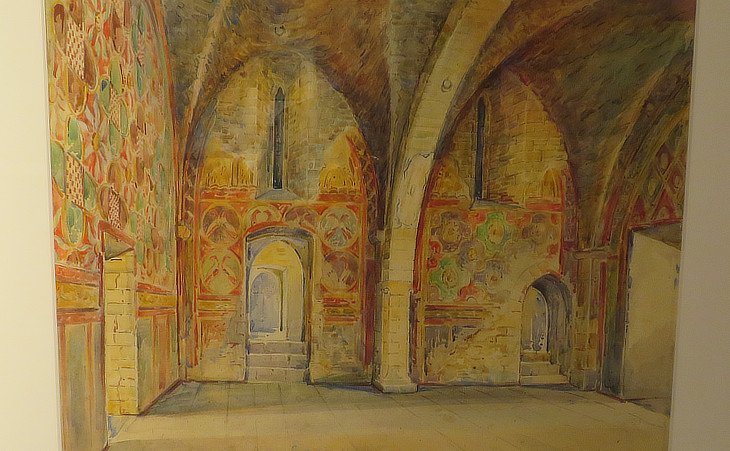
Temporary exhibition at Centrale Montemartini: Hall of the Slap in a 1920 watercolour by Maria Barosso, an archaeologist of the Soprintendenza di Roma, the department responsible for monuments, the environment and historical buildings
The Hall of the Slap might not be exactly the location of the famous slap, but it retains a rare example of the decoration of a noble Italian palace of the XIIIth century.
Besides his dramatic end Pope Boniface VIII is best known for having issued a bull in February 1300 which decreed that sinners would be granted special indulgences if they visited in that year the city of Rome and the tomb of St. Peter, Prince of the Apostles. He declared the year 1300 a holy year: it was the first Christian Jubilee.

(left) Porta S. Francesco; (right) Porta S. Maria
The curse pronounced by Benedict IX no longer rests upon Anagni; yet, so recently as the year 1616, its superstitious inhabitants believed that they were suffering under it. When the then well-known traveller, Leandro of Bologna, visited the town, he found it in a heap of ruins; even the Gaetani palace had been destroyed. The frightful war waged against the Lords of the Campagna by Alba had reached this place, and the poor townsfolk complained to their visitor from Bologna that since Boniface, the proud Pope, had been betrayed there, their town had been pursued by constant calamities. Gregorovius
After the disastrous effects of the 1556 Guerra di Campagna
Pope Pius IV built new walls and gates which resemble Porta Pertusa.
Introductory page on Ferdinand Gregorovius
Previous pages in this walk: Colonna and Zagarolo. Palestrina, Cave, Genazzano, Olevano and Paliano.
Other walks:
The Ernici Mountains: Ferentino, Frosinone, Ceccano, Ceprano, Alatri, Fiuggi (Anticoli di Campagna), Piglio and Acuto
The Volsci Mountains: Valmontone, Segni, Norma and Cori
On the Latin shores: Anzio and Nettuno and Torre Astura plus excursions to Ardea and to Lavinium
Circe's Cape: Terracina and San Felice
The Orsini Castle in Bracciano
Subiaco, the oldest Benedictine monastery
Small towns near Subiaco: Cervara, Rocca Canterano, Trevi and Filettino.


