
All images © by Roberto Piperno, owner of the domain. Write to romapip@quipo.it.


Notes:
Page revised in November 2022.
All images © by Roberto Piperno, owner of the domain. Write to romapip@quipo.it.
Notes:
Page revised in November 2022.
 Porta Pertusa
Links to this page can be found in Book 1, Map D2, Day 8, View C1 and Rione Borgo.
The page covers:
The plate by Giuseppe Vasi
Today's view
Porta Pertusa
Villa Alberici
S. Maria del Buon Riposo
Villa Carpegna
Casale di S. Pio V
The
Walls between Porta Pertusa and Porta Angelica

When in 1562 Pope Pius IV decided to build new walls around the Vatican, some of his advisers suggested not including in the new curtain the western end of the Vatican hill, in order to limit costs. The Pope however preferred to follow the advice Antonio da Sangallo the Younger had given to his predecessor Pope Paul III in 1536 and the new walls reached the top of the hill much the same as those built by Pope Leo IV in ca 850 had done. Torre di S. Giovanni, the round tower behind the gate, was the western limit of the medieval walls, where a gate called Porta Pertusa already existed.
Probably Pope Pius IV had in mind to develop the area between S. Pietro and the walls, as he had done in Borgo Pio, but neither he nor his successors did it and the gate at the top of the hill was eventually closed because no road led to it from the city. This explains why the etching Giuseppe Vasi made in 1747 showed Porta Pertusa closed.
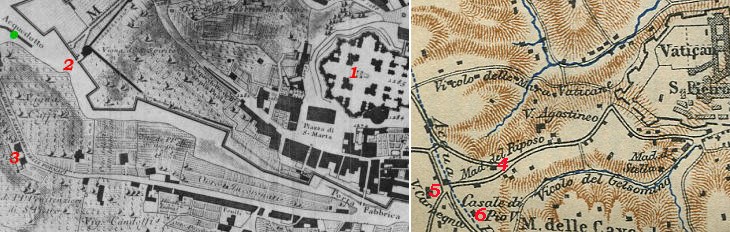
The view is taken from the green dot in the small 1748 map here below (left) which shows: 1) Dome of S. Pietro; 2) Porta Pertusa; 3) Villa Alberici. The 1883
map (right) shows: 4) Madonna del Riposo (S. Maria del Buon Riposo); 5) Villa Carpegna; 6) Casale di S. Pio V. 1) is covered in another page.
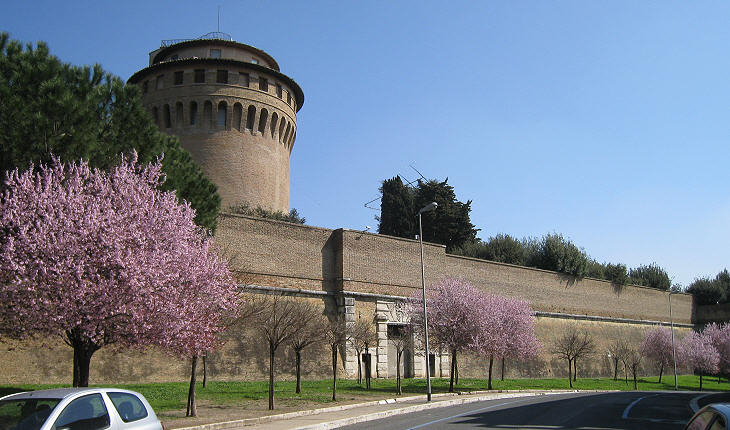
The view in March 2010
The walls have been raised (most likely by Pope Gregory XVI) and the dome of S. Pietro is no longer visible; Torre di S. Giovanni was restored by Pope John XXIII and it is used to host important guests of the popes.
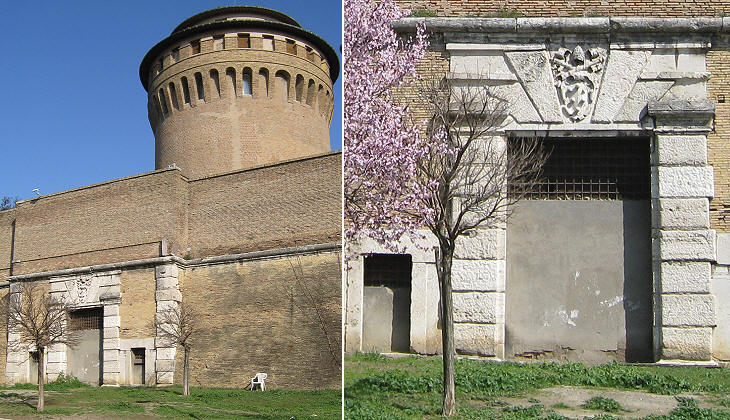
(left) Porta Pertusa and Torre di S. Giovanni; (right) detail of the gate
In his 1761 guide to Rome Vasi attributed the coat of arms on the gate to Pope Leo X, but in the text accompanying the etching he was less certain about it and he wrote that it was a Medici coat of arms. Pope Pius IV (Giovanni Angelo de' Medici) was not a member of the Florentine Medici family, but he was "allowed" to use their coat of arms.
The name of the gate means "pierced" and the word is thought to indicate that Porta Pertusa was opened in the medieval walls after they were built. The image used as background for this page shows a posterula, a small opening in the walls near the gate.
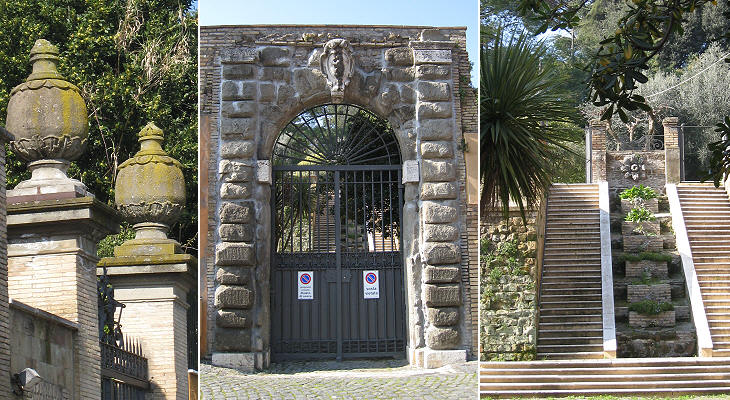
(left) Jars on a modified entrance to Villa Alberici; (centre) main portal; (right) former fountain
The Alberici were a minor noble family from Orvieto; their villa was made up of small buildings very near the entrance and it was located along Via delle Fornaci, a road which branched off Via Aurelia at Villa Carpegna and led to Porta Cavalleggeri; Villa Alberici was built in the second half of the XVIth century and it was modified before the death in 1622 of Pirro Alberici, whose name and portrait can be seen on one of the remaining buildings. At Vasi's time it belonged to Collegio dei Penitenzieri.
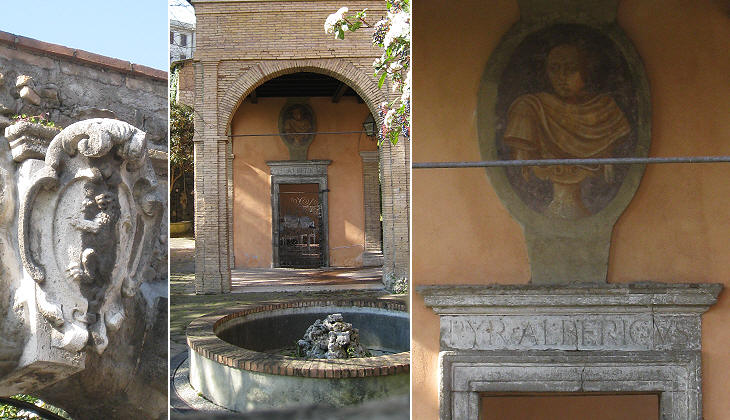
(left) Coat of arms of the Alberici; (centre) small casino; (right) inscription and portrait of Pirro Alberici
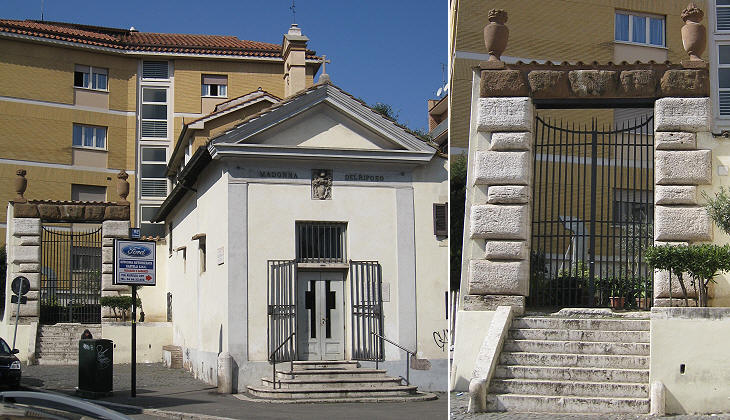
(left) S. Maria del Buon Riposo; (right) former entrance to Villa Giraud (lost)
This small chapel was founded by Pope Pius IV, but it is mainly associated with Pope Pius V, his successor, who used to stop and pray here on his way to his summer residence on Via Aurelia. Buon riposo means good rest and it can be a reference to the chapel providing rest to travellers or more generally to death. This second meaning is confirmed by the inscription over the slit of the alms box which says "he who lives well, dies well".
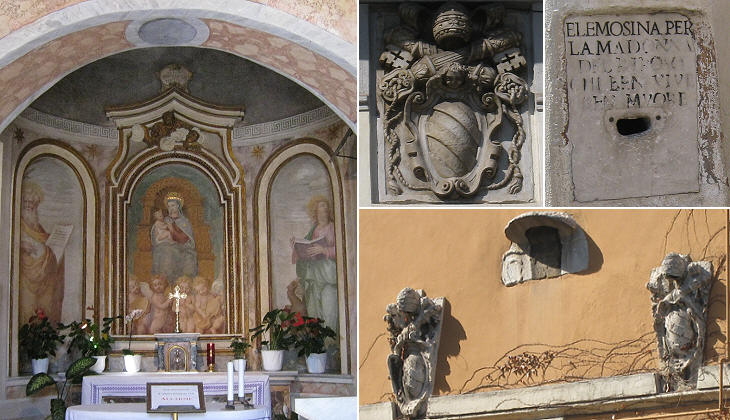
(left) Interior; (right) alms box and coats of arms of Pope Pius V
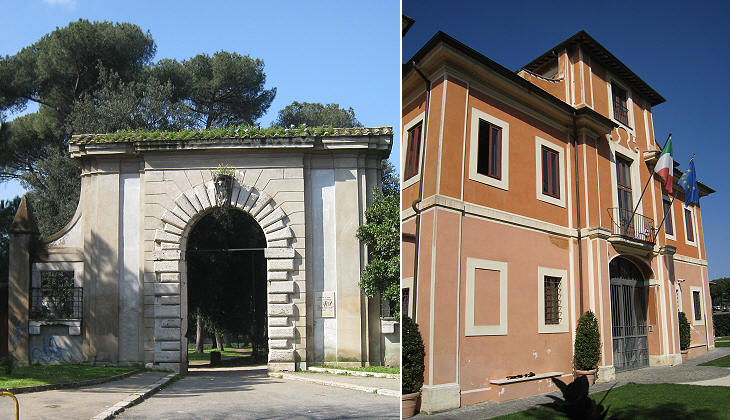
(left) Gate; (right) casino
Villa Carpegna was both a farm and a summer residence and its main building is an attempt
to meet both requirements. It was most likely designed by Giovanni Antonio de' Rossi for Cardinal Gaspare Carpegna towards the end
of the XVIIth century.
The Carpegna were a noble family from Montefeltro, a region near Urbino. The Cardinal had a palace in Rione Sant'Eustachio and other members of the family had a palace in Rione Trevi.
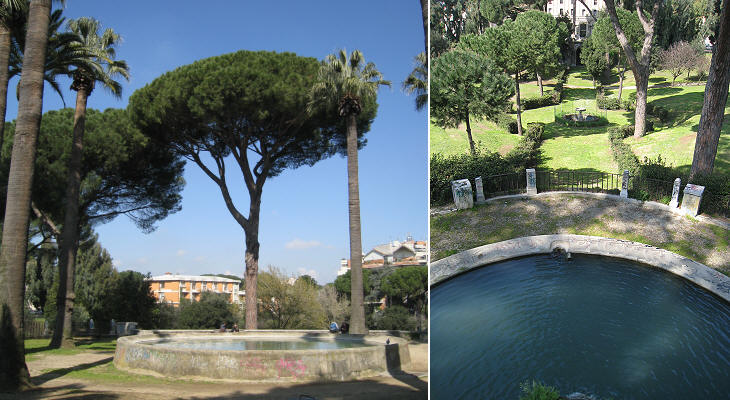
Former series of fountains
Villa Carpegna was situated in a rather remote location; this explains why it did not attract the interest of painters or engravers. In the XIXth century its gardens were modified to adapt them to patterns in fashion at the time; in the XXth century the property was sold and divided up; this led to not properly maintaining the series of fountains which from the back of the main casino crossed a small valley and ended in a nymphaeum.
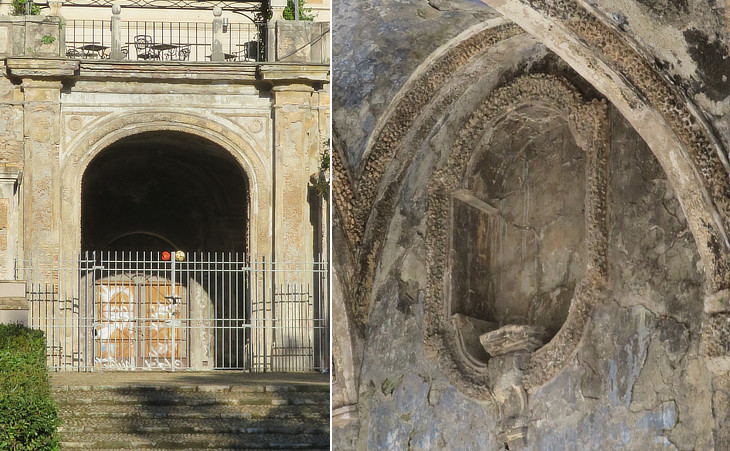
Nymphaeum at the end of the gardens and detail of its decoration
In 1981 the City of Rome acquired the casino and a minor part of the gardens, but it has been unable to fully restore the fountains and their decoration.
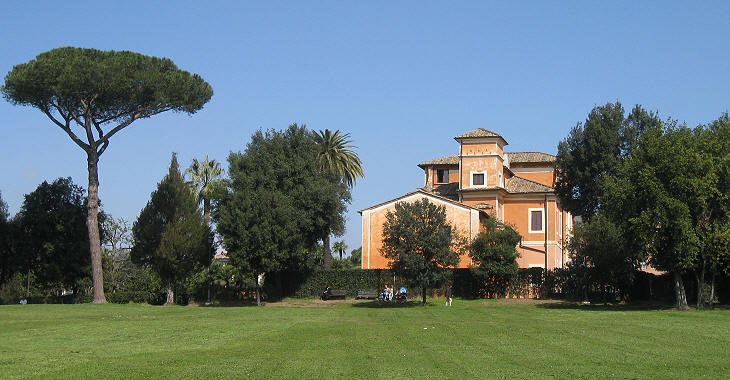
Gardens of Villa Carpegna
Cardinal Carpegna was appointed Cardinal Vicario (i.e. Deputy Bishop of Rome) in 1671 by Pope Clement X. He was requested by the Pope to effectively control the access to the ancient Christian catacombs and cemeteries in order to prevent the stealing of relics. In this capacity Cardinal Carpegna was able to gather a formidable collection of Roman coins and jewels. The collection was bought by Pope Benedict XIV in 1743. Its classification took two years because it had more than 4,000 items.
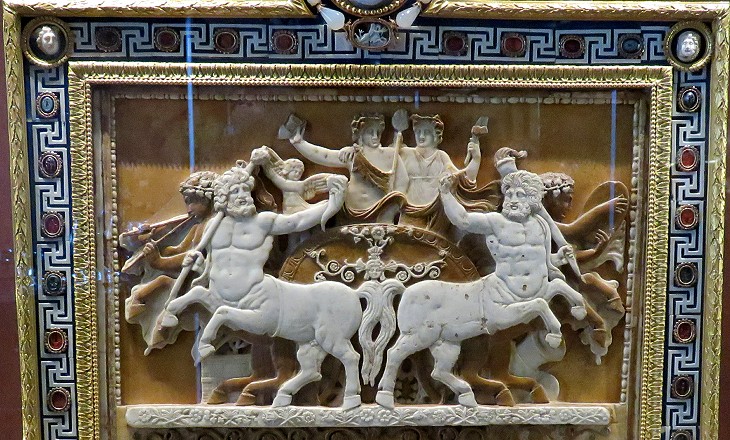
Louvre Museum in Paris: The Triumph of Bacchus - Frame by Luigi Valadier - Collezione Cardinal Gaspare Carpegna from Catacombe di Calepodio near S. Pancrazio
During the French occupation of Rome in 1798 the best pieces of the collection of coins and jewels were shipped to Paris. Some of them were donated by Napoleon to other European monarchs. After the restoration of the Papal authority in Rome in 1814 Pope Pius VII and Antonio Canova who negotiated on his behalf were not able to recover the entire collection.
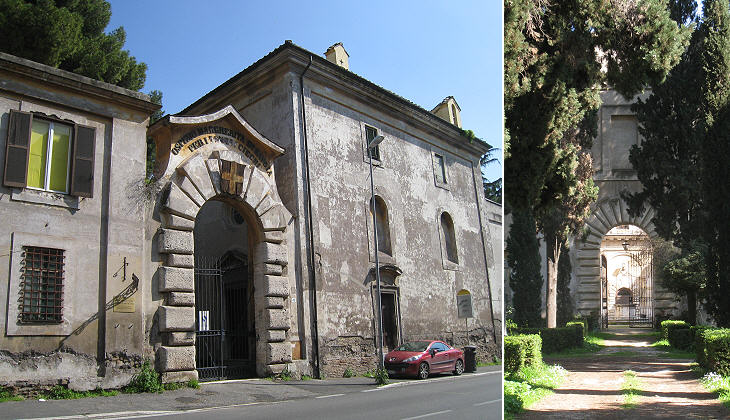
(left) Entrance along Via Aurelia Antica which ends at Porta S. Pancrazio; (right) tree-lined walkway leading to the main building
Pope Pius V built in the open countryside behind the Vatican walls a residence where he often went to rest. It was most likely designed by Nanni di Baccio Bigio, a Florentine architect. Other works by him were Porta del Popolo, Palazzo Salviati and Tor S. Michele at Ostia.

Main courtyard and its well
At the end of the XIXth century Casale di S. Pio V became a house for the blind; this required several modifications to the building; nonetheless the main courtyard retains the original design. Today it houses a university campus.
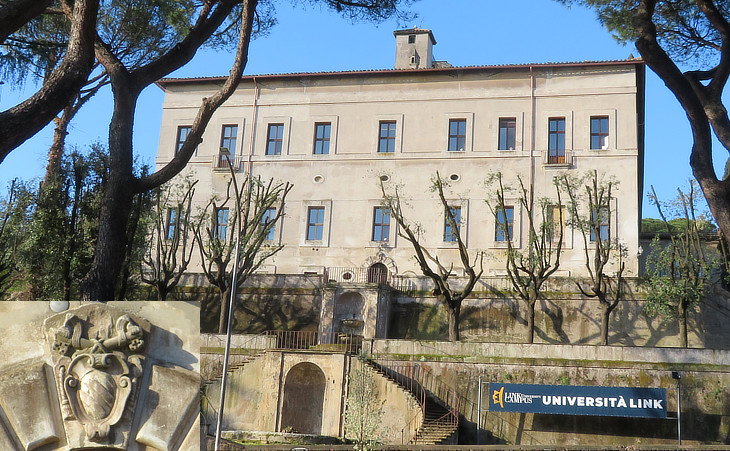
Rear view of the building and coat of arms of Pope Pius V
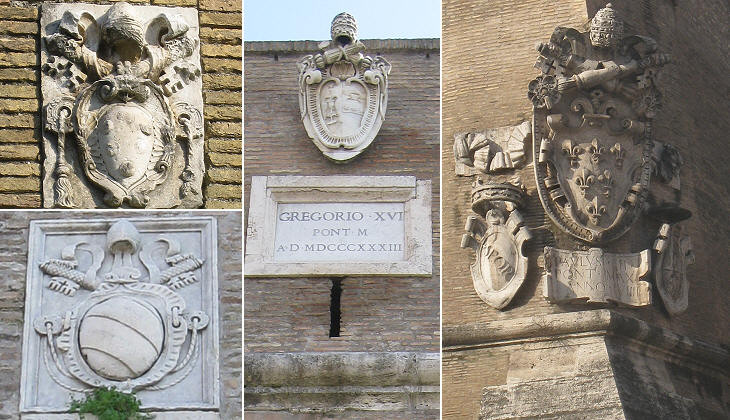
Papal coats of arms: (left-above) Pius IV; (left-below) Pius V; (centre) Gregory XVI; (right) Paul III
In addition to many coats of arms of Popes Pius IV and Pius V, the Renaissance walls betwen Porta Pertusa and Porta Angelica retain many coats of arms of Pope Gregory XVI who raised the height of the walls. The last bastion before Porta Angelica was designed by Michelangelo and it was decorated with a gigantic coat of arms of Pope Paul III, which is very similar to that at Bastione del Sangallo.
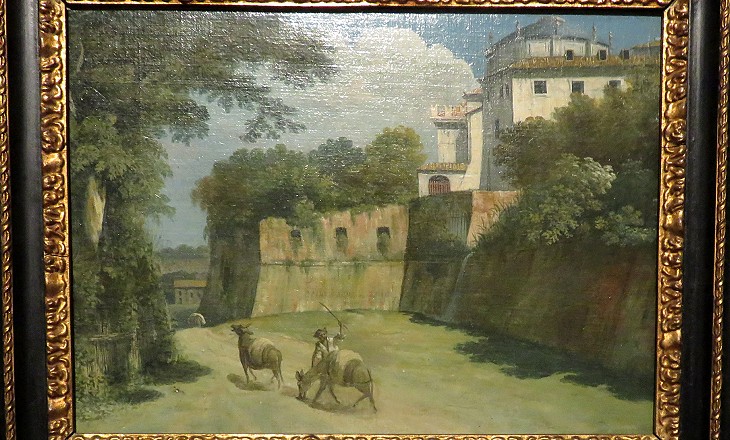
Museo di Roma a Palazzo Braschi: XIXth century painting showing the walls where now the entrances to Musei Vaticani are located and Sala Rotonda of Museo Pio-Clementino above the walls
The plate by Vasi shows that there was not a proper road surrounding the walls at Porta Pertusa. This situation continued for the whole of the XIXth century until Viale Vaticano was built along the walls in order to link Prati, a new neighbourhood with Via Aurelia.
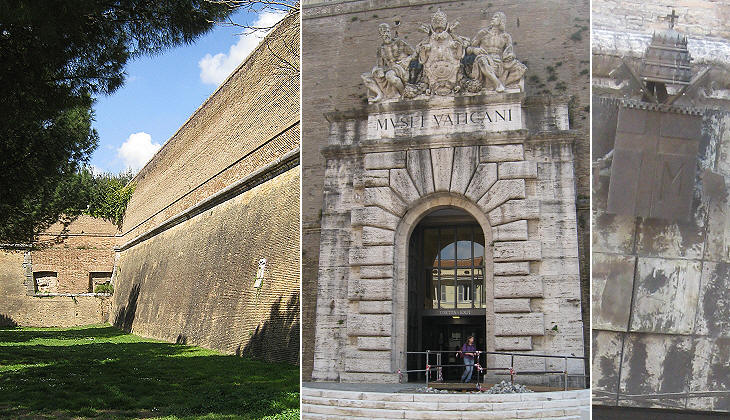
(left) Walls near Porta Pertusa; (centre) 1932 entrance to Musei Vaticani, a work by Giuseppe Momo who designed also other buildings inside the Vatican City State; (right) detail of the 2000 entrance with the coat of arms of Pope John Paul II by Cecco Bonanotte
The opening of Viale Vaticano eventually led to giving an independent entrance to Musei Vaticani, which until then were reached by going around the apse of S. Pietro to Atrio dei Quattro Cancelli.

Musei Vaticani: double staircase by Giuseppe Momo in the 1932 entrance
Next plate in Book 1: Porta Angelica.
Next step in Day 8 itinerary: Giardino Pontificio.
Excerpts from Giuseppe Vasi 1761 Itinerary related to this page:
Porta PertusaNel più alto del colle Vaticano siede questa porta, la quale serviva solamente per comodo della Corte Pontificia, perchè nel giardino Pontificio corrisponde, e non nella Città. Prese un tal nome per l'antica sua piccolezza, ma Leone X. la ornò con buona architettura; resta però ancora chiusa e senza alcun uso. Appresso a questa si vedono le torri con leMura della città LeoninaDal Pontefice s. Leone IV. fu cinto il Vaticano di mura e di torri, allora quando nell'an. 849. ebbe notizia, che dall'Affrica venivano i Saracini con una poderosa armata in danno di quest'Alma Città; onde sollecito ristaurò le antiche mura, e rinforzò le porte con nuove torri, facendo venire da tutto lo Stato Ecclesiastico operarj: e perchè la basilica Vaticana e li molti ospizj , e spedali restavano esposti agli insulti delle nazioni barbare, perchè fuori della Città, con animo grande cominciò a cingere tutto quel vasto sito di forti mura, sopra le quali egli molto vigilante e sollecito scorreva or per una parte, ed ora per un'altra, acciò l'opera si finisse presto e bene, non distogliendolo nè freddo, nè vento, nè pioggia, ne caldo. Dipoi impiegandovi i Saracini fatti prigioni nella sconfitta data loro nella spiaggia di Ostia, e col lavoro di 4. anni compì la grande opera formando una nuova Città, che dal suo fondatore si disse Leonina. Il medesimo Papa per lo stabilimento di essa ordinò, che tutti i Vescovi , Preti, Diaconi, e Chierici della Chiesa Romana, posciachè si fossero cantate le Litanie, e il Salterio, girassero seco insieme con Inni, e Cantici spi rituali intorno alle nuove mura, cori piedi scalzi, e con cenere in capo. Oltre a ciò ordinò che i Cardinali, e Vescovi facessero l'aqua benedetta, e nel passare aspergessero con essa le dette muraglie. E dopo il medesimo s. Pontefice recitò con lacrime, e sospiri sopra le istesse mura tre orazioni; una sopra la porta verso s. Pellegrino, l'altra sopra la porta Castello, e la terza sopra quella di san Spirito. Dopo di che il Papa con tutto il Clero, e Baronìa di Roma, andò processionalmente alla basilica di s. Pietro, recitando orazioni e laudi, e poi celebrò la Messa solenne per la salute del popolo, e conservazione della Città; il che successe il dì 27. Giugno dell' ottavo anno del suo Pontificato. |


