All images © by Roberto Piperno, owner of the domain. Write to romapip@quipo.it.


Notes:
Page revised in November 2024.
All images © by Roberto Piperno, owner of the domain. Write to romapip@quipo.it.
Notes:
Page revised in November 2024.
 - Ancient Cori
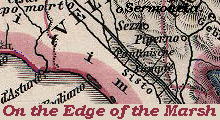
The Volscian mountains, sweeping from north to south in a bold semicircle, close the view of the Pontine Marshes to the east. On their sides the traveller beholds Cora, Sezza, Piperno, like aerial palaces shining in contrast with the brown rugged rock that supports them. These towns are all ancient, and nearly retain their ancient names.
John Chetwode Eustace - A Classical Tour through Italy in 1802
Ferdinand Gregorovius, a German historian best known for his studies on medieval Rome, spent the summer of 1860 at Genazzano with his friend Johannes Muller, a painter; the two decided to go on a ride across the Volsci Mountains (aka Monti Lepini). The journey was described in an account (Aus den Bergen der Volsker) written by Gregorovius for a
German paper. From the Volsci mountains he enjoyed commanding views over the Pontine Marshes which he described in another travel account.

(left) Porta Ninfina; (right) "Sipportica"
The next morning we hired mules to convey us from Norma to the ancient and renowned town of Cori or Cora. Here we arrived, after a hard ride of three long hours. A road leading to Cori traverses the level ground by Nympha; but we chose a shorter way across the Volscian Mountains, by a mountain path skirting the precipices, for the prospects from that higher route are wide and fine, extending all over the marshes, the sea, and as far as Rome, across the Campagna. The early freshness of daybreak, the clearest of September atmospheres, made this ride sufficiently enchanting, although the hills over which we were riding were uniform and lifeless, save where the shepherds had gathered in their flocks to milk the ewes, or to make cheeses over a fire, or were setting up their temporary huts made of branches of broom and heather.
Ferdinand Gregorovius - From the Volscian Mountains - 1860 - Translation by Dorothea Roberts.
Cori was the journey's final destination and Gregorovius and his friend reached it from Norma by a mountain road. The historical access from Rome was from Porta Ninfina, the southern gate of the town, where one sees a sort of summary of Cori's history: a) a sample of the ancient walls which supported the terraces above which the town was built; b) Sipportica, a covered medieval street, and c) Palazzo Chiari, a XVIIth century palace built on top of the Sipportica.

Views from the terrace of S. Oliva towards Convento di S. Francesco (above) and Velletri (below), the see of the large diocese which included Cori (see Cori from Velletri)
A summer spent here would richly repay the visitor. The air is cool and fragrant, the wine is excellent, the fruits are in such abundance that I bought twenty-six fresh figs for one bajocco; but Cora is not visited by the Romans. They congregate at Frascati and Albano, and few indeed of them know anything about the charms of their own Campagna. Gregorovius
Giuseppe Vasi briefly mentioned Cori in his description of the environs of Rome, but only as an excursion site from Velletri. Cori was not regarded as one of the Castelli Romani, the ring of towns around the volcanic lakes of Albano and Nemi, south of Rome. This is true also today and Cori is not a destination of the October outings of the Romans.

And there, set on its mountain, Cori lies before us, a pyramid of houses, high over them all those most beautiful remains of the temple of Hercules. At the foot of the hill are vineyards and olive woods. (..) As you look across this classic land of that Latian strand and over the ancient country of the Rutuli and of Ardea, if you have any poetry in you, you will recall the people in Virgil's Aeneid, for this is the Roman Troy, the scene of the combats between the heroes in Virgil's great poem.(..) We find the name of Coras, the founder of Cori, in the seventh book of the "Aeneid". Gregorovius
|
Tum gemini fratres Tiburtia moenia linquunt, fratris Tiburti dictam cognomine gentem, Catillusque acerque Coras, Argiva iuventus, Book VII - vv. 669-671 |
Then twin-brothers, Catillus, and brave Coras,
Argive youths, leaving the walls of Tibur,
and a people named after their brother Tiburtus. (translation by A. S. Kline) |
A beautiful road conducts from Velletri to Cori. (..) We
meet a road to our left, which enters Cori at its upper
extremity and commands a view of the Volscian plains
and Pontine marshes; but the lower road will be found
more convenient, and brings the traveller within more
immediate reach of accomodation on his arrival at Cori. (..) The form of
the city is pyramidal, the temple of Hercules constituting its vertex: from its summit to its base we shall
meet three enclosures and it is divided by an olive
grove into Cora a valle and Cora a monte.
Rev. Jeremiah Donovan - Rome Ancient and Modern - 1844

Fresco at Casino di Belvedere in Rome depicting an idyllic view of the Pontine Marshes at the time of Pope Pius VI with Mount Circeo in the background
Camilla, the Amazon, scours the plain; her beautiful form is visible glancing through the forests. She is the heroine of this Volscian land. (..) The melodious lines of the Aeneid must be read again in these Latian Meads to feel all their charm. Virgil's poetry is as translucent, as full of serious beauty as is the Campagna of Rome itself. That deathless poem of his will always remain the most soul-inspiring which we have left to us from Roman times. In all future centuries these mountains, these woods, these meadows, must be imbued by it. Gregorovius
|
Hos super advenit Volsca de gente Camilla agmen agens equitum et florentis aere catervas, bellatrix Book VII - vv. 803-805 |
Besides all these came Camilla, of the Volscian race,
leading her line of horse, and troops gleaming with bronze,
a warrior girl. (translation by A. S. Kline) |

Plate from "Le Antichità di Cora" by Giovanni Battista Piranesi (1764) depicting fragments of capitals and columns which he saw in houses and streets of Cori
The Virgilian memories bring Troy and Hellas into the near neighbourhood of ancient Rome. The atmosphere becomes more and more Hellenic the closer we approach to Cora, for this oldest of towns belonged to the mythological Pelasgi in the days of prehistoric Italy. Rome is called the Eternal, but not because of her age; most of the Campagna towns are far older. Cora, according to the calculations of both ancient and modern topographers, is one of the oldest towns in the world - it is said to have been built 1470 years before Christ, and 700 before Rome. Gregorovius
All the legends about the foundation of Cori have one point in common; they set the foundation of the town at a much earlier time than that of Rome.

(left) Plate from "Le Antichità di Cora" by Giovanni Battista Piranesi (1764); (right) Museo della Città di Cori: fragments of ancient buildings with a decoration similar to that shown in the plate
Piranesi is best known for his dramatic views of the grand monuments of Ancient Rome (see that of Ponte Milvio compared to Vasi's one). The etchings showing the two temples of Cori and fragments of ancient buildings were made for cultured foreign customers who were interested in discovering elements of Greek architecture and art in their Italian travels. Because of its antiquity Cori, as Gregorovius wrote, had an Hellenic character for many foreigners, although its monuments are generally dated Ist century BC.

Sections of the polygonal walls near S. Oliva
I will not fatigue the reader with the description of its ruins; but well do its Pelasgic or Cyclopean walls deserve his admiration. They are visible from many parts of the town, and have been compared to those of Mycenae or Tiryns. They support the Acropolis, the crowning pinnacle of the town. Gregorovius
The remains of the ancient walls of Cora belong
to four different epochs. (..) The third is composed of polygons dressed on
every side and the fourth is constructed of small polygons , and is always placed over the others, a proof
that it is more recent, and belongs to the Roman colony. (..) The walls,
when not ancient, are of the XV. century. Donovan
Similar to other towns described by Gregorovius (e.g. Alatri and Segni), Cori was protected by massive walls in opus poligonalis (polygonal masonry).
Archaeologists have identified four types of such a masonry; those shown above belong to the third type which is characterized by stones which were cut, polished and aligned in order to obtain a smooth vertical surface.

(left) Via delle Colonne; (centre/right) remaining columns of Tempio dei Dioscuri (Castor and Pollux)
Castor and Pollux, Fortuna, Diana (the huntress goddess of the Pontine plains), Sol, Janus and Eolus, Apollo and Aesculapius all had their temples in Cora. Still, four beautiful Corinthian columns are shown, built into the wall of a house, which to this day are called the Temple of the Dioscuri. Gregorovius
In the via delle Colonnette are numerous fragments of Doric columns and in the wine cellar of the
house opposite the casa Tommasi are remains of an ancient tesselated pavement. We also meet in the wall of
a house to the right as we advance a mutilated altar and having reached the house of Count Tassoni, we observe at the opposite side of the street, to the
rear of a small yard, a polygonal wall of the third epoch. Donovan
The temple was probably surrounded by other facilities, because parts of columns can be seen in the street leading to it.

Piazza di Pozzo Dorico and (above) S. Salvatore and Tempio dei Dioscuri
Returning by the via delle Colonnette we descend
to an artificial piazza beneath the temple of Castor and
Pollux, called Pizzitonico (today Pozzo Dorico), which had been the terrace
over the reservoirs of ancient Cora. They have been in
part converted into stables, cellars, dwellings etc., as
may be seen in the street beneath the piazza but they
are also still partly in use, as is seen on the piazza itself, where part of one of the cisterns is still supplied
with water and their existence proves that, in ancient
as well as in modern times, Cora had no aqueduct,
having been supplied with rain water collected in these
reservoirs. The modern name of Pizzitonico is probably
derived from pozzo, a well, a name which was probably
given to the reservoirs, which the people now call baths.
The polygonal substructions of the temple of Castor
and Pollux are here seen to advantage, and belong to
the first epoch. Donovan
The use of massive walls was not limited to the construction of fortifications, but was required by the nature of the rocky ground in order to obtain terraces, cisterns, streets, etc. Although at first sight the wall shown above seems on the verge of collapsing, it has supported the weight of huge buildings for the last 2,000 years.

Piranesi: Tempio dei Dioscuri showing a fallen fragment of the inscription
The piazza S. Salvatore is sustained by ancient substructions of opus incertum, built on the primitive polygonal walls, which supported the area of the temple of Castor and Pollux. In the end wall of the house opposite the church door are partly enclosed the two columns that formed the central intercolumniation of the portico of that temple, which had six columns in front and two at either side, of the Corinthian order and of superior execution. The columns had been covered with stucco; and the inscription on part of the entablature still remaining, although mutilated, leaves no doubt of its having been dedicated to Castor and Pollux. Donovan

Tempio dei Dioscuri: inscription bearing also the names of the local magistrates who built the temple (also in the image used as background for this page)
Having espoused the cause of Sylla, Cora suffered much
from the party of Marius, but it was repaired and embellished by Sylla. Strabo and Pliny are the last writers, who mention it as
existing in their time and an inscription records its having been a municipium about the time of the emperor
Claudius, the last memorial that remains of ancient Cora. Donovan
Cori was plundered during the civil war between Silla and Marius (89-83 BC) and the temple was built after that
period on the site of an older one. It was dedicated to Castor and Pollux, whom the Romans regarded as
protectors of their republic and to whom they dedicated a major temple in the Roman Forum.

Ponte della Catena, a Roman bridge outside the walls
Remains of baths, of cisterns, a Roman bridge over the foaming mountain stream which rushes from the mountain side from Cora - these and other ancient relics of past glories will pleasantly occupy him who may care to search for them. Gregorovius
At a
short distance from the wall is an ancient bridge called
the ponte della Catena, built of square blocks of tufa,
and having three ranges of masonry in its massive arch,
like that of the Cloaca Maxima in Rome. It is a work of
the Romans, of more than 2,000 years standing. Donovan

Piranesi: Tempio di Ercole
We begin our walk through Cora with the temple of Hercules, the rear of which serves as a vestibule to the parish-church of S. Pietro, and the tetrastyle portico of which still remains in a small garden to the rear of the sacristy. The portico, as is still seen had been covered with stucco and on the door frame of the cella are inscribed the names of the Duumvirs, Marcus Manlius and Lucius Turpilius, by whom it was erected by order of the Senate. (..) This inscription has no stops, and the letters in both lines are of equal size: their form is analogous to that of the other inscriptions of the VII. century of Rome (Ist century BC). Donovan

Tempio di Ercole and bell tower of S. Pietro
This temple is beautifully situated on the citadel; the quadrilateral area on which it stands is
sustained by a wall of opus incertum of the epoch of
Sylla; and the laurels and cypresses, the rocks and wild
aloes in front of it, form a fine foreground. Donovan
When you climb up the Acropolis, you find yourself standing, filled with amazement, before the peristyle of a temple which seems to be entirely Greek. It is a graceful little building, of the Doric order, in good preservation. The bluish-grey colour which the travertine of the pillars has assumed gives it a charmingly antique aspect. They call it the Temple of Hercules, but apparently without any good reason for doing so. Gregorovius
The most famous monument of Cori is the Temple to Hercules which is located at the very top of the town; it was studied by many Renaissance artists, including Raphael.

Tempio di Ercole: detail of its Doric decoration
Its Doric portico of eight columns and the
front walls of the cella are alone visible. The columns
are seven diameters in height without the bases or capitals, in all twenty one feet high; and the architecture,
although somewhat heavy, is elegant and not unlike
that of the circular temple at Tivoli. Donovan
The reason for all this interest was in the
use of Doric columns having the proportions (height versus diameter) of Ionian ones and in the fact that the front is slightly concave; the temple was built at the same time as Tempio dei Dioscuri. It was eventually incorporated into the church of S. Pietro which was destroyed by bombings during WWII, with the exception of the bell tower.

(left) Museo della Città di Cori: cast of the statue of Minerva/Rome in Piazza del Campidoglio; (right) ancient altar inside S. Pietro
It is commonly called the temple of Hercules; but the baptismal font in the adjoining church rests on an ancient square
altar of beautiful execution, which, as is clear from the
Gorgon on its side, had been sacred to Minerva; and
the discovery of this her altar and of her statue, now over
the fountain of the Capitol, both found here, render
it highly probable that it had been dedicated to that
goddess. Donovan
The statue of Minerva was found at Cori at the end of the XVIth century and in 1593 it was placed in Piazza del Campidoglio. It is dated late Ist century AD.

Museo della Città di Cori: capitals
As we descend hence to the
piazza S. Salvatore , we observe at the door of Signor
Prenci an ancient Corinthian capital. (..) Going from the Temple of Castor and Pollux by the via delle Colonnette towards the
casa Tassoni, and entering the first hall door to the right, which opens into a house raised on the ruins
of an ancient edifice built of opus reticulatum, we find
part of a mosaic floor in the cellar to the left of the
little court-yard to the rear, and a Corinthian capital,
a base and a fragment of an inscription in the yard itself. (..)
Returning through the gate the first house that meets
us to the right is that of one Vittori, in the courtyard of
which are two Doric columns, which belonged to some
edifice coeval with the temples. Donovan
Over time the fragments of ancient Cori which visitors had to search for in the houses of the town were gathered in the Town Hall and in 2024 a modern museum was inaugurated in the former premises of an Augustinian monastery adjoining S. Oliva.

Museo della Città di Cori: (left) statue from the Forum; (right-above) inscription celebrating two magistrates, the left part was found near S. Maria della Pietà; (right-below) fallen fragment of the inscription of Tempio dei Dioscuri shown by Piranesi

Museo della Città di Cori: fragments of terracotta votive statues which were found in the Temple to Hercules

Museo della Città di Cori: fragments of the terracotta decoration of an archaic temple; they are part of a "sima", the typical decoration of the upper part of an Etruscan temple (see a Vth century BC example at Arezzo). This type of decoration is found also in towns south of Rome, e.g. Praeneste
Move to Medieval and Renaissance Cori.
With the description of Cori, Gregorovius ended his account of the Volsci Mountains; previous pages: Valmontone and Montefortino; Segni and Gavignano; Carpineto; Norma
Next page (in Giuseppe Vasi's Environs of Rome): Albano
Introductory page on Ferdinand Gregorovius
Other walks:
The Roman Campagna: Colonna and Zagarolo, Palestrina, Cave, Genazzano, Olevano, Paliano and Anagni
The Ernici Mountains:
Ferentino,
Frosinone, Alatri, Fiuggi (Anticoli di Campagna), Piglio and Acuto
On the Latin shores: Anzio and Nettuno and Torre Astura
Circe's Cape:
Terracina and San Felice
The Orsini Castle in Bracciano
Subiaco, the oldest Benedictine monastery
Small towns near Subiaco: Cervara, Rocca Canterano, Trevi and Filettino.
An Excursion through Sabina and Umbria: Aspra, ancient Casperia and Todi
Excerpts from Giuseppe Vasi 1761 Itinerary related to Velletri:
Giuseppe Vasi
|