
All images © by Roberto Piperno, owner of the domain. Write to romapip@quipo.it.


Notes:
Page revised in January 2026.
All images © by Roberto Piperno, owner of the domain. Write to romapip@quipo.it.
Notes:
Page revised in January 2026.
 Spiaggia verso la Bocca della Verità
Links to this page can be found in Book 5, Map C3, Day 5, View C10 and Rione Ripa.
The page covers:
The plate by Giuseppe Vasi
Today's view
Cloaca Massima
Casa dei Pierleoni (S. Aniano)

In the 1740s Giuseppe Vasi published Vedute di Roma sul Tevere, his first book of etchings which included fifteen views of the river; while in general the works by Vasi show a lot of attention to the details of the monuments of Rome, his early engravings are more similar to landscape paintings. In 1754 some views from Vedute di Roma sul Tevere, including that shown above, were reused for Book 5 which covered the same subject in addition to the bridges of Rome.
The plate shows Velabro, the strip of land between the Tiber and the Palatine Hill, but it is named after Bocca della Verità, a round relief portraying a human face with an open mouth which is situated in the portico of S. Maria in Cosmedin.
The view is taken from the green dot in the small 1748 map here below. In the description below the plate Vasi made reference to: 1) Ruin of Ponte Palatino (better known as Ponte Emilio or Ponte Rotto);
2) Palazzo di Pilato; 3) Monte Palatino; 4) S.
Maria del Sole (Tempio di Vesta); 5) Discharge point of Cloaca Massima (which is shown in the image used as background for this page); 6) S.
Maria in Cosmedin aka Bocca della Verità. The small map shows also: 7) Casa dei Pierleoni (and the lost church of S. Aniano).
1), 2), 3), 4) and 6) are shown in detail in other pages.


The view in January 2010
The view is quite different owing to the high walls on the river bank which were built in the 1880s to prevent floods. They hide most of the monuments shown in the plate.

Details which can be seen by walking a few steps along the opposite river bank: (left) Torre del Campidoglio which is shown in the left end of the plate; (centre) Palazzo di Pilato; (right) Tempio di Vesta and a terrace on the Palatine

Discharge point of Cloaca Massima
Close by this Church (which stands by the River side) the great sink of Rome, called Cloaca
Maxima, emptied it self into Tyber. And tho
this were but a sink, yet it deserves to be mentioned among the rare Magnificencies of ancient
Rome. For it was nobly built by Tarquimus Priscus of Free-stone, Arched over head, with a
world of Springs running into it: And it was so
great, that a Cart might have gone in it. This
sink was one of the evident tokens of the greatness and magnificence of Rome anciently.
Richard Lassels' The Voyage of Italy, or a Compleat Journey through Italy in ca 1668
Rome was founded on the Palatine and then it expanded on the Capitoline hill which became the religious centre of the city; the area between the two hills where later on the Romans built their Forum was subject to becoming marshy; according to tradition at the time of King Tarquin the Elder the Romans built Cloaca Massima, a sewer which received the excess water from a system of drains and discharged it into the river.

Sacello (Shrine) di Venere Cloacina near Basilica Aemilia in the Roman Forum
At the left-hand corner of the Vicus Tuscus and the Via Sacra, a
brick pedestal marks the site of the Shrine of Venus Cloacina, erected in commemoration of Tarquin making the Cloaca Maxima. Cloacina comes from cluere = purgare (to purge).
S. Russell Forbes - Rambles in Rome - 1887
The shrine was also used for the ritual purification of the Roman and Sabine armies. Cloaca Massima was modified many times and what we see today is a conduit of the IInd century BC. Read Henry James' account of his access to Cloaca Massima from a former paper mill near S. Giorgio al Velabro.

(left) Casa dei Pierleoni; (right) baroque coat of arms
The architect and archaeologist Antonio Munoz (1884-1960) played an important role in the design of the "imperial"
perspectives which in the 1930s isolated some of the most imposing monuments of Ancient Rome. He supervised the opening of Via del Mare which led to the loss of Piazza Montanara and Ospizio di S. Galla and to the redesign of the area near S. Maria in Cosmedin.
Munoz set his residence in a medieval house which had belonged to the Pierleoni, opposite Tempio di Vesta. The house was actually pulled down and rebuilt, but the frames of the small windows come from the old building. Although Munoz disliked baroque art, he decorated the entrance to his house with a coat of arms of that period/style.
The small church of S. Aniano (now lost)
was located near this house. It belonged to the guild of the cobblers and it was dedicated to St. Agnan of Orleans, who was their patron saint. You may wish to see a directory of churches belonging to a guild.
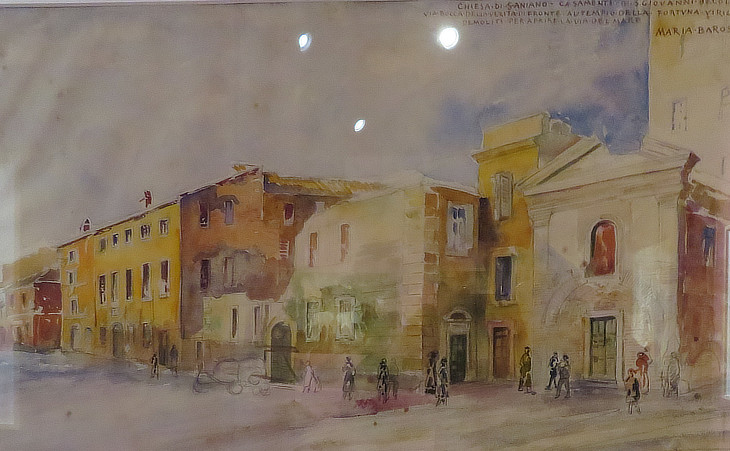
Temporary exhibition at Centrale Montemartini: S. Aniano and adjoining buildings in the process of being pulled down in a watercolour by Maria Barosso, an archaeologist who worked with Antonio Munoz
Next plate in Book V: Monte Aventino e Vestigi del Ponte Sublicio.
Next step in Day 5 itinerary: Anticaglie presso il Ponte Palatino.
Next step in your tour of Rione Ripa: Anticaglie presso il Ponte Palatino.


