
All images © by Roberto Piperno, owner of the domain. Write to romapip@quipo.it.


Notes:
Page revised in December 2023.
All images © by Roberto Piperno, owner of the domain. Write to romapip@quipo.it.
Notes:
Page revised in December 2023.
 Orti Farnesiani sul Palatino
Links to this page can be found in Book 10, Map B3, Day 1, View C9 and Rione Campitelli.
The page covers:
The plate by Giuseppe Vasi
Today's view
Orti Farnesiani
- Fountains
- Gardens
- Gates
- Casino del Giardino Segreto
Loggetta Mattei
S. Sebastiano al Palatino and S. Bonaventura

When Giuseppe Vasi published this etching in 1761 Orti Farnesiani, the Farnese Gardens on the Palatine Hill, had already entered a long period of decline. In 1845 Rev. Jeremiah Donovan wrote in Rome Ancient and Modern: In the XVIIIth century the male branch of the Farnese family became extinct, and the Orti descended to Elizabeth Farnese, Queen of Spain and thus became the property of the Bourbon of Naples, who transferred their artistic treasures to Naples and suffered the villa to fall into decay, insomuch that in the wide extent of the hill the destruction is the most complete.
In 1761 Ferdinand IV, King of Naples, was a boy of ten and the country was run by a regency council whose members had no interest in pouring money into the maintenance of Orti Farnesiani.
The view is taken from the green dot in the small 1748 map here below.
In the description below the plate Vasi made reference to: 1) First entrance;
2) Porticoes and Fontana della Pioggia; 3) Second floor; 4) Third floor; 5) Aviaries on the top floor. The small map shows also 6) Entrance to Villa Spada (Mattei); 7) S. Sebastiano
al Palatino; 8) S. Bonaventura.


The view in April 2018 (after a thorough restoration)
The main gate of Orti Farnesiani was situated on Stradone di Campo Vaccino which was thoroughly excavated in the second half of the XIXth century to unearth the ruins of the Roman Forum. The upper section of the stairway leading to the aviaries is the only remaining part of the buildings/gardens depicted in the plate. Today it is part of the archaeological area which includes both the imperial palaces and the Roman Forum.

A view of the Orti Farnesiani and of the whole north-western side of the Palatine from Terrazza delle Quadrighe at the top of Monumento a Vittorio Emanuele II in March 2023

(left) Stairway leading to the Fontana della Pioggia (Rain); (right) stairway leading to "il Fontanone"
One of the first decisions taken by Pope Paul III after his election in 1534, was to give the cardinal's hat to his grandson Alessandro, who was aged fifteen.
Cardinal Alessandro Farnese played a major role in assisting his grandfather and his successors. He was a great supporter of the Jesuits (he built il Gesù), a great collector of
works of art and a capable advocate of the interests of his family.
The Farnese had a large palace in Rione Regola and a palace/villa at Caprarola, but Cardinal Alessandro Farnese, who was a man of the Renaissance and therefore
very fond of the ancient past of Rome, decided to buy several parcels of land overlooking the site of the Roman Forum. He then commissioned il Vignola with the design and construction of a summer residence for the Farnese. It was called Orti, rather than villa, because this was the word used by the ancient Romans for their suburban residences (e.g. Horti Sallustiani). A feature of Italian Renaissance gardens was the attention paid to symmetry and perspective; similar to Villa d'Este, Orti Farnesiani had a series of terraces linked by stairways which were flanked by trees and decorated with statues.

Fontana della Pioggia (after a lengthy restoration which was completed in December 2023)
In order to escape the heat of summer the ancient Romans used natural or man-made caves as a shady recess which they embellished with statues: Emperor Tiberius recreated Polyphemus' cave at his villa by the sea near Sperlonga and caves can be seen at Emperor Nero's villa at Anzio.
In the lack of natural caves, Italian gardens had man-made grottoes which were often given the appearance of a nymphaeum, an ancient Roman monument dedicated to nymphs of springs (e.g. Ninfeo di Egeria) and thus they had a source of water; the caves were designed in order to receive some natural light (see those of Palazzo Rospigliosi).
Fontana della Pioggia (Rain Nymphaeum) was a space that the Farnese used as a place for partying and delight, especially during the summer. Their guests gathered discreetly in a large semi-subterranean room decorated with frescoes and ancient sculptures.

Side wall of Fontana della Pioggia
According to archaeological literature, environments and architectural structures that readapt or artificially imitates natural caves (specus aestivi, coenationes, etc), placed inside imperial residences, domus and villas as preferred context for cultual symposium, otium, political and private relationships, are habitually defined as nymphaea. From an architectural point of view, they represent the central cells of ancient residences as private spaces of excellence representation, giving a crucial contribution to the creation of organisms made of buildings and artificial landscapes, real or imagined.
With the Renaissance and the rediscovery of the ancient world architecture, the Roman nymphaeum, based on ancient authors and monumental testimonies, become inspirational for palaces, villas and gardens, directing architectural and landscape creations intended to reshape the Italian and European residential architecture and establishing a tradition that will last until the XXth century.
From the presentation of the International Conference "Ancient and modern nymphaea in Rome and Lazio" - December 13-15, 2023 - Curia Julia.

Fontana della Pioggia: fresco of the ceiling by Giovan Battista Magni, detto il Modanino (1591/92-1674), see a similar fresco at Palazzo Pamphilj at Valmontone
Wee went straight to St Marcel, and there heard the most sweete and harmonious musicke, which one, being once out of Rome, must never upon Earth be expected to heare the like. It was composed of at least 20 voyces, organes, Lute, Violl, and two Violins, all which made such melodious and delightful musicke that Cicero with all his eloquence could never describe the sweetenesse of this more than sweete and harmonious musicke.
Francis Mortoft's Journal of his travels in France and Italy - 1659
Baroque Roman composers are best known for their religious works, but they were often asked by their patrons for secular music to be performed by small ensembles. The restoration of the ceiling fresco lets us understand what the original function of the nymphaeum was and how it was used. A space illusorily conceived as a pergola in a garden, animated by music and songs, poetry and cultured conversations in the shadow of the ancients and of nature. You may wish to see a page on some finely decorated Renaissance and Baroque musical instruments.
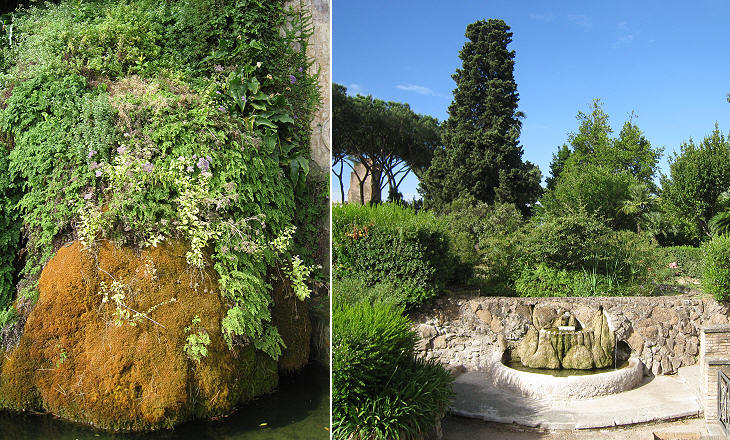
(left) Il Fontanone; (right) a small fountain
The fountains were added in the XVIIth century by Girolamo Rainaldi when the supply of water to the Palatine was restored. Because the water pressure was low, the fountains were not of the spouting type, but "sweating" ones, where water flowed on the surface as sweat does on the skin (similar to Meta Sudante, an ancient Roman fountain).
The ogee domed roofs of the aviaries are lost. They were made of iron similar to those at Villa Borghese.
In 1861 Francis II, the last King of Naples (more correctly of the Two Sicilies), sold Orti Farnesiani to Emperor Napoleon III of France.
The Italian
government acquired the property in 1870 and it started a systematic plan of excavations to search for the ancient imperial palaces.

1683 Plan of Orti Farnesiani by Giovanni Battista Falda
Entring into this garden
I found some pretty waterworks and grottes at the entrance, and fine high walks above, overlooking the
place where the Circus Maximus stood anciently.
Richard Lassels - The Voyage of Italy - 1670
September 1787. In the evening we went to the gardens on the Palatine, the spaces
between the ruins of the imperial palaces having been
gracefully cultivated. There, in a free social square,
where, under splendid trees, the fragments of adorned
capitals, of smooth and channelled pillars, shattered bas-reliefs, etc. were disposed in a wide circle, like tables,
chairs and benches arranged in the open air for a lively
party, there we enjoyed a charming entertainment to our
hearts' content, and we surveyed the scene with
purified and cultivated eyes by sunset.
J. W. Goethe - Italian Journey - translation by Charles Nisbet.

(left/centre) Views of the gardens; (right) flowers from America (genus Brugmansia)
We know that a section of the Farnese gardens, known as Giardino della Palma, was dedicated to exotic plants from America and Africa (see below). In the design of the archaeological area an attempt was made to partially recreate it. Giacomo Boni, one of the archaeologists who led the excavation campaigns on the Palatine wanted to be buried in this garden; his tomb is at the centre of it.

View from the terrace of the garden
The modern garden stands on a terrace of Domus Tiberiana, one of the imperial palaces, which enjoys commanding views over the Capitoline Hill, the Roman and Imperial Fora and the Quirinal Hill. You may wish to see a page on the terraces/sites of Rome which enjoy commanding views.

(left) An ancient statue; (centre) a XVIIth century sphinx which decorated a fountain; (right-above and centre) heraldic symbols of the Farnese; (right-below) an inscription with the name of Pietro Squarcialupi, a friend of Pope Leo X who in 1520 made some excavations in the area in search of marbles/statues
The Farnese family were ambitious of a summer house in the imperial precincts. They levelled, they built, and they planted (..) and the master pieces of ancient sculpture, statues, reliefs, and coloured marbles were drawn (..) for the embellishment of the
rising villa. Following antiquaries (..) were pleased to remark that
these peopled gardens had succeeded to the
solitude of the long neglected hill. The extinction or aggrandisement of the Farnese dukes
stripped this retreat as well as the palace of the family of all its treasures. Naples was fated to be enriched by the plunder of Rome.
John Cam Hobhouse - Dissertations on the Ruins of Rome - 1818
All the ancient statues which decorated Orti Farnesiani were moved to Naples or sold, so those near the aviaries and in the modern garden come from the storehouses of Museo Nazionale Romano. Here and there one notices see some
fleurs-de-lis, the heraldic symbol of the Farnese which is shown also in the image used as background for this page.

(left) Main gate of Orti Farnesiani; (right) gate of Villa Mattei Spada
The main gate of Orti Farnesiani was situated on Stradone di Campo Vaccino, as shown in a large 1765 etching by Vasi. It has been relocated to Via di S. Gregorio, near S. Gregorio Magno, and it serves as the grand entrance to the archaeological area.
Orti Farnesiani did not include the whole of the Palatine Hill; its southern side, that facing Circus Maximus, was part of Villa Mattei; later on this section of the villa was sold to the Spada.

Arches designed by Carlo Rainaldi for the "possessio" of Pope Clement X in 1670 (left) and Pope Alexander VIII in 1689 (right)
On the 12th November 1644: I spent most of the day in viewing the two triumphal arches which had been purposely erected a few days before, and till now covered; the one by the Duke of Parma, in the Foro Romano, the other by the Jews in the Capitol, with flattering inscriptions. They were of excellent architecture, decorated with statues and abundance of ornaments proper for the occasion, since they were but temporary, and made up of boards, cloth, etc., painted and framed on the sudden, but as to outward appearance solid and very stately.
John Evelyn's Diary and Correspondence
In 1644 the Farnese built an ephemeral triumphal arch next to the main gate of Orti Farnesiani to celebrate the possessio of Pope Innocent X (the procession which accompanied the newly elected pope from the Vatican to S. Giovanni in Laterano. It became a tradition and leading architects were involved in their design. The last arch was erected for the possessio of Pope Pius VI in 1775. Similar arches were erected also at Piazza del Campidoglio.

(left) Gate of Vigna Barberini; (right) another gate of Orti Farnesiani
The Barberini owned another (minor) portion of the Palatine; it was not a villa, but a vigna (vineyard) on an artificial terrace built by Emperor Tiberius; the gate of Vigna Barberini is decorated with a modern painting (on ceramics) portraying the martyrdom of St. Sebastian, because it serves as entrance to the church by the same name.

(left) The Casino seen from the archaeological area; (right) the Casino seen from the Aventine
On the edge of the ruins of Domus Flavia Cardinal Alessandro Farnese raised a casino, the north (western) portico of which was painted in arabesques by a pupil of Taddeo Zuccari. The panels represent Aeneas visiting Evander, Cacus stealing the oxen of Hercules, Evander sacrificing to Hercules, the grotto of the Lupercal, the foundation of Rome, subjects drawn from the Virgilian reminiscences of the Palatine.
Rodolfo Lanciani - The ruins and excavations of ancient Rome - 1898
The small construction was perhaps meant to be part of a larger one, because the Horti Farnesiani did not have a proper residential building. The position was chosen in order to provide the loggia with a magnificent view over S. Pietro.

Frescoes in the Loggia of the Casino
In the plan by Falda the Casino is depicted at the right upper corner and it is part of a small walled garden, thus it is named Casino del Giardino Segreto. Probably it was used to grow officinal (medicinal) plants the access to which was restricted. Tobia Aldini, physician of Cardinal Odoardo Farnese was in charge of the selection of the plants and in 1625 he published Exactissima descriptio rariorum quarundam quae contenintur Romae in Horto Farnesiano, an illustrated book which describes and depicts the rare and exotic plants found in the Farnese Gardens, the seeds of which were brought to Rome by members of the Jesuit Order travelling abroad, and showing species not previously seen in Europe.

(left) Frontispice of the book by Tobia Aldini; (centre/right) plants from America in a small area near the terrace overlooking the Forum

Loggetta Mattei (reconstructed inside an ancient hall which houses also "Aula Isiaca")
The property of the Mattei Spada was bought in 1820 by Charles Mills, Esq. He rebuilt the Renaissance casino in a Tudor style with the consequent loss of its frescoes and architectural features. Only a small loggia was spared; it had been designed and decorated by Baldassarre Peruzzi, a leading architect and painter of the early XVIth century for Cristoforo di Paolo Stati, a Roman nobleman who sold the property to the Mattei in 1561. The frescoes of the walls were detached and sold to foreign museums in 1841.

Loggetta Mattei - details of the ceiling: (above) The Marriage of Hercules and Hebe, goddess of youth, at the presence of Zeus; (below) Apollo and two zodiacal signs
Then I caught sight of mighty Heracles, I mean his phantom, since he joys in feasting among the deathless gods, with slim-ankled Hebe for wife, she the daughter of great Zeus and golden-sandalled Hera.
Odysseus in the Underworld - Odyssey - Book XI - translation by A. S. Kline
The depiction of the zodiacal signs was very popular during the Renaissance because astrology was highly regarded. The overall design of the ceiling reflects the discovery of the decoration of Nero's Domus Aurea.

S. Bonaventura seen from near Arco di Costantino. S. Sebastiano is visible above the top of the arch
The most populous part of ancient Rome is now but a landscape. Mount Palatine, which originally contained all the Romans, and was afterwards insufficient to accommodate one tyrant, is inhabited only by a few friars. I have gone over the whole hill, and not seen six human beings on a surface which was once crowded with the assembled orders of Rome and Italy. (..) All round the Palatine, the forum, the Velabrum, and the Sacred Way is the favourite field of antiquarian polemics.
Joseph Forsyth - Remarks on Antiquities, Arts, and Letters in Italy in 1802-1803
The small churches of S. Bonaventura and S. Sebastiano
al Palatino were spared by the excavations and, although being surrounded by the archaeological area, they can be accessed without entering the latter.

(left) Downhill view of Via di S. Bonaventura (in the background bell tower of S. Francesca Romana);
(right) uphill view of the same street
Via di S. Bonaventura, the almost hidden street leading to the two churches, gives a pretty good idea of how most of the eastern and southern parts of Rome appeared to an XVIIIth century traveller: isolated churches, Roman ruins and high walls surrounding large villas. You may wish to see some other similar streets of Rome.

S. Sebastiano al Palatino to the right of which one can see the foundation of an ancient temple
The monastery was fortified, or, to speak more exactly, was included in the Palatine fortifications of the Frangipani. (..) Later on it became the official residence in Rome of the abbots of Monte Cassino. (..) At the time of Urban VIII. the building was entirely profaned and turned into a farm-house. Lanciani
S. Sebastiano was built in the Xth century on a Roman temple dedicated by Emperor Heliogabalus to the Sun.
The church and the adjoining monastery were protected by walls and towers. The area was abandoned when in 1630
Pope Urban VIII acquired it and rebuilt the church. It was designed by Luigi Arrigucci, a state architect, who at the same time was working at the redesign of SS. Cosma e Damiano in the Forum.

Colosseo seen from the supposed location of "Coenatio Rotunda" the revolving dining hall of
Emperor Nero in the terrace of S. Sebastiano al Palatino
There was nothing however in which he (Nero) was more ruinously prodigal than in building. He made a palace extending all the way from the Palatine to the Esquiline, (..) the Golden House. Its size and splendour will be sufficiently indicated by the following details: (..) the main banquet hall was circular and constantly revolved day and night, like the heavens.
The Twelve Caesars by Gaius Suetonius Tranquillus published in the Loeb Classical Library, 1914.
Archaeologists have looked for this circular hall for ages. Eventually in 2009, some of them came to the conclusion that it stood on the terrace of S. Sebastiano. The revolving mechanism had the purpose of allowing Nero's guests to admire the night sky, but the site had also a commanding view over the pond where eventually the Colosseum was built.

(left) S. Sebastiano al Palatino; (right) coat of arms and heraldic bee of Pope Urban VIII
In 1920 the church was acquired by the State and subsequently restored. It is not deconsecrated and it is now dependent on the parish of Santa Maria in Campitelli; it is a sought-after location for small weddings.

(left) Stations of the Cross and S. Bonaventura; (right) the first station and ruins of the Roman palaces
Religion is still triumphant after the fall of the palace of the Caesars, the towers of feudal
lords, and the villas of papal princes. The church and contiguous monastery of St. Bonaventura, preserve a spark of life upon the site
of the town of Romulus. The only lane which
crosses the Palatine, leads to this church between dead walls, where the stations of the via
crucis divert the attention from the fall of the
Caesars, to the sublimer and more humiliating
sufferings of God himself. Hobhouse
The last stretch of the street is flanked by XVIIIth century Stations of the Cross; it leads to the
church of S. Bonaventura which was built in 1677 by Blessed Bonaventure of Barcelone (Miguel Baptista Gran Peris), a Spanish Franciscan friar. The church was built on the site of a large Roman cistern. You can see its structure from the archaeological area.

(left) XVIIth century statue of St. Bonaventure of Bagnoregio; (centre) main altar (redesigned in 1890); (right-above) XVIIIth century monument to painter Francesco Mancini; (right-below) 1731 inscription stating that those making the spiritual pilgrimage through these Stations of the Cross earned the same indulgences which were granted to those who made it at the Via Dolorosa (Sorrowful Way) at Jerusalem. The second part of the inscription says that it was strictly forbidden to play ball games or to damage the Stations
Next plate in Book 10: Teatro di verdure nella Villa Corsini alla Lungara.
Next step in Day 1 itinerary: Chiesa di S. Maria Liberatrice.
Next step in your tour of Rione Campitelli: Colosseo.
Excerpts from Giuseppe Vasi 1761 Itinerary related to this page:
Orti FarnesianiSopra il celebratissimo monte Palatino, o per dir meglio sopra le rovine del palazzo Imperiale, furono questi deliziosi giardini, eretti da Paolo III. col disegno del Buonarroti proseguiti da Giacomo Barozio, che vi fece il nobilissimo portone, e poi terminati da Giacomo della Porta. Tra le fontane, la più magnifica è quella della pioggia, e tra le statue tiene il primato quella di Agrippina madre di Nerone, lavorata con tanta arte, che vi si conosce il soprapensiere, e la malinconia di dover morire.s. Sebastiano, cognominata in Pallara, già che si vede nella salita a destra, eretta per conservare la memoria di essere stato ivi martirizzato; e poco più oltre la Villa Spada con maravigliose rovine del palazzo Imperiale, e poi la chiesa, e convento di s. Bonaventura. |


