
All images © by Roberto Piperno, owner of the domain. Write to romapip@quipo.it.


Notes:
Page revised in August 2020.
All images © by Roberto Piperno, owner of the domain. Write to romapip@quipo.it.
Notes:
Page revised in August 2020.
 - Nettuno and Torre Astura
Ferdinand Gregorovius, a German historian who lived in Rome for 22 years, in June 1854 spent some weeks at Anzio; he described his sojourn there in Idyllen vom Lateinischen Ufer, which he wrote for a German paper. From the inn where he was staying Gregorovius could see Torre Astura, an isolated small castle along the coast where in 1268 Conradin of Swabia, the last German emperor of the Hohenstaufen family, was betrayed and handed over to Charles I of Anjou; Gregorovius decided to walk to Torre Astura together with a German painter he had met at Anzio.

Views of the medieval burg and of its fortifications
Both noble female beauty and unique national character adorn the little town of Nettuno, which stands picturesquely upon the eastern shore, the black walls of its castle sinking
down into the waves. One reaches it in three quarters of an hour, by
a straight well-made road from Porto d'Anzio, one of the most beautiful on this coast. Gregorovius
Gregorovius and his friend first reached Nettuno, a small town three miles east of Anzio; it was located on the sea, but it did not
have a harbour; its economy was based on farming. Nettuno was most likely built by inhabitants of ancient Anzio who fortified a temple dedicated to Neptune, which stood on the site of Chiesa Collegiata, the main church; the town was surrounded by walls with towers and a circular bastion built by Pope Urban VIII.

The medieval burg retains several picturesque buildings which reflect the various phases of the history of the town; in addition to the fortifications on the seaside high towers protected the gates on the opposite side.
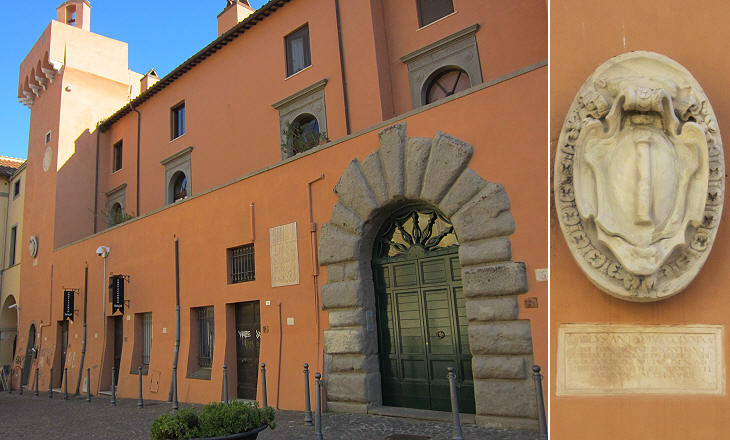
(left) Palazzo Orsini Colonna; (right) coat of arms of Marcantonio II Colonna
In 1426 the Colonna acquired the fiefdom of Nettuno and retained it until 1596 with the exception of short intervals in 1501-1503 when Pope Alexander VI confiscated the possessions of the Colonna and in 1556-1559 when Pope Paul IV did the same. In 1569 Marcantonio II Colonna enlarged the family palace and strengthened its fortifications.
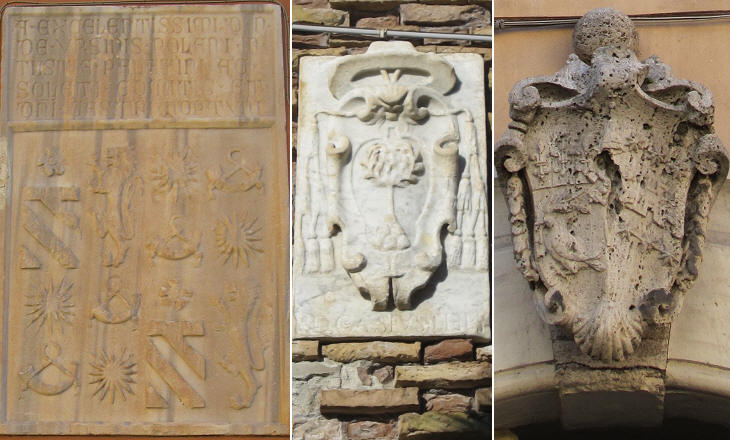
(left) Palazzo Orsini Colonna: heraldic symbols of the Orsini together with heraldic symbols of other fiefdoms which belonged to Nicola Orsini
di Nola (1331-1399); (centre) coat of arms of Cardinal Pier Donato Cesi on the bastion built by Pope Urban VIII;
(right) coat of arms of Prince Camillo Pamphilj, nephew of Pope Innocent X, and his wife Olimpia Aldobrandini
above the entrance to Palazzo Pamphilj
Prior to the Colonna, Nettuno belonged to a Neapolitan branch of the Orsini; Nicola Orsini supported Cardinal Gil Alvarez de Albornoz in restoring papal authority in Italy. In 1596 the Colonna sold their fiefdom to the state; soon after the Cesi, a family with several possessions in Umbria, built a small casino with a view of the beach and promoted the construction of a bastion at the eastern end of the town; their property was bought by the Pamphilj who enlarged it and retained it until 1834 when they sold it to the Borghese.
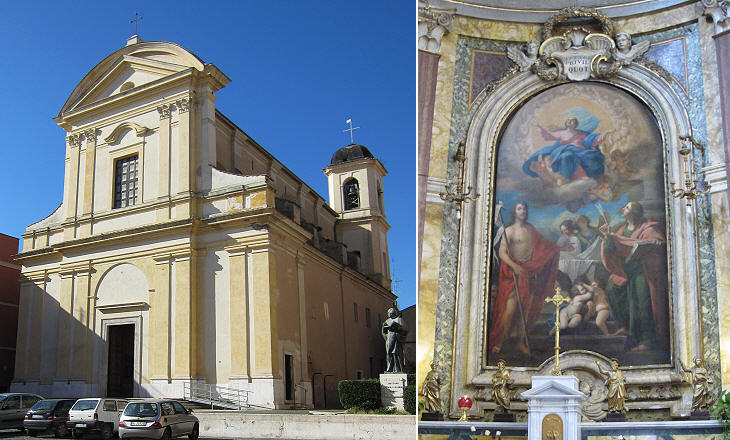
(left) Chiesa Collegiata; (right) painting on the main altar by Vincenzo Strigelli
At the beginning of the XVIIIth century many important Roman families built villas between Nettuno and Anzio; among them the Corsini, the family of Pope Clement XII, who in 1738 promoted the construction of a new large church which replaced a medieval one; it was designed by Carlo Marchionni, but during the construction some expensive details were omitted.
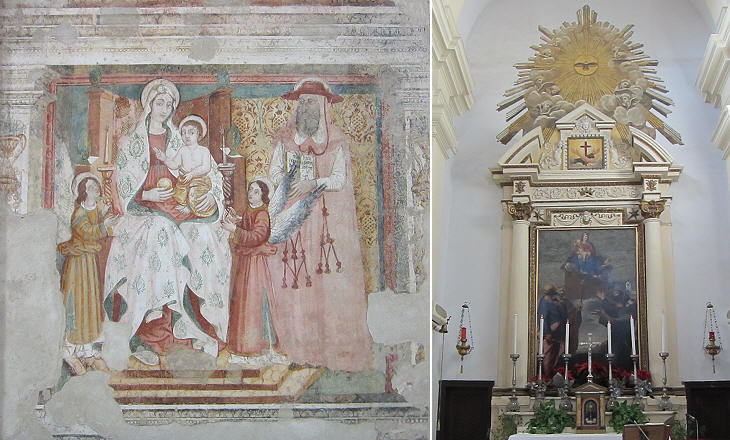
S. Francesco d'Assisi: (left) XVth century fresco by Maestro Petrus; (right) main altar by Andrea Sacchi
Interesting paintings can be found at S. Francesco, a small church immediately outside the fortified town.
After having confiscated Nettuno, Pope Alexander VI and his son Valentino Borgia ordered the construction of a state-of-the-art fortress near the walled town, but not adjoining it; the design of the fortress is attributed to Antonio da Sangallo the Elder, who designed fortresses for the Pope at Nepi and Civita Castellana and who strengthened Castel Sant'Angelo. The construction of the fortress was justified by the increased threat of Ottoman corsair raids; in that same period and for the same reason a fortress was built at a small burg near ancient Ostia.
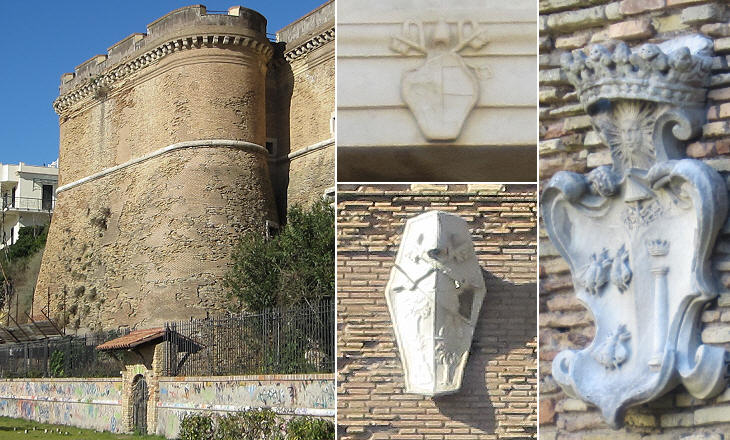
(left) Detail of Forte Sangallo; (centre-above) coat of arms of Pope Alexander VI; (centre-below)
coat of arms of Pope Alexander VII; (right) coat of arms of the Barberini Colonna
(the radiant sun is a heraldic symbol of the Barberini,
the family of Pope Urban VIII)
Several coats of arms show the interest of the popes in strengthening this fortress; the image used as background for this page shows the coat of arms of Pope Alexander VI.
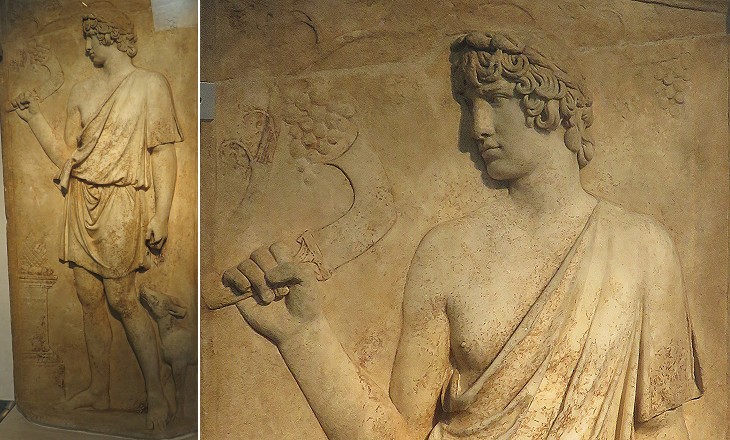
Museo Nazionale Romano - Palazzo Massimo - Rome: relief portraying Antinous, Hadrian's favourite, as Silvanus,
Roman god of wood and flocks, by Antonianos of Afrodisias
(found at Torre del Padiglione between Nettuno and Lanuvio - IInd century AD - see some inscriptions related to Silvanus which were found in Rome)
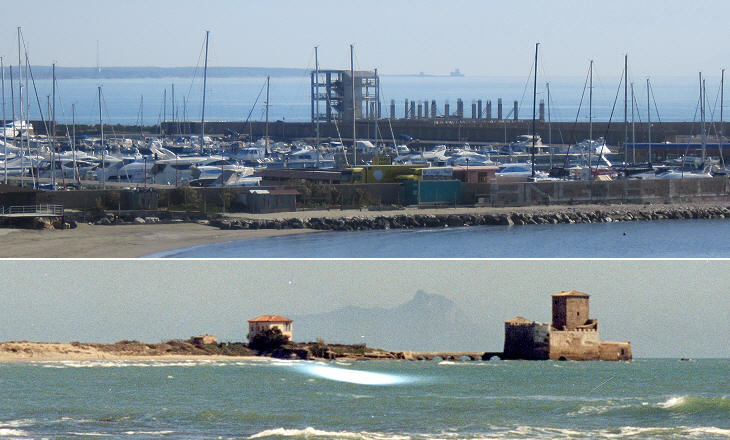
(above) View of Torre Astura from Nettuno (in the foreground the modern marina of the town); (below) Torre Astura and behind it Monte Circello (Circeo), the assumed home of sorceress Circe
where Ulysses stayed for one year
The name of Torre Astura is associated with Conradin of Swabia, the last of the Hohenstaufen.
In 1267, at the age of fifteen, Conradin tried
to regain control of southern Italy, which his uncle Manfred had lost in 1266, after having been defeated at Benevento
by Charles of Anjou.
Conradin, with limited resources from Germany and a few very
young followers stayed for a while in northern Italy
until Pisa provided him with support for his attempt.
Conradin entered Rome, abandoned by Pope Clement IV who preferred to stay in safer
Viterbo, and he received some additional help from powerful Roman families; in August 1268, near
Tagliacozzo in the Abruzzo region, his army initially defeated the Angevins of King Charles; Conradin dispersed his forces to follow the fugitives, but Charles kept a group of cavalrymen as a reserve and threw them onto the battlefield at this point and won the battle.
Conradin managed to escape, reached Rome and
tried to go back to Pisa by sea: in this attempt he came to Torre Astura, a small castle of the Frangipane, then a very important Roman family.
Giovanni Frangipane at first was inclined to help Conradin, but the emissaries of Charles
reached him and, after a few days of uncertainty, he handed over Conradin and his
young friends to their enemy.
On October 29, after a mock trial, Conradin was beheaded in Naples; he was buried there in S. Maria del Carmine; because of his death at such a young age Conradin became an icon of the German nation; in 1847 a monument based on a project by Bertel Thorvaldsen was erected in this Neapolitan church by Maximilian, crown prince of Bavaria.
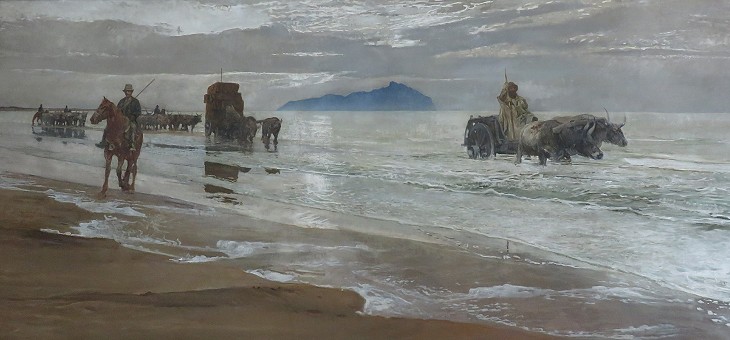
Giulio Aristide Sartorio - Mount Circeo (early XXth century) - Accademia di S. Luca at Palazzo Carpegna
On the right the green plain stretches down to the sea where Cape Circello lifts itself, now a promontory, but formerly Circe's Island, where tradition lands Ulysses. As I went along, the mists, which began to dissipate, floated over the green extent where the canals shone like linen on a bleaching-ground. (..) I met a peasant, whose pale, yellow, sickly exterior contradicted the vigorous fertility which the marshes presented. Like a dead man arisen from the grave, he rode upon his black horse, and held a sort of lance in his hand with which he drove together the buffaloes which went into the swampy mire.
Hans Christian Andersen - The Improvisatore - 1845
All sign of civilized life ceases with Nettuno, for immediately behind the town begins the Pontine wilderness. The brushwood
extends from this to Terracina. Not a single human dwelling exists
again upon the coast, only solitary towers rise out of the romantic solitude, at distances of about two miles from one another. The melancholy desolation of this shore and the impressiveness of its time-honoured
solitude is great. One feels as if one were no longer on the classic
shore of Italy, one seems to be wandering on the wild coasts of the Indian America. The constant murmur of the sighing sea-waves, the
summer breeze breathing over the ever-smooth, ever-white-sanded
shore, the endless deep green wood, which follows the sea on and on at
a hundred paces distant, the shrill cry of the hawks and falcons, the quiet
and high-hovering eagle, the stamping and bellowing of the herds of
wild cattle, air, colour, sound, every existence and element is in unison
with the most entire impression of an old-world wilderness. Gregorovius
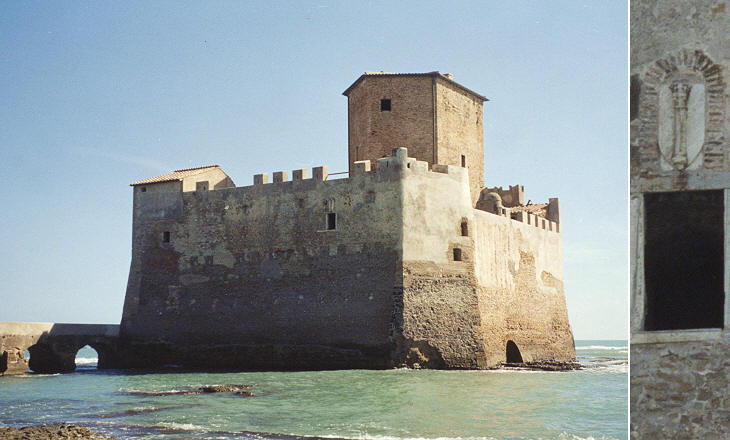
(left) Torre Astura; (right) coat of arms of the Colonna
Torre Astura is very small: the tower goes back to the XIIIth century, the outer walls were built by the Colonna in the XVIth century; it rests on the ruins of an ancient Roman villa which are in part below the current sea level (Cicero had a villa in this location).
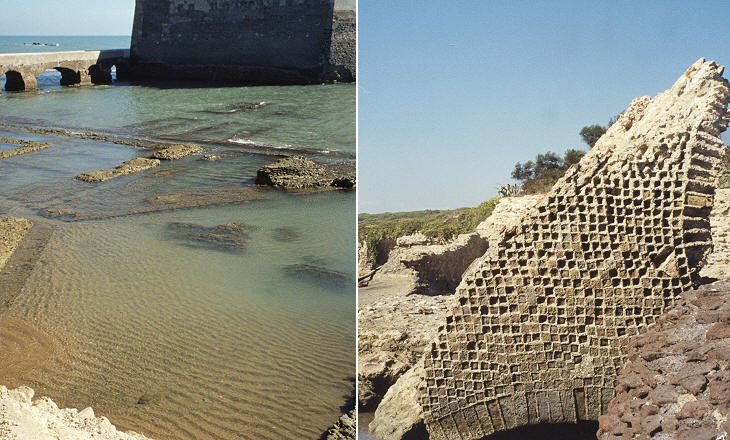
Ruins of a Roman villa
Gregorovius and his friend moved along the beach towards Torre Astura; in his account of the visit to Torre Astura Gregorovius quoted Philip Schaff's History of the Christian Church: The fate of young Conradin was not forgotten. Three centuries later it played its part in the memories of the German nation, and through
the pictures of his execution distributed in Martin Luther's writings contributed
to strengthen the hand of the Protestant Reformer in his struggle with the papacy,
which did not fail.
The fate of Conradin inspired many poets, including Dante; here below two XIXth century poems dedicated to the young Emperor.
|
CORRADINO DI SVEVIA by Aleardo Aleardi (1856) Mutiam dolore. Sull'estremo lembo De la cerulea baia, ove i fastosi Avi oziar nei placidi manieri, Ermo, bruno, sinistro èvvi un castello. Quando il corsaro fe' quest'acque infami, La paura lo eresse. Ivi da lunghi Anni una fila d'augurosi corvi É condannata a cingere volando Ogni mattin le torri: ivi sui merli, Fingendo il suono di cadente scure, La più flebile fischia ala di vento: Ivi pare di sangue incolorata L'onda che sempre ne corrode il fondo: Poi che una sera sul perfido ponte, A consumar un'opera di sangue, In sembianza di blando ospite stette Il Tradimento. Vuoi saperne il nome? O fida come il sol, tu che non sai Che sia tradire, deh! sègnati in prima Col segno de la croce, Itala mia. È il Castello d'Astura. Un giovinetto Pallido, e bello, con la chioma d'oro, Con la pupilla del color del mare, Con un viso gentil da sventurato, Toccò la sponda dopo il lungo e mesto Remigar de la fuga. Aveva la sveva Stella d'argento sul cimiero azzuro, Aveva l'aquila sveva in sul mantello; E quantunque affidar non lo dovesse, Corradino di Svevia era il suo nome. Il nipote a' superbi imperatori Perseguito venìa limosinando Una sola di sonno ora quieta. E qui nel sonno ei fu tradito; e quivi Per quanto affaticato occhio si posi, Non trova mai da quella notte il sonno. La più bella città de le marine Vide fremendo fluttuar un velo Funereo su la piazza: e una bipenne Calar sul ceppo, ove posava un capo Con la pupilla del color del mare, Pallido, altero, e con la chioma d'oro. E vide un guanto trasvolar dal palco Sulla livida folla; e non fu scorto Chi 'l raccogliesse. Ma nel dì segnato Che da le torri sicule tonaro Come Arcangeli i Vespri ei fu veduto Allor quel guanto, quasi mano viva, Ghermir la fune che sonò l'appello Dei beffardi Angioini innanzi a Dio. Come dilegua una cadente stella, Mutò zona lo svevo astro e disparve. E gemendo l'avita aquila volse Per morire al natìo Reno le piume; Ma sul Reno era un castello, E sul freddo verone era una madre, Che lagrimava nell'attesa amara: - Nobile augello che volando vai, Se vieni da la dolce itala terra, Dimmi, ài veduto il figlio mio?- -Lo vidi; Era biondo, era bianco, era beato, Sotto l'arco d'un tempio era sepolto.- | CONRADIN VON SCHWABEN (Nach der Chronik der Hohenstaufen. S. 492. by Ludwig Achim von Arnim) Als Conradin zu Jahren kam, Ein schnelle Sach sich bald vernahm, Er wollt sich männlich halten, Alle Erbländer nehmen ein, Die von den Aeltern eigen sein, Die wollt er frey verwalten. Daß er sie frey und eigen hätt Um Kriegsvolk thät er schreiben Im Königreich, Fürstenthüm und Städt, Da sollt niemand ausbleiben, Sondern ihm treuen Beystand thun, Bis er ein Heer zusammenbracht, Hat er kein Rast und konnt nicht ruhn. Als nun Papst Clemens solches vernahm, Der Sache bald zuvor auch kam, Thät auch ein Kriegsheer verschreiben. Und schrieb dem Grafen Karl gleich, Dem Bruder des Königs in Frankenreich, Er sollte nicht ausbleiben, Sondern Konrad wehren thun, Und alle Päß verlegen. Graf Karl thäts alsbald nun, Er zog ihm straks entgegen, Und machte durch Verrätherey, Daß er Neapel genommen ein, Eh Conradin noch kam herbey. Karl der schicket aus gar viel Verräther in geheimer Still, Sie sollten Sperl einnehmen, Denn Karl ließ gar viel darauf gehn, In Papstes Namen ists geschehn, Den Conradin zu dämmen; Der Papst verhieß ihm grosses Gut, Wenn er ihn möcht bestreiten, Derhalben hielt er gute Hut, Er ließ groß Gut erbiethen, So die Verrätherey gemacht, Die Steg und Weg daselbst er wußt, Da rückt er bey in tiefer Nacht. Conradin mit seinem Heer Auf die Nacht da einkehrt. Zu Morgens wollt er rücken Ja ins Königreich Neapel ein! Ließ ausrufen mit heller Stimm, Sein Red wollt er nicht zucken, Eh müß ihm drauf gehn Leib und Gut, Er wolle es drauf setzen! - Die Landsknecht sind nun wohlgemuth: Die Reis' soll uns ergötzen! Sie konnten sich nicht rüsten mehr, Hineinzurücken in das Land, Als schon der Feind vorhanden wär. Nun höret zu, wie es ergieng, Als sich der Schimpf mit Ernst anfieng, Die Schanz ward hastlich übersehen. Conradin hat gesiegt im Anfang, Da über die Beut die Ordnung sank, Da war der Schaden geschehen, Sie waren übereilet schon Von ihrem Gegentheile, Deshalb empfingen bösen Lohn, Ihre Haut war ihnen feile, Der Vortheil übergeben ward, Das Spiel, das war verloren schon, Vermißt ward ihnen hier die Kron. Es kostet manchen stolzen Mann, Der seine Haut wollt rücken dran, Zu retten seinen Herren, Und ihm ein treuen Beystand thun In Nöthen gänzlich nicht verloren, Mit Tapferkeit zu wehren. Es konnt damit doch nichts mehr seyn, Sie waren überlänget, Der Feind drang bald auf sie herein, Daß sie wurden zerdränget, Noch dennoch war ihr Herz so gut, Eh einer seinen Herrn lassen wollt, Vergossen sie ihr eigen Blut. O Jammer über Jammersnoth, Wie viel der Kriegsleut blieben todt, Noch dennoch ward gefangen Ihr Herr, für den sie Gut und Blut Daran gesetzt aus freyem Muth, Der must nun von hindannen Mit einem Herzog zu Oesterreich, Friedrich ward er genennet, Sie wurden beyd hinweg zugleich Geführet unzertrennet, In die Hauptstadt, die ward genannt Neapel von dem Königreich, Gefangen sassens in ihrem Land. Als Conradin gefangen war, Wurd er gehalten grausam hart, Mit samt dem Herzog Friedrich, Verspottet, jämmerlich traktirt, Zu einem Schauspiel umgeführt, Und was man konnt erdichten. - Den vorgen Tag der Held ging zu Durch Berg und Thal mit glänzendem Heer; Der Papst hat weder Rast noch Ruh, Vor Neid konnt er nicht warten mehr, Aus eitel Gift und grimmen Zorn Gab er Befehl, daß man sollt schnell Mit ihnen zum Gericht fortfahrn. Man führt herfür die Fürsten beyd, Wer hat gesehen solches Leid Bey Denken aller Zeiten, Da auf die Wahlstadt, die da war Bereitet ihnen also baar, Oeffentlich vor allen Leuten, Man schlug ihnen beiden ihr Häupter ab, Da war gar kein Erbarmen, Es must daran der junge Knab Mit seinen schneeweissen Armen, Als er alt war sechzehen Jahr, Durch den Papst Clemens den vierten Ist das geschehen offenbar. |
Next page (in Giuseppe Vasi's Environs of Rome): Ostia, città antichissima
Introductory page on Ferdinand Gregorovius
Other walks:
Roman Campagna: Colonna and Zagarolo. Palestrina, Cave, Genazzano, Olevano, Paliano and Anagni.
The Ernici Mountains: Ferentino, Frosinone and Alatri; Fiuggi (Anticoli di Campagna); Piglio and Acuto
The Volsci Mountains: Valmontone, Segni, Norma and Cori
Circe's Cape: Terracina and San Felice
The Orsini Castle in Bracciano
Subiaco, the oldest Benedictine monastery
Small towns near Subiaco: Cervara, Rocca Canterano, Trevi and Filettino.
Excerpts from Giuseppe Vasi 1761 Itinerary related to this page:
Giuseppe Vasi
|


