
All images © by Roberto Piperno, owner of the domain. Write to romapip@quipo.it.


Notes:
Page revised in June 2020.
All images © by Roberto Piperno, owner of the domain. Write to romapip@quipo.it.
Notes:
Page revised in June 2020.
 Piazza di Pescaria
Links to this page can be found in Book 2, Day 5, View C8 and Rione Sant'Angelo.
The page covers:
The plate by Giuseppe Vasi
Today's view
La Pescheria and S. Andrea dei Pescivendoli
Portico di Ottavia
S. Angelo in Pescheria
S. Ambrogio alla Massima
Casa dei Vallati e Albergo della Catena
Case dei Fabi in Vico di Pescaria

This small 1752 etching by Giuseppe Vasi had three features which attracted the interest of prospective foreign buyers. It depicted: a) Portico di Ottavia, a monument of Ancient Rome which was associated with Emperor Augustus, b) the Dome of S. Maria in Campitelli, a XVIIth century church, and c) a scene of ordinary Roman life because it showed the fish market of Rome. Pesce means fish hence pescaria, today pescheria, means fish shop/market.
The view is taken from the green dot in the small 1748 map here below (near one of the gates of the Jewish Ghetto).
In the description below the plate Vasi made reference to: 1) Ancient Portico;
2) S. Angelo; 3) Vico (narrow street) di Pescaria; 4) Dome of S. Maria in Campitelli. 4) is shown in another page.
The small map shows also: 5) S. Andrea dei Pescivendoli; 6) S. Ambrogio della Massima; 7) Casa dei Vallati; 8) Albergo della Catena; 9) Casa dei Fabi.


The view in February 2018 (the portico is shown also in the image used as background for this page)
In the late XIXth century the fish market was moved to another location and the whole area was redesigned in conjunction with the construction of high walls on the river banks. Portico di Ottavia was freed from the houses to its left and in recent times its foundations were brought to light and a passage leading to Teatro di Marcello was opened. You may wish to see some late XIXth century drawings depicting the fish market.

Musei Capitolini: 1581 inscription from Piazza di Pescheria stating that the heads of the fish which exceeded the size of the relief were to be given to the Conservatori, i.e. to the Municipality of Rome
No want of fish either of fresh or salt water,
though it be sold commonly dearer than flesh, as being brought a great way. Scarce any fish to be found
any where on the coast of Italy but some time or
other it may be met withal heer. Those that are the
most frequent in the markets are, of River or Fresh-water fish, Pike, Carp, Tench, Trout, Eel, Barbie,
Chevin, Dace. I do not remember that I ever saw a
Perch to be sold in Rome. Of Sea-fish, Mullus antiquorum, which they call Triglia, of which they have a
Proverb, La Triglia non mangia chi la piglia. He
that takes the Triglia eats it not. This fish the French
call Rouge from its colour and we in Cornwal
(where I have seen of them taken) Surmullet. Spigole, in Latin Lupus marinus, of which kind I have
not seen any in England; Orate, Giltheads; Cephali,
which we in English call Mullet, the ancients called it Mugil; Sarde, a kind of Sprat; Conger; Lamprey; Sole; Plaise and others of the flat kind; Merluzzos, which we call Hake; sometimes small sturgeons; Dog-fish of several sorts; Tuny and
Sword-fish is also to be sold heer.
John Ray - Observations (..) made in a journey through part of (..) Italy in 1663
The fish depicted in the relief is a sea sturgeon. It was caught in May/June when it entered the river to breed. It was called Lupus Tiberinus (Tiber Wolf) by the ancient Romans and it could reach a remarkable size. The head was regarded as a delicacy for making a really good fish soup.
Maybe the fishmongers who worked at the market resented this sort of taxation, but they could not complain about the artistic way they were notified about it. This duty was abolished in 1798.

(left) Columns of Portico di Ottavia and S. Andrea dei Pescivendoli; (right) detail of its portal
In 1689 Università dei Pescivendoli, the guild of the fishmongers, decorated a small oratory and dedicated it to St. Andrew, who was a fisherman by trade (see a list of churches belonging to a guild). A fine stucco relief above the portal portrays St. Andrew: in line with the traditional iconography the saint bears his cross, but he seems more interested in watching the symbols of his trade. Today the oratory houses a gift shop.

(above) Part of the inscription celebrating Emperor Septimius Severus and his son Caracalla for a restoration after a fire (incendio); (below-left) a restoration of the Vth/VIth century where ancient materials were reused; (below-centre) a relief perhaps depicting a "caduceus", a symbol of Mercury; (below-right) fresco perhaps depicting the coat of arms of a cardinal; see another detail of the portico in the historical section
The portico was initially built in the IInd century BC to surround two existing temples to Jupiter and Juno. It was rebuilt by Augustus who dedicated it to his sister Ottavia (the nearby theatre was dedicated to Marcellus, Ottavia's son). It was restored by Emperor Septimius Severus in 203 AD. The area of the portico included today's Piazza di Campitelli and it ended near S. Caterina dei Funari. Parts of the portico and of the temples are still inside the houses which were built in the following centuries. You may wish to see Portico d'Ottavia in a 1588 Guide to Rome.

(left) Columns to the left of the main entrance and behind them a medieval building; (centre) columns to the right of the main entrance (in the background the three columns of Tempio di Apollo Sosiano); (right) capital of the temple dedicated to Juno (in Via S. Angelo in Pescheria - see an enlargement in the historical section)

(left) Lateral view of the entrance showing in the background Teatro di Marcello; (right) view showing
the difference in the ground level between the ancient Roman period and the XVIth century
The portico houses the XVIth century entrance to S. Angelo in Pescheria (aka S. Michele Arcangelo in Pescheria). The first church was built in the VIIIth century, but it was modified several times and in a particularly extensive way in the XIXth century.

(left) Interior; (right) Cappella del Crocifisso (XVIIIth century, but the statue of Jesus is dated XVIth century)
The interior was entirely redesigned in 1864 with the aim of eliminating some structural deficiencies of the building. The result of this intervention deprived the church of its original design and of many works of art. In addition the decorated ceiling collapsed in 1928.

(left) Cappella di S. Andrea dei Pescivendoli; (right) marble inlay with the coat of arms of the fishmongers. It depicts a deer, symbol of nobility, a dove, symbol of fecundity, a goose, symbol of fidelity and a sturgeon
Luckily the XIXth century changes did not impact on the chapel the fishmongers had inside the church. It was built between 1579 and 1619 and eventually a passage was opened between the chapel and the adjoining oratory.

(left) Portal of the nunnery; (centre) XVIIth century fountain making use of a sarcophagus; (right-above) detail of the bell tower; (right-below) detail of the sarcophagus
The nunnery of S. Ambrogio is located behind Portico d'Ottavia and part of it is today used for other purposes. The fine 1626 portal built at the expense of Abbess Beatrice de Torres, sister of Cardinal Ludovico de Torres, Archbishop of Monreale, leads to a small warehouse of the municipal street cleansing services; torre means tower and the Abbess placed a small tower on the top of the bell tower. The Torres had a palace in Piazza Navona and they restored S. Pancrazio. A gate on the left leads to a courtyard with a small fountain and to the church.

(left) Interior; (right-above) marble altar from a church in Liguria; (right-below) detail of a marble altar bequeathed by the Barberini family
The church, although largely modernized, retains some interesting memories of its past and in particular some finely decorated altars.

Casa dei Vallati after its 1930s restoration; (inset) inscription on the lintel of the portal. It is a quotation from Terence, Andria, II, 1, 6: "(Quoniam id fieri quod vis non potest) id velis quod possis" i.e. (As you can not do what you wish,) you should wish what you can do
The plate shows on the right side a rather anonymous building. In 1930 it was partially demolished to highlight its original design. It belonged to the Vallati (or Vailati) family and it consisted of two houses of different periods (left XVIth century - right XIVth century).

Medieval, modern and ancient Rome: (left to right) Albergo della Catena, S. Rita da Cascia and Tempio di Apollo Sosiano
In 1926-931 the excavation of the area between Portico d'Ottavia and Teatro di Marcello isolated two medieval buildings. They housed Albergo della Catena, an inn for the merchants who came from the countryside to do business in nearby Piazza Montanara. It was named after a chain which blocked the passage to carriages in the small street which led to the inn.

In Rome things to see come (left/centre) .... and go (right). In 2015 an unassuming house behind Albergo della Catena was given a temporary fake XVIIth century decoration for the shooting of a movie (you may wish to see a page on Cinecittà, the movie studios of Rome)
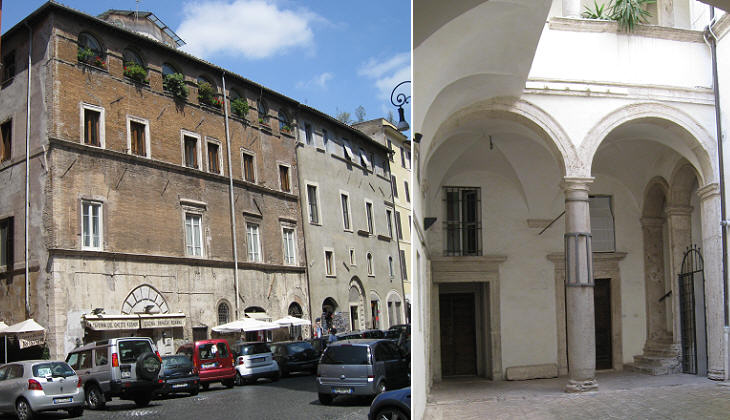
(left) Case dei Fabi; (right) courtyard of N. 13
Vico di Pescaria was a very narrow street leading to Piazza Giudia; in the general redesign of the area it was enlarged by pulling down its southern side and it is now called Via del Portico d'Ottavia. Its northern side has some interesting Renaissance buildings. A recent restoration has given emphasis to the original architectural design of two houses belonging to the Fabi, who pretended to descend from the Gens Fabia, an important family in Ancient Rome during the Republic (see an inscription found at Sagunto). The buildings were embellished by loggias, which were closed at a later stage to obtain some more rooms.
Next plate in Book 2: Piazza Giudia.
Next step in Day 5 itinerary: Piazza Montanara.
Next step in your tour of Rione Sant'Angelo: Teatro di Marcello.
Excerpts from Giuseppe Vasi 1761 Itinerary related to this page:
Chiesa di s. Michele Arcangelo in PescheriaLe anticaglie, che qui si vedono, sono credute del portico di Giunone, il quale essendosi abbruciato, fu ristaurato da Settimio Severo, Marco Aurelio, e Antonino Pio; ora per il sito basso, ed umido quì fa capo ogni sorta di pesce, e poi si sparge all'altre piazze. La chiesa di san Michele Arcangelo, che si vede fra quelle rovine, fu eretta da Bonifazio II., e fu detta in Summo Circi, cioè come spiegano, in capite Circi Flaminii, la quale poi per la demolizione del Circo rimasta desolata, fu riedificata quivi forse da Stefano III. che fu nell'anno 752. il quale l'arricchì di alcuni corpi di ss. Martiri levati da una chiesa, che era sulla strada di Tivoli, e furono li ss. Getulio, e Sinforosa sua moglie con sette loro figliuoli, e però si vedono in essa più memorie antiche, che ornamenti moderni.Chiesa e Monastero di s. Ambrogio della MassimaEntrando poi nel vicolo accanto alla fontana, che sembra non aver riuscita, si trova questa antichissima chiesa insieme col monastero delle monache Benedettine. Fu già quivi un'antica chiesa dedicata a s. Stefano, ed appresso fuvvi la casa di s. Ambrogio arcivescovo di Milano, la quale essendo dalla sua sorella ridotta in forma di monastero, lo fece poi erede di tutto il suo avere. Indi Celestino I. nell' anno 432. avendo avuto nuova, che il Concilio Efesino aveva dichiarato, che la ss. Vergine era Madre di Dio, aggiunse alla salutazione Angelica quelle parole: Santa Maria Mater Dei, ed in onore di lei edificò alcune chiese, fra le quali fece questa di nuovo, e la dedicò alla ss. Vergine Madre di Dio, e fu detta in Ambrogio. L'anno poi 1606. fu nuovamente fatta da D. Beatrice Torres coll'ajuto però del Cardinale suo fratello Arcivescovo di Monreale, e fu ornata di belli altari con pitture, e marmi. La statua di s. Ambrogio nel primo altare a destra è di Orfeo Rufelli fatta sul modello di Francesco Fiammingo; la deposizione dalla Croce nell'altare, che siegue è del Romanelli, e il quadro sull'altare maggiore, di Ciro Ferri. Le pitture nella volta sono del Cozza, e quelle nella cappella della Madonna, del Cav. d'Arpino; il s. Stefano però nell'ultima cappella è opera insigne di Pietro da Cortona. Credono queste monache di avere nella loro chiesa il corpo di santa Candida; ma non sanno poi se da Cartagine fosse qui portato, o se ella venne a morire in questo monastero. |


