
All images © by Roberto Piperno, owner of the domain. Write to romapip@quipo.it.


Notes:
Page revised in July 2020.
All images © by Roberto Piperno, owner of the domain. Write to romapip@quipo.it.
Notes:
Page revised in July 2020.
 Casino al Pigneto del Marchese Sacchetti
Links to this page can be found in Book 10, Day 8 and View C1.
The page covers:
The plate by Giuseppe Vasi
Today's view
Casino al Pigneto
Monte dei Ciocci (Ciocchi)

This 1760 etching by Giuseppe Vasi shows the second architectural work (1625-1630) by Pietro da Cortona who was chiefly a painter;
the view is based on drawings by Cortona because when Vasi visited the site the roofs had collapsed,
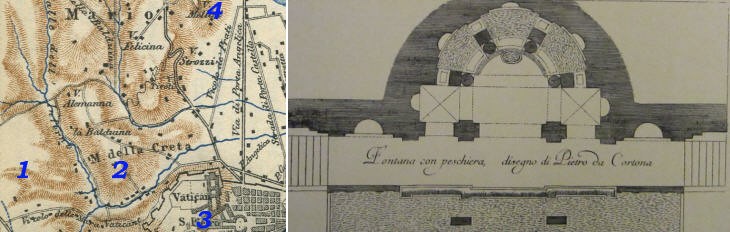
the staircases were barely identifiable in the rubble and the fountains were dry; Vasi added a technical drawing of the main fountain to the plate.
Pigneto means pinewood and the etching shows the casino surrounded by pine trees;
its location was rather remote, at the end of Valle dell'Inferno, a depression between the Vatican and Monte Mario; its name means Hell's Valley, but it is a corruption of vallis infera (low valley).
The small late XIXth century map below shows; 1) site of Casino Sacchetti; 2) Monte dei Ciocci; 3) S. Pietro; 4) Villa Mellini (Monte Mario). 3) and 4) are covered in other pages.
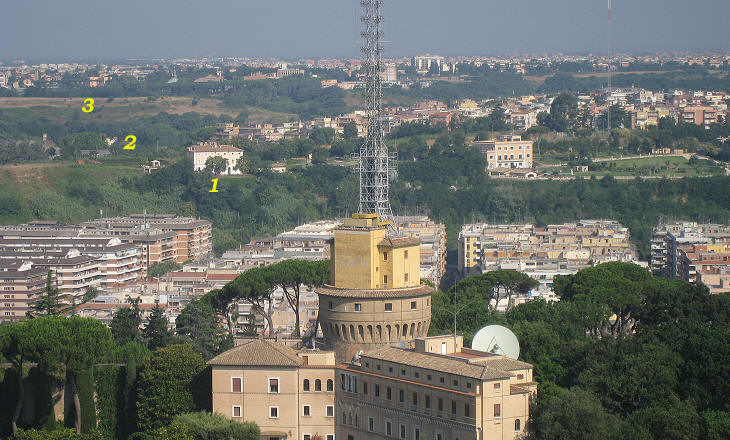
View from the dome of S. Pietro in July 2010: in the foreground the Vatican Gardens and the broadcasting equipment of the Vatican Radio: 1) Monte dei Ciocci; 2) Valle dell'Inferno; 3) site of the Sacchetti property
The development of modern Rome has not completely obliterated the countryside aspect of the area between the Vatican and the site of Casino Sacchetti; the ruins of the building were removed after 1861 when the property was bought by the Torlonia.
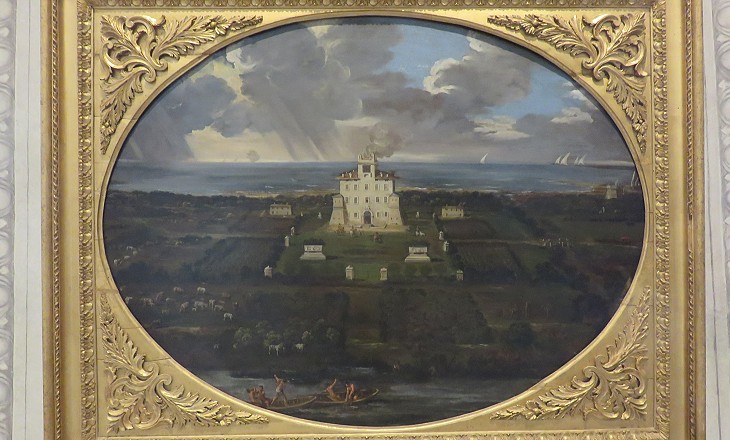
Galleria Nazionale d'Arte Antica a Palazzo Barberini: Villa Sacchetti at Castelfusano by Pietro da Cortona
The design of the Villa al Pigneto followed that of a villa at Castelfusano, on the site of today's Lido di Ostia and along the ancient Via Severiana, the first architectural work by Pietro da Cortona. Because of its proximity to the coast this building had the aspect of a small fortress. We know that its construction was supervised by Bernardino Radi, who was in charge of the fortifications of Civitavecchia.
On the basis of drawings and etchings Rudolf Wittkower noted:The interplay of convex and concave forms in the same building, foreshadowed (..) in Cortona's Villa Sacchetti al Pigneto, is a typically
Roman High Baroque theme which also fascinated Borromini and Bernini. Art and Architecture in Italy - 1600-1750 - Penguin Books 1958

Casali Torlonia (other stone pines can be seen in the image used as background for this page); (inset) coat of arms of the Torlonia
Casino al Pigneto was commissioned by Giulio Sacchetti at the time of his appointment as cardinal because the
property of a countryside villa was regarded as necessary for a man in that position; he also bought the palace named after him in via Giulia; this building had a garden along the river which was decorated with fountains in 1660; it is possible that the family lost interest in their remote villa and preferred to entertain their guests in the city palace. It appears that the casino was completely abandoned after the death in 1705 of Cardinal Urbano Sacchetti, nephew of Giulio.
In 1861 the vast estate was bought by the Torlonia, who almost surrounded Rome with their properties; they restored and placed their coats of arms on two existing buildings; one of them is falling apart, while the other one was in recent years turned into a public library.

(above) View towards S. Pietro; (below) view towards Monte Mario (in the inset Villa Mellini)
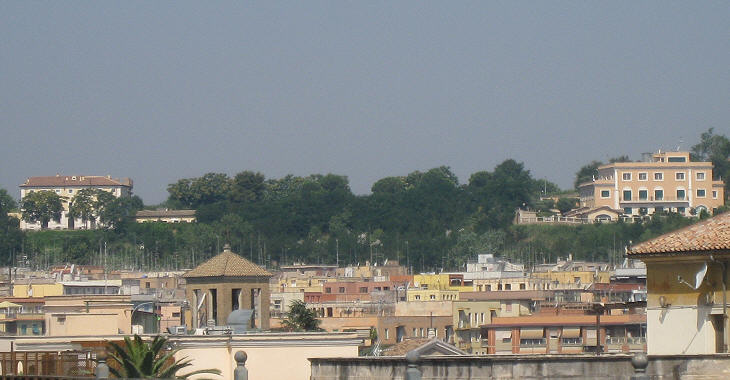
Monte dei Ciocci seen from Casino di Belvedere: (left) Casale Ciocci; (right) Villa Bini - Les Aigles
The name of this small hill and of Casale Ciocci, a former farmhouse, are a corruption of Ciocchi (It. chi = kee; It. ci = tchee) del Monte, the family of Pope Julius III to whom the area belonged in the XVIth century; the hill was spared intensive development because it houses an agricultural high school. Also the nearby posh neighbourhood of Balduina owes its name to the Ciocchi del Monte.
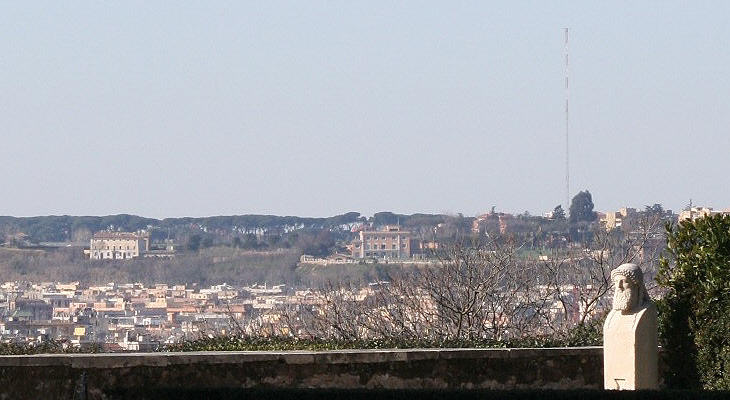
Monte dei Ciocci seen from Villa Medici (courtesy Marie Engel)
Next plate in Book 10: Villa Madama fuori Porta Angelica.
Next step in Day 8 itinerary: Chiesa di S. Maria del Rosario.
Excerpts from Giuseppe Vasi 1761 Itinerary related to this page:
Casino SacchettiÈ vero, che troppo lungo è il cammino per trovare le rovine di questo magnifico casino eretto dal Card. Giulio Sacchetti, ma essendo stato questo il primo disegno di architettura, che abbia fatto Pietro da Cortona, merita l'incomodo d'andare a vederlo, ancorchè sia quasi rovinato. Si ravvisa da quel poco, che vi è rimasto del prospetto, quale sia stato, e sotto il riposo di alcune scale si vede però ben conservato un fonte ornato di colonne doriche, disposte a guisa di portico sferico, come ne riportai la pianta. |


