
All images © by Roberto Piperno, owner of the domain. Write to romapip@quipo.it.


Notes:
Page added in October 2026.
All images © by Roberto Piperno, owner of the domain. Write to romapip@quipo.it.
Notes:
Page added in October 2026.
 The Strada Nuova
You may wish to see pages on Palazzo Ducale and on Palazzo del Principe first.
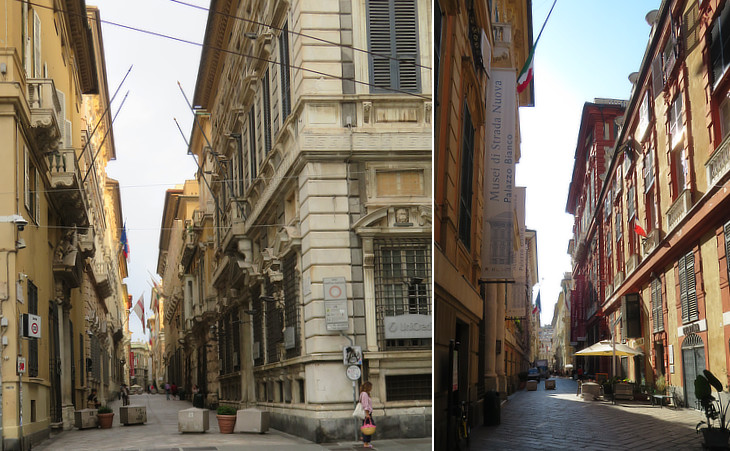
Strada Nuova (Via Garibaldi): (left) from its eastern end at Piazza delle Fontane Marose with Palazzo Agostino Pallavicino on its northern side;
(right) from its western end with Palazzo Bianco on its northern side
A famous and most celebrated architect, also, among others of the present day, is Galeazzo Alessi of Perugia
(see the dome he designed at Assisi). He was invited by the Genoese with much honour into the service of that Republic, for which the first work that he did was
to restore and fortify the port and the mole; nay rather, to make it almost entirely different from what it was before. (..)
The same Galeazzo has executed the new street of Genoa, with so many palaces built in the modern manner after his designs,
that many declare that in no other city of Italy is there to be found a street more magnificent and grand than that one, nor one more
full of the richest palaces, all built by those Signori with the persuasion and directions of Galeazzo, to whom all confess that they
owe a very great obligation, in that he has been the inventor and executor of works which render their city,
with regard to edifices, incomparably more grand and magnificent
than it was before.
Giorgio Vasari - Lives of the most eminent painters,
sculptors & architects - 1568 - transl. by De Vere
A little lower and within the wals, is the new streete, vulgarly
La strada Nuova, lying from the West to the North-east, each house whereof is built with Kingly magnificence, neither doe I thinke that any City in
the world hath so faire a streete. These houses or rather Pallaces may be seene by strangers,
for the Gentlemens servants keeping them, willingly shew them to any desiring that favour, as well in expectance of reward,
as for the honour of their Master and Countrey.
Fynes Moryson - An Itinerary: Containing His Ten Years Travel Through .. Italy (in 1594)
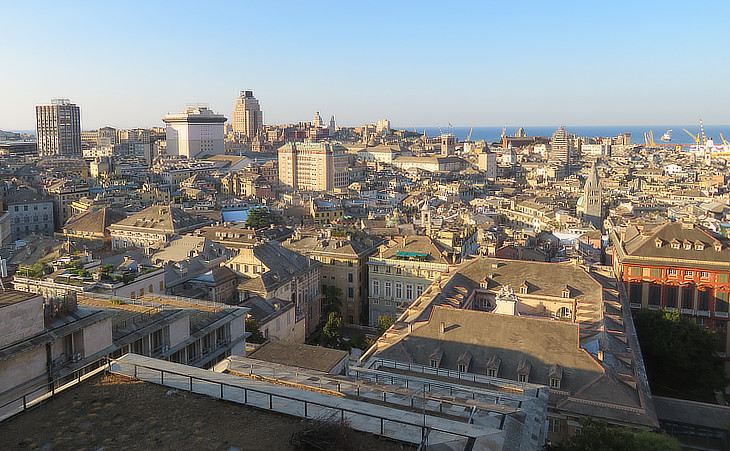
Strada Nuova with Palazzo Doria Tursi and Palazzo Rosso (Red) in the foreground seen from Castelletto
The endless details of these rich Palaces: the walls of some of them, within, alive with masterpieces by Vandyke!
The great, heavy, stone balconies, one above another, and tier over tier: with here and there, one larger than the rest, towering high up -
a huge marble platform; the doorless vestibules, massively-barred lower windows, immense public staircases, thick marble pillars,
strong dungeon-like arches, and dreary, echoing vaulted chambers: among which the eye wanders again, and again, and again, as every palace
is succeeded by another - the terrace gardens between house and house, with green arches of the vine, and groves of orange-trees and
blushing oleander in full bloom, twenty, thirty, forty, feet above the street.
Charles Dickens - Pictures from Italy - 1846
Genoa's great period of architectural development is the second half of the sixteenth
century. It was Galeazzo Alessi who created the Genoese palazzo type along the Strada Nuova, begun by him in 1551.
But to his contemporary Rocco
Lurago must be given pride of place for having recognized the architectural potentialities which the steeply rising ground of Genoa offered.
His Palazzo Doria Tursi in Via
Garibaldi (begun 1564) shows for the first time the long vista from the vestibule through the cortile to the staircase ascending at the end.
Rudolf Wittkower - Art and Architecture in Italy - 1600-1750.
The redesign of the urban layout during the XVIth century can be noticed also
at Rome where Strada Giulia, Strada Pia and
Strada Felice changed the landscape of the City.
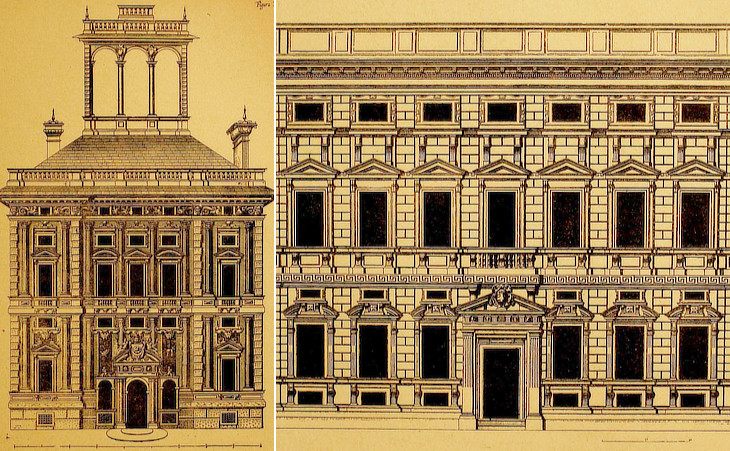
Engravings from "Palazzi di Genova", a 1622 book written and illustrated by Peter Paul Rubens: (left) Palazzo Enrico Salvago
(aka Baldassare Lomellino - see below); (right) Palazzo Agostino Pallavicino - see below
The Citty is built in the hollow or bosom of a mountaine, whose ascent is very steepe, high, and rocky, so that, from the Lantern and Mole to
the hill, it represents the shape of a theater; the streetes and buildings so ranged one above another as our seates are in play-houses;
but, from their materials, beauty, and structure, never was an artificial scene more beautiful to the eye, nor is any place, for the size of it,
so lull of well-design'd and stately palaces, as may be easily concluded by that rare booke in a large folio which the great virtuoso and paynter
Paul Rubens has published, tho' it contains the description of only one streete and 2 or 3 churches. (..) The famous Strada Nova, built wholly of polish'd marble, was
design'd by Rubens, and for statelinesse of the buildings, paving, and evennesse of the streete, is far superior to any in Europ, for the
number of houses; that of Don Carlo d'Orias is a most magnificent structure. In the gardens of the old Marquiss Spinola I saw huge
citrons hanging on the trees, apply d like our apricots to the walls.
John Evelyn's Diary and Correspondence related to his stay in Italy in 1644
"Palazzi di Genova" is the only book Rubens published himself (although he provided illustrations for a number of other books).
The first volume contained plans, facades and additional views of 12 of the palaces of Genoa; the second volume contained a further 19 palaces
and 4 churches. Rubens was an admirer of Italian architecture and thanks to his book and to the praise lavished by Vasari on Galeazzo Alessi
the Genoese style became very popular throughout Europe (and some travellers thought it was developed by Rubens himself).
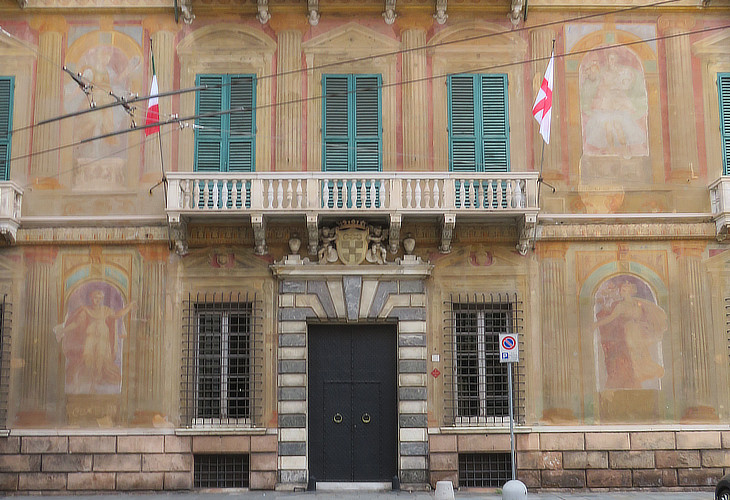
Piazza Fontane Marose: Palazzo Paolo e Niccolò Interiano (aka Palazzo Negroni)
The Strada Nuova opens into an irregular Place, called the Piazza delle Fontane Amorose, irregular in shape, but containing some fine buildings,
of which the principal are the Palazzo Negroni No. 24, a widespreading and noble front, where are some good pictures, relating to the great deeds
of the Negroni family, by Parodi.
John Murray - Handbook for travellers in Northern Italy - 1843
The piazza is named after a lost fountain with three arches from which
water spouted like a sea wave (It. maroso). It was an empty space until it was redesigned by Alessi who made it the starting point of Strada Nuova.
Palazzo Interiano provides the street with a coloured focal point.
The practice of painting the façades of
new buildings became very popular in the early XVIth century at Rome and elsewhere in Italy; it was generally based on the
graffito technique, but in the second half of the century also frescoes were used
(see a palace which retains its decoration). In Genoa it involved
architectural elements as well as depictions of persons or scenes.
The façade of Palazzo Interiano was painted by Lazzaro
Calvi who portrayed the Four Cardinal Virtues (Prudence, Temperance, Justice and Fortress).
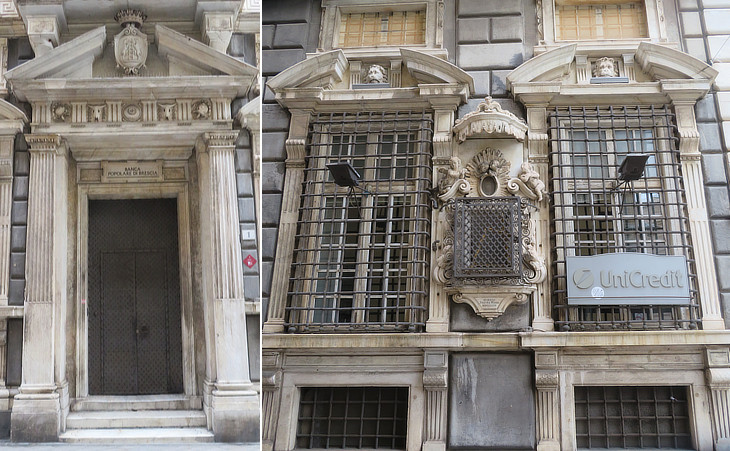
Palazzo Agostino Pallavicino: (left) portal; (right) windows
We observed many most stately and magnificent Pallaces, the worst of which might be sufficient to entertaine any great Prince,
which makes it to be noted that the Genovais take more delight in stately Buildings then any other Nations in the world, and which is
the cause that soe few of them travel abroad, in regard they think noe Citty comparable to Gennes, any Gentleman in this Citty counting
it almost a death to him, if he be banished out of it for a short tyme.
Francis Mortoft's Journal of his travels in France and Italy in 1659
The New Street answers the fame that goeth of it. It is but short,
consisting only of 8 or 10 Palaces, built of marble, very sumptuous and magnific, the meanest of them being able to receive and lodge the greatest
Prince and his Retinue.
John Ray's Observations (..) made in a journey through part of (..) Italy in 1663.
The Strada Nova here surpasseth all the streets I ever saw any where else for neatness and proportion; and, if it had but
'breath enough to hold out at the same rate a little longer, it would be the true Queen-Street of Europe: Ordinary houses are so out of
countenance here, that they dare not appear in this street; where here's nothing but Palaces, and Palaces as fine as art and cost,
or as Marble and Painting can make them.
Richard Lassels' The Voyage of Italy, or a Compleat Journey through Italy in ca 1668
The references made by many
travellers about the palaces being able to lodge a prince were based on actual facts. A Senate Decree of 1576 established that those built along the Strada Nuova were placed on an
official list (Rolli) of "public lodging house",
which meant that the owners were obliged to provide
accommodation to
distinguished guests, on behalf of the Republic. Later on the Rolli lists included palaces in other parts of Genoa. Today some palaces
house museums and public bodies, and they are open to the public
all year round, while those for private use are only partially open to visitors.
Palazzo Agostino Pallavicino was traditionally attributed to Alessi, but it is now thought to have been designed by
Bernardino Cantone, who is known to have worked with Alessi. Agostino Pallavicino was a very rich
man, but his family was not among the noblest ones, so he wanted his palace to symbolise his social status, thus all the
architectural elements of the building were made of ashlar stone. The rise of the Pallavicino in the Genoese society was testified to
by the appointment of
Cipriano Pallavicino as Archbishop of Genoa in 1567 and by his highly decorated funerary monument in the Cathedral.
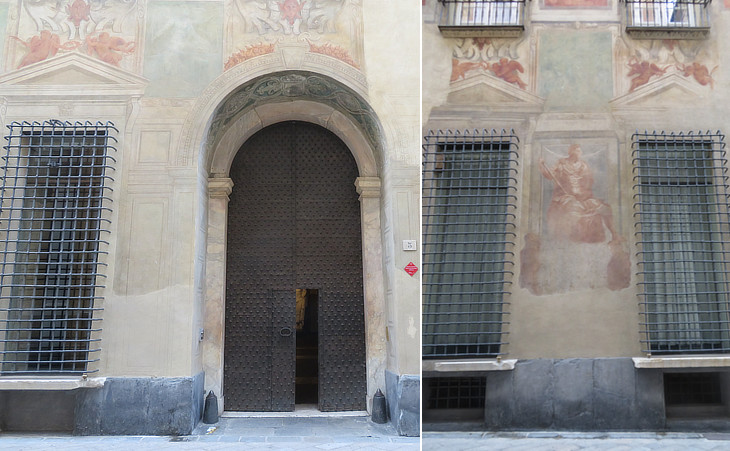
Palazzo Angelo Giovanni Spinola: (left) portal; (right) fresco portraying a Roman emperor
The new-street is a double range of palaces from one end to the other, built with an excellent fancy, and fit for the greatest princes to inhabit.
I cannot however be reconciled to their manner of painting several of the Genoese houses. Figures, perspectives, or pieces of history, are
certainly very ornamental, as they are drawn on many of the walls, that would otherwise look too naked and uniform without them:
But, instead of these, one often sees the front of a palace covered with painted pillars. If these were many true columns
of marble set in their proper architecture, they would certainly very much adorn the places where they stand; but as they are now, they only
shew us that there is something wanting, and that the palace, which without these counterfeit pillars would be beautiful in its kind, might
have been more perfect by the addition of such as are real.
Joseph Addison's Remarks on several parts of Italy, in the years 1701, 1702, 1703
The Town in general makes a
very fine Appearance, and the principal Palaces are extremely noble. The Strada Nuova consists almost all of such, being most of them all over
Marble, and the Architecture magnificent. Tis a great Disadvantage to them that the Street is excessively narrow. (..) The Painting the Outside-of
the Houses is very frequent; some with historical Subjects, or Landskape, Perspective, but many with Pillars, Cornices, and other Ornaments of
Architecture, representing such real ones as had been proper in their Place. Against these last an Objection has been made,
That it puts us in mind of something that is wanting. Tis true, the Reality is wanting, and would still be wanting, tho' other painted
Ornaments had been made there, rather than these: but, if any sort of Painting be allow'd, why not that which represents such Ornaments,
which, if real, had been of all others the most proper in its room? The Author Sir Addison. of this Objection is truly a great one but
this great City does likewise on her part demand so much Justice from the Traveller, (who cannot but be delighted with her Beauties) as to
oblige him to consider at least, whether such sort of Ornaments are indeed to be accounted so ill-judg'd or no.
Edward Wright Some observations made in travelling through France, Italy, &c. in 1720, 1721, and 1722
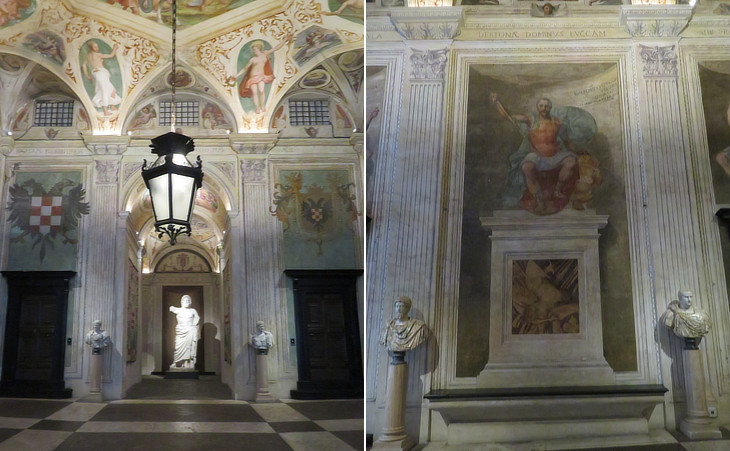
Palazzo Angelo Giovanni Spinola: (left) entrance hall; (right) fresco portraying Galeotto Spinola
The worn out façade hides a very well restored entrance hall leading to the garden. Its walls are decorated with coats of arms of the
Spinola which are held by the double-headed eagle of the Habsburgs.
Similar to what Andrea Doria had done at his suburban palace,
Angelo Giovanni Spinola and his son
Giulio had their ancestors portrayed as Roman commanders in the walls of the entrance hall. Galeotto Spinola was with Raffaello Doria the
last Capitano del Popolo before Simon Boccanegra was created the first doge of Genoa in 1339.
The building was designed by Giovanni Ponzello, a Ligurian architect who was involved also in the
design of Palazzo Doria Tursi.
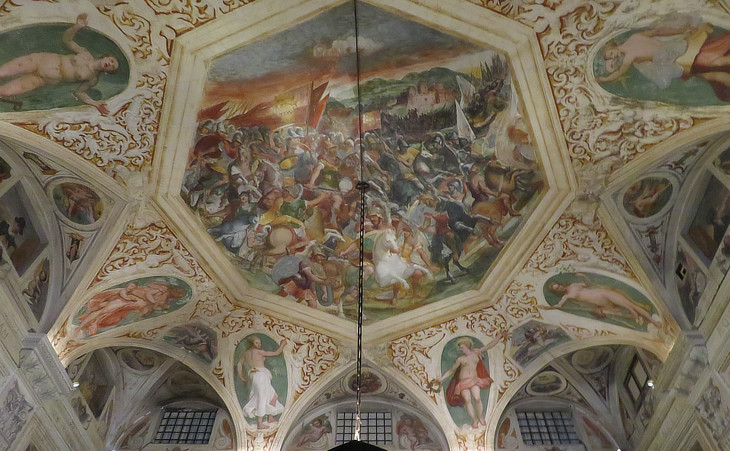
Palazzo Angelo Giovanni Spinola: entrance hall: octagonal vault by the Calvi brothers depicting a battle fought by Gherardo Spinola against the Florentines
Genoa and Florence were usually allied against Pisa, but in 1329 Gherardo Spinola bought Lucca from
German Emperor Louis IV of Bavaria and had to defend his new possession from the attacks of the Florentines. In 1331 however he gave up Lucca and returned
to Genoa.
This and other palaces of Strada Nuova have been bought by banks and insurance companies which have ensured their maintenance and restoration.
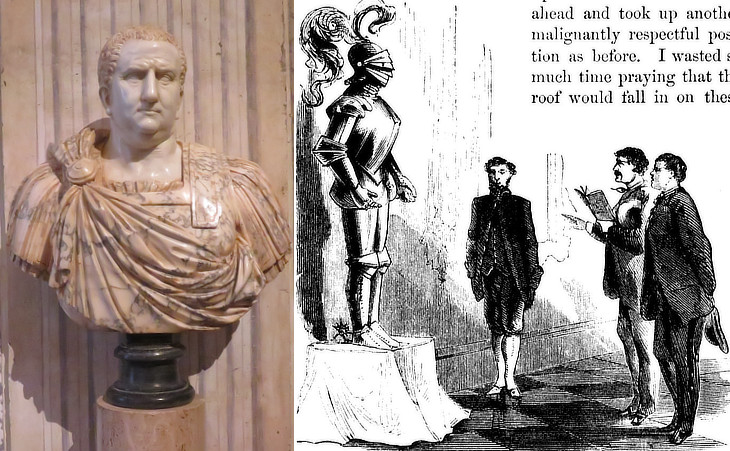
Palazzo Angelo Giovanni Spinola: (left) bust of a Roman Emperor, perhaps Titus (although the palaces of Strada Nuova are known for their collections of paintings,
they had also some antiquities or fake ones); (right) illustration from "Mark Twain - The Pilgrims Abroad - 1869"
"The Superb" and the "City of Palaces" are names which Genoa has held for centuries. She is full of palaces, certainly, and the palaces are sumptuous inside, but they are very rusty without, and make no pretensions to architectural magnificence. "Genoa, the Superb," would be a felicitous title if it referred to the women. We have visited several of the palaces - immense thickwalled piles, with great stone staircases, tesselated marble pavements on the floors and grand salons hung with pictures by Rubens, Guido, Titian, Paul Veronese, and so on, and portraits of heads of the family, in plumed helmets and gallant coats of mail, and patrician ladies, in stunning costumes of centuries ago. But, of course, the folks were all out in the country for the summer, and might not have known enough to ask us to dinner if they had been at home, and so all the grand empty salons, with their resounding pavements, their grim pictures of dead ancestors, and tattered banners with the dust of bygone centuries upon them, seemed to brood solemnly of death and the grave, and our spirits ebbed away, and our cheerfulness passed from us. We never went up to the eleventh story. We always began to suspect ghosts. There was always an undertaker-looking servant along, too, who handed us a programme, pointed to the picture that began the list of the salon he was in, and then stood stiff and stark and unsmiling in his petrified livery till we were ready to move on to the next chamber, whereupon he marched sadly ahead and took up another malignantly respectful position as before. Twain
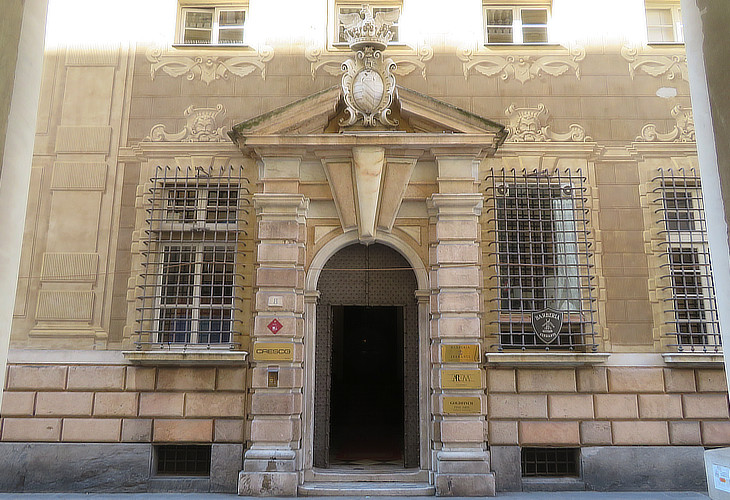
Palazzo Lazzaro e Giacomo Spinola (aka Cattaneo Adorno)
There are some Genoese nobles who have each five or six elegant palaces magnificently
furnished, either in the city, or in different parts of the Riviera. The two streets called Strada Balbi and Strada Nuova, are continued
double ranges of palaces adorned with gardens and fountains: but their being painted on the outside has, in my opinion, a poor effect.
Tobias Smollett's Travels through France and Italy in 1765
The palaces, I apprehend, gave to this city the epithet of Proud; their black and white fronts were once the
distinctive of the highest nobility; but most of those marble mansions have disappeared: the modern palaces are all faced with stucco,
and some are painted in fresco. This fashion of painting figures on house-fronts, though
admired even by severe critics, to me it appears too gay for any building that affects grandeur. Nothing can be grand in architecture
that bears a perishable look.
Joseph Forsyth's Remarks on Antiquities, Arts, and Letters in Italy in 1802-1803
The huge palaces of Genoa are each supposed to be occupied by one family, but they could accommodate a hundred, I should think.
They are relics of the grandeur of Genoa's palmy days - the days when she was a great commercial and maritime power several centuries ago.
These houses, solid marble palaces though they be, are in many cases of a dull pinkish color, outside, and from pavement to eaves are
pictured with Genoese battle-scenes, with monstrous Jupiters and Cupids and with familiar illustrations from Grecian mythology.
Where the paint has yielded to age and exposure and is peeling off in flakes and patches, the effect is not happy.
A noseless Cupid, or a Jupiter with an eye out, or a Venus with a fly-blister on her breast, are not attractive features in a picture. Twain
The palace is the last batch built on the new street and was commissioned by the cousins
Lazzaro and Giacomo Spinola in the years between 1585 and 1588. The architect has not been identified.
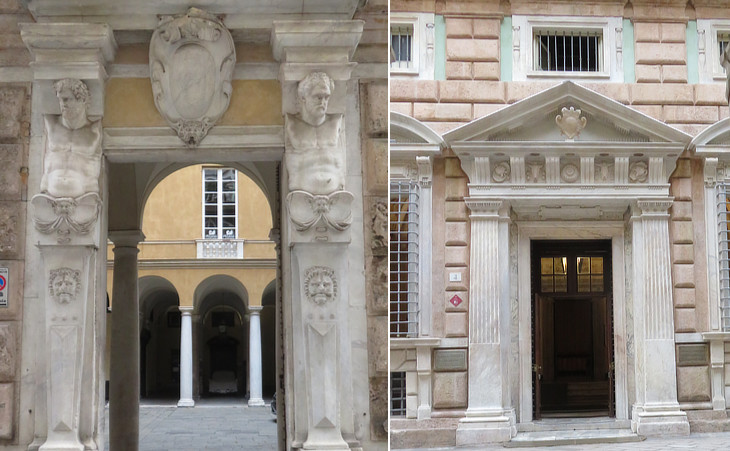
(left) Palazzo Franco Lercari; (right) Palazzo of Tobia Pallavicino
The new street is a double range of
palaces from one end to the other, fit for the greatest princes to inhabit. They are all richly adorned with marble, which is lavished as it
were thro' every part of this fine city. (..) The palaces most worthy of notice are those of Durazzo, Pallavicini, Spinola, Balbi,
Grimaldi, Lomellini, and Tursi, which are all magnificent buildings.
Thomas Nugent - The Grand Tour - 1749
Similar to the Pallavicini the Lercari were among the richest families of XVIth century Genoa.
They did not have the same prestige as the Doria or the Spinola, so Franco Lercari decided to place two telamons with a broken nose as reminders
of the punishment his ancestor Mergollo
imposed on his prisoners. In the early XIVth century Mergollo raided the coasts of the Empire of Trebizond and he forced the
Emperor to open his ports to Genoese merchants who thus established a profitable trade route in the Black Sea.
The telamons are a work by Taddeo Carlone, who is best known for a
gigantic statue of Giovanni Andrea Doria.
Palazzo Tobia Pallavicino was designed in 1558-1561 by Giambattista Castello from Bergamo,
one of the many sculptors and architects from Lombardy and Italian
Switzerland who worked at Genoa and at many other towns of Italy. He designed also Palazzo Nicolosio Lomellino and Palazzo della Meridiana.
The small red plaques with a number which can be seen near the portals of many palaces
indicate that they are listed in the 2006 UNESCO World Heritage Site named "The Strade Nuove and the system of the Palazzi dei Rolli". The area of the site
contains 42 palaces that were on the Rolli list. They are those which have best preserved their authenticity.
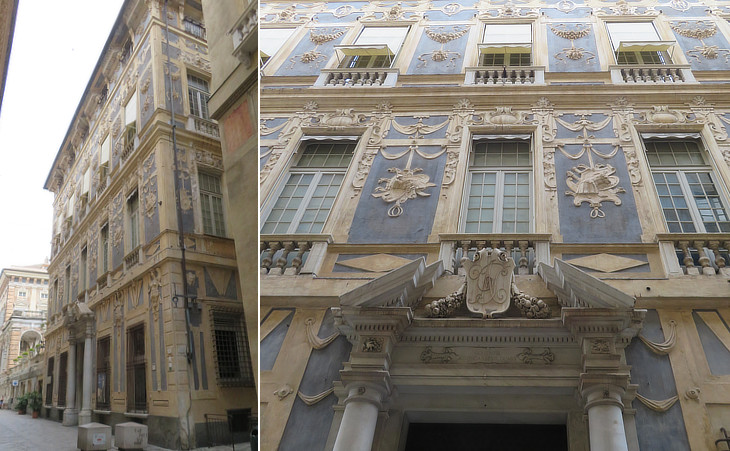
Palazzo Nicolosio Lomellino: (left) overall view; (right) decoration of the façade (a detail portraying an angel is shown in the background
image of this page)
Corals are fished in this sea towards Sardinia and Corsica Ilands, not farre distant, and the
ounce thereof is here sold for three lires. Moryson
L'Annunciata is, like many others which we have noticed, a monument of
private munificence. It was built and decorated at the expense of the Lomellini family, formerly sovereigns of the island of Tabarca off the
coast of Africa, which they held until 1741,
when it was taken by the Bey of Tunis. Murray
The Lomellini were a minor noble family until the mid of the XVIth century
when, thanks to the help of Andrea Doria, they obtained
the right to fish coral around the island of Tabarka, a Spanish possession opposite the coast of Tunisia (and near an ancient Roman port). Skilled fishermen from Pegli, a suburb of Genoa,
were relocated to Tabarka. The new settlement was protected by walls and it rapidly developed. The revenues of this trade were so high that the Lomellini became one of the
richest families of Genoa and they decided to exhibit their wealth by erecting a highly decorated palace in the Strada Nuova and by financing the
construction of a grand new church.
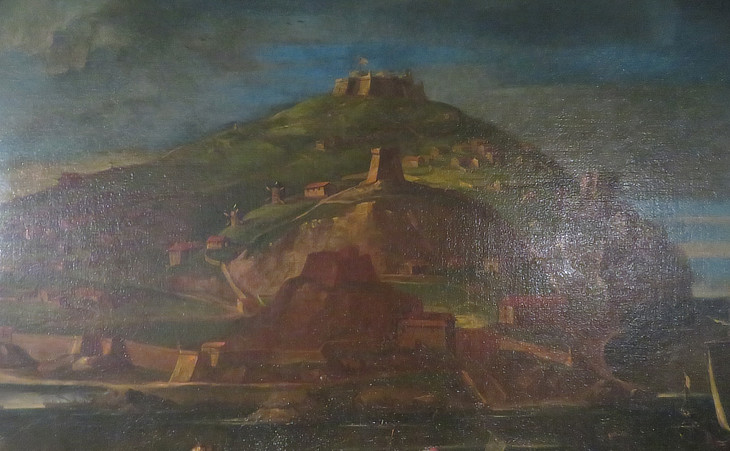
Museo del Mare: view of Tabarka (late XVIIth century, attributed to Carlo Antonio Tavella
- bequeathed by Luigi Lomellini in 1905)
The small island which lyeth over against the coast is, at present, in the Possesssion of the Genoese,
who pay an annual Rent for It to This Regency; but the little Advantage that hath lately been made of the Coral Fishery, the chief Reason of
Their Settlement, will possibly oblige Them to abandon It in a short Time. They have here a tolerable good Fort, very capable to protect Them,
as well against any Surprize from the Zenati and other Arabs of the neighbouring Continent, as from the Insults of the cruising Vessels of
Algiers
and Tripoly.
Thomas Shaw - Travels, or, observations relating to several parts of Barbary and the Levant - 1738
The coral fishery is chiefly practised at Trapani:
they have invented a machine there, which answers the purpose much beyond their expectation. (..) Since this invention the coral fishery has turned
out to considerable account.
Patrick Brydone - A tour through Sicily and Malta. 1775
The development of coral fisheries at Trapani was promoted by
Charles
of Bourbon, King of Naples and Sicily to the detriment of those of Tabarka. In 1738 part of the population of Tabarka was offered to
relocate to two uninhabited islands on the south-western coast of Sardinia where the
locals still speak a Genoese dialect. In 1741 Tabarka was conquered by the Bey of Tunis and its remaining few inhabitants were enslaved.
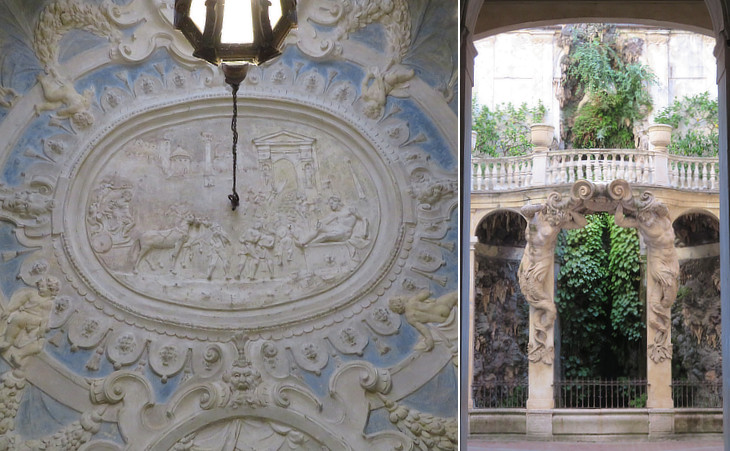
Palazzo Nicolosio Lomellino: (left) stucco ceiling of the entrance hall depicting an imaginary triumph of a Roman commander; (right) XVIIIth century fountain designed
by Domenico Parodi
Nicolosio wanted the façade of his palace to be entirely decorated with stuccoes which were most likely executed by Marcello Sparzo (see his stuccoes at Andrea Doria's suburban palace). The palace was designed by Giambattista Castello. The stuccoes depict winged herms on the ground floor, trophies hanging from ribbons and drapes on the first floor and on the second garlands. Today it is privately owned and therefore retains its original function as lodging for a Genoese family. The palace is in good state of conservation.
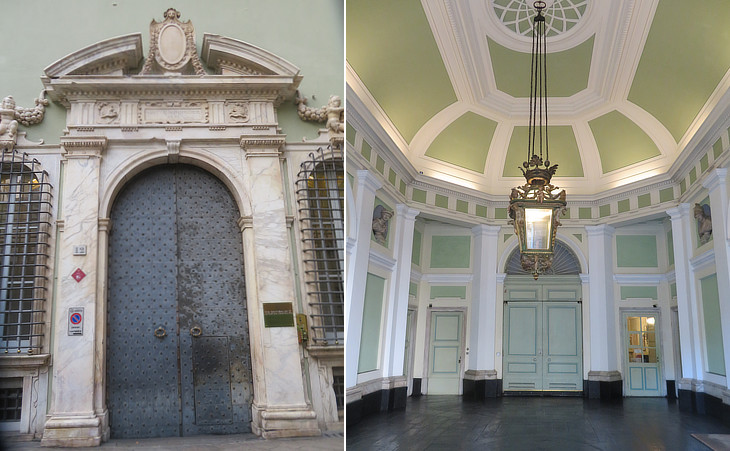
Palazzo Baldassare Lomellino: (left) portal; (right) entrance hall
This palace was one of the first in the street to be built (1562) and it was designed by Giovanni Ponzello for Baldassare Lomellini. The portal by Taddeo Carlone bears the inscription "VENTURI NON IMMEMOR AEVI" (Mindful of posterity). In 1588 it was acquired by by the Salvago and in 1770 by Cristoforo Spinola, who made radical changes in order to give it a Neoclassical aspect. 1942 bombings greatly damaged the main hall and the loggia.
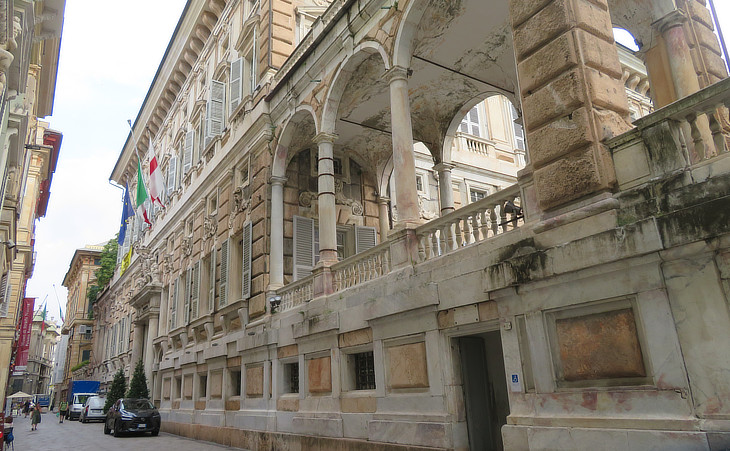
Palazzo Doria Tursi (named after Tursi, a small town in the Kingdom of Naples which was acquired by a branch of the Doria) and Palazzo Rosso (Palazzo Brignole Sale)
opposite it and Palazzo Bianco (Palazzo Durazzo Brignole Sale) behind it
Palazzo Doria Tursi, in the Strada Nuova, late the residence of the Queen Dowager, and afterwards the Jesuits' College.
The façade is grand, and is flanked by terraced gardens. The architect was Rocco Lurago, of Como. Since the expulsion of the Jesuits
it has been given to the city for
public purposes; it is now occupied by the National Guard. Murray
Palazzo Doria Tursi houses the Town Hall of Genoa and a small museum. Palazzo Rosso and Palazzo Bianco house the municipal collections of
paintings. These three palaces are going to be covered in detail in separate pages.
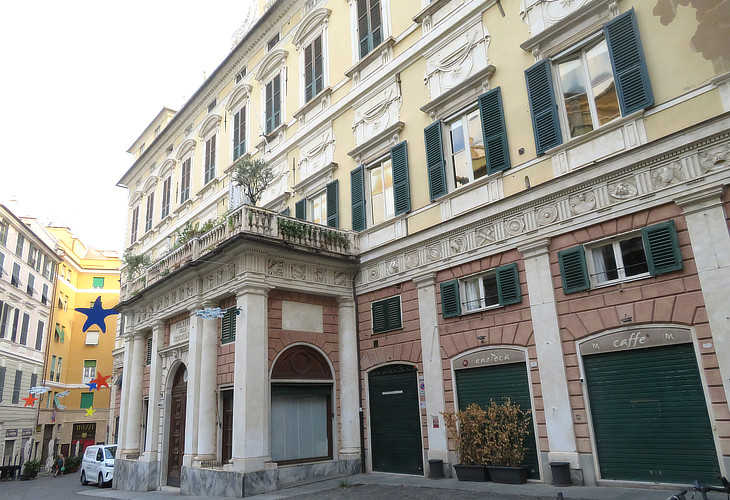
Palazzo della Meridana aka Palazzo Gerolamo Grimaldi, at the very beginning of "Strada Nuovissima"
Doria, Spinola, Grimaldi and Fieschi (known as the Quator Gentes) were the four most powerful families of medieval Genoa. They all built palaces along Strada Nuova, exception made for the Fieschi who in 1547 were banished from Genoa for having plotted against Andrea Doria. Palazzo Gerolamo Grimaldi was built before the design of Strada Nuova was finalized and it is located at its western end. In 1786 "Strada Nuovissima" (Via Cairoli) was opened to provide an easy connection between Strada Nuova and Strada Balbi and this led to the redesign of the façade of Palazzo Grimaldi. The marble portal was incorporated into a low terraced screen at the centre of two wings of the building.
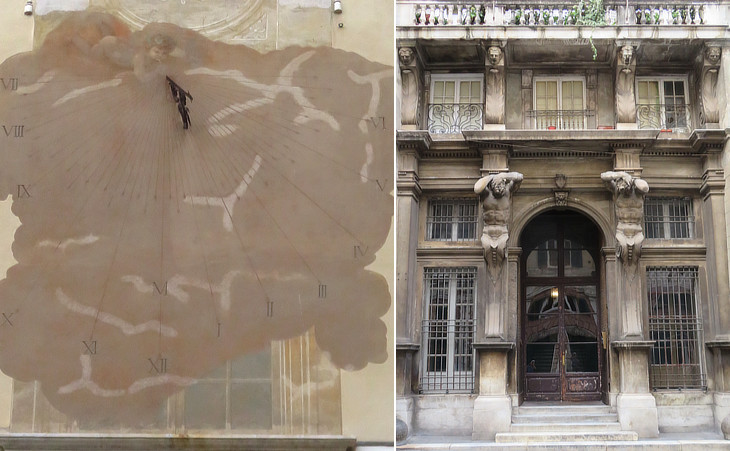
(left) Sundial (Meridiana) of Palazzo Grimaldi (late XVIIIth century); (right) Palazzo Gio. Carlo Brignole: portal with telamons by Filippo Parodi
Just at the entrance of the Strada Nuova but in the Strada Nuovissima, is the Palazzo Brignole
(one of three belonging to this family): the portal is supported by two gigantic Terms. Murray
Palazzo Brignole was built
in 1623-1626 by Gio. Batta Brignole, but the building was doubled in size by Gio. Carlo Brignole in 1671. The new façade was designed
by Pietro Antonio Corradi. The Durazzo family took over the property a little after 1820.
In origin the Brignole were traders in wool and silk but
during the XVIth century their wealth was increased by a marriage with the heiress of Giulio Sale, who was a nobleman as he owned Groppoli, a tiny
fiefdom in Tuscany.
The decoration of portals with telamons was popular in northern Italy (e.g. at Chioggia) and especially at
Vienna, but not at Rome.
Move to
The Ancient Town
The Cathedral
The Doria's Palaces and Church
Palazzo del Principe
The Harbour
The Piazza Nuova
The Strada Nuova
Via Balbi
Two Grand Churches
A Walk to Castello
In the Heart of the Old Town
Old and New Portoria
Museums: Exhibits from Churches
Museums/Palaces: Tursi and Bianco
Museums/Palaces: Rosso and Spinola
Some Environs of Genoa
Anthony van Dyck's 2026 Exhibition


