
All images © by Roberto Piperno, owner of the domain. Write to romapip@quipo.it.


Notes:
Page added in November 2026.
All images © by Roberto Piperno, owner of the domain. Write to romapip@quipo.it.
Notes:
Page added in November 2026.
 A Walk to Castello
You may wish to see pages on the Cathedral, The Harbour and Palazzo Ducale first.
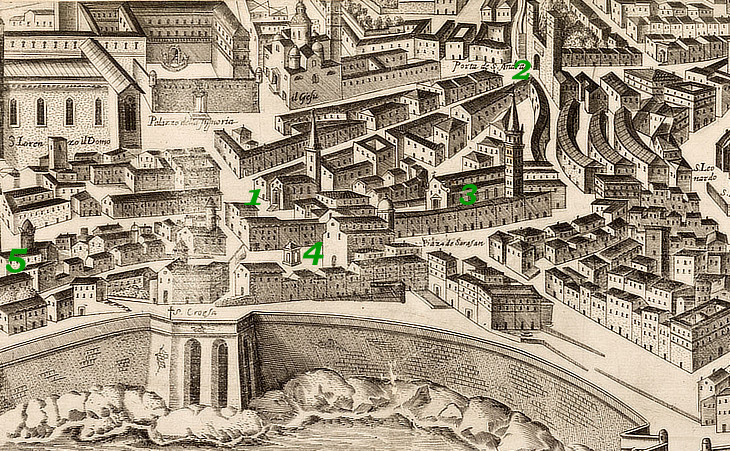
The hill of Castello in a 1637 engraving by Alessandro Baratta: 1) S. Donato; 2) Porta S. Andrea or Soprana; 3) S. Agostino
(Piazza Sarzano); 4) S. Salvatore and Fontana di Giano; 5) approximate site of Torre degli Embriaci; the left upper corner shows Palazzo Ducale (Palazzo della Signoria)
Let us look back for a moment to the days when Genoa was a small town gathered into the neighbourhood
of Sta. Maria del Castello, when there was neither Faro, nor Molo, nor Arsenal; when most of the bay was sand fringed, with vineyards and
olive groves sloping gently down to the marge.
Robert Walter Carden - The city of Genoa - 1908
The historical part of Genoa was divided into six districts
(sestieri). That of Molo (Wharf)
included:
a) The hill of Castello, seat of the first city settlement, in a commanding position over the harbour.
b) The portion of the old town at the foot of the hill, the seat of the political and religious powers.
c) The neighbourhood properly called Molo which was heavily bombed during WWII and was redesigned in the late XXth century.
Castello, notwithstanding the impact of the bombings, retains most of its mainly medieval aspect as it is cut off from the
XIXth century city centre and the more recent urban development of Genoa.
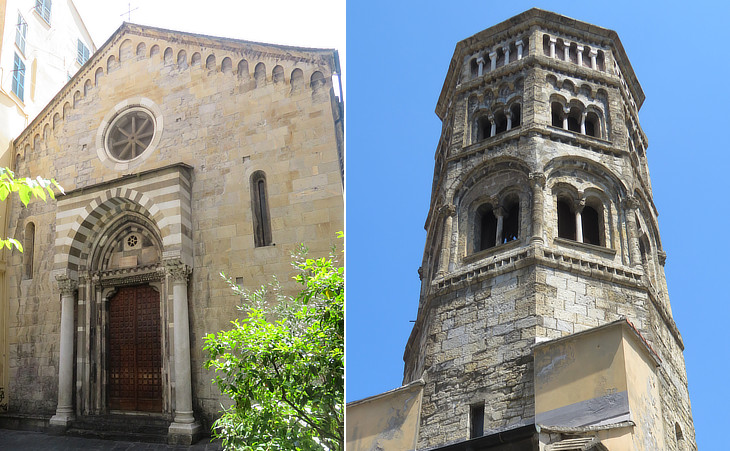
S. Donato: (left) façade; (right) bell tower
The architectural features of Genoa are first its mediaeval churches, with striped facades of black and white marble,
and, secondly, its magnificent sixteenth-century palaces. (..) Close by Palazzo Ducale is the Church of S. Donato, with an octagonal bell-tower
of the twelfth century.
Augustus J. C. Hare - Cities of Northern and Central Italy - 1876.
S. Donato, the best example of Romanesque architecture in Genoa, was built in the XIth century, but a preceding church existed in this site
since the VIIth century. The simple façade has a stone cladding in black and white stripes. The octagonal bell tower is actually a lantern tower because it is built above the main nave (see that of the
Cistercian Abbey of Fossanova) and not at the side of the church, as usual in Italy.
It has a fine decoration of mullioned windows (the highest row was added in the late XIXth century).
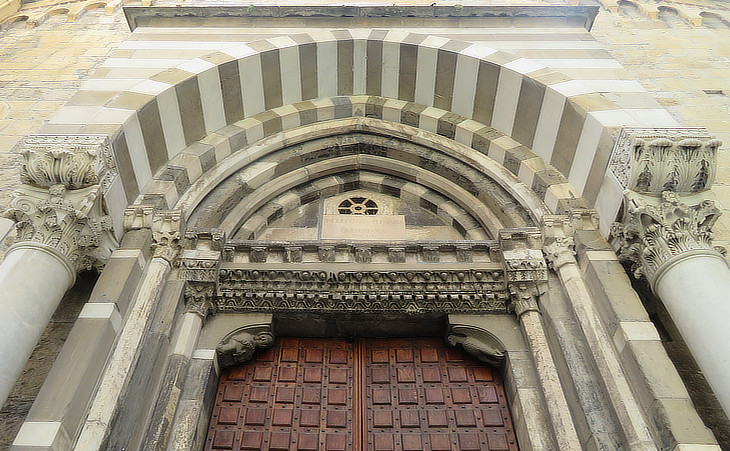
S. Donato: XIIth century portal with a fragment of an ancient cornice, similar to that at S. Maria di Castello
Over the centuries the church underwent some changes, but the medieval aspect of the façade was revamped by Alfredo d'Andrade, a Portuguese painter and architect who
settled in Genoa and who, because of his extensive researches on Italian medieval art was appointed Superintendent for Fine Arts in Piedmont and
Liguria in 1885.
The church is dedicated to St. Donato, a IVth century martyr and the second bishop of Arezzo. His deeds are celebrated in a beautiful
marble altar in the Cathedral of that town.
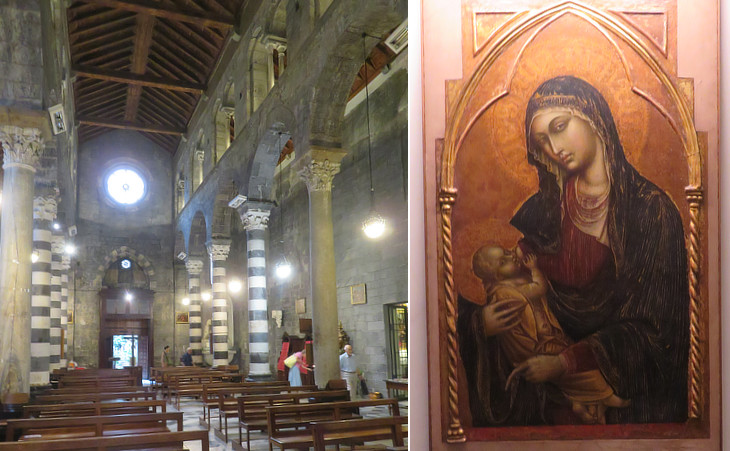
S. Donato: (left) interior; (right) Madonna del Latte (Nursing Madonna) by Barnaba da Modena (ca 1380)
The interior has a typical structure with a nave and two aisles which are separated by twelve columns, six of which come from ancient Roman buildings and
six are in Romanesque style with black and white stripes. The columns support a fake matroneum (women's gallery).
The apse and the ceiling were damaged by WWII bombings.
Barnaba of Modena (..) surpassed not only his own countrymen,
but the Bolognese and Pisans of his time; and he made a respectable approach to the better class of Siennese painters.
Like them he practised the familiar method of colouring, which consisted in stippling lights over deep preparations of verde,
fusing the parts together without much contrast of light and shade, but with the patient minuteness of the period and glazing
the whole with warm rosy tones. His draperies, of many involved and ill defined folds, are touched up with strokes of gold light,
and are generally of brightly contrasted colours, (..) His pictures have thus a sort of lively brilliancy, with a flat surface unrelieved by
light and shade. Affectation of grace in the Virgin and child, which was his favorite subject, regular forms and proportions in the frame,
roundness and breadth in the heads, give his pictures an old Siennese appearance, which is increased by the roundness and gaze of the eyes,
the pursy lips and long-fingered but coarse jointed hands. (..) When the authorities of the Pisan Campo Santo sent for him, to complete the
frescos of S. Raineri, in 1380, their messenger was despatched to Genoa.
J. A. Crowe and G. B. Cavalcaselle - A new history of painting in Italy - 1864
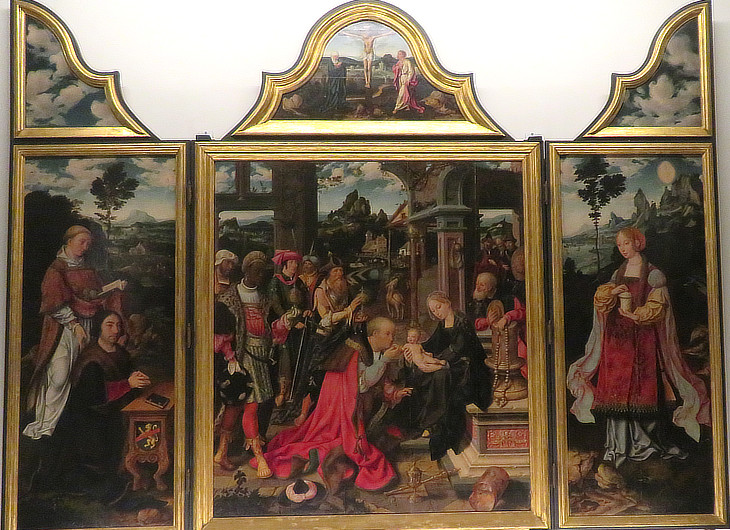
S. Donato: Adoration of the Magi by Joos van Cleve (1515?) - see some Italian examples of this International
Gothic style at Ancona
Renaissance paintings were often copied, repeated or adapted; at least six versions of an Adoration of the Magi by Joos van Cleve and his workshop are known. The name of this painter was identified in the early XXth century and it appears he lived and worked for most of his life at Antwerp. He might have visited Italy, but the presence of this triptych is due to Stefano Raggio who commissioned it and who is portrayed in the left panel with St. Stephen. Stefano belonged to a family of Genoese merchants and in 1507 he was sent to Antwerp to learn the ropes of his trade under the tutelage of a paternal uncle. He was back at Genoa in 1515 and he became very wealthy. When he was assigned a funerary chapel at S. Donato he commissioned the triptych. In the right panel, behind St. Mary Magdalene, a harbour is painted, probably Genoa. You may wish to see this same subject painted in the same period, but in a Renaissance context at SS. Trinità dei Monti in Rome.
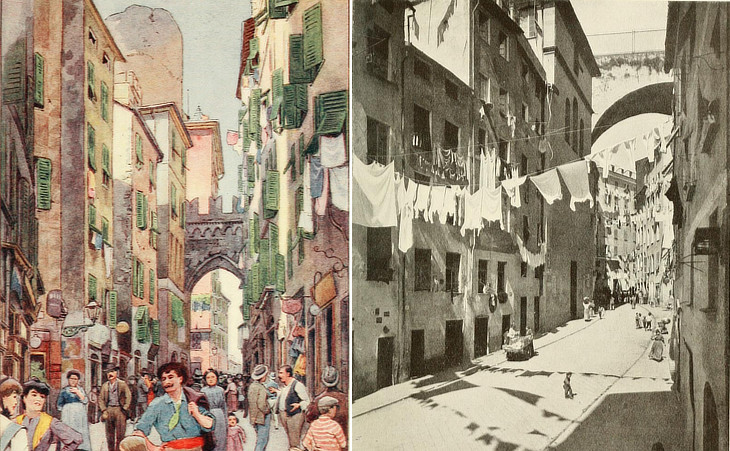
Illustrations from "Robert Walter Carden - The city of Genoa - 1908": (left) Porta S. Andrea by William Parkinson; (right) Borgo
dei Lanaioli (woolworkers) with Ponte di
Carignano in the background
The only deformity of this City is the narrowness of the streets unanswerable to the tallness of the houses and yet they
are made so on purpose, partly to save ground, which heer is precious and partly to keep off the scorching beams of the Sun in Summer time,
for the conveniency of walking cool for which reason I have observed many of the ancient Towns of Italy to have their
streets made very narrow.
John Ray's Observations (..) made in a journey through part of (..) Italy in 1663.
In winter the bridge is a sunny and delightful walk, and from
it you look down on the immensely high, many-storied, many-windowed houses of this crowded quarter; painted pink, blue, white, and yellow;
with gardens of flowers on their roofs; with clothes suspended in mid-air from house to house.
In the deep streets below are figures moving like ants, in an obscurity which seems almost black compared with the light above. Hare
Genoa is the tightest topographic tangle
in the world, which even a second visit helps you little to straighten out. In the wonderful crooked, twisting, climbing, soaring, burrowing
Genoese alleys the traveller is really up to his neck in the old Italian sketchability.
Henry James - Italian Hours - 1909 (this essay was written in 1878)
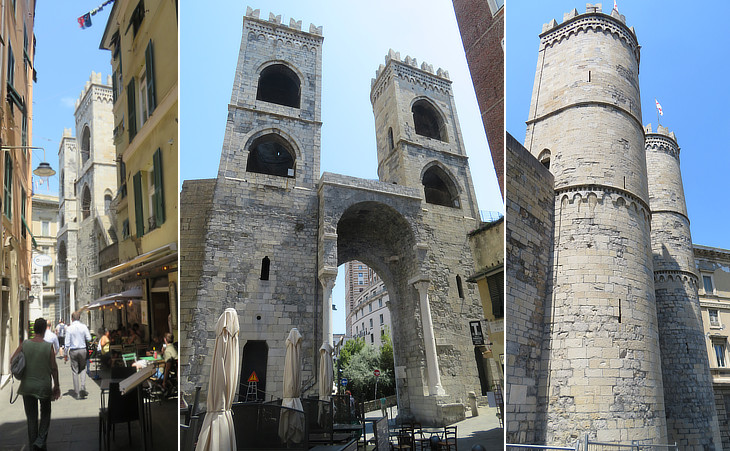
Porta S. Andrea or Soprana, the main entrance to the medieval city from the
east: (left) from Via Ravecca; (centre) town side; (right) external side
The City hath certaine inner gates, which alwaies stand open,
and shew that the circuit of the City is now much increased.
Fynes Moryson - An Itinerary: Containing His Ten Years Travel Through .. Italy (in 1594)
We tooke horses and made the circuite of the Citty as far as the new walles would let us; they are built of a prodigious
height, and with Herculanean industry, witnesse those vast pieces of whole mountaines which they have hewn away, and blown up with gunpowder,
to render them steepe and inaccessible. They are not much lesse than 20 English miles in extent, reaching beyond the utmost buildings of the
Citty.
John Evelyn's Diary and Correspondence related to his stay in Italy in 1644
The gate is part of the medieval walls: Soprana comes from Italian sopra (above, over, on top of), because it is on high ground, whereas a gate of the western walls was called Sottana
(or Porta dei Vacca) because it stands by the sea. The reference to St. Andrew is due to a lost monastery adjoining the gate.
Similar to S. Donato, the medieval aspect of the gate was restored by d'Andrade.
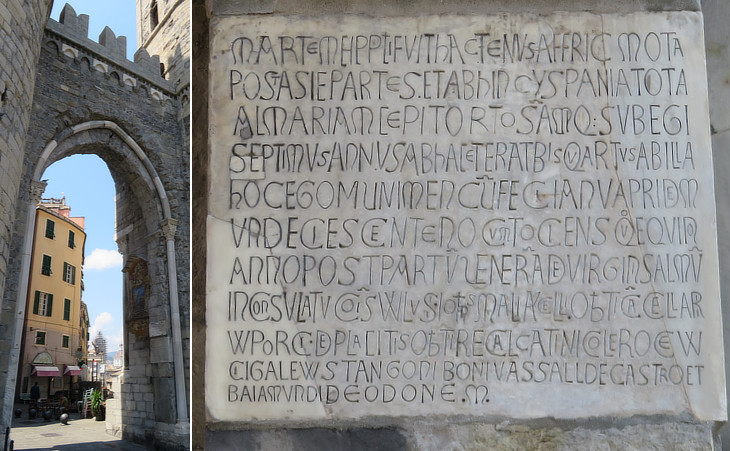
Porta S. Andrea or Soprana: (left) outer view; (right) inscription celebrating the construction of the gate (1155) and the conquest of
Almeria in Spain (1147)
In 1155 when the gate was built the Christian states in the Levant were under attack. A crusade (1147-1150) to recover the County of Edessa had failed its objective (and paved the way for the fall of Jerusalem in 1187). The inscription celebrating the conquest of Almeria was meant to highlight the Genoese victory in the context of the Crusades and to portray the city as both a protagonist in the struggle against Islam and a major diplomatic force. Some of the columns which decorate the portal of the Cathedral were taken from Almeria.
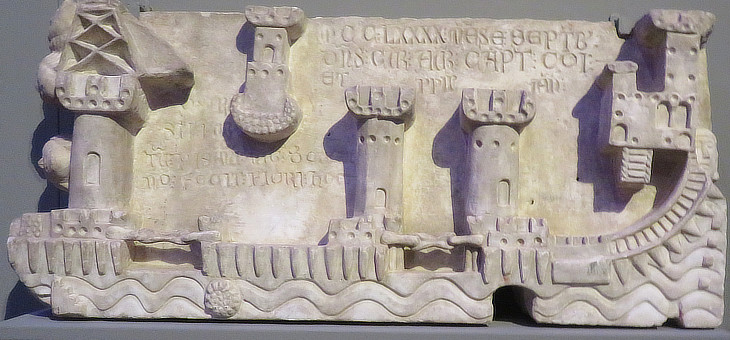
Museo di S. Agostino: relief which stood near Porta Soprana and which celebrates the conquest of Porto Pisano, of which
it shows the towers and chains (you may wish to see the chain which protected the Golden Horn at Constantinople)
Upon these gates are chaines of iron, for remembrance (as they say) of their
liberty once lost. Moryson
As I was going about the Town, I observ'd on the principal Gates some pieces of great Iron Chains hung up on each of them.
My Guide told me were brought from a Port of the Pisans (while they were a Republick) they had near Leghorn.
These Pisans had taken some Gallies from the Genoese, which the Genoese retook; broke the great Chain which was to secure the
Gallies in the Harbour, and brought away the Gallies, Chain and all, which they distributed in pieces, as above-mention'd.
Edward Wright Some observations made in travelling through France, Italy, &c. in 1720, 1721, and 1722
In 1860, when Italy became one nation, Genoa resolved to restore the chain to Pisa, and accordingly a deputation headed by the mayor solemnly handed the relics over to
the Gonfaloniere, and with much ceremony they were hung up in the celebrated Camposanto. Carden
Originally this relief was placed on the façade of a private house in a street leading to Porta Soprana. The stone celebrates the victory of the Genoese who, after defeating the Pisans in the naval battle of Meloria (1284),
had inflicted a stringent peace agreement on them, which was largely broken. This led to a naval expedition to force the rival
city to respect the pacts: having broken the chains protecting the port, the Genoese devastated it. The chains were displayed as a
trophy in Genoa at some of its main monuments.
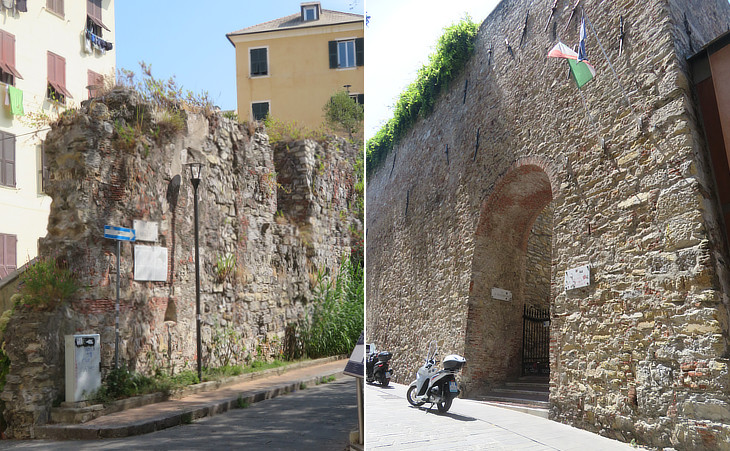
"Mura del Barbarossa": (left) Via del Colle; (right) Salita S. Agostino (Palazzo del Vescovo)
The city enclosed within the new walls of 1159 - built in frenzied haste against the second coming
of Barbarossa - was so small that S. Matteo, S. Siro, and Sta.
Maria delle Vigne were excluded from their protection. Carden
A few fragments of the medieval walls can still be noticed at the top of the hill. They are not particularly impressive but when they were
built they were on a commanding position over the valley between Castello and Carignano.
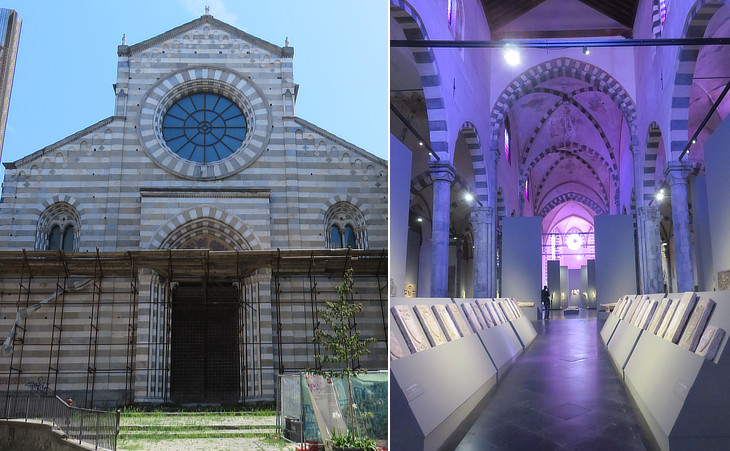
S. Agostino: (left) façade; (right) Gothic interior which today houses a museum of medieval sculpture; the image used as background for this page shows a relief portraying
St. Augustine
The town contains about thirty parish churches, twenty colleges, and as many convents and religious houses.
Thomas Nugent - The Grand Tour - 1749
Hence the Stradone di S. Agostino leads to the beautiful but ruined front of that church, of the fourteenth century:
the campanile is inlaid with coloured tiles. Hare
The monastery and the church were closed in 1798 and they were turned into a warehouse and
into other civilian facilities. The church was restored in the 1920s, but it was damaged by WWII bombings. It was restored again and
the museum was inaugurated in 1984 (it is going to be
covered in another page).
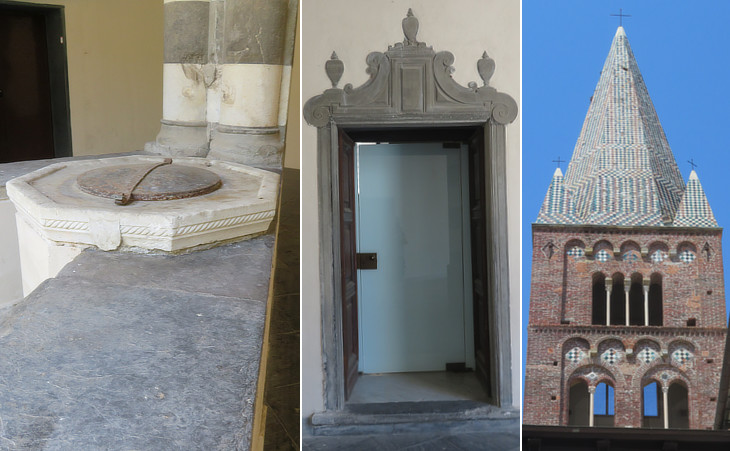
S. Agostino: (left) well in the cloister; (centre) a door of the convent; (right) bell tower
The convent had a peculiar cloister having only three sides, so that the well was placed at one of its angles. It was a large building and it still shows evidence of its long history. The spire of the bell tower with four small pinnacles is the finest of this type (see the other two - it opens in another window). It is typical of northern Italy, see those at Verona and Pomposa. The decoration with tiles is unique in Genoa.
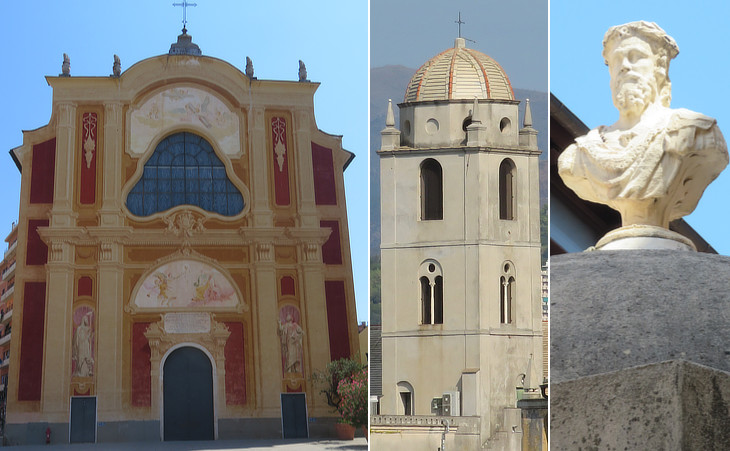
(left) S. Salvatore; (centre) bell tower of S. Silvestro; (right) bust at the top of Pozzo di Giano
S. Salvatore was a medieval church which was entirely redesigned in the XVIIth century, whereas the decoration of the façade
belongs to the next century. It was almost destroyed by WWII
bombings, similar to the nearby convent of S. Silvestro. The two sites were chosen to house the Faculty of Architecture of the University of Genoa.
The façade of the church was rebuilt and repainted and today it is the grand entrance to the Aula Magna (Great Hall) of the Faculty.
The area between S. Agostino and S. Salvatore and the space in front of the
latter is known as Piazza Sarzano (after Arx Jani, Citadel of Janus) and it housed a busy market.
The map by Baratta shows Pozzo di Giano, a well with four columns supporting a
small dome with a Renaissance bust of the two-headed god Janus, the mythical founder of Genoa
(see a Roman bust of the god).
PIAZZA SARZANO
Streets and more streets climb towards the ancient tournament square and in the pure air the sea is perceived under the sky. The pure air is barely scored with light clouds. The air is pink. An ancient twilight has dyed the square and its walls. And it endures under the enduring sky, rosy summer of a rosier summer.
|
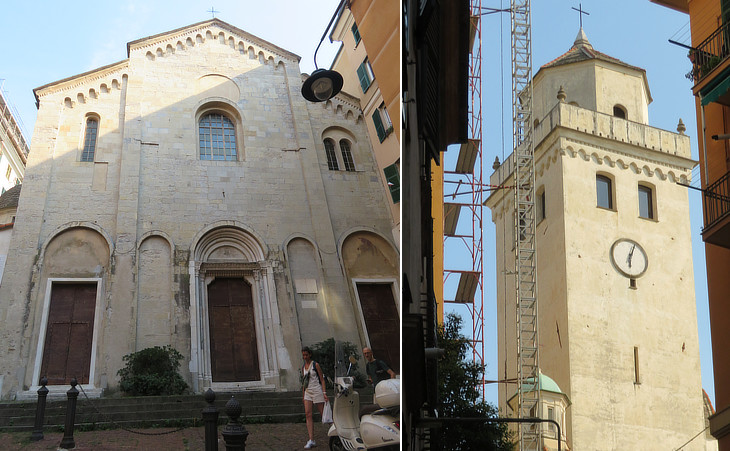
S. Maria di Castello: (left) façade with a Roman cornice inside the portal; (right) bell tower
Santa Maria di Castello, said to be built on the site of a temple of Diana, some of the columns
of which still remain. Murray
The four oldest churches in Genoa are those of Sta. Maria del Castello, the Cathedral of San Lorenzo, San Michele Arcangelo (now incorporated with S. Stefano
degli Archi), and San Siro, formerly dedicated to the SS. Apostoli. There are no records to show when they were founded, but it is clear that
they were all in existence at least as early as the tenth century. Carden
In the XIIth century the church was officiated by a college of canons,
but in 1441 it was assigned to the Dominicans who built a large convent with three cloisters next to it.
The interior of the church was renovated in the XVIth century. The bell tower retains only the overall structure of the medieval one.
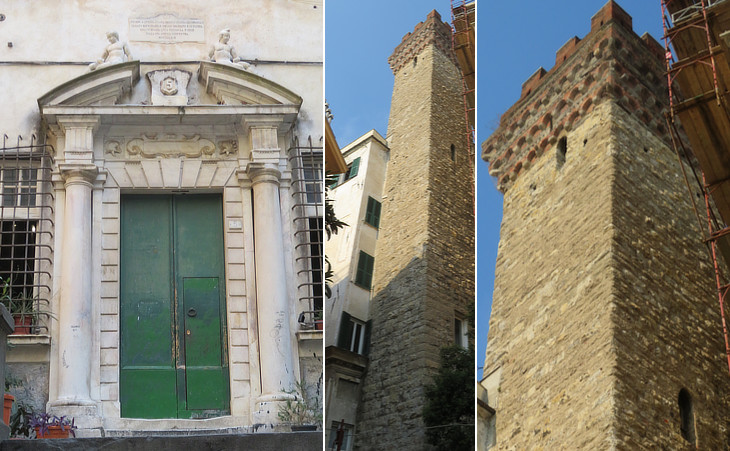
(left) Palazzo Giulio Sale aka Brignole Sale; (centre/right) Torre degli Embriaci on the back of the palace; it was restored in 1869 and the merlons were added in 1927
Turning left, below the church, we reach the small Piazza Embriaci, with an inscription which tells that -
Round this piazza the Embriaci had their home, a family renowned in the wars of the cross and in their own country. Behind, rises intact the giant height of their
ancient tower. Hare
The towers were reduced to the lawful height of eighty feet in 1197. (..) A singular exception was made in favour
of the Embriaco family, in recognition of the services of Guglielmo at the siege of Jerusalem. Their tower still rears its head above the
buildings in the neighbourhood of Sta. Maria del Castello. Carden
Guglielmo Embriaco was rewarded with the fiefdom of Gibelet, ancient Byblos for his contribution to
the conquest of Jerusalem. His heirs ruled that fiefdom for two centuries and later on the Embriaco became a major family of the Kingdom of Cyprus.
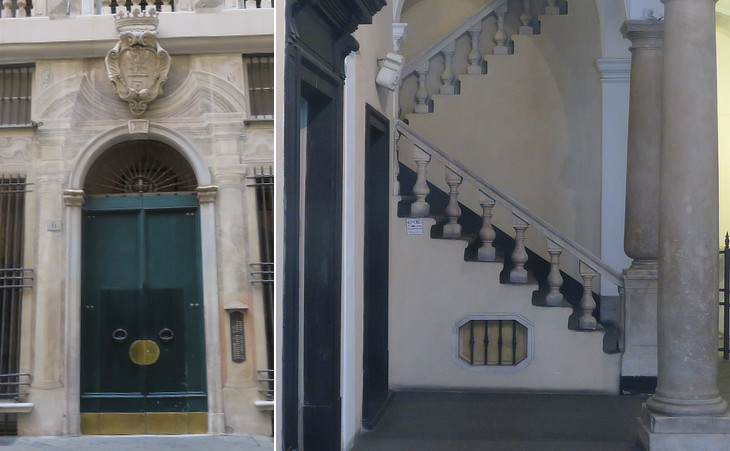
Palazzo Marcantonio Giustiniani: (left) portal; (right) interior
The hill of Castello because of its slope was not the most suitable location for building large palaces, so they were erected in two streets which were designed for this purpose: first Strada Nuova and then
Via Balbi. The ground at the foot of the hill and very near the Cathedral was flat enough to house the relatively
small palace of the Giustiniani. It is the result of the merger of two buildings which were given the same aspect in the XVIIth century.
It was modified in the XIXth century when it housed a department store.
You may wish to see Palazzo Giustiniani at Rome and learn how this family entered the Roman nobility and assembled
a great collection of antiquities.
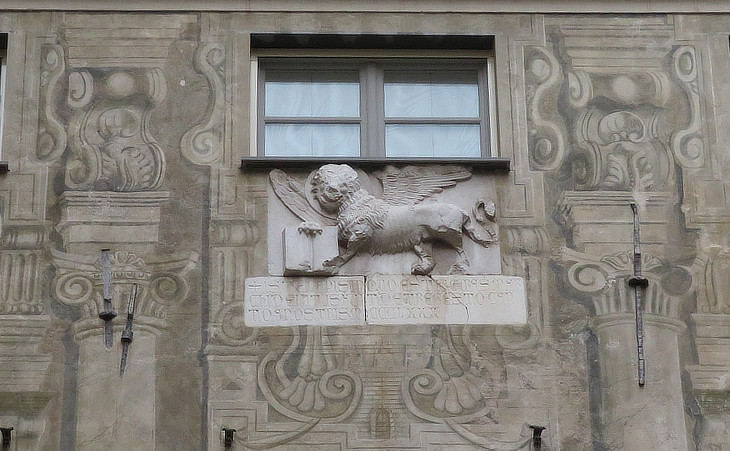
Palazzo Marcantonio Giustiniani: Winged Lion of St. Mark
Genoa is one of the three great republics which, during the middle ages, that is, at a period when the rest of Europe was immersed in
slavery, ignorance, and barbarism, made Italy the seat of liberty, of science, and of civilization, and enabled her, though bereft of general
empire, not only to outshine her contemporary powers, but even to rival, at least in military fame, and domestic policy, the glories of
Greece herself in her most brilliant era. Of these republics Venice was undoubtedly the first, and Genoa confessedly the second.
These honors she acquired by her commerce and by her fleets, which enabled her often to dispute, and frequently to share the empire of
the seas with her adversary. At one period indeed the Ligurian capital had for some time the advantage, and reigned queen of the Mediterranean.
About the middle of the fourteenth century, not Corsica and Sardinia only, but the islands of the Archipelago, and the coasts of Syria and
Africa acknowledged the sovereignty of Genoa, and even the imperial city of Constantinople itself saw a colony of Genoese
established in its suburbs.
(..) The consequences of the contest, by weakening the two great maritime states of Italy,
destroyed the balance of power, and opened the way to the conquests of the Turks in the succeeding century.
Italy owes to that destructive rivalry, the loss of her mercantile superiority, and the lead which the Portuguese
and Spaniards afterwards took in the discovery of the East and West Indies, and in the general commerce of Europe.
John Chetwood Eustace's Classical Tour of Italy in 1802 (publ. 1813)
The inscription says:
Iste lapis
in quo est figura S. Marci de Venetiis fuit de Tergesto capto a nostris
MCCCLXXX (This relief which depicts the Venetian St. Mark was taken by us at Trieste in 1380).
The event took place
during the War of Chioggia which saw the Genoese nearly conquering the rival city.
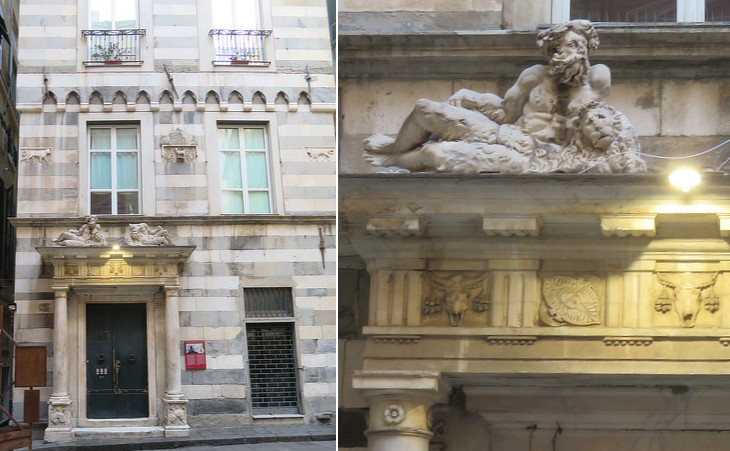
Palazzo Agostino and Giacomo Salvago: (left) historical part; (right) detail of the portal
This small palace was built in 1532. Agostino Maria Salvago was Archbishop of Genoa in 1555-1558. The portal was designed by Giacomo Della Porta and Nicolò da Corte. The former became a leading architect in Rome, but he started his career at Genoa as assistant of his uncle Bartolomeo. The statues above the portal were meant to portray two savage men, a reference to Salvago (It. selvaggio). Their posture however is rather composed and imitates that of Roman statues of rivers.
Move to
The Ancient Town
The Cathedral
The Doria's Palaces and Church
Palazzo del Principe
The Harbour
The Piazza Nuova (Palazzo Ducale)
The Strada Nuova
Via Balbi
Two Grand Churches
A Walk to Castello
In the Heart of the Old Town
Old and New Portoria
Museums: Exhibits from Churches
Museums/Palaces: Tursi and Bianco
Museums/Palaces: Rosso and Spinola
Some Environs of Genoa
Anthony van Dyck's 2026 Exhibition


