
All images © by Roberto Piperno, owner of the domain. Write to romapip@quipo.it.


Notes:
Page added in October 2026.
All images © by Roberto Piperno, owner of the domain. Write to romapip@quipo.it.
Notes:
Page added in October 2026.
 The Harbour
You may wish to see pages on the Ancient Town and the Palace of the Prince first.
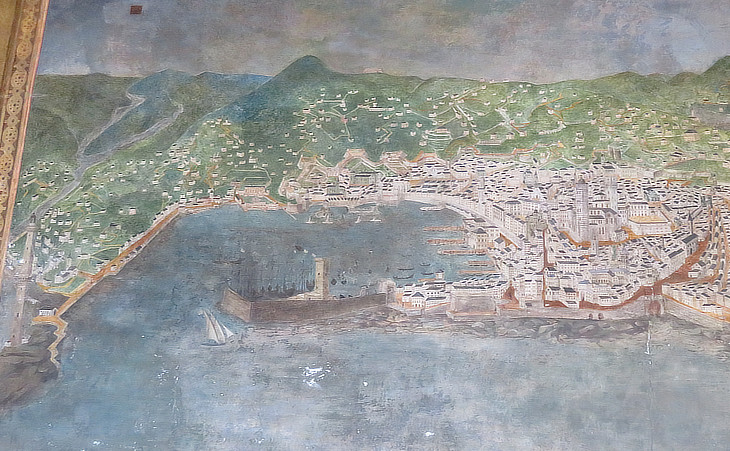
View of Genoa in a fresco inside Palazzo Doria Spinola (ca 1580)
On the South-side is the outward Haven, in the forme of a halfe moone, upon the horne whereof towards the East, lies the sea
banke, called La Mola, about 600. paces long, which keepeth off the waves of the sea that beat upon the City on the East side.
And in the middest of this bank is a Fort built to defend the Navy. And in the furthest corner of this haven towards the City, is an inner haven,
compassed with wals, where the gallies lie under a covered building. Neer that is the Armory of the City, and the chief gally in the Port called,
La Reale, the Regal, was about seventy five walking paces long, and they sayd that foure hundred Rowers belonged to it.
Fynes Moryson - An Itinerary: Containing His Ten Years Travel Through .. Italy (in 1594)
16 Oct. 1644. We got to
anker under the Pharos, or watch-tower, built on a high rock at the mouth of the Mole of Genoa, the weather being still so fowle that for two
houres at least we durst not stand into the haven. Towards evening we adventured, and came on shore by the Prattiq-house, where, after
strict examination by the Syndics, wc were had to the Ducal Palace, and there, our names being taken, we were conducted to our inne kept by one
Zacharias, an Englishman.
John Evelyn's Diary and Correspondence related to his stay in Italy in 1644
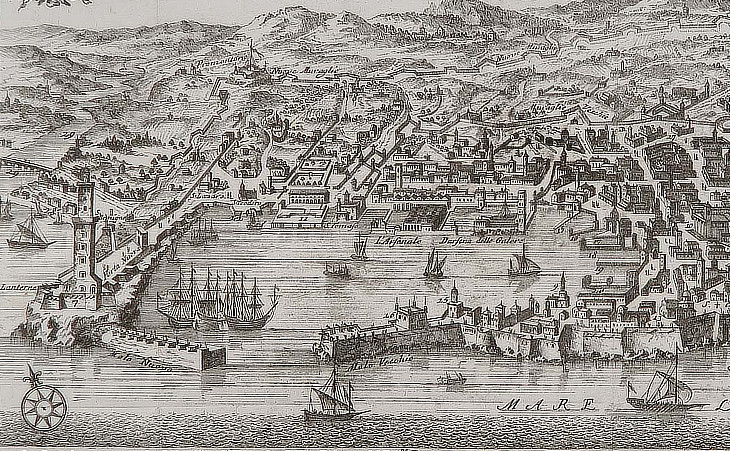
1751 View of Genoa by Giambattista Albrizzi from the Italian edition of Thomas Salmon's "Modern History or the Present
State of all Nations (1739)": it shows Mola Vecchia and Mola Nuova (fortified breakwaters), Arsenale (shipyard), Darsena delle Galere
(wharf for the galleys) and other facilities of the harbour
The Mole is a worke of solid huge stone stretching neere 600 paces into the main sea, and secures the harbour, heretofore
of no safety. Of all the wonders of Italy, for the art and nature of the designe, nothing parallels this. Evelyn
The Haven heretofore was very unsafe, and many Ships which had tugg'd through the most dangerous Seas abroad, were seen to sink here in
the Haven at home; the French, then Masters of Genoa, not suffering her to shut up her Haven, least she should shut them out.
But since she hath shaken off the French yoke, she hath locked up her Treasures, and bolted the door on the inside, by that admirable Mola,
which crossing almost quite over the Bay doth not only bolt out all Enemies, but even locks up the bolsterous Sea itself, and makes it
tame in the Haven. It's a prodigious work, and able to have puzzl'd any two Kings in Europe to have done it.
Richard Lassels' The Voyage of Italy, or a Compleat Journey through Italy in ca 1668
I never beheld any thing more amiable: Only figure to yourself a vast semicircular basin,
full of fine blue sea, and vessels of all sorts and sizes, some sailing out, some coming in, and others at anchor; and all round it palaces, and
churches peeping over one another's heads, gardens, and marble terraces full of orange and cypress trees, fountains, and trellis-works covered
with vines, which altogether compose the grandest of theatres.
Thomas Gray's Letters to family and friends from France and Italy in 1739-1741
Turning the light-house point, you find yourself close to the mole, which forms the harbour of Genoa. It is built at a great expence from each
side of the bay, so as to form in the sea two long magnificent jetties. At the extremity of each is another smaller lanthern. These moles are both
provided with brass-cannon, and between them is the entrance into the harbour. But this is still so wide as to admit a great sea, which, when
the wind blows hard from south and south-west, is very troublesome to the shipping. Within the mole there is a smaller harbour or wet dock,
called Darsena, for the gallies of the republic.
Tobias Smollett's Travels through France and Italy
in 1765
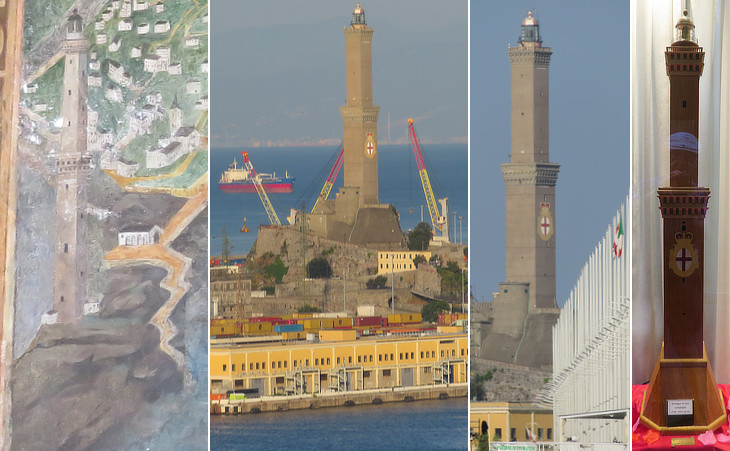
The Lanterna, the symbol of Genoa: (left to right) from the fresco at Palazzo Doria Spinola (ca 1580); from Castelletto; from Palazzo di S. Giorgio (see below); in a
shop window in Via Garibaldi (Strada Nuova)
At the other horne of the outward Port towards the south-west, is the tower Faro upon firme land, kept by certaine watchmen, who by night hang out
lights to direct the marriners at sea. Moryson
We pass'd over to the Pharos, or Lantern, a
towre of very great height. Evelyn
At one end of this Mola stands the Pharos upon a little rock, with a Lantern upon it, to give notice, by known signs, what Ships, how many,
and from what side they Come: or else to guide their own Ships home safely in the night. Lassels
The first object that strikes your eye at a distance, is a very elegant pharos, or light-house, built on the projection of a
rock on the west side of the harbour, so very high, that, in a clear day, you may see it at the distance of thirty miles. Smollett
The port, round which "Genova la Superba" extends, is terminated at either extremity by two piers, the Molo Vecchio and the Molo Nuovo. Near the land end of the western pier stands the Fanale, or lighthouse, built 1547; the tower
rising to the height of more than 300 feet out of the rock. Several towers had previously stood here in succession.
John Murray -
Handbook for travellers in northern Italy - 1843
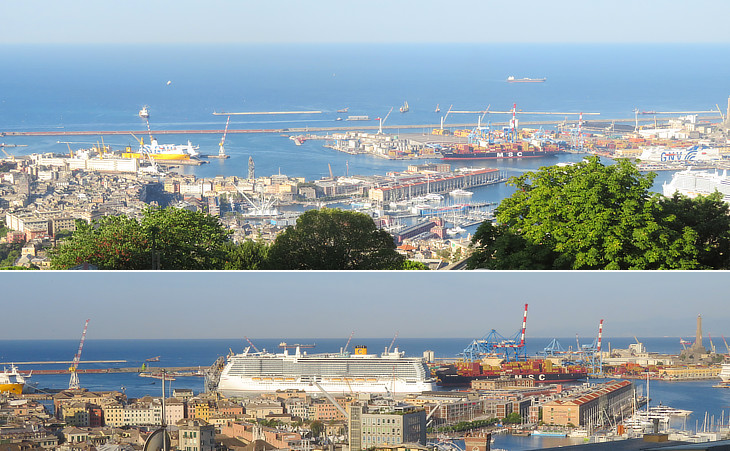
Views of the historical harbour (Porto Vecchio) from Righi (above) and Castelletto (below); today it is reserved to ferries and
cruise ships, all the other activities having been relocated west of it
Their fleet, that formerly gained so many victories over the Saracens, Pisans, Venetians, Turks, and Spaniards, that made them masters
of Crete, Sardinia, Majorca, Minorca, Negrepont, Lesbos, Malta, that settled them in Scio, Smyrna, Achaia, Theodosia, and several towns on the
eastern confines of Europe, is now reduced to six gallies. When they had made an addition of but four new ones, the King of France
(Louis XIV)
sent his orders to suppress them, telling the republic at the same time, that he knew very well how many they had occasion for.
This little fleet serves only to fetch them wine and corn, and to give their ladies an airing in the summer-season.
Joseph Addison's Remarks on several parts of Italy, in the years
1701, 1702, 1703
At my Entrance into Genoa,
I pass'd by the Lantern Tower, which is for lighting Ships in the Night; and so along the Sides of the Harbour, which is a large one; and had,
as I went along there, a very fine View of the City. There were in the Harbour five Gallies with Slaves: and, as I was told, they are not to
exceed that Number, being oblig'd to it by Powers stronger than themselves.
Edward Wright Some observations made in travelling through France, Italy, &c. in 1720, 1721, and 1722
The harbour is large and deep, but lies exposed to the southwest, the most troublesome wind in those seas. There is a little harbour,
built within the great one for their gallies, and two moles for the security of their ships besides a third mole begun since the French
bombardment in 1684, and some new batteries erected towards the sea since the present war, in order to secure them from the insults of an enemy.
(..) They had formerly a very considerable fleet, (..) but their naval force is now dwindled to six gallies.
Thomas Nugent - The Grand Tour - 1749
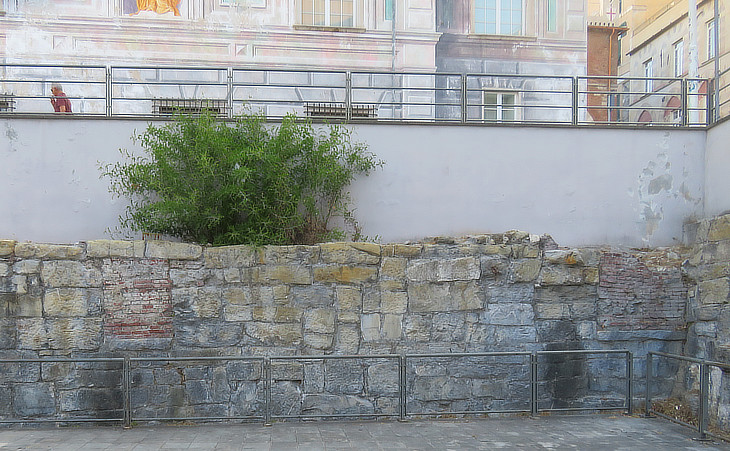
Medieval quays which have been unearthed when digging for the "S. Giorgio" underground station in 2003
In origin the natural location of the harbour was a beach. During the XIIIth century the
rulers of Genoa financed the deepening of the bay and its protection by short breakwaters made of piles and stones.
This small harbour was known as Mandraccio and was reserved to the galleys of the Republic; the same name can be found on
Rhodes and Malta.
The prevailing currents having
clogged the harbour with a heavy deposit of sand, it became necessary to deepen the waterways. The mouth of the basin was sealed, probably with
sheet piling, and an enormous wheel was built astride the dock. To it were attached large buckets
and the huge machine was set in motion by a smaller wheel worked by ropes and cords, while between seven and eight hundred men were required
daily to supply the motive power. Thus a new facility especially designed for building large galleys was completed in 1457.
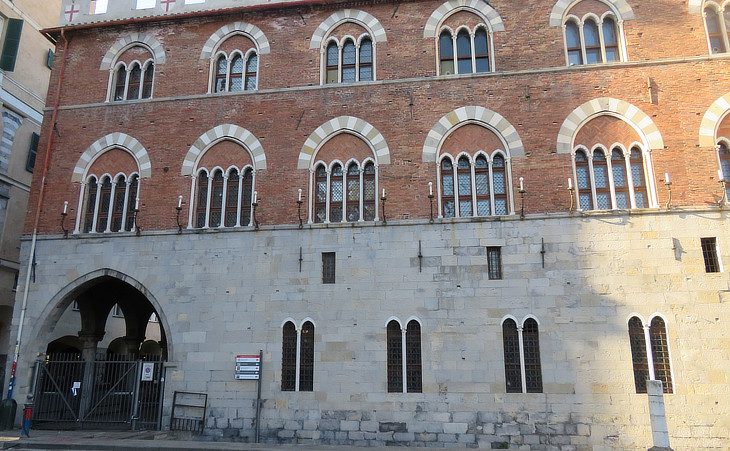
Palazzo di S. Giorgio: medieval part of the palace (restored in the XIXth century)
The Office of S. George is (as far as I understand it) nothing but a company of Bankers, which lend money to the Commonwealth, for which they are allowed so much per cent, and have
assigned to them the publick gabells and other revenues, and for their further security have also the Island of Corsica engaged to them.
John Ray's Observations (..) made in a journey through part of (..) Italy in 1663.
I know nothing more remarkable in the government of Genoa, than the bank of St. George, made up of such branches of the revenues,
as have been set apart and appropriated to the discharging of several sums, that have been borrowed from private persons, during the
exigences of the commonwealth. Whatever inconveniencies the state has laboured under, they have never entertained a thought of violating the
public credit, or of alienating any part of these revenues to other uses, than to what they have been thus assigned.
The administration of this bank is for life, and partly in the hands of the chief citizens, which gives them a great authority in the state, and a
powerful influence over the common people. (..) These managers have been
represented as a second kind of Senate. Addison
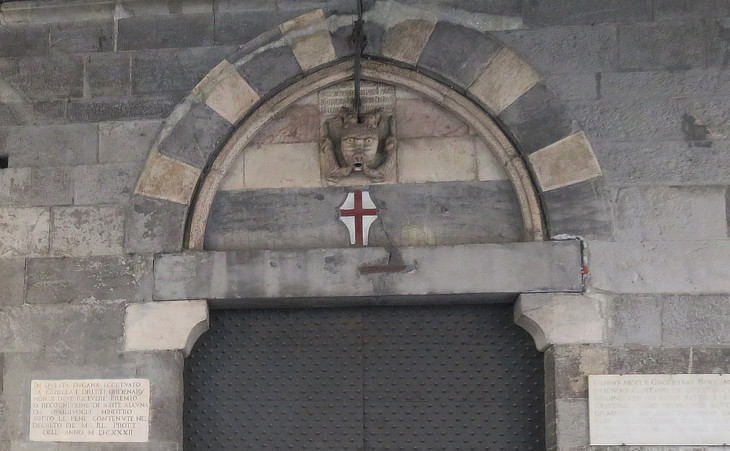
Palazzo di S. Giorgio: medieval portal with a mask depicting the head of a lion and the inscription celebrating its foundation (the mask was most likely
taken at Constantinople after that city had been conquered by the Crusaders in 1204); a 1632 inscription warns that
no payments should be made apart from the customs duty (learn why St. George's Cross is the symbol of the Republic of Genoa)
The building itself dates from soon after the middle of the XIIIth century, when Guglielmo Boccanegra was elected captain or governor
of the city. He seems to have been a masterful and tyrannical individual, and one who so far disgusted his fellow-citizens that in a few
years' time he was summarily driven from power. In the meanwhile he had ordered the building of the palace for himself as head of the State;
and its architect is said to have been a monk named Oliveri, from the monastery of S. Andrew in Sestri Ponente, who had already been employed
in other public works. Some authorities place the completion of the building in the year 1260, others in 1262. It is further recorded
that in 1278 the son of the then King of Sicily was lodged there. At a still later date the palace is mentioned with the name of the
Palazzo del Comune al Mare, the communal palace by the sea. It was enlarged in 1368, and again in 1392, before being taken over by the
Compere di San Giorgio in 1407; without, however, ceasing to belong to the State, which only ceded it absolutely to
the Administration in 1451, when its name was changed to that by which we now know it.
William Scott - The Riviera painted and
described - 1907
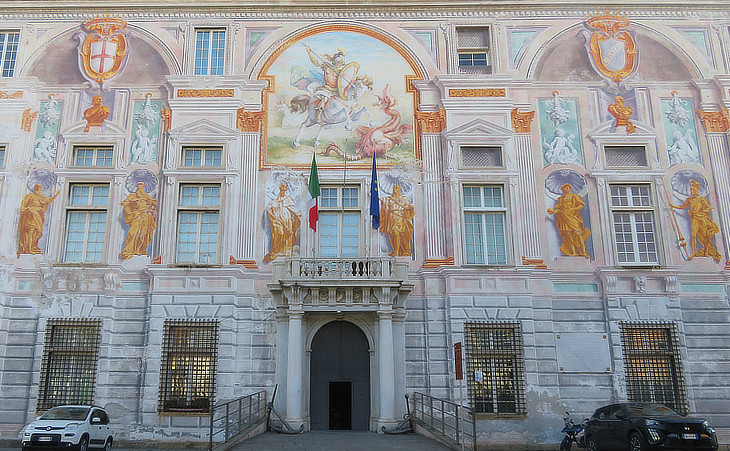
Palazzo di S. Giorgio: Renaissance façade with 1606 frescoes by Lazzaro Tavarone which were thoroughly repainted in 1913 (see other
frescoes by Tavarone at the Cathedral); the fresco portraying St. George is shown in the image used as background for this page
It was not until 1675 that the administration of the Compere (pawns) took the name of Bank, though its operations had, of course, been of a banking nature;
but at this date its functions were considerably enlarged, and, in consequence, the new title granted.
Among the important operations carried on by the Compere was the taking over from the State of many of its conquered properties,
when these had a commercial importance; managing them from a business point of view, and afterwards ceding them again to the Government.
In this way the institution became possessor of the island of Corsica. (..)
The palace was afterwards enlarged, this time by the society itself, in 1535, and again in 1571, so greatly did the importance of the business
operations increase, necessitating fresh accommodation. Scott
What is most remarkable in the Modern History of Genoa, is, the rebellion of their subjects in the island of Corsica,
which could never have subsisted so many years, if it was not fomented by some foreign powers; but who they are is yet a secret. (..) The French,
under pretence of making themselves umpires between the Genoese and their subjects, have introduced a body of troops
into that island, and will probably give law to both. Salmon
There is a bank at Genoa known by the name of S. George, which has part of the public duties for its fund, but has suffered much in its
credit by the late troubles of the republic. Nugent
In 1768 the Republic of Genoa ceded Corsica to King Louis XV of France.
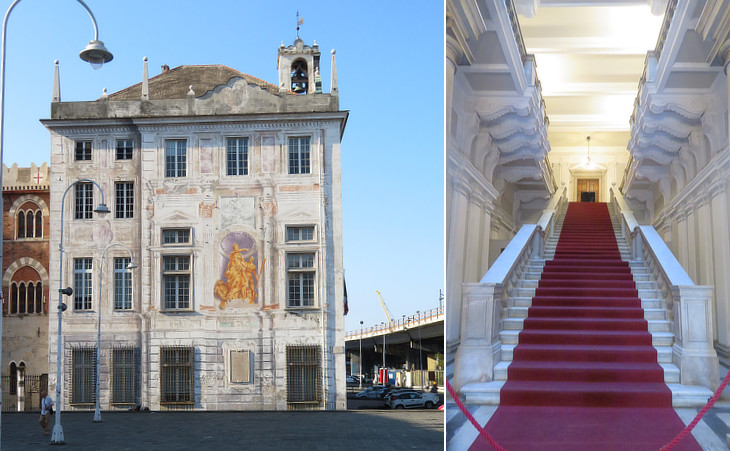
Palazzo di S. Giorgio: (left) western side and to its right "Strada Sopraelevata" a highway that runs across the historical harbour;
it is supported by concrete pillars high above the street level below, thus greatly modifying the urban landscape; (right) grand staircase (early XXth century)
The Compera, or Banco di San Giorgio (Bank of St. George), of which the hall is now used as the custom-house, was the most ancient establishment
of this description in Europe. It was a combination, so to speak, of the Bank of England and the East India Company, being both a banking and a
trading company. The colonies of Caffa in the Crimea, several ports in Asia Minor, and also Corsica, were under its administration, and
the latter island is still studded with the towers and blockhouses upon which the arms of the Bank are engraved.
The Bank was managed with great ability and integrity; and most of the charitable public institutions had their
funds placed here at interest, which was regarded, and justly, as a most secure investment. The French passed their sponge over the accounts,
and ruined the individuals and the communities. Murray
The recently established institution (today known as the Western Ligurian Sea Port Authority) which, with the authorisation - indeed, the participation - of the Government, has
taken charge of all business matters connected with the port of Genoa, and has its headquarters on the old Palazzo di San Giorgio, has served, among other things, to call attention to this old building, which has played an important part
in the history of the Republic, though during the past century it had been neglected or misused. Scott
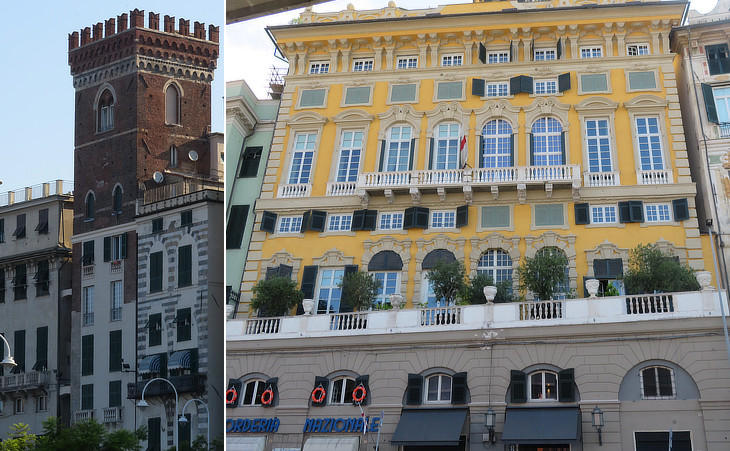
(left) Torre dei Morchi (it was part of the "Croce di Malta" hotel); (right) Palazzo di Stefano Durazzo (part of it houses luxury suites)
We passed through a considerable number of ships and vessels lying at anchor, and landing
at the water-gate, repaired to an inn called La Croix de Malthe in the neighbourhood of the harbour. Here we met with such
good entertainment as prepossessed us in favour of the interior parts of Italy, and contributed
with other motives to detain us some days in this city. Smollett
I had found my hotel, in the first place, extremely entertaining - the Croce di Malta, as it is called, established in a gigantic palace on the
edge of the swarming and not over-clean harbour. It was the biggest house I had ever entered - the basement alone would have contained a
dozen American caravansaries. I met an American gentleman in the vestibule who (as he had indeed a perfect right to be) was annoyed by
its troublesome dimensions - one was a quarter of an hour ascending out of the basement - and desired to know if it were a "fair sample"
of the Genoese inns. It appeared an excellent specimen of Genoese architecture generally; so far as I observed there were few houses
perceptibly smaller than this Titanic tavern. I lunched in a dusky ballroom whose ceiling was vaulted, frescoed and gilded with the
fatal facility of a couple of centuries ago, and which looked out upon another ancient housefront, equally huge and equally battered,
separated from it only by a little wedge of dusky space - one of the principal streets, I believe, of Genoa.
Henry James - Italian Hours - 1909 (this essay was written in 1878)
Palazzo Durazzo is among those chosen by the City Council in 1576, to accommodate the Eminent Guests of the Repubblic.
They are known as Rolli Palaces after "rolli", official lists of buildings which were suited for this purpose. The entrance to the palace is in Via
del Campo, a historical street of Genoa. The rear side overlooking the harbour was redesigned in the XVIIIth century.
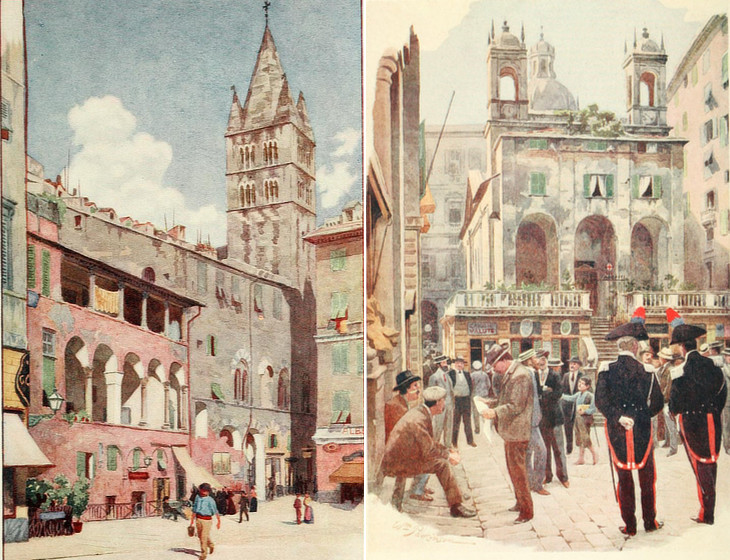
Churches very near the harbour by William Parkinson, from "Robert Walter Carden - The City of Genoa - 1908": (left) S. Giovanni di Prè; (right) S. Pietro in Banchi
Into this harbour sailed Pope Urban VI with the six rebellious cardinals in 1385, and by
the margin of its waters five of them were strangled in the dark mysterious vaults of San Giovanni di Pre. (..) Where San Giovanni di Pre now
stands an irregular patch of sand made a deep indentation into the pastures behind. History has forgotten when the church was first built,
but it was there to shelter the ashes of St. John the Baptist when they reached Genoa in 1097, and long before it was called San Giovanni di Pre
it had borne the name of "S. Johannes in capite arenae" (at the top of the sands)."
(..)
From morning to night the square and the street leading down to the Piazza Caricamento are thronged with
business men who embody the modern commercial activity of Genoa. The flight of steps leading up to the red curtained door of San Pietro Banchi forms a
pleasant out-door office, which is shared by stock brokers and beggars. Carden
S. Giovanni di Prè was a hospital with an adjoining church
which belonged to the
Knights Hospitallers. Prè means prati/meadows because the building was located outside Porta Vacca,
the western gate of the medieval town. The hospital was eventually closed and the church underwent many modifications. In 1895 a fine monument to
Antonio Grimaldi, a Knight, was relocated to the southern side of the Cathedral.
Banchi is a term which means stalls/shops/banks and it was used also at Rome and Siena.
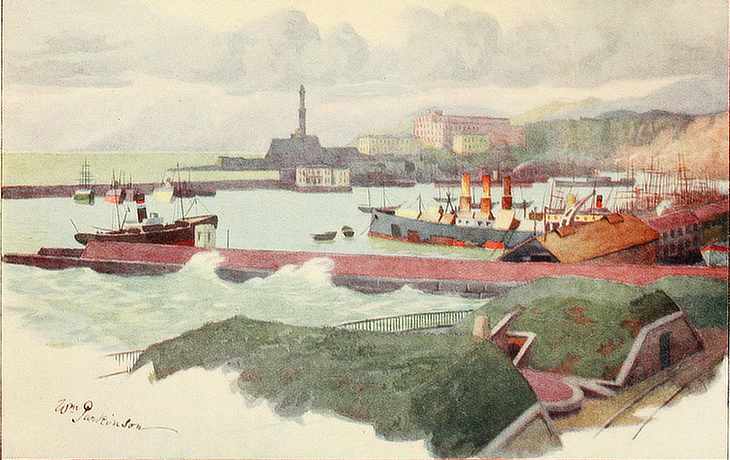
View of the Harbour by William Parkinson, from "Robert Walter Carden - The City of Genoa - 1908"
The harbour of Genoa now presents a different scene. The high-built galleons which bore the D' Oria admirals to victory have been succeeded by the stately liners of the North German Lloyd, the Navigazione Generale Italiana and other great shipping companies. Venice and Pisa, her old-time rivals have long ceased to contend with her, and the battle for supremacy is being fought out between the modern ports of Genoa and Marseilles. The Italy of to-day is striving to make her great harbour the most important on the Mediterranean. Carden
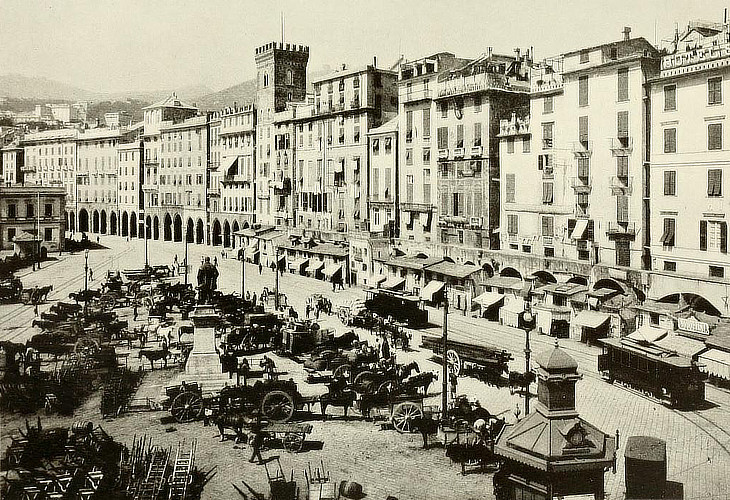
Piazza Caricamento (Loading) and Sottoripa from "Robert Walter Carden - The City of Genoa - 1908"
Shortly after coming into the port our whole party landed, and we found ourselves at
once in the midst of a crowd of cab-drivers, hotel-runnets, and coin missionaires, who assaulted us with a volley of French,
Italian, and broken English, which beat pitilessly about our ears; for really it seemed as if all the dictionaries in the world had been
torn to pieces, and blown around us by a hurricane. Such a pother!
Nathaniel Hawthorne - Passages from the French and Italian
note-books - 1872
Sands and fields, a church dedicated to the Blessed Virgin, and situated among the vines with a sparkling rivulet
close by; such was once the spot now built over with tall warehouses and stores, and where the din of traffic never ceases.
There were olive mills and orchards where the crazy vaults of Sottoripa stand to-day (..) At the corner of the Piazza Caricamento, facing the
Palazzo di San Giorgio, is the old residence of the Adorni family, now a hotel, and over the arches of Sottoripa there are the palaces of Genoa's
chief merchants. Carden
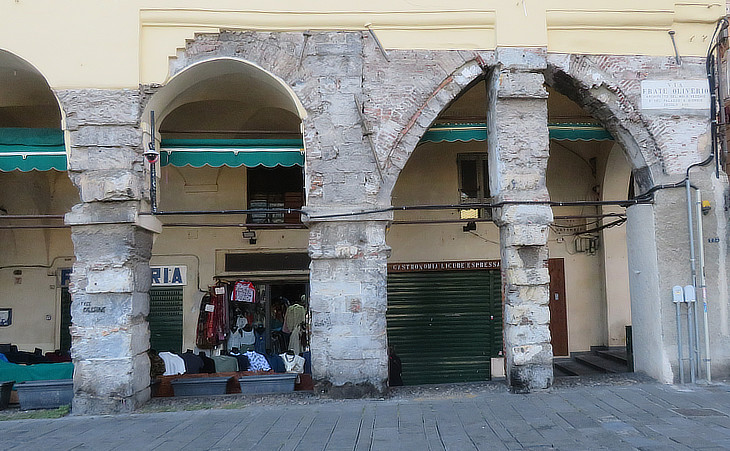
Evidence of a medieval warehouse at Sottoripa
Before the basements of these houses, is an arcade over the pavement: very massive, dark, and low, like an old crypt.
The stone, or plaster, of which it is made, has turned quite black; and against every one of these black piles, all sorts of filth and garbage
seem to accumulate spontaneously. Beneath some of the arches, the sellers of maccaroni and polenta establish their stalls, which are by no means
inviting.
Charles Dickens - Pictures from Italy - 1846
I am bound to say however that I believe a great deal of the sensuous optimism observable in the Genoese alleys and beneath the low,
crowded arcades along the port was very real. Here every one was magnificently sunburnt, and there were plenty of those queer
types, mahogany-coloured, bare-chested mariners with earrings and crimson girdles, that seem to people a southern seaport
with the chorus of "Masaniello" (an opera by Daniel Auber). James
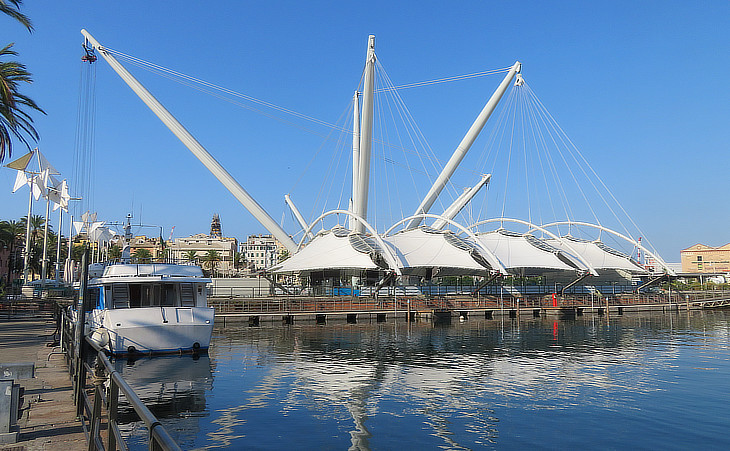
"Il Bigo" the name of a traditional ship-loading crane, by Renzo Piano, a Genoese architect (see the Auditorium he designed in Rome in 1994)
The relocation of most of the harbour activities to new facilities at Sampierdarena and Sestri Ponente led to the decision by the
Government and the City of Genoa to create a series of tourist attractions to give a new purpose to Porto Vecchio, the old harbour.
The redesign of the area was financed in the frame of Expo 1992, an international exhibition which celebrated the 500 years since the
discovery of America by Columbus.
"Il Bigo" is the symbol of the
development project. Its tensile structure shelters Piazza delle Feste, a venue for events and concerts.
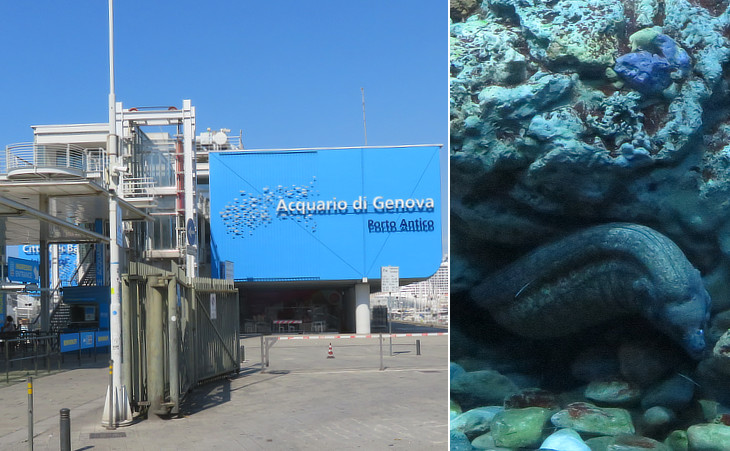
(left) Aquarium of Genoa by Renzo Piano; (right) tank of the Mediterranean moray (the meat of moray eels was so highly valued in ancient times that the
Romans built breeding pools where they would raise and fatten them to have them always available, e.g. at Sperlonga; according to a dark legend
Emperor Tiberius fed moray eels with the flesh of slaves or enemies, thrown alive into these pools)
It is proverbially said of this City; (..) Mar senza pesci, (..):
That is, (..) Sea without fish. Moryson
The greatest attraction of Porto Vecchio is its new aquarium, the largest one in Italy.
It was inaugurated in October 1993 and in 1998 it was expanded.
The facility houses around 12,000 animals representing more than 600
species, displayed in over 70 exhibition tanks that recreate marine and terrestrial ecosystems from around the world - from
tropical seas to polar regions.
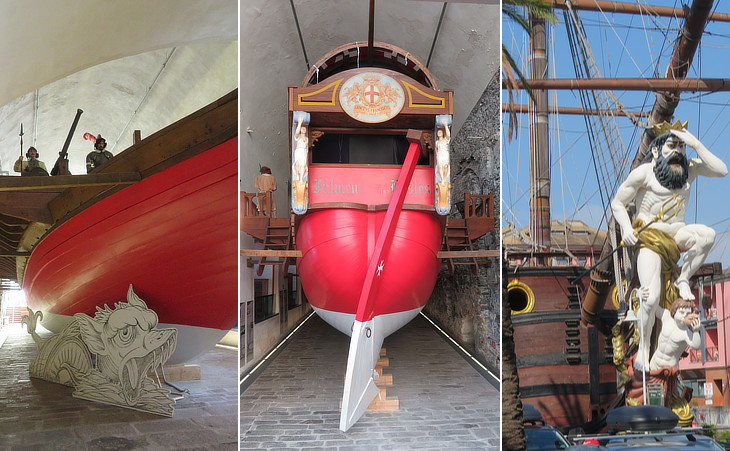
(left/centre) Galata - Museo del Mare - a reconstructed XVIIth century Genoese galley; (right) figurehead (Neptune) of a modern replica of a
galleon
We descended towards the Arsenale, where the gallys lie in excellent order. Evelyn
Towards the end of the XIXth century new wharfs were built on the site of the historical arsenal. One of them was named Galata,
after the Genoese colony which stood opposite Constantinople.
In 2004 the warehouses along the wharf
were redesigned in order to house a Museum on the relationship between Genoa and the Sea. Its most impressive exhibit is the reconstruction of a XVIIth century Genoese galley,
placed on the original launching slide. During the bad season sailing was not recommended and galleys were pulled dry and disarmed in the arsenals.
Neptune is a ship replica of a fictional galleon designed by naval architect David Cannell.
The ship was built in 1985 for Roman Polanski's film Pirates, where she portrayed the Spanish ship of the same name.
The ship is an accurate replica above the waterline, but sporting a partly steel hull, planked in timber and two main engines with Schottel drive.
The Neptune is currently a tourist attraction in the port of Genoa.
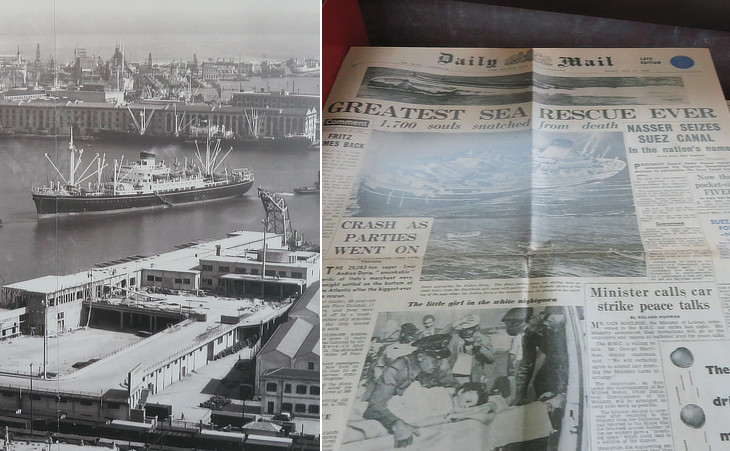
Galata - Museo del Mare: (left) SS Andrea Doria in the harbour of Genoa; (right) 26 July 1956 - after the collision with MS Stockholm, SS Andrea Doria is about to sink off the coast of Nantucket, Massachusetts
Move to
The Ancient Town
The Cathedral
The Doria's Palaces and Church
Palazzo del Principe
The Piazza Nuova
The Strada Nuova
Via Balbi
Two Grand Churches
A Walk to Castello
In the Heart of the Old Town
Old and New Portoria
Museums: Exhibits from Churches
Museums/Palaces: Tursi and Bianco
Museums/Palaces: Rosso and Spinola
Some Environs of Genoa
Anthony van Dyck's 2026 Exhibition


