
All images © by Roberto Piperno, owner of the domain. Write to romapip@quipo.it.


Notes:
Page added in October 2026.
All images © by Roberto Piperno, owner of the domain. Write to romapip@quipo.it.
Notes:
Page added in October 2026.
 Palazzo del Principe
You may wish to see pages on the Houses of the Doria around S. Matteo and the Cathedral first.
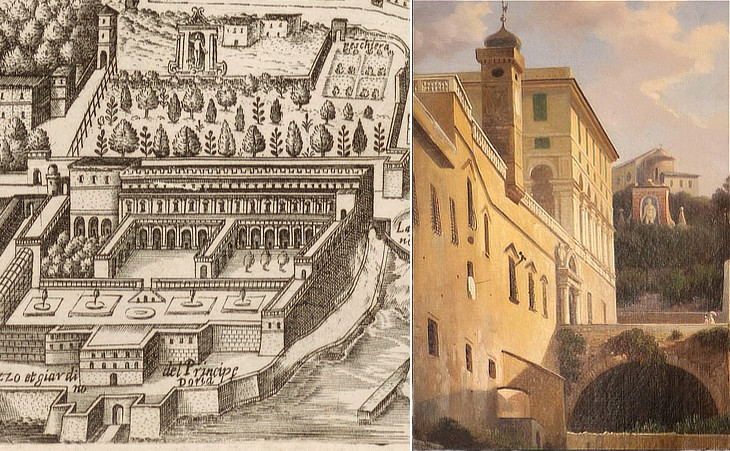
(left) Palazzo del Principe, 1637 engraving by Alessandro Baratta; (right) "Eastern side of the Palace with its town entrance and the
statue of Neptune" in a painting by Domenico Pasquale Cambiaso (1864)
The church (S. Matteo) finished, the same Prince Doria
ordained Agnolo Montorsoli that work should be
begun on his Palace (he had also a palace in town), and that new additions of
buildings should be made to it, with very beautiful gardens.
He also executed a great Neptune in stucco, which was placed on a pedestal in the garden of the Prince (see the fountain of Neptune he made
at Messina).
Giorgio Vasari - Life of Fra Giovanni Agnolo Montorsoli - 1568.
As you walke towards the City, and before you enter into the gates, lies the stately
Pallace of Andreetta D' Auria, (or Doria) the building whereof, the garden, the staires to discend to the sea, the banquetting house, and divers
open galleries, are of Kingly magnificence. Not farre thence upon the wall is a statua erected to Andrea d' Auria, late Admirall to the Spanish
Fleete. (..) My selfe did see Tis Pallace the building whereof was very stately, and the garden not
onely most pleasant, but adorned with statuaes and fountaines. And in one of the chambers were the Gentlemens Armes, whereof some were of pure
silver guilded over.
Fynes Moryson - An Itinerary: Containing His Ten Years Travel Through .. Italy (in 1594)
The great Andrea Doria
is emphatically called "il Principe" (for that title of dignity had been granted
to him by Charles V). The successive employments held by Doria enabled him to acquire great wealth.
With these riches he was able to keep a fleet of 22 galleys; a force with which he turned the scale against the French, and accomplished the
deliverance of Genoa, 11th Sept. 1528, from the heavy yoke which they imposed. It was under Doria's influence and counsel that the form of
government was established in Genoa which lasted till the revolution. He was offered the ducal authority for life, and there is no doubt
but that he might have acquired the absolute sovereignty.
John Murray -
Handbook for travellers in northern Italy - 1843
I had not been in Genoa since 1864 except for a few days in 1905, and I saw changes which I will
mostly not specify. Already at the earlier date the railway had cut through the beautiful and reverend Doria garden and left the
old palace some scanty grounds on the sea-level, where commerce noisily encompassed it with trams and tracks and lines of freightcars.
But there had remained up to my last visit that grot on the gardened hill-slope whence a colossal marble Hercules (!) helplessly overlooked the
offence offered by the railroad; and now suddenly here was the lofty wall of some new edifice stretching across in front of the Hercules and
wholly shutting him from view (the gigantic stucco statue portraying Neptune was demolished in the 1930s).
William Dean Howells - Roman Holidays, and others - 1908
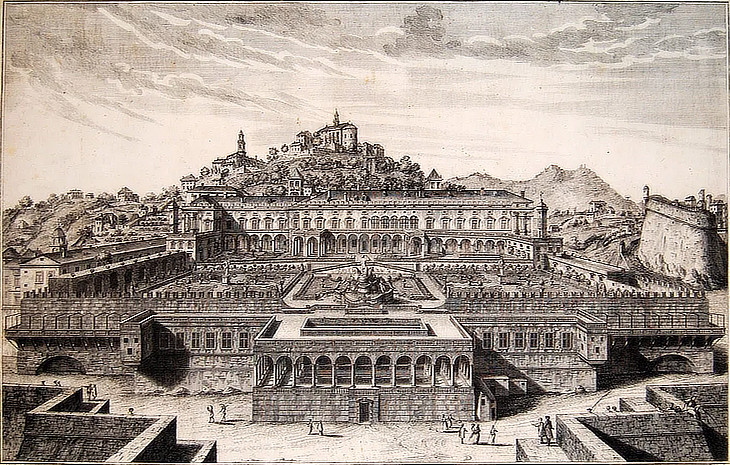
Palazzo del Principe, etching by Antonio Giolfi (ca 1769)
17 Oct. 1644. One of the greatest palaces here for circuit is that of the Prince d'Orias, which reaches from the sea to
the summit of the mountaines.
The house is most magnificently built without, nor less gloriously furnish'd within, having whole tables and bedsteads of massy silver, many of them sett with achates, onyxes, cornelians, lazulis, pearls, turquizes, and other precious stones.
The pictures and statues are innumerable. (..) The gardens are full of orange-trees, citrons, and pomegranads, fountaines,
grotts, and statues; one of the latter is a Colossal Jupiter (!), under which is the sepulchre of a beloved dog.
John Evelyn's Diary and Correspondence related to his stay in Italy in 1644
As you return from San Pietro d' Arena, to the Town, not far from the Gates, stands the Villa, or Palace of the Duke D' Oria. I reserved
this for the last, "pour faire bonne bouche" (to finish on a high note). (..)
From the Palace we were led over the Street to his great Garden upon the Hill side, where all the Graces that can make up a Garden are found.
Richard Lassels' The Voyage of Italy, or a Compleat Journey through Italy in ca 1668
From hence to the Palazzo Doria. I should make you sick of marble, if I told you how it was lavished here upon the porticoes, the balustrades,
and terraces, the lowest of which extends quite to the sea. The inside is by no means answerable to the outward magnificence;
the furniture seems to be as old as the founder of the family. There great embossed silver tables tell you, in bas-relief, his victories at sea;
how he entertained the Emperor Charles, and how he refused the sovereignty of the Commonwealth when it was offered him;
the rest is old-fashioned velvet chairs, and gothic tapestry.
Thomas Gray's Letters to family and friends from France and Italy in 1739-1741
The duke of Doria's palace makes the best appearance of any in Genoa, and is deservedly admired for its situation, architecture, tapestry lace
hangings and other rich furniture, gardens, fountains, statues and among the rest a fine one of the famous Andrew Doria, busts, basso - relievo's,
and most beautiful paintings.
Thomas Nugent - The Grand Tour - 1749
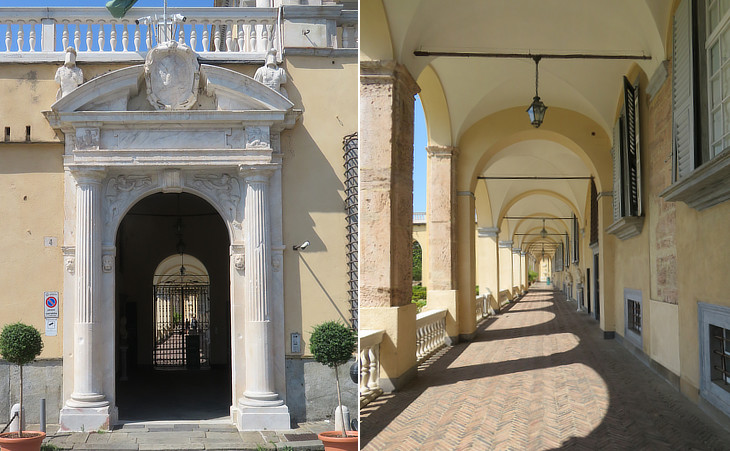
(left) Portal of the town entrance; (right) ground floor loggia
To detail the palaces of Genoa would be impracticable in the present work, yet one more must be noticed, which, from its situation, is the most
striking of them all: the Palazzo Doria Panfili, the gardens of which
extend to the sea-shore. These gardens, as well as those of the palace in their centre, form a noble feature in the panorama of the port of Genoa.
(..) This magnificent pile, was acquired by the great Andrea Doria, and improved, or rather rebuilt, and brought to its
present form, by him. The architect was Montorsoli, a Florentine: but many portions were designed by the celebrated Pierino del Vaga,
who has here left some of the best productions of his pencil, but which are fast decaying, upon the walls; so rapidly, indeed, that in a few
years, it is to be apprehended, they will have almost wholly disappeared. Murray
I begin, then, by saying that at the entrance of the Prince's Palace there is a marble portal composed in the Doric Order, and built after
designs and models by the hand of Perino, with all its appurtenances of pedestals, socles, shafts, capitals, architrave, frieze, cornice and
pediment, and with some most beautiful seated figures of women, who are supporting an escutcheon.
Giorgio Vasari - Life of Perino del Vaga - 1568
Prince Doria's palace is detached from the throng, and commands attention as an historical monument. Though magnificent when viewed from the
bay or the mole, the mansion itself is patched and neglected; the titles of the immortal Andrew, which extended 200 feet in front, were
effaced by the late revolution: the gardens are unnaturally pretty; colossal statues rise over cut box; nothing corresponds with the majesty of the site.
Joseph Forsyth's Remarks on Antiquities, Arts, and Letters in Italy in 1802-1803
The present entrance is all but imposing,
although its 1581 portal has points in common with that designed by Perin del Vaga and described by Vasari.
The palace is almost sieged by railway lines and by highly congested roads and the hill behind it is a disorderly mass of buildings stacked upon each other.
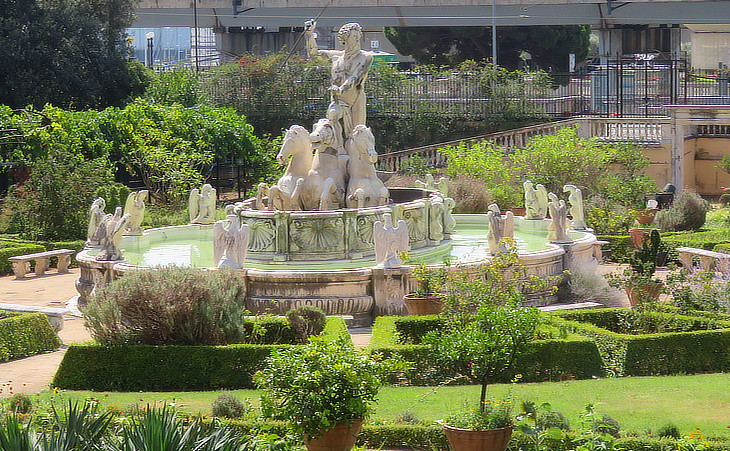
Fountain of Neptune (second half of the XVIth century - you may wish to compare it with a similar fountain at Piazza della Signoria in Florence)
To this Palace belong three gardens, the first whereof is beautified with a terrace, supported by pillars of marble;
there is a fountaine of eagles, and one of Neptune with other Sea-gods, all of the purest white marble; they stand in a most ample basine of the
same stone. Evelyn
The palace stands upon the Sea-side, and its Garden towards the Sea is built
upon three Rows of white Marble Rails, born up by white marble Pillars, which ascending by degrees, is so beautiful to behold from the Sea, that
Strangers passing that way to Genoa, take this Garden for a second Paradise. In the midst of it stands the rare Fountain of Neptune,
representing the true looks of brave Andrea D' Oria, the Neptune of the Ligurian Sea, and the Man who put his Country out of Livery,
and taught it not to serve. Lassels
Beyond this gallery you look upon
the garden, where are walks of cypress and orange, fountains, statues, and vases. In the background are the sea, the moles, the lighthouse.
The fountain in the centre represents Andrea in the character of Neptune. Murray
Today the view over the harbour and the sea is marred by
the Strada Sopraelevata a highway that runs several miles, connecting residential areas to industrial zones and
motorway exits. It is supported by concrete pillars high above the street level below, thus greatly modifying the historical urban landscape. The Palace had direct access to the harbour
where the Doria kept their galleys, as shown in the 1637 engraving.
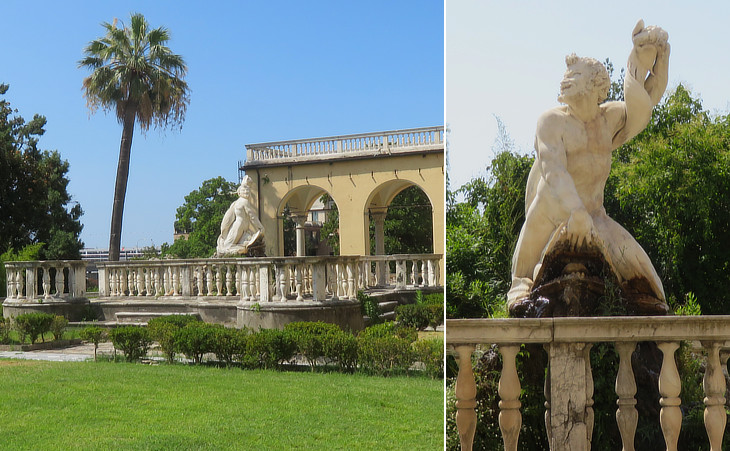
Fountain of the Satyr or Triton, actually a satyr riding a dolphin
The gardens were executed under the direction of the Frate (Montorsoli), who, having at the last
constructed a fish-pond in front of that Palace, made a sea monster of marble in full-relief, which pours water in great abundance into
that fish-pond. Vasari
All the same I will not deny that I enjoyed more than any of the improvements which I noted in Genoa that bit of the
old Doria palace-grounds which progress has left it. The gray edifice looks out on the neighboring traffic across the leafiness of a lovely
old garden, with statues and stone seats, and in the midst a softly soliloquizing fountain, painted green with moss and mould.
Howells
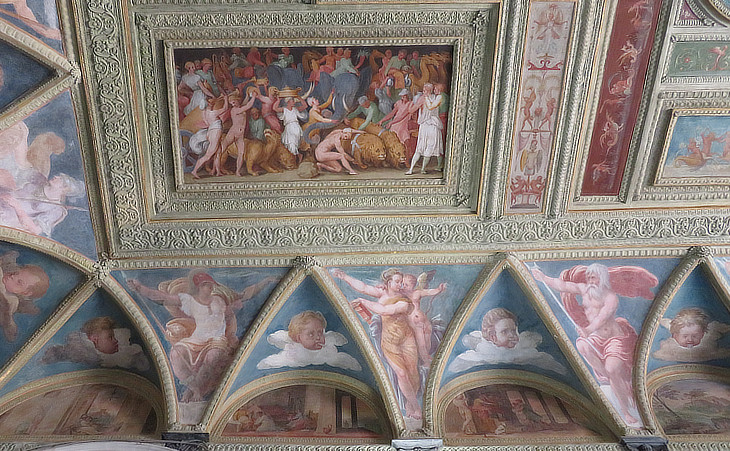
Decoration of the Atrium by Perin del Vaga (restored in the mid-XIXth century); scene depicting the Triumph of Bacchus in India (see a later painting
by Annibale Carracci in Rome)
Perino was guided and governed by art, whom he always acknowledged as his true mother and honoured without ceasing.
And the studies of the art of painting were pursued by him with such zeal and diligence, that he was enabled in due time to execute those
noble and famous decorations which have brought so much glory to Genoa and to Prince Doria. (..) Arriving at Genoa, and making himself known
to that Prince his coming was as welcome to His Excellency as any agreeable experience that he had ever had in all his life. He was received,
therefore, with the greatest possible warmth and gladness, and after many conversations and discussions they finally arranged that he should
begin the work; and they decided that he should execute a palace
adorned with stucco-work and with pictures in fresco. (..) Entering one finds over the vestibule a vault covered with stucco-work, varied scenes, and grotesques, and little arches
in each of which are scenes of war and various kinds of battles, some fighting on foot and others on horseback, and all wrought with truly
extraordinary diligence and art. Vasari
Perin del Vaga was already an acclaimed painter in Rome, but he had
to flee the City because of the 1527 sack by the Imperial troops.
Several churches of Rome retain paintings he made before leaving for Genoa, e.g. S. Marcello,
SS. Trinità di Monti and S. Stefano del Cacco.
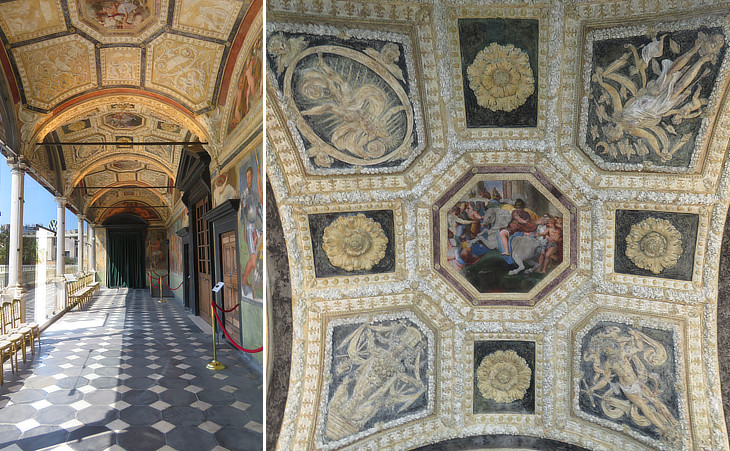
(left) Upper loggia (Loggia of the Heroes), designed and decorated by Perin del Vaga; (right) ceiling
On the left one finds the staircase, which has decorations of little grotesques after the antique that could not be richer or
more beautiful,
with various scenes and little figures, masks, children, animals, and other things of fancy, executed with that invention and judgment that
always marked his work, insomuch that of their kind they may well be called divine. Having ascended the staircase, one comes into a most
beautiful loggia, which has at each end a very handsome door of stone; and over each of these doors, in the pediment, are painted two figures,
one male and the other female, represented in directly opposite attitudes, one showing the front view and the other the back.
The vaulting has five arches, and is wrought superbly in stucco, and it is also divided by pictures in certain ovals,
containing scenes executed with the most perfect beauty that could be achieved. Vasari - Life of Perino del Vaga
When you enter the palace, as you do in response to a custodian who soon comes with a key and asks if you would like to see it, you find yourself,
one flight up in a long glazed gallery, fronting on the garden, which is so warm with the sun that you wish to spend the rest of your stay in Genoa
there. Howells
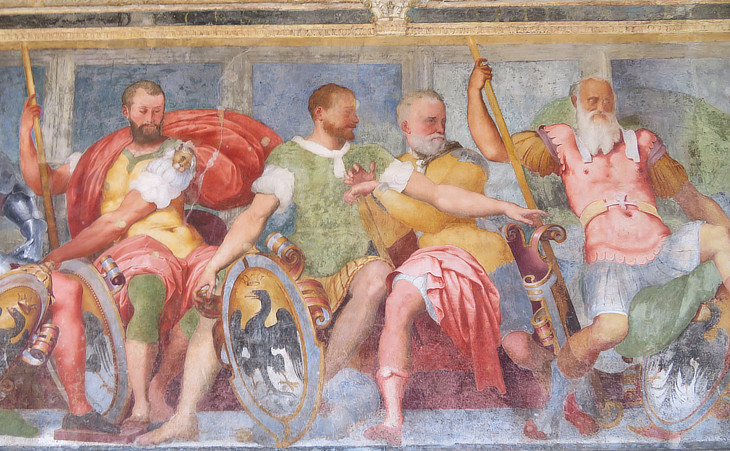
Upper loggia: portraits of the ancestors of Andrea Doria (Pagano Doria is the man spreading his arms)
The walls are painted down to the floor with many seated
figures of captains in armour, some drawn from life and some from imagination, and representing all the ancient and modern captains of the
house of Doria, and above them are large letters of gold, which run thus: "Magni viri, maximi duces, optima fecere pro patria." (
The great men, supreme leaders, performed excellent deed for their homeland)".
Vasari
In the gallery that leads to the terraced garden are the portraits of Andrea Doria and his ancestors.
The figures are in a semi-heroic costume; and supporting themselves upon their shields.
These interesting portraits have been much injured by the soldiery quartered here during the late revolution. Murray
The portraits of the ancestors are linked to one another by a rhythmical sequence of gestures which is an original invention by Perin del Vaga.
Annibale Angelini, a painter and restorer from Perugia worked on the frescoes in mid XIXth
century in an attempt to recover those that had been severely damaged.
Angelini had just finished working on the Loggia when in April 1849, the Palazzo del Principe was overcome by
violent uprisings against Piedmont. The insurgents barricaded themselves in it and the Army fired its artilleries and then sent out an infantry regiment.
Many rebels were killed, the palace was plundered and the soldiers jabbed the points of their bayonets into the faces of the Doria heroes disfiguring them. The consequences of the WWII bombings were even more devastating and
destroyed some vaults of the loggia causing infiltrations and humidity. A thorough restoration was completed in 2002.
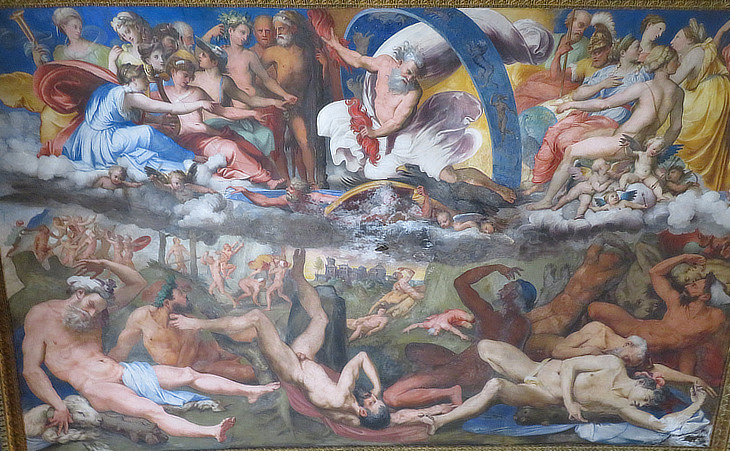
Hall of the Giants: Gigantomachy by Perin del Vaga (see the Council of the Gods at Villa Farnesina in Rome by Raphael and his assistants, including Perin)
In another hall, into which one enters by the right-hand door in the loggia, he executed the vaulting works in stucco and painted pictures in fresco of Jove slaying the Giants with his thunderbolts,
in which are many very beautiful nudes, larger than life. In the Heaven, likewise, are all the Gods, who are making gestures
of great vivacity and truly appropriate to their natures, amid the terrible uproar of the thunder; besides which, the stucco-work is executed
with supreme diligence, and the fresco-colouring could not be more beautiful, seeing that Perino was very able-indeed, a perfect master-in that
field. Vasari
Pierino worked there, not merely as a painter, but generally as a
decorator; and it was Doria's express wish to
reproduce here, as much as possible, the magnificence of Rome, especially in the buildings which Raphael had adorned. The decorations introduced
by Pierino in this palace were exceedingly admired; and he became, in fact, the founder of the peculiar style which prevails in the other ancient
palaces by which Genoa has been so much adorned. Murray
The Gigantomachy was depicted in the fronts of many sarcophagi and on a colossal scale
on the Altar to Zeus at Pergamum. All the gods were involved in the fight (see a sarcophagus in Rome) but
Perin chose to portray only Jupiter in an active role and all the other gods as spectators. It was an indirect way to highlight the role of
Andrea Doria in defending the Republic. It is in this hall that the throne of Charles V was placed when the Emperor visited Genoa in March 1533.
After having completed the decoration of the palace, Perin returned to Rome where he mainly worked at the decoration of the apartment of
Pope Paul III at Castel Sant'Angelo. See also his portrait of Cardinal Alessandro Farnese iuniore, the Pope's grandson.
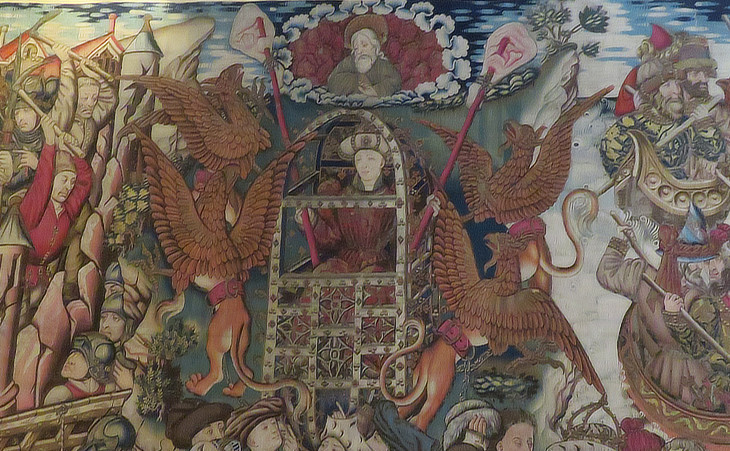
Hall of the Giants: Tapestry portraying the Ascension of Alexander the Great (see a rough Xth century relief portraying this episode in Rome)
The Hall of the Giants is embellished by two large tapestries. They are characterized by the richness of the materials, woven with gold and silver thread mixed with silk and wool. These tapestries were woven around 1460 in Tournai in Belgium, at the time a possession of the Dukes of Burgundy which was eventually inherited by Charles V, and may well have belonged to a cycle of six. The two at Genoa depict Alexander's childhood and his last years. The detail shown above depicts the Macedonian ruler in XVth century attire seated inside a cage studded with jewels holding two long red rods with skewered hams. Four griffins are chained to the cage flapping their wings as they try to reach the meat. By doing so, they raise their load higher and higher into the sky which Alexander wanted to explore. God surrounded by cherubs looks on.
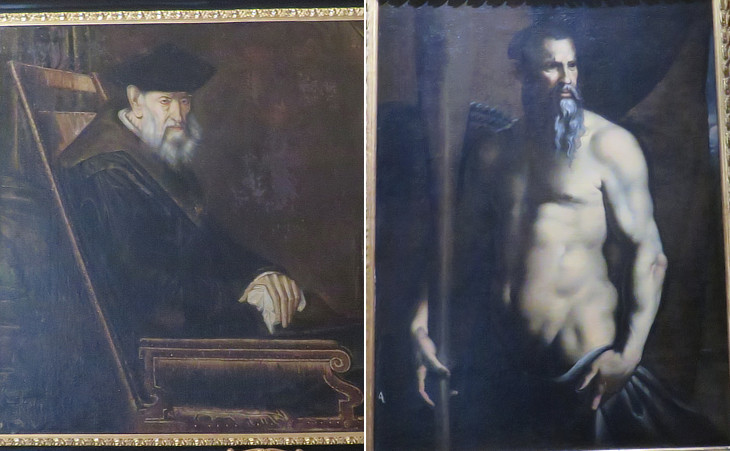
Portraits of Andrea Doria (1466-1560): (left) by Willem Key, a Flemish painter (ca 1550); (right) as Neptune by Agnolo Bronzino (ca 1540 - another copy is at
Pinacoteca di Brera - Milan - it opens in another window)
If you have been here before you will be reserving yourself for the portrait which the custodian will lead you to see in the ultimate chamber of the rather rude old palace, where it is like a living presence.
It is the picture of a very old man in a flat cap, sitting sunken forward in his deep chair, with his thin, long hands folded one on the other,
and looking wearily at you out of his faded eyes, in which dwell the memories of action in every sort and counsel in every kind.
Victor in battles by land and sea, statesman and leader and sage, he looks it all in that wonderful effigy, which shuns no effect of his more
than ninety years, but confesses his great age as a part of his greatness with a pathetic reality.
The white beard, with each particular hair defined, falling almost to the pale, lean hands, is an essential part of the presentment,
which is full of such scrupulous detail as the eye would unconsciously take note of in confronting the man himself and afterward supply
in the remembrance of the whole. (..) There are possibly better portraits in the world than this, but I
remember none which has moved me more. Howells
I shall speak first of Agnolo, called Bronzino, a Florentine painter truly most rare and worthy of all praise.
(..) And having arrived in Florence, he painted as it were by way of pastime (..)
for Monsignor Giovio, his friend, the portrait of Andrea Doria.
Giorgio Vasari - Life of Agnolo Bronzino
The portrait by il Bronzino shows the impact that Michelangelo had over the painters of his time and it is another
example of the identification of the Great Admiral with the God of the Sea.
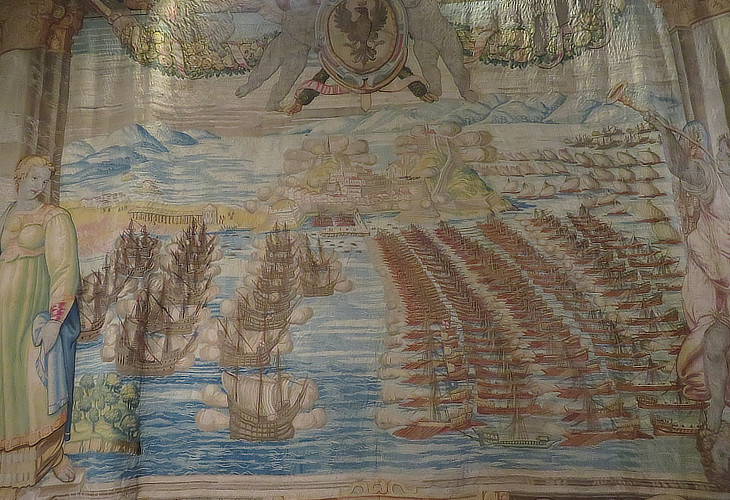
Hall of the Shipwrecks (thus named after a fresco depicting shipwrecks): Tapestry depicting the Christian fleet
at Corfu after the Battle of
Lepanto (the Doria eagle is shown in the image used as background for this page)
The Duke of Doria's
palace has the best Outside of any in Genoa, as that of Durazzo is the best furnished within. There is one room in the first, that is hung with
tapestry, in which are wrought the figures of the great persons that the family has produced; as perhaps there is no house in Europe that can shew
a longer line of Heroes, that have still acted for the good of their country.
Joseph Addison's Remarks on several parts of Italy, in the years 1701, 1702, 1703
Addison perhaps had in mind the
frescoes in the loggia,
but undoubtedly the Palace is full of references to the Doria, including many tapestries depicting their deeds.
Andrea Doria did not have children of his own and he was succeeded by Giovanni Andrea I (1539-1606, grandson of a cousin of Andrea Doria) who
in 1571 took part in the Battle of Lepanto in
which the Christian fleet triumphed over the Ottoman one. He was in charge of a group of Genoese galleys which had been contracted to Spain.
The event was celebrated in all the Catholic countries and Giovanni Andrea commissioned a series of tapestries depicting the various
phases of the expedition starting from The Departure of the Christian Fleet from Messina and ending with The Return to Corfu,
where the dead were buried. The tapestries were woven in Brussels, based on drawings by Lazzaro Calvi and Luca Cambiaso.
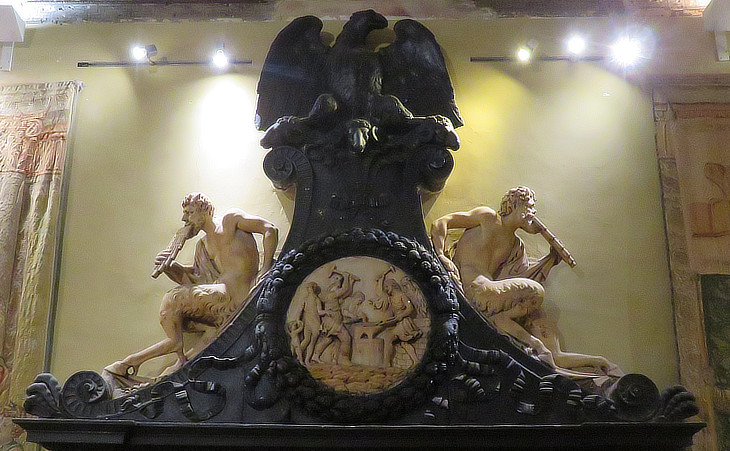
Hall of the Shipwrecks: mantelpiece (the black stone - Pietra di Promontorio - was quarried outside the western end of the harbour)
Then entring into the Palace, we found it most curiously adorned
with Rareties and Riches suitable to the Countries Humor, and the Masters Purse. It's true, when this Queen of Spain (Mariana of Austria,
second wife of King Philip IV) passed from Germany into
Spain in 1649, by the way of Milan and Genoa, the Governour of Milan told her, that she should see in D' Oria's Palace here many fine things,
but all borrowed of the Townsmen, Which d' Oria hearing of beforehand, caused to be written over' the great Gates of the Palace,
where the Queen was to enter and lodge, these words in Spanish, "By the Grace of God, and the King's Favour there's no thing here borrowed".
It may be the cunning Governour of Milan thought by telling the Queen this, to oblige the Duke D' Oria to present some of his best things
to the Queen, to shew her that they were his own; (..) but, the wise Italian by this trick, both kept his own, and yet satisfied
the Queen. Indeed he hath things here both too good to be given away, and too great to be carried away. Lassels
The palace has lost a great part of its original furniture, but the imposing mantelpieces could not be moved. The relief
shows the scene of Venus and Love in Vulcan's forge to receive Aeneas' weapons (learn more about this event). At the sides of Doria's heraldic eagle,
two satyrs are playing the pan pipes.
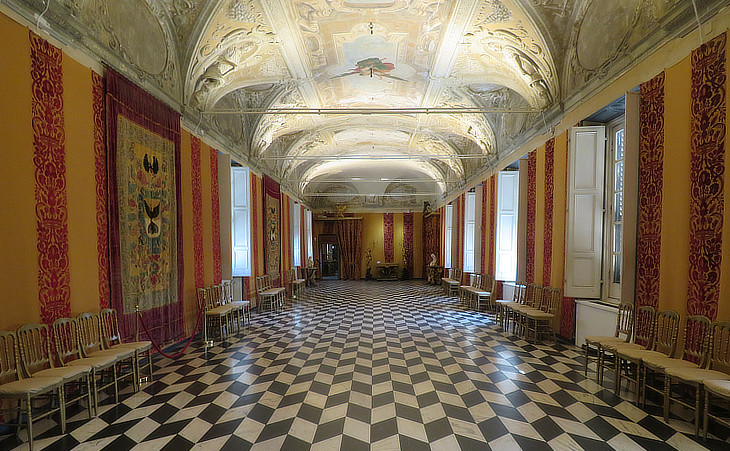
Galleria Aurea
Andrea Doria had been the Admiral of Charles V and Giovanni Andrea fought for King Philip II of Spain, although he did not achieve the command of the united Spanish and Genoese fleet. In 1565 he took part in the relief of the Great Siege of Malta and in 1573 in the temporary conquest of Tunis. By continuing to provide ships to Spain Andrea Doria maintained the wealth of the family and added new facilities to the palace by building Galleria Aurea, a long hall which had a view on both the southern and the northern gardens and which was named after its golden stucco decorations.
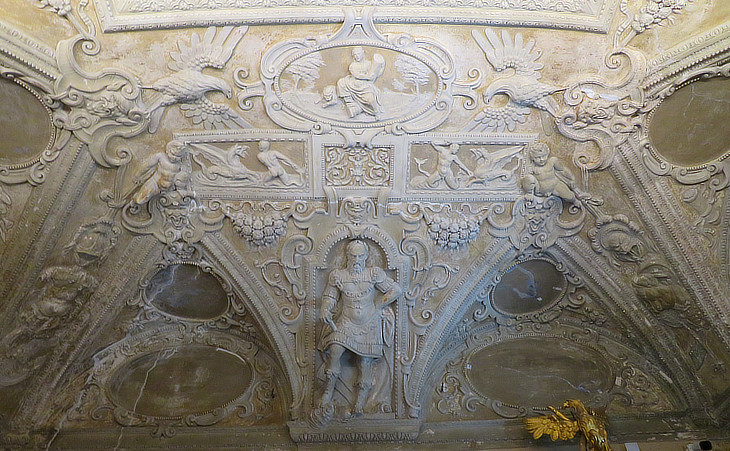
Galleria Aurea: detail of its stucco decoration including a relief portraying Andrea Doria with his foot upon the head of an Ottoman commander
Galleria Aurea replaced that of the Giants as reception hall of the palace; its complex stucco decoration included twelve reliefs portraying important members of the family, similar to the Upper Loggia. Payment records indicate that a Luca Carlone was involved in the design of the hall. The family Carlone played a major role in the design and decoration of palaces and churches of Genoa through the whole XVIIth century and beyond (also at Vienna). The execution of the stuccoes was entrusted to Marcello Sparzo from Urbino where this kind of decoration had already reached high levels of sophistication.
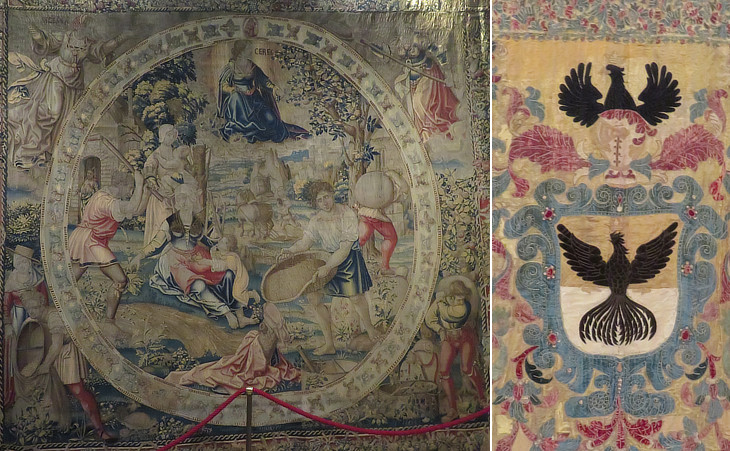
(left) Hall of the Sacrifices (after frescoes by Perin del Vaga depicting sacrifices to the pagan gods): tapestry depicting the Month of
August; (right) Galleria Aurea: tapestry showing the eagles of the Doria
The inventory of the possessions left by Andrea Doria included twelve tapestries from Brussels depicting the Twelve Months.
Some of the tapestries were given away as part of dowries or destroyed or stolen, but three of them still embellish the palace.
They all show a central circular element in which the divinities that mythology associates with the months are depicted.
Around them, typical activities of the varying periods of year are shown, in particular relating to agriculture.
External to the circle, the winds are shown along with some minor divinities and other scenes related to what would typically happen
in that particular month. In the upper part of the central circle in the tapestry depicting August, Ceres, god of harvest and wealth,
overlooks scenes of country life. On the left, a man strikes wheat, while near him two women with their children symbolize fertility.
To the right, a young boy is holding a basket full of grapes.
The tapestries in the Galleria Aurea are made of a yellow silken background, and are embroidered with various shades of velvet, which create intricate
intertwining garlands, leaves and flowers surrounding the Doria eagles.
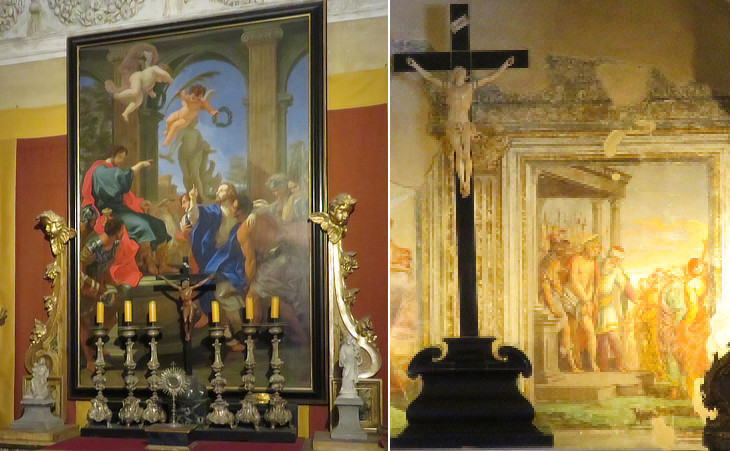
(left) Chapel adjoining Galleria Aurea: Martyrdom of St. Julian by Giovanni Battista Gaulli, aka il Baciccio; (right)
Changing Room of Donna Zenobia, wife of Giovanni Andrea I: Ecce Homo by Lazzaro Calvi
The Chapel was built by Giovanni Andrea; he and his wife Zenobia were very devout. The ceiling of the chapel was damaged by
bombings during WWII. The altar piece was added at the start of the XVIIIth century by "Il Baciccio", a Genoese painter who had already achieved
great fame in Rome, thanks to the
support of Gian Lorenzo Bernini.
The Saint Julian portrayed by il Baciccio is not St. Julian the Hospitaller,
but a IIIrd century martyr of Alexandria who is regarded as the patron of gout-sufferers, a disease rather common among the wealthy,
whose diet included excessive levels of red meat.
The palace houses
other religious symbols including a beautiful XVIIIth century ivory crucifix and small XVIth century paintings.
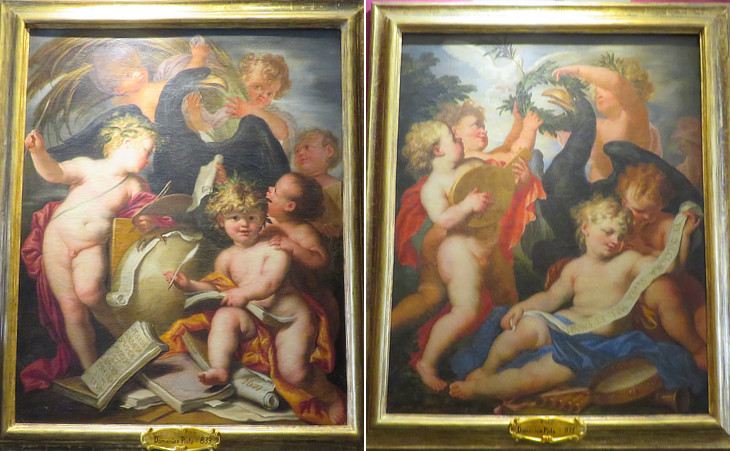
Canvasses by Domenico Piola, a leading Genoese painter, portraying children playing with Doria eagles for the 1671 marriage of Giovanni Andrea III Doria with
Anna Pamphilj; the union of the two families is underlined in one of the paintings where the Pamphilj dove joins the eagle
inside a crown of laurels
The Doria family is not extinct, but they live in Rome; and the palace is abandoned to ruin. Murray
The marriage produced its main effects in 1767, almost a century later, when the Doria inherited parts of the Pamphilj properties, including their Roman
palace and its gallery of paintings and
antiquities. Prince Andrea IV Doria had to relocate to Rome in order to safeguards his rights on the Pamphilj heritage.
Palazzo del Principe is still owned by the Doria Pamphilj who
keep it very well and open it to the public.
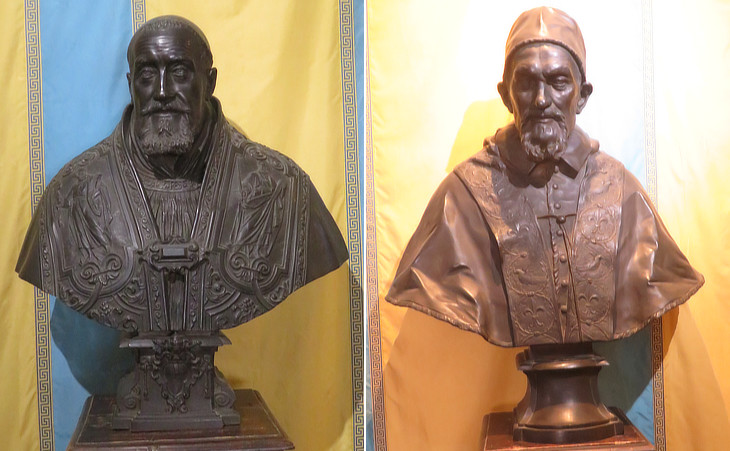
Busts: (left) Pope Gregory XV by Gian Lorenzo Bernini; (right)
Pope Innocent X by Alessandro Algardi
Palazzo del Principe is a visual tale of the standing of the Doria. A few items from the Roman collections hint at that of the Pamphilj. Gian Lorenzo Bernini and Alessandro Algardi were the leading (and rival) sculptors of the Roman High Baroque. Bernini worked often for a foreign clientele, Algardi enjoyed the patronage of Pope Innocent X. Two large statues of pontiffs by them face each other at Palazzo dei Conservatori in Rome. You may wish to see two busts by Algardi and Bernini in the Doria Pamphilj palace in Rome.
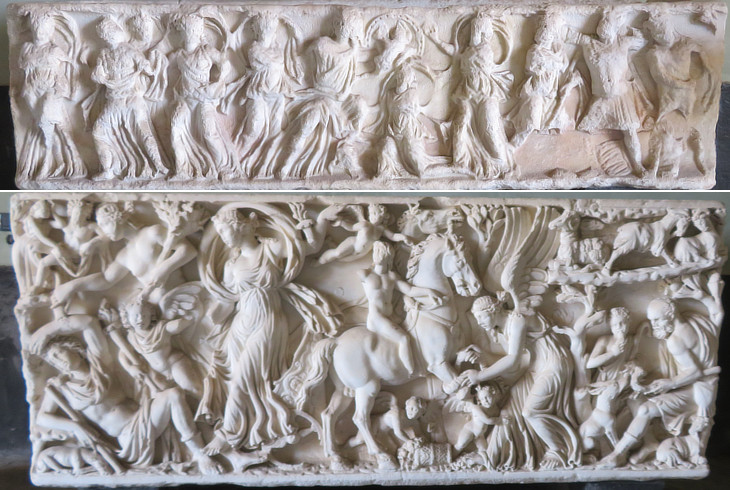
Fronts of Roman sarcophagi (IIIrd century AD): (above) Achilles, disguised as a girl at the court of Lycomedes, king of Scyros (see a fine mosaic
depicting this subject); (below) Selene/Diana and Endymion (also in a sarcophagus of the Roman collections)
The collections of Palazzo del Principe have been enriched by relocating there two sarcophagi and some Roman reliefs.
Move to
The Ancient Town
The Cathedral
The Doria's Palaces and Church
The Harbour
The Piazza Nuova
The Strada Nuova
Via Balbi
Two Grand Churches
A Walk to Castello
In the Heart of the Old Town
Old and New Portoria
Museums: Exhibits from Churches
Museums/Palaces: Tursi and Bianco
Museums/Palaces: Rosso and Spinola
Some Environs of Genoa
Anthony van Dyck's 2026 Exhibition


