All images © by Roberto Piperno, owner of the domain. Write to romapip@quipo.it.


Notes:
Page added in March 2026.
All images © by Roberto Piperno, owner of the domain. Write to romapip@quipo.it.
Notes:
Page added in March 2026.
 From Porta Romana to S. Francesco
This section is complemented by pages on two Popes from Siena: Pius II and Pius III. They contain images and text related to some monuments of Siena.
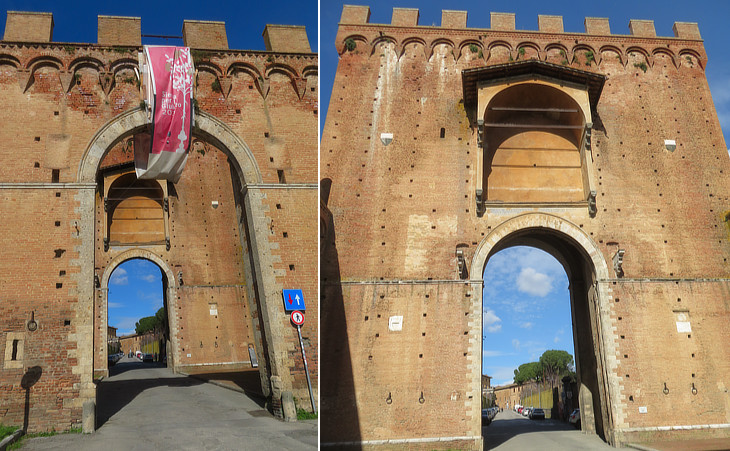
Porta Romana seen from Via Cassia: (left) outer gate; (right) inner gate which was embellished with a fresco which was removed in 1978 to prevent its total decay. In 1561, in the space between the two gates, Cosimo I de Medici, Duke of Florence and of Siena, placed his coat of arms
November 1644. We set out by Porto Romano, the country all about the town being rare for hunting and game. Wild boar and venison are frequently sold in the shops in many of the towns about it.
John Evelyn - Diary and Correspondence related to his stay in Italy in 1644
The road for a long distance, in a singular manner, passed over the ridges of wild and barren mountains, commanding extensive prospects, and crossed the dry channels of the mountain torrents, which in rainy seasons are difficult to pass; numerous castles crowned the distant hills, and patches of cultivation marked the valleys. The country as we advanced improved in cultivation, till we approached the white clay hills of Sienna. Soon after, the neat country seats which skirted the settlement, showed that we were entering a city of elegance and taste.
Rembrandt Peale's Notes on Italy, written during a tour in the years 1829 and 1830
During the period of its freedom the territory of Siena was large and populous; 100,000 men were found within its walls; it had thirty-nine gates, of which all but eight are now closed. The Gates of Siena are in many respects remarkable. (..) The most interesting of these are the Porta Camollia, the Porta San Viene and the Porta Romana. (..) The Porta Romana, built in 1327 by Agostino and Angelo da Siena, is an interesting example of those great architects; it has also its painting - the Coronation of the Virgin, by Sano Lorenzetti in 1422.
John Murray - Handbook for travellers in Central Italy - 1843
Siena is located along Via Francigena (ancient Via Cassia), the main road leading to Rome from the Alps, thus it was visited by many travellers and pilgrims en route to Rome or on their way back from the Eternal City (e.g. John Evelyn and Rembrandt Peale).
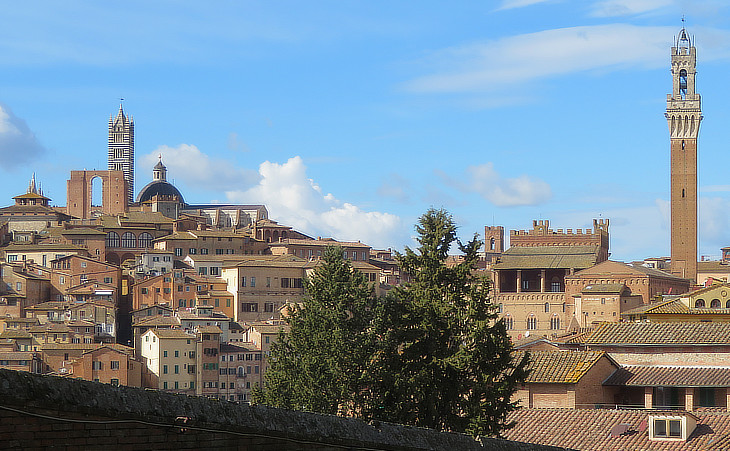
A view of the Cathedral and of Palazzo Pubblico from S. Clemente in S. Maria dei Servi near Porta Romana
21st May, 1645. We dined at Sienna, where we could not pass admiring the great church built entirely both within and without with white and black marble in polished squares, by Macarino, showing so beautiful after a shower has fallen.
Evelyn
The view through the noble arch of the gate as you leave Sienna is at once exquisitely romantic and picturesque.
William Hazlitt - Journey Through France and Italy in 1824-1825
At midnight we dropped down upon Sienna , and as the moon was in the full without a cloud , we saw the venerable city to great advantage. Its massive buildings stood frowning in the moonlight.
William Gardiner's Sights in Italy. Published in 1847.
The long uphill street which leads from Porta Romana to the centre of Siena bears different names: Via Roma from the gate to Porta S. Maurizio, Via di Pantaneto (swamp, because being not paved it was muddy) and eventually Banchi di Sotto (Lower Shops/Banks), its most monumental section which includes Palazzo Piccolomini between Loggia del Papa and Loggia della Mercanzia where it joins Banchi di Sopra and Via di Città, the other two main streets of Siena.
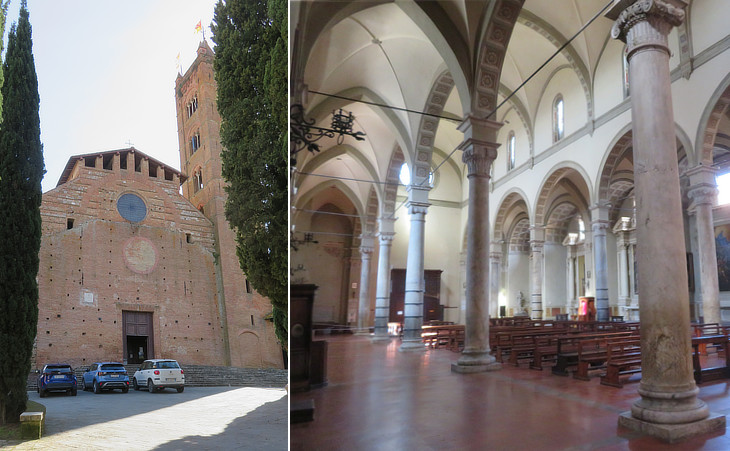
S. Clemente in S. Maria dei Servi: (left) façade (see a more complete image); (right) interior
In the early XIIIth century seven Florentine merchants joined together to live a penitential life. They devoted themselves to the Virgin Mary, who, according to tradition, appeared to them in a vision and bade them withdraw into solitude. They founded the Order of the Friar Servants of St. Mary in 1233 and went to live on Monte Senario, north of Florence, where they built a hermitage. In 1240 a second vision of Mary disclosed her wishes that they serve her, wear a black habit, and adopt the rule of St. Augustine of Hippo. They returned to Florence and founded a church (today SS. Annunziata) and a nearby convent.
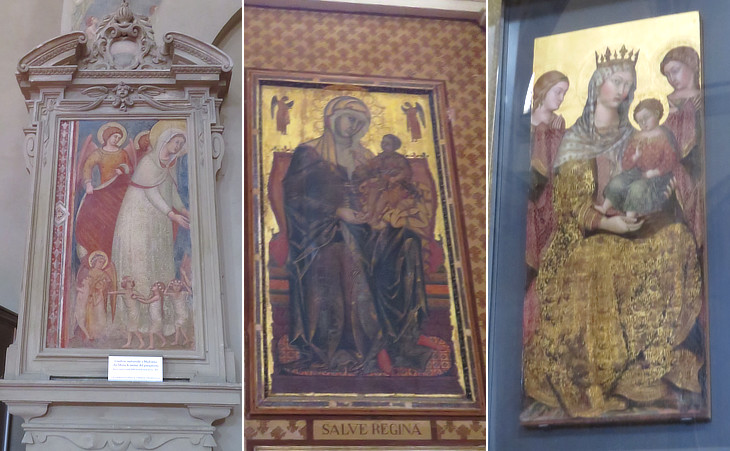
S. Clemente in S. Maria dei Servi: (left) fragment of a fresco depicting the Virgin Mary freeing the souls in Purgatory; (centre) Madonna del Bordone, by Coppo di Marcovaldo (1261); (right) Madonna di Belverde by Taddeo di Bartolo (1405)
The Church of Sta. Maria de Servi has some frescoes of the old Sienese masters, a Madonna throned, by Dietisalvi, 1281; a Madonna, over the door of the Sacristy, by Bonaventura da Siena 1319; and others by Gregorio da Siena, 1420. Murray
Alessio Falconieri, one of the seven merchants, founded a convent at Siena very near Porta Romana and next to a parish church dedicated to St. Clement which over time became part of the convent. You may wish to see S. Marcello, the church of the Order in Rome, one of the finest Late Baroque buildings.
Coppo di Marcovaldo was a Florentine painter who was captured at the battle of Montaperti (1260). In order to pay his ransom he painted and signed a Madonna in a chapel dedicated to the pilgrims (bordone being their staff).
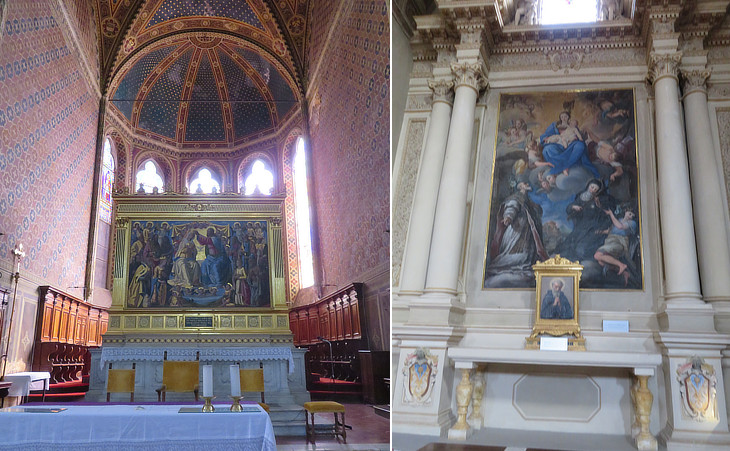
S. Clemente in S. Maria dei Servi: (left) Apse with main altar and a Coronation of Mary by Bernardino Fungai (1501); (right) Madonna and Child with St. Philip Neri and St. Giuliana Falconieri, niece of Alessio Falconieri, by Giuseppe Nicola Nasini (before 1736)
The original church was greatly enlarged and the new building was consecrated in 1533, although its decoration was not yet completed which explains why it houses works of art of very different periods.
Bernardino Fungai (1460-1516) was a pupil of Benvenuto di Giovanni and his works show the transition from the local Gothic tradition to Renaissance patterns.
Giuliana Falconieri, the founder of the nuns of the Servite Order, was beatified only in 1678 (and canonised in 1738). Giuseppe Nicola Nasini, another local painter, portrayed her with St. Philip Neri, the most important Italian saint of the XVIIth century and the founder of the Congregation of the Oratorians. The Seven Holy Founders of the Servite Order were canonised in 1888. The best known member of the Servite Order is St. Philip Benizi.
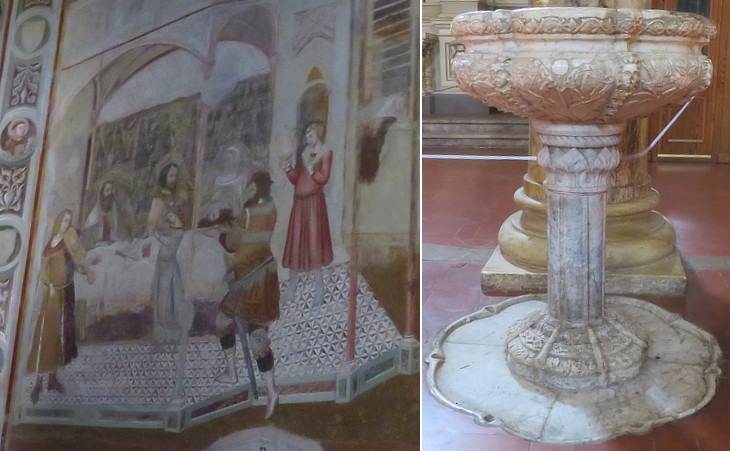
S. Clemente in S. Maria dei Servi: (left) Decollation of St. John the Baptist by Pietro Lorenzetti; (right) holy water basin (partly XIIIth century and almost identical to one at S. Francesco)
Records confirm that Pietro Lorenzetti was in practice at Siena in 1305, when he completed an altarpiece for the governors of the city. But, in the course of centuries, these and later works were lost, and we ascend to the year 1320 before finding any picture of undoubted authenticity. Judging from these later productions we find that Pietro was a painter of great power, whose characteristic figures are marked by many most important qualities. (..) In the church of the Servi at Siena in a chapel to the right of the choir is a fresco of the Massacre of the Innocents by Pietro Lorenzetti.
J. A. Crowe and G. B. Cavalcaselle - A new history of painting in Italy - 1864
Pietro Lorenzetti was the elder brother of Ambrogio Lorenzetti and his works were often confused with those of the latter.
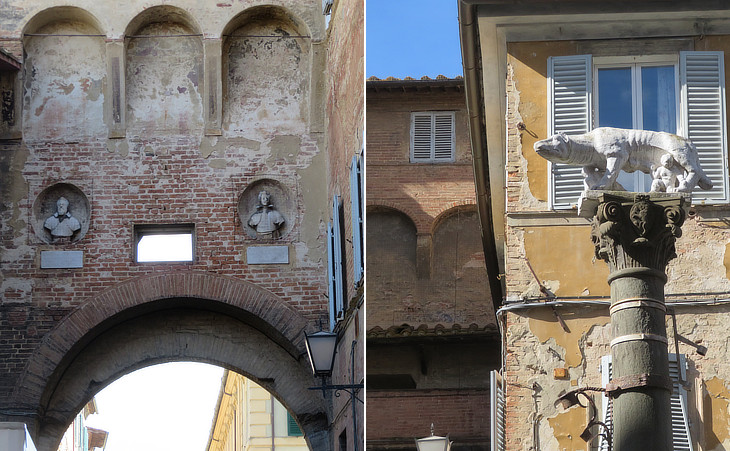
(left) Inner side of Porta S. Maurizio with busts of Grand Dukes Ferdinand I and Cosimo II, his son; (right) She-wolf of Siena outside the gate, one of many similar symbols of the town
The gate was opened in the walls which were built in 1180-1200 and it marked the southernmost point of Siena until the construction of Porta Romana. It was named after a nearby small church.
In 1616 Mario Alberighi, of a local noble family, acquired the property of the arch which stood between two palaces he owned and he built a passage between them. He thanked Grand Duke Cosimo II for having endorsed his plans by placing a bust of him and of his father in the inner wall of the arch. The external wall was decorated with lost frescoes depicting heraldic symbols of the Alberighi.
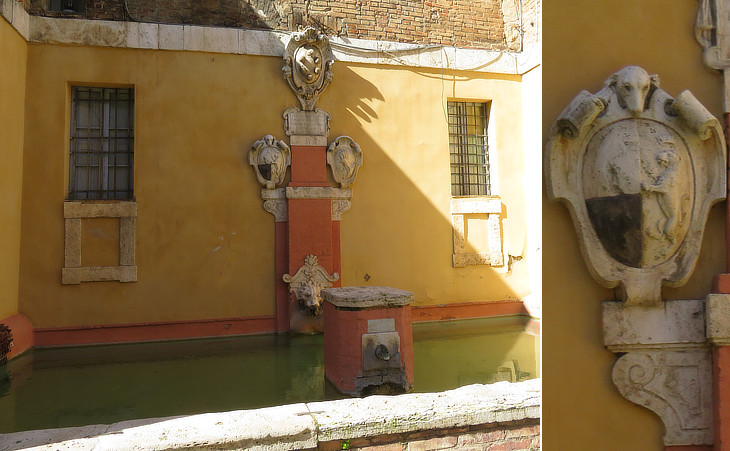
(left) Fonte di San Maurizio (outside Porta S. Maurizio); (right) coat of arms of Siena
This fountain was redesigned in 1474 and it included two other basins; one was a watering trough and the other a public wash house. It was restored in 1588 at the time of Grand Duke Ferdinand I and at the initiative of Giulio del Caccia, Governor of Siena in 1585-1590 whose coat of arms (a lion's paw) was placed to the right of the Medici one, whereas that of the City of Siena is on the other side. It is made up of the balzana, the traditional black-and-white emblem of Siena, and of a crowned rampant lion, symbol of the people of Siena. Other major fountains of Siena are Fonte Branda, Fonte Nuova and Fonte Gaia.
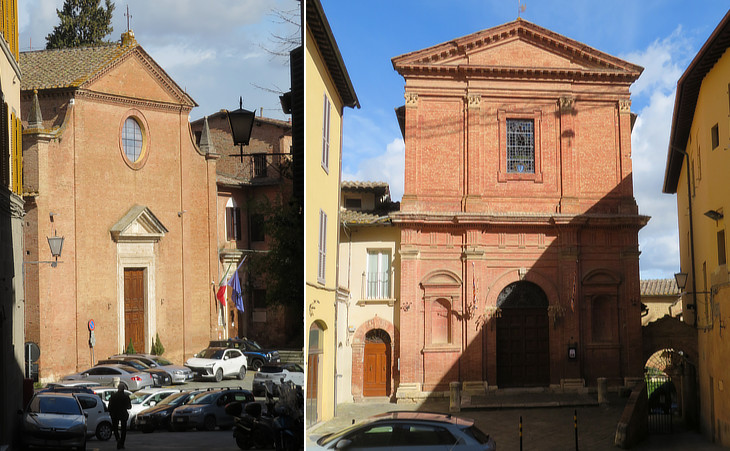
(left) S. Spirito; (right) S. Giovannino della Staffa or in Pantaneto
The wards are denominated each by a respective animal or emblem, as, La contrada della Lupa, La contrada dell' Acquila, etc., not, as in Lombardy, by the gates.
Joseph Forsyth - Remarks on Antiquities, Arts, and Letters in Italy in 1802-1803
Both churches were built in the first half of the XVIth century, when Siena was still an independent Republic and the impact of the conflict between France and Spain for the hegemony over Italy had not exhausted its economy. S. Spirito was erected in 1519 and its portal was designed by Baldassarre Peruzzi, a leading architect of his time who worked for Agostino Chigi, a very rich banker from Siena.
S. Giovannino della Staffa was designed by a local pupil of Peruzzi in 1537. Staffa (stirrup) is a reference to the symbol of Contrada (district) del Liocorno (a rampant unicorn) whose inhabitants were the patrons of the church.
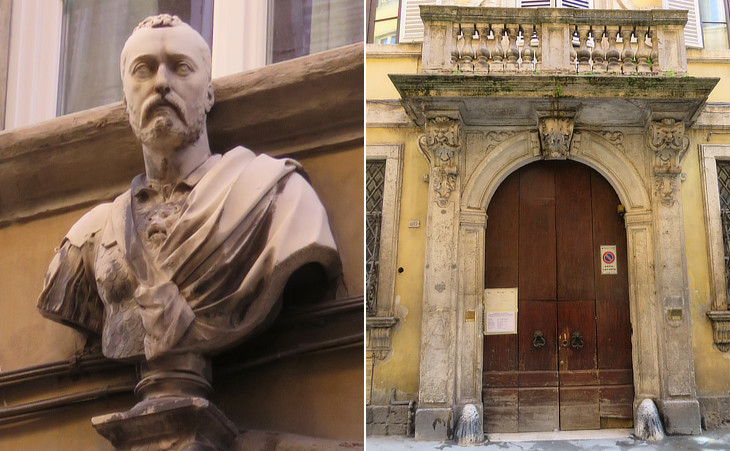
Via di Pantaneto: (left) bust of Francis I, Grand Duke in 1574-1587 with the Collar of the Golden Fleece; (right) Palazzo Biringucci then Landi Bruchi
Damnatio memoriae, literally "damnation of memory", was a law or a process for removing the remembrance of a person (abolitio nominis) and of his deeds. It is usually associated with Emperor Nero. In a way it applies to Grand Duke Francis I because the number of his busts and statues is overwhelmed by those of his brother and successor Ferdinand I. The succession was not a very smooth one and Ferdinand commissioned many statues and busts of himself which were placed in the main towns of the Grand Duchy, e.g. Florence, Pisa and Arezzo.
There are some curious old Palazzi in the town, which is very ancient; and without having (for me) the interest of Verona, or Genoa, it is very dreamy and fantastic, and most interesting.
Charles Dickens - Pictures from Italy - 1846.
Palazzo Biringucci was built in 1680-1696 and its portal is attributed to Carlo Fontana, a leading architect of Rome. Via di Pantaneto is not an overly touristic location and one can have a look at its old palaces without being pushed by other passers-by as it occurs elsewhere in Siena.
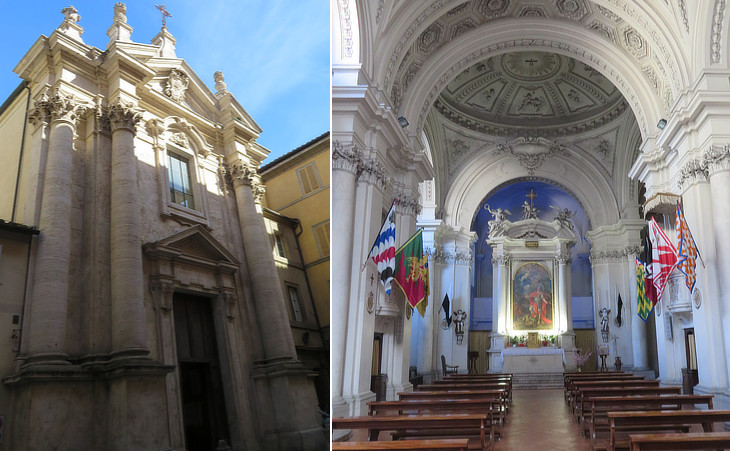
S. Giorgio: (left) façade; (right) interior with the flags of the Contrade (they can be seen in several other churches, e.g. S. Domenico)
San Giorgio contains the tomb of Francesco Vanni, the painter. The tower has thirty-eight windows, said to allude to the thirty-eight companies which fought at the great battle of Monte Aperto. The bell of the Carroccio, called the Martinella, captured from the Florentines, was also preserved here as a memorial of that decisive victory. Murray
The bell tower is not visible from the street, but only from the courtyard of a private house. The church was built to celebrate the victory of Siena over Florence at Montaperti in 1266, but in the early XVIIIth century the façade and the interior were entirely renovated at the initiative of the Chigi-Zondadari family. Ansano Zondadari, of a wealthy family of merchants married Agnese Chigi, niece of Pope Alexander VII and three sons of the couple held important positions in Siena.
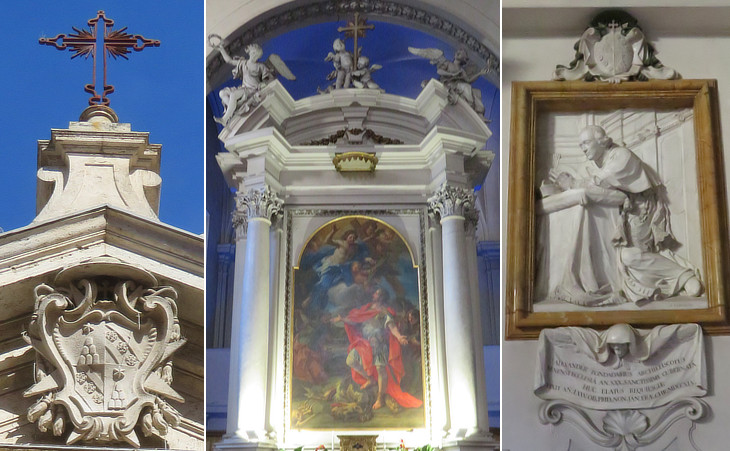
S. Giorgio: (left) top of the façade with the coat of arms of Cardinal Antonio Felice Zondadari seniore and behind it the Cross of Malta; (centre) main altar with a painting portraying St. George by Sebastiano Conca, a leading Roman painter; (right) monument to Alessandro Zondadari, Archbishop of Siena
Cardinal Zondadari was Nuncio before King Felipe V (Philippe de Bourbon) of Spain for affairs related to peace after the war of Spanish succession, but because of a controversy between the King and Pope Clement XI in 1709, he was ordered to move to Avignon. During the 1730 conclave King Felipe V vetoed his election.
Marc'Antonio Zondadari was Grand Master of the Order of Malta and his deeds are celebrated in a monument by Giuseppe Mazzuoli in the Cathedral of Siena. Alessandro Zondadari was Archbishop of Siena in 1715-1745 and another Zondadari held the same position in 1795-1823.

S. Martino, near Loggia del Papa
The church gives the name (Terzo di S. Martino) to the whole neighbourhood described in this page. It is located at il Porrione, as the opening of the Via S. Martino was called, a point of strategical importance in the furious factions of mediaeval Siena. Similar to Pisa, Siena was divided into three districts (Città, Camollia and S. Martino) and in the early phases of its development conflicts were frequent between Città, the most ancient one, and the other two districts.
The church is first recorded in the VIIIth century and it was dedicated to St. Martin of Tours who was regarded as a protector of the pilgrims. The building was redesigned in the XVIth century. The façade was completed in 1613 and it is attributed to Giovanni Fontana, an engineer who worked with his brother Domenico at the construction of Acqua Felice and Acqua Paola.
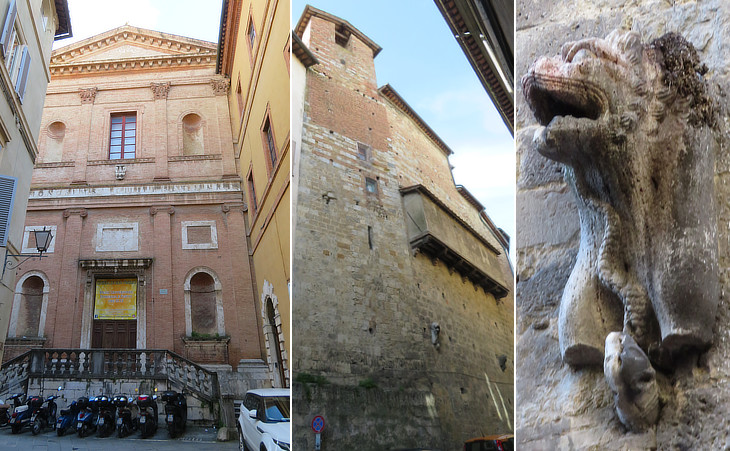
S. Vigilio (left) façade; (centre) bell tower and side along Via Bandini; (right) medieval relief depicting a dragon and a snake
Sienna is an university, pretty much frequented by foreigners, especially Germans, who enjoy several privileges.
Thomas Nugent - The Grand Tour - 1749
Siena houses a University for Foreigners which is specialized in the teaching of Italian, in addition to a State University. Special masses are held in S. Vigilio for students, many of whom live in this part of the town where renting accommodation is cheaper. The church dates back to the XIth century, but its façade and the interior were entirely renovated by the Jesuits in the XVIth century. The side along Via Bandini retains its medieval aspect and two unusual reliefs.
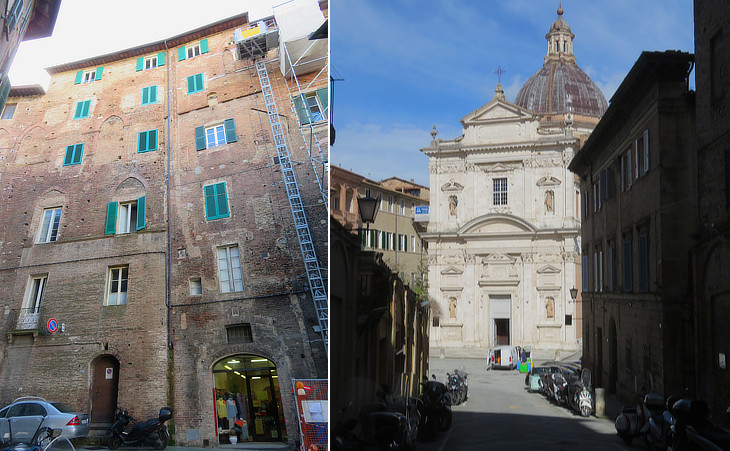
(left) Medieval houses in Via Bandini; (right) S. Maria di Provenzano seen from Via Bandini
October 2nd, 1858. We drove up hill and down (for the surface of Siena seems to be nothing but an irregularity) through narrow old streets, and were set down at the Aquila Nera, a grim-looking albergo near the centre of the town. (..) The house seemed endlessly old, and all the glimpses that we caught of Siena out of window seemed more ancient still. (..) The interest of the old town would soon be exhausted for the traveller, but I can conceive that a thoughtful and shy man might settle down here with the view of making the place a home, and spend many years in a sombre kind of happiness.
Nathaniel Hawthorne - Passages from his Note-books in France and Italy
(1873) Lying massed within her walls on a dozen clustered hill-tops, she shows you at every turn in how much greater a way she once lived; and if so much of the grand manner is extinct, the receptacle of the ashes still solidly rounds itself. This heavy general stress of all her emphasis on the past is what she constantly keeps in your eyes and your ears, and if you be but a casual observer and admirer the generalised response is mainly what you give her. (..) These streets are hardly more than sinuous flagged alleys, into which the huge black houses, between their almost meeting cornices, suffer a meagre light to filter down over roughhewn stone, past windows often of graceful Gothic form, and great pendent iron rings and twisted sockets for torches.
Henry James - Italian Hours - 1909
Via Bandini departs from Via di Pantaneto and it reaches one of the highest hill-tops of Siena. Its very tall houses testify to the size of Siena in the early XIVth century, before the Black Death halved its population.
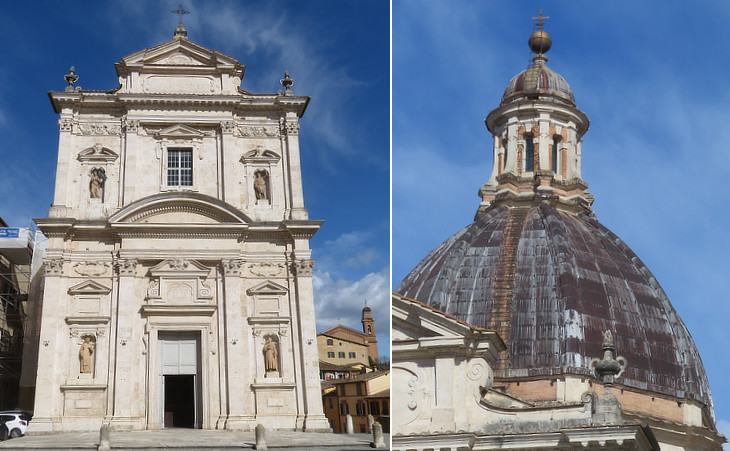
S. Maria di Provenzano: (left) façade; (right) dome
The other principal places, are (..) the churches of S. Francis (..) and of the Madonna di Provenzano.
Nugent
The Madonna of Provenzano was raised to the Blessed
Virgin as Protectress of Siena at the end of the sixteenth century. As an inscription to the left of the
church bears witness, this part of the city was notorious for its evil living, mainly given
up to houses of ill-fame, especially in the days of
the Spanish occupation. According to the legend, St
Catherine had set up a little shrine with an image of the
Madonna here, which was rediscovered by Brandano,
who declared that here was the greatest treasure of
Siena, and that "hither all the most honoured ladies of
the nation shall one day come." In 1594 the image began to work miracles, and the present sanctuary was
built in consequence. (..) The
hermit Brandano had
wandered through Italy
preaching repentance, clothed in sackcloth with
a halter round his neck, a Crucifix in one hand
and a death's-head in the other. On the eve of
the sack of Rome he had
appeared in the Eternal
City.
William Heywood - The story of Siena and San Gimignano - 1899
Provenzano Salvani was a military commander at the Battle of Montaperti. The miraculous image of the Virgin Mary was found where the Salvani had their houses, hence the name of the church.
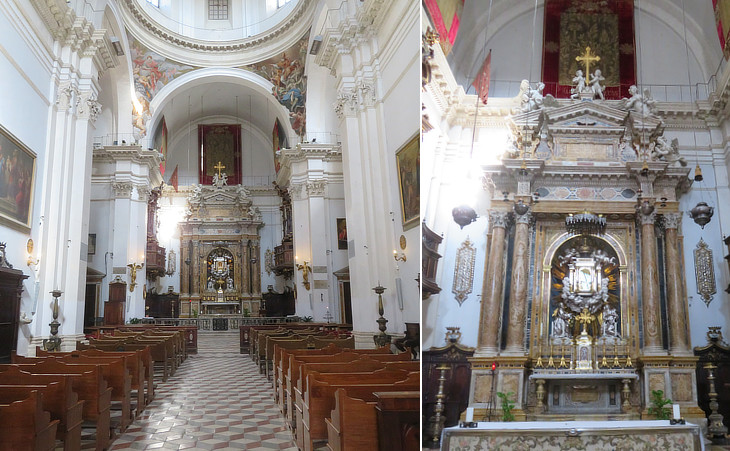
S. Maria di Provenzano: (left) interior; (right) main altar with the holy image
Last remnants of these departed glories are races which are now run twice a year - on the festivals of our Lady's Visitation (July 2nd) and of her Assumption (August 15th) - with mounted horses by the contrade. The race is still called the Palio, from the rich stuff (now represented by a banner) given as prize. (..) From the beginning of the XVIIth century the Feast of Our Lady of Provenzano became well- nigh the principal holiday of the Sienese year. It was celebrated on the 2nd of July, the day of the Visitation of the Blessed Virgin; and on the evening of the festival a display of fireworks was given in the Piazza di Provenzano in front of the newly constructed church. Towards the middle of the century it was resolved to inaugurate annual horse-races in the Piazza del Campo, to be run between the various Contrade. It is to this decision that we owe the modern Palio of July. Heywood
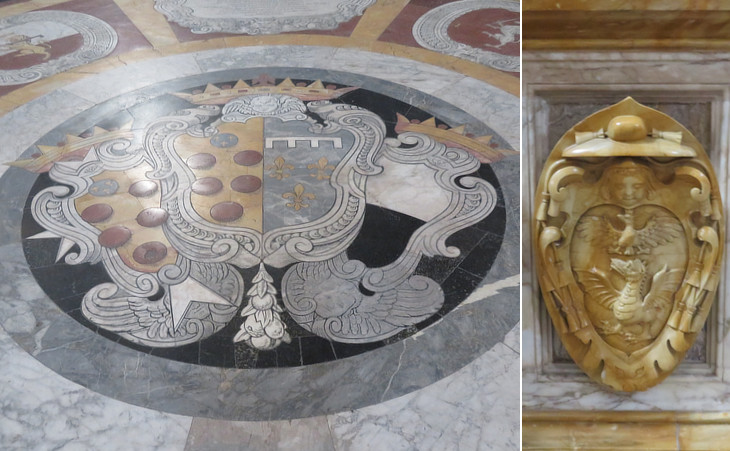
S. Maria di Provenzano - coats of arms: (left) C.o.a. of Grand Duke Cosimo III and his wife Marguerite Louise of Orleans between those of Francesco Maria de' Medici and of the City of Siena; (right) Archbishop of Siena Camillo Borghese (cousin and namesake of Pope Paul V)
The main authorities of Siena contributed to the embellishment of the church. Francesco Maria de' Medici was the junior brother of Grand Duke Cosimo III. He was appointed Governor of Siena and Grand Prior of the Sovereign Order of Malta in Pisa. In 1686 he was created cardinal. He visited the Roman countryside perhaps to look for a villa, but he chose to remain in Florence, in his residence of Lappeggi, devoting himself to a life non propriamente religiosa. In 1709 he was forced to give up the cardinalate in order to marry a young Italian princess in a failed attempt to provide a heir to the Medici dynasty.
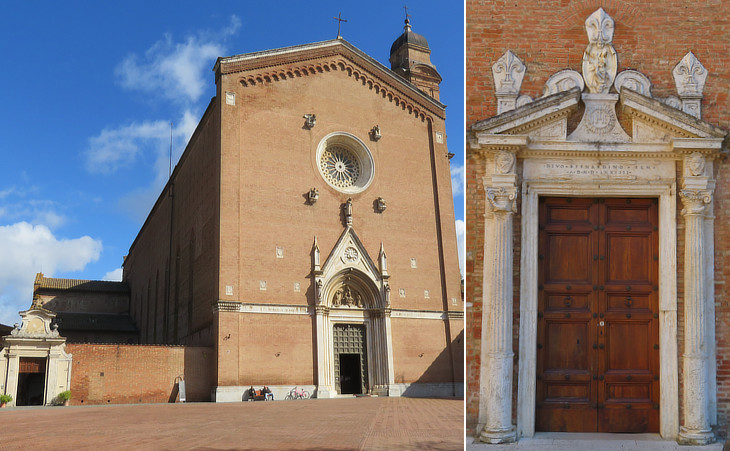
(left) S. Francesco; (right) Portal of Oratorio di S. Bernardino (1574); the blazing sun, symbol of the saint is shown in the image used as background for this page (see that at L'Aquila)
St. Francis's Church is a large pile, near which, yet a little without the city, grows a tree which they report in their legend grew from the Saint's staff, which, on going to sleep, he fixed in the ground, and at his waking found it had grown a large tree. They affirm that the wood of it in decoction cures sundry diseases. Evelyn
San Francesco is a fine and spacious church built from the designs of Angelo and Agostino da Siena. (..) The Oratory of San Bernardino is rich in paintings. Murray
The site of the church and convent of S. Francesco was occupied by the Franciscan friars as early as 1236, and the present church was erected early in the 14th century. The building has passed through many vicissitudes, the disastrous fire of 1655 having destroyed most of the famous monuments, (..) and the subsequent Baroque reparations having completed the ruin. Some twenty years ago restorations were undertaken on the original lines, and have been carried out, on the whole, not unsuccessfully.
William Heywood - Guide to Siena - 1905.
The unfinished medieval façade of S. Francesco was entirely redesigned in 1894-1913.
St. Bernardine (1380-1444) revived the Franciscan Order and churches were dedicated to him in many towns where he had preached e.g. Perugia and L'Aquila where he died. His glory is celebrated in a fine fresco by il Pinturicchio at S. Maria in Aracoeli in Rome.
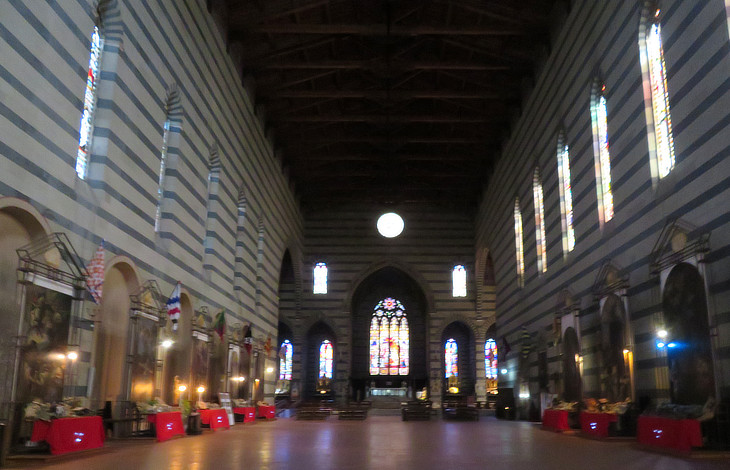
S. Francesco: Interior
Although the bad modern glass does not add to the beauty of the interior, the visitor may form an excellent idea of the original appearance of the great churches of the preaching orders - with their grandly simple proportions and spacious interiors. Heywood
The design of S. Francesco is not typical of Italy where three-aisled churches are more common. They feature a central nave with a higher roof which allows for the opening of large windows whereas the interior of S. Francesco is too dark.
The Franciscan and the Dominican convents stand at the opposite ends of Siena, similar to what occurs in other Italian medieval towns, e.g. Gubbio, Spoleto and Orvieto.
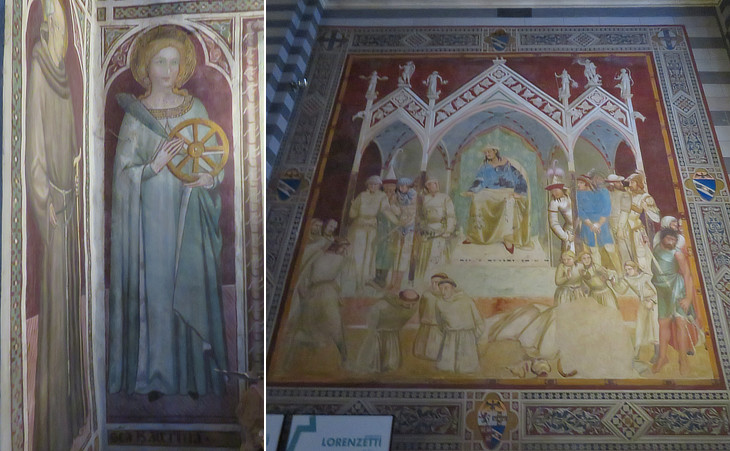
Frescoes: (left) St. Catherine of the Wheel attributed to Andrea Vanni (second half of the XIVth century); (right) Martyrdom of six Franciscan friars by Pietro Lorenzetti (1335-1340) from the Capitular Hall
On the R wall is an altar niche with frescoes by a late Trecento artist, entirely renewed. Heywood
Ghiberti (a Florentine sculptor and writer) dwells with unaccustomed rapture on the beauty of a series painted by Ambrogio and Pietro Lorenzetti in San Francesco of Siena. It is not long since a part of these paintings was rescued from whitewash and placed in two chapels of the convent church. (..) The second fragment represents the Soldan, sword in hand, surrounded by guards intended for Africans, but more like Chinamen and dressed in the strangest and most fanciful habits. The Soldan's expression is stern. On the left, three kneeling Franciscans with their backs to the spectators, await the stroke of the executioner. Three others have already been decapitated, and very ugly children throw stones at their corpses. Crowe and Cavalcaselle
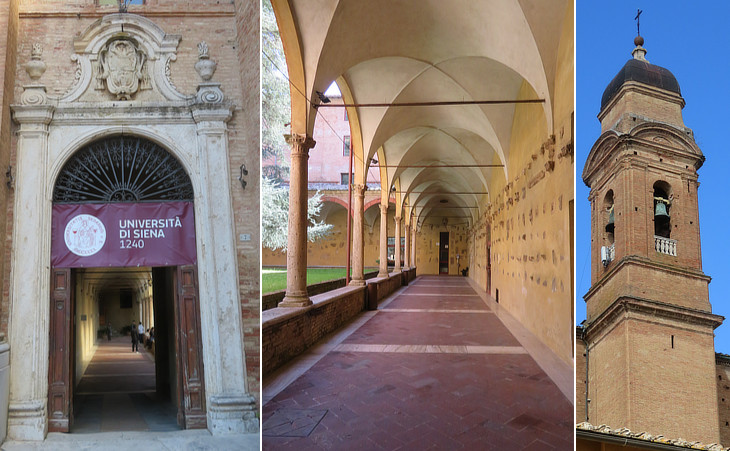
(left) External portal of the cloister (now a facility of the University of Siena); (centre) cloister with fragments from the medieval church; (right) bell tower designed in 1763-1765 by Paolo Posi, an architect from Siena who acquired fame in Rome
We leave the church by the graceful cloister, rebuilt in 1518. On the R stands a Gothic portal of 1336, which once gave access to the tomb of the Petroni. Here are also, embedded in the walls, various fragments of sculptures and some very fine tiles, saved from the wreck of the former church. Heywood
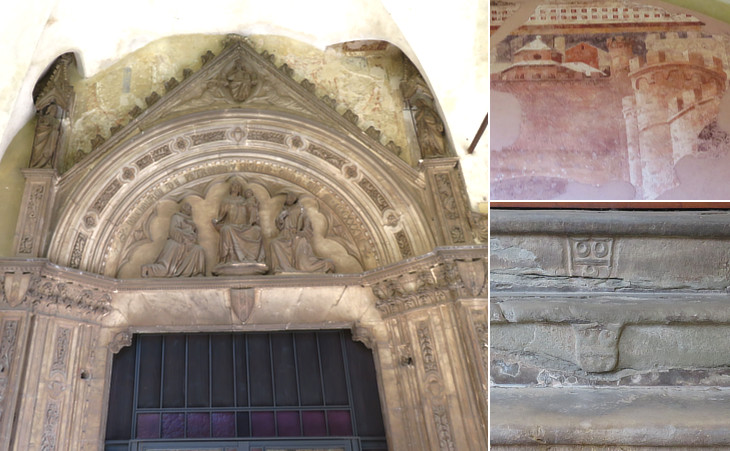
Cloister: (left) Gothic portal of the Petroni chapel by Agnolo di Ventura, a sculptor who worked at the Monument to Bishop Tarlati in Arezzo; (right-above) fragment of a fresco by Ambrogio Lorenzetti; (right-below) steps leading to the church
The steps bear the coat of arms of the Tolomei because 18 members of that family are buried under them. They were poisoned in 1337 by the Salimbeni at a banquet outside Siena which was supposed to reconcile the two families; the location is still known as Malamerenda (Bad lunch).
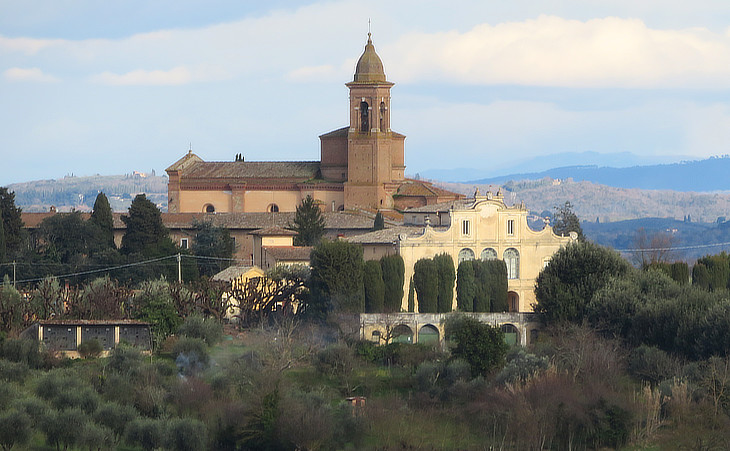
S. Bernardino all'Osservanza and Villa Gori Pannilini (1690) seen from Antiporto di Camollia
All the country for twenty miles round Siena is hill or mountain. The more rugged hills are planted with olive-trees. The rest are arable, intermixed with vineyards. Forsyth
In the neighbourhood of Siena is the large Franciscan Convent of L'Osservanza, remarkable for the tomb of Pandolfo Petrucci, the celebrated tyrant of Siena, cited by his friend Machiavelli as one of the best types of a usurper. He died in 1512; the tomb is the work of the scholars of Peruzzi. Murray
Move to
From Porta Camollia to S. Domenico
Piazza del Campo
Cathedral - Exterior
Cathedral - Interior
Museo dell'Opera del Duomo
S. Maria della Scala