All images © by Roberto Piperno, owner of the domain. Write to romapip@quipo.it.


Notes:
Page added in January 2026.
All images © by Roberto Piperno, owner of the domain. Write to romapip@quipo.it.
Notes:
Page added in January 2026.
 A walk along the northern Terzieri
The old town is divided into three districts: Terziere di S. Maria and Terziere di S. Francesco north of the River Arno and Terziere di S. Martino, south of it (see a map of 1831 Pisa). You may wish to see pages covering Piazza dei Miracoli and Piazza dei Cavalieri, which are both located in Terziere S. Maria, first. The churches of the northern terzieri are covered in separate pages (see those in Terziere S. Maria and those in Terziere S. Francesco).
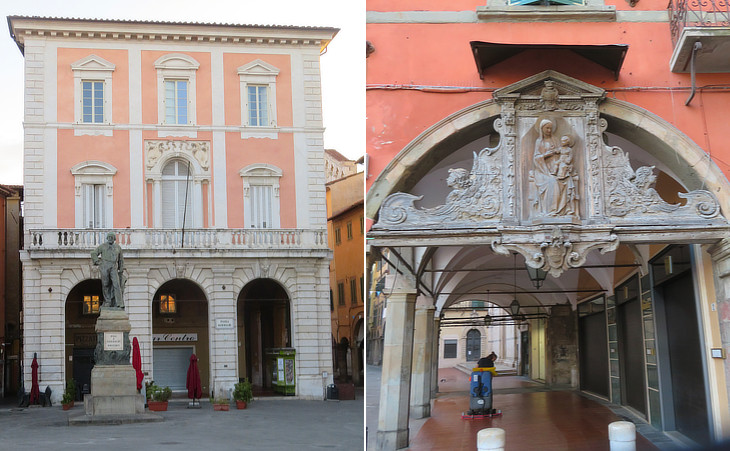
Piazza Garibaldi: (left) Casino dei Nobili; (right) Madonna dei Vetturini (Coachmen) at the beginning of Borgo Stretto
The street which separates the two northern terzieri is commonly called Borgo and it goes from Piazza Garibaldi (at the northern end of Ponte di Mezzo) to Porta a Lucca. It is divided into Borgo Stretto and Borgo Largo.
The Casino dei Nobili was built at the initiative of Emmanuel de Nay, Earl of Richecourt, a nobleman of Lorraine who was in charge of the administration of the Grand Duchy of Tuscany in 1749-1756 on behalf of Emperor Francis Stephen of Lorraine, husband of Maria Theresa of Austria who acquired the Grand Duchy of Tuscany in 1737. In 1750 a reform was introduced which formally established the privileges and duties of the noble families of the Grand Duchy. Access to the Casino was reserved to the noblemen of Pisa who however had to pay for its construction and maintenance (see a similar palace at Siena).
The relief of the Madonna and Child was in the church of S. Maria della Spina from which it was removed in the XVIth century to be placed inside a wood tabernacle on the first arcade of the porticoes which characterize Borgo Street.
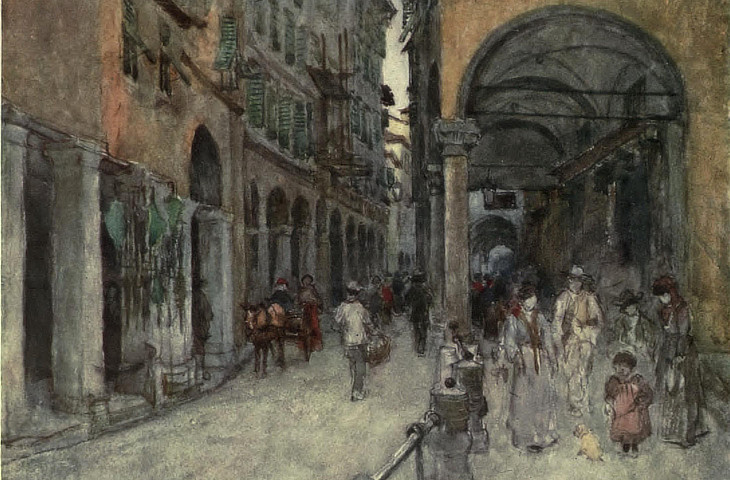
Borgo Stretto in an illustration from "Florence & some Tuscan cities painted by Colonel R. C. Goff - 1905"
The palaces were in perfect repair; the pavements were clean; behind those windows we felt that there must be a good deal of easy, comfortable life. It is said that Pisa is one of the few places in Europe where the sweet, but timid spirit of Inexpensiveness - everywhere pursued by Railways - still lingers, and that you find cheap apartments in those well-preserved old palaces. No doubt it would be worth more to live in Pisa than it would cost, for the history of the place would alone be to any reasonable sojourner a perpetual recompense, and a princely income far exceeding his expenditure.
Dean Howells - Italian Journeys - 1867
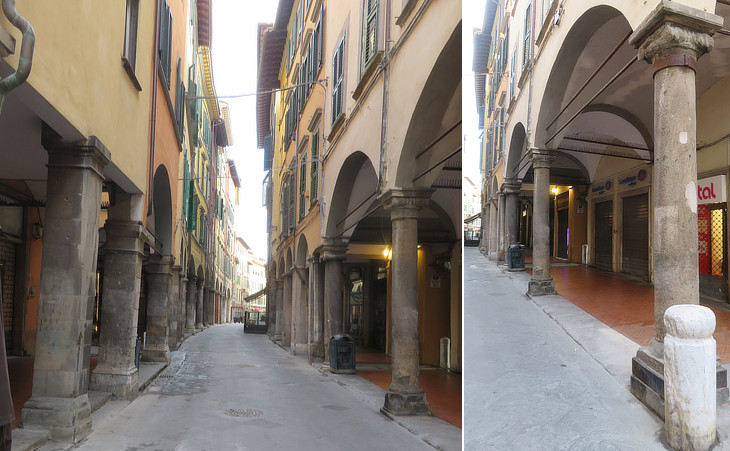
Borgo Stretto today at the same point shown by Colonel Goff (very early morning)
The term borgo usually designates a neighbourhood outside the walls. Its use at Pisa for the central axis of the northern part of the town is explained by the fact that until the XIIth century the Terziere di S. Francesco was not included in the walls and was called Foriporta. Because of its central position in the enlarged town Borgo soon became a very commercial area where shops and taverns were opened. The columns which supported the porticoes were made of timber and the buildings were not aligned.
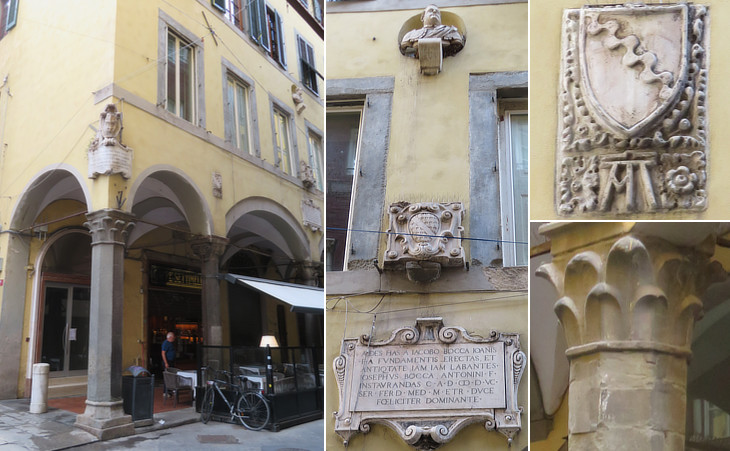
Palazzo Bocca in Borgo Stretto: (left) corner with an inscription indicating that Vincenzo Galilei, father of Galileo, lived in an apartment of the building; (centre) 1595 inscription celebrating the renovation of the palace by the Bocca at the time of Grand Duke Ferdinand I, whose bust is placed above a coat of arms of the Della Seta who inherited the property; (right) coat of arms of the Bocca, similar to that of the Caetani and a lotus leave capital of the portico
Grand Dukes Cosimo I and Ferdinand I promoted a Renovatio Urbis, a large-scale program of urban renewal and transformation at Pisa, similar to those undertaken by Popes Sixtus IV and Sixtus V in Rome. Ferdinand in particular issued a decree in 1593 which established the main features of the buildings along Borgo and especially the continuity of their porticoes and the columns which supported them. Palazzo Bocca is one of the best examples of this renovation, also because the family enjoyed considerable privileges at the Medici court.
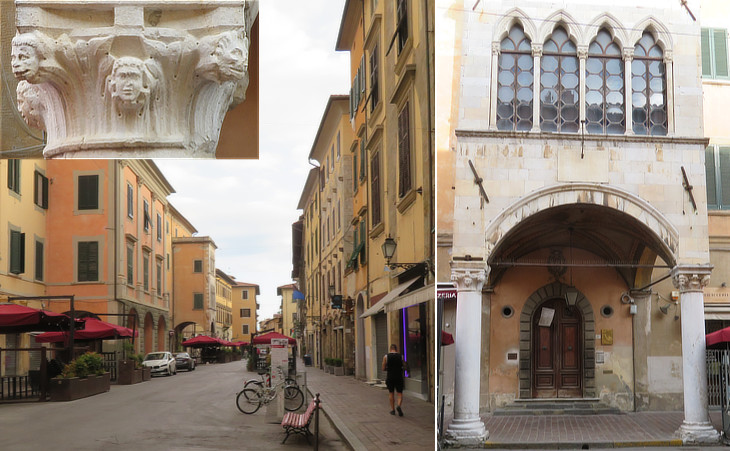
(left) Borgo Largo; (right) Palazzetto Scorzi; (inset) a capital of Palazzetto Scorzi
The streets are large, straight, paved with great stones; and most of the houses well built. They have several handsome squares.
Thomas Nugent - The Grand Tour - 1749
An inscription on the façade of the Casa Scorzi at Pisa
recalls to this day that there, on February 12th, 1664, through
the mediation of the Grand Duke Ferdinand II. of Tuscany,
"peace" was signed between Alexander VII. and Louis XIV. by the plenipotentiaries of the Pope and the King, Cesare
Rasponi and the Abbe Bourlemont. By the terms of the
treaty the Pope's brother, Mario, was compelled (..) to keep away from Rome until such time as
his son, Cardinal Flavio, should have presented his excuses,
as papal Legate to the King of France. (..) On February 18th, in a secret Bull, the Pope put on
record the fact that brute force alone and the necessity
of avoiding war in Italy, because of the peril threatening
from the Turks, had compelled him to agree to the humiliating conditions which called forth the sneers of his enemies.
Ludwig von Pastor - The History of the Popes - translation by Ernest Graf - 1940
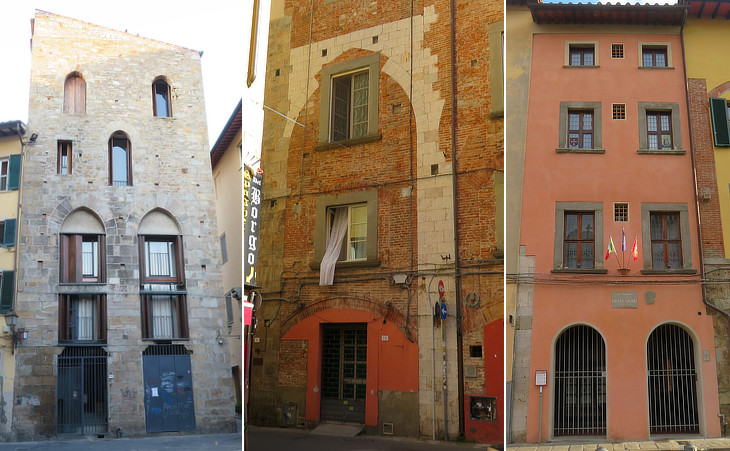
Tower houses near Borgo Stretto: (left) Via Domenico Vernagalli 15; (centre) Via dei Mercanti; (right) Casa Ammannati in Via Giusti where Galileo Galilei was born
Its towers, though no longer a mark of nobility, may be traced in the walls of modernized houses.
Joseph Forsyth - Remarks on Antiquities, Arts, and Letters in Italy in 1802-1803
Blessed Domenico Vernagalli was born in the Vernagalli tower house in 1180. His life was dedicated to helping others, especially the little ones. In 1218, the year before his death, he founded the Hospital of the Gittatelli (thrown away, abandoned). The tower house retains some of its original pointed arches.
Via dei Mercanti is named after one of the guilds. It is characterized by a series of tower houses having the same height, due to a decree by Dagoberto Lanfranchi, the first archbishop of Pisa in 1092.
The exact location of Galileo Galilei's birthplace has been the object of much debate. One hypothesis was Palazzo Bocca. Since the birth was registered as taking place in the parish of Sant'Andrea, it was presumed to be a house of Terziere di S. Martino, the southern one, because the church was located there. Today it is believed that the parish church was S. Andrea Forisportam in Terziere S. Francesco where the family of Giulia Ammannati, Galileo's mother, lived.
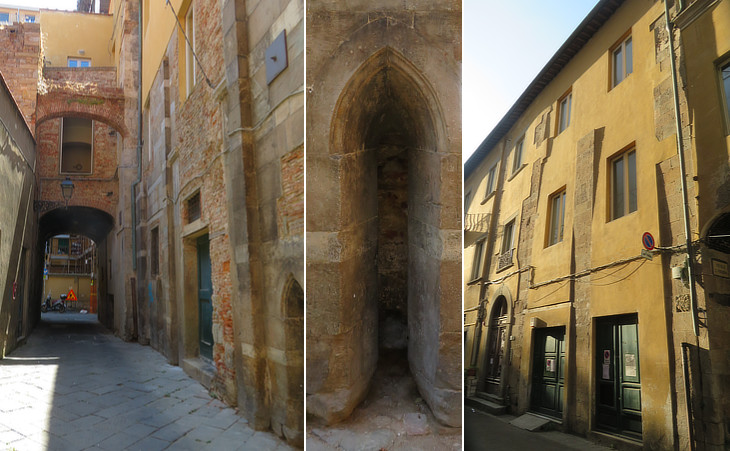
Tower houses east of Piazza Cairoli: (left/centre) Vicolo S. Piero; (right) Via delle Belle Torri
Tower houses are typical of Italian medieval towns and they usually belonged to the families who competed for the control of the town (see some imposing tower houses at Vicopisano, Volterra and Siena). At Pisa however their very high number testifies to the size of the population which at the beginning of the XIVth century was in the region of 50,000 (Rome did not exceed 30,000).
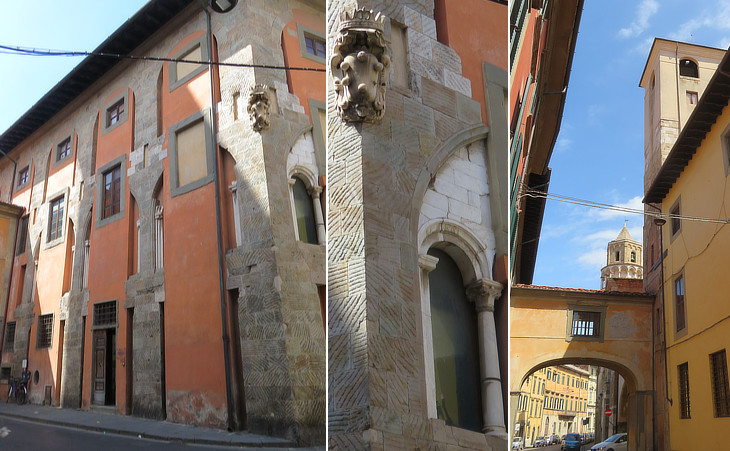
(left/centre) Palazzo delle Vedove (Widows); (right) Passage to Palazzo Granducale and to S. Nicola, via Torre de Cantone
S. Nicola is connected with the palace of the Grand Duke by an archway; it was the chapel of the Court during its residence at Pisa.
John Murray - Handbook for travellers in Central Italy - 1861.
The palace was redesigned in the late XVIth century to be used as an addition to Palazzo Granducale to which was connected by a covered passage. The original structure of the building which was erected in the XIIth century for the Bocci family is clearly visible in the external walls. It is named after the widows of the Grand Dukes or of other members of the Medici family who resided there when the Court spent the winter at Pisa. Some of the widows held a role in the government of the Grand Duchy, e.g. Christina of Lorraine, widow of Ferdinand I, was regent during the minority of her grandson from 1621 to 1628 and Vittoria della Rovere, the very religious widow of Ferdinand II, had such an influence over her son Cosimus III that the wife of the latter chose to return to France after five years of marriage.
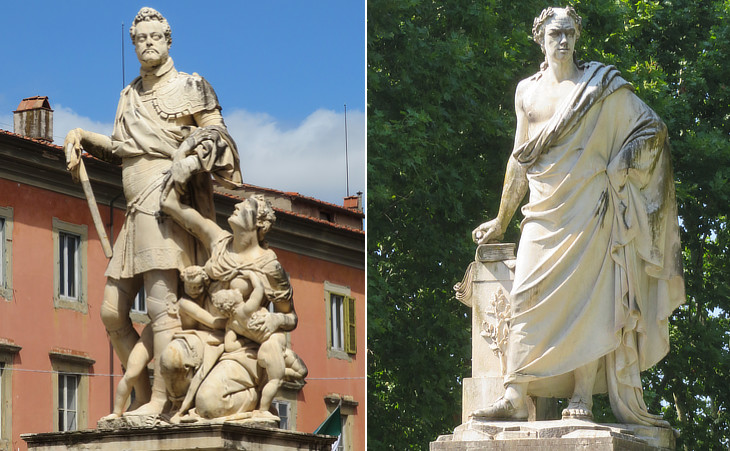
(left) Monument to Grand Duke Ferdinand I near Palazzo Granducale by Pietro Francavilla, a pupil of Giambologna (see another monument he made at Arezzo); (right) Monument to Grand Duke Leopold I in Piazza S. Caterina by Luigi Pampaloni (see his Monument to Lucien Bonaparte at Canino)
In the midst of the City upon the banke of Arno, is the Pallace of the Duke of Florence, and there is a statua erected to Ferdinando the Duke then living, who much favoured this City, in which he was borne.
Fynes Moryson - An Itinerary: Containing His Ten Years Travel Through .. Italy (in 1594)
The Duke has a stately Palace before which is placed the statue of Ferdinand the Third.
John Evelyn - Diary and Correspondence related to his stay in Italy in 1644
January 1765. There are some elegant palaces, particularly that of the grand-duke, with a marble statue of Ferdinand III.
Tobias Smollett - Travels through France and Italy
Some travel accounts mention Ferdinand III because the Latin inscription says Ferdinando Med. Magni Duci Etruriae III, meaning that he was the third Grand Duke of Tuscany, after his father Cosimo I and his brother Francesco. The monument shows the Grand Duke helping the allegory of Pisa (a fallen Charity) to rise again (see the equestrian bronze statue of Ferdinand by Giambologna in Florence).
The Piazza di Santa Caterina, an open space produced by the demolition of the once fine church and convent of San Lorenzo, has no architectural beauty excepting from the church of Sta. Caterina, which has been spared. In the centre is a statue of the Grand Duke Leopold I. in Roman armour at the time by Pampaloni, raised to that excellent sovereign 40 years after his death. Murray
The 1846 Monument to Grand Duke Leopold II at Grosseto combines elements from the two statues at Pisa.
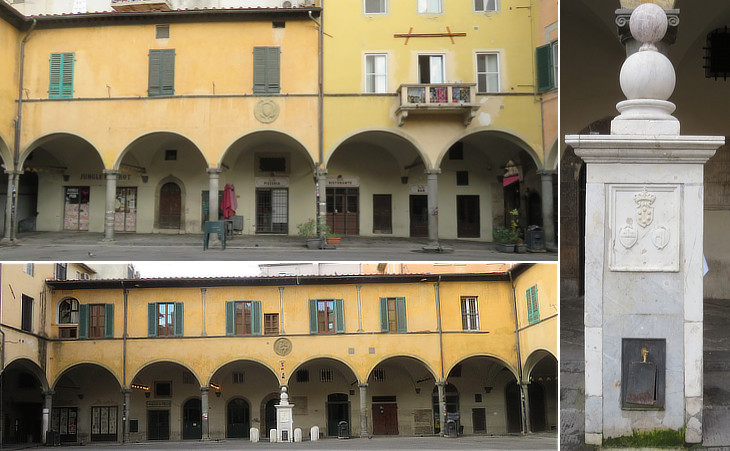
(left) Two sides of Piazza delle Vettovaglie (Provisions) in Terziere Santa Maria; (right) 1715 fountain with a Medici coat of arms which is shown in the image used as background for this page
The houses are well built, the streets open, straight, and well paved; the shops well furnished; and the markets well supplied. Smollett
The square was designed between 1543 and 1565 as part of the Renovatio Urbis promoted by Cosimo on the site of an existing small square known as Piazza dei Porci (pigs). The new market was chiefly meant for cereals and some of the buildings which surrounded it were granaries. Over time, because of its central location very near Borgo Stretto, it became the main food market and in 1771 its name was changed from Piazza del Grano to Piazza delle Vettovaglie. At that time fruit and vegetables were traded at Piazza dei Cavoli (today Piazza Cairoli) on the other side of Borgo Stretto in Terziere San Francesco.
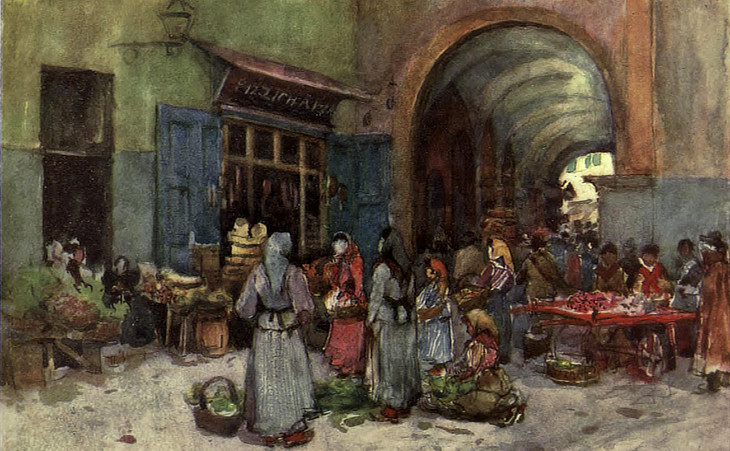
Street-sellers, an illustration from "Florence & some Tuscan cities painted by Colonel R. C. Goff - 1905"
An everyday market scene at Pisa, where countrywomen, having no fixed market stalls, stand selling their wares. (..) Beyond the Piazza dei Cavalieri stretches a maze of picturesque old streets, some colonnaded, and in the centre of these is the old market-place, which might once have been a cloister. It makes a charming picture, the long stalls piled up with fruit and vegetables striking a fine note of colour within the shade cast by the deep and vaulted arches.
Colonel R. C. Goff and Clarissa Catherine De Hochepied - Florence & some Tuscan cities - 1905
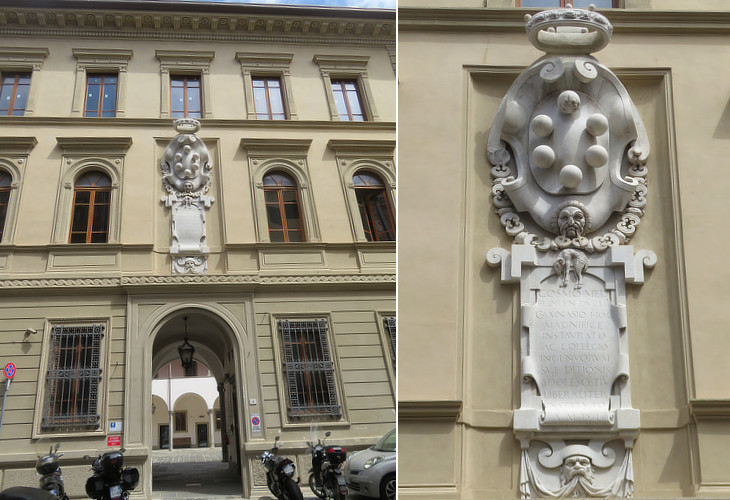
Università della Sapienza (today the Faculty of Law) and coat of arms of Grand Duke Cosimo I with the Collar of the Golden Fleece and a 1550 inscription celebrating the foundation of the college
The pleasant seat of the City, the curtesie of the Citizens, and my desire to converse with the Professors of the University, made me spend some daies in this City, where I paid by the day for my chamber and bed three creitzers, and my Host was tied to buy and dresse such meat for me as I desired, wherein I spent some three Giulii by the day. Moryson
We went to the College, to which joins a gallery so furnished with natural rarities, stones, minerals, shells, dried animals, skeletons etc., as is hardly to be seen in Italy. Evelyn
Some good Colleges there are but unfrequented then by reason of a late Plague: none running faster from the Plague than Scholars, especially when it comes near to the Schools.
Richard Lassels - The Voyage of Italy, or a Compleat Journey through Italy in ca 1668
The other places worth notice are the old exchange, the custom-house, and the college della Sapienza. Nugent
This University is now reduced to three colleges; yet still allots a chair to each faculty . Many of these , indeed , have lost their old scholastic importance , and left their professors idle ; for the students attend only the classes necessary to their future degree. Universities being, in general, the institution of monkish times, are richest in objects related to church or state. Divinity and law engrossed the manors of the pious founders, and left little or nothing to the improvement of natural science. In this university, however, Physicks found the earliest protection: it boasts the first anatomical theatre, and the first botanical garden in Europe; both created before the middle of the sixteenth century . (..) That excluding spirit which prevails in other universities is here unknown. No religion is proscribed. All degrees, except in divinity and canonical law, are open to hereticks and jews. Forsyth
When Pisa was subjugated by the Florentines, the University felt the decay of public prosperity, gradually lost its fame, was forsaken by its students, and at length sunk into insignificance. It was afterwards restored by Lorenzo de Medici, and many professors of eminence were engaged to fill its different chairs. But it again declined; and it was again restored by the Grand Duke Cosmo the First. Since that period it has continued the seat of many eminent professors, though it has never recovered the number of its students, or regained all its ancient celebrity. (..) Pisa is indeed the seat of Tuscan education, and is much frequented by the subjects of the Florentine government; hence, when I say it has never recovered its ancient numbers, I mean not to say that it is deserted, but that its present state does not equal its former glory.
John Chetwood Eustace - Classical Tour of Italy in 1802 (publ. 1813)
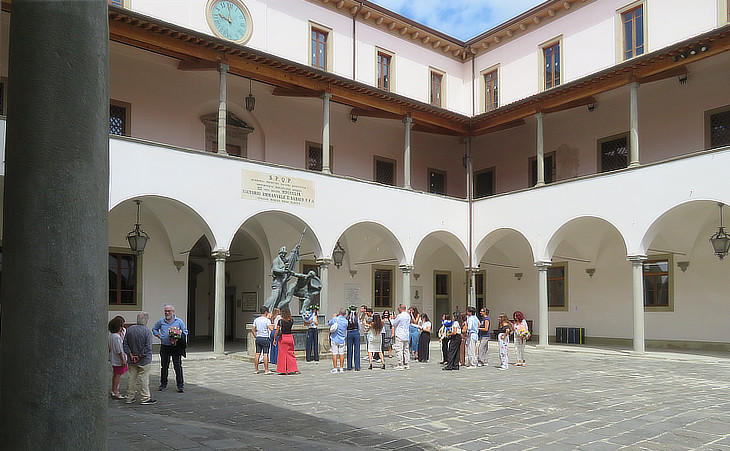
Courtyard with a Monument to the students who fell at Curtatone and Montanara in 1848 and an inscription celebrating the reopening of all faculties of the University in December 1859 in which Victor Emmanuel II of Savoy is referred to as Elected King of Central Italy
The University of Pisa is, even at this day, one of the most reputed seats of learning in Italy. Until within the last few years the Tuscan government did everything in its power to maintain it in its ancient splendour, by calling to it the best professors from every part of the peninsula; but it is to be regretted that the last Grand Duke, discontented with the political feeling of some of its members, and with the strenuous opposition displayed by the townspeople to an establishment of female Jesuits which the Court wished to found here, had in a great measure broken it up by transferring the faculties of law and philosophy to Sienna: the consequence has been the rapid decline of this once celebrated seat of learning. (..) There are only three faculties - medicine and surgery, physical sciences and mathematics, and natural sciences. It contained on an average between 500 and 600 students before the late removal of the faculties of law and philosophy; and though this number may not appear large, prosperity of the city greatly depended upon their resort to it. The students scarcely now reach 300. (..) Near the monument of Henry of Luxembourg has been recently placed a tablet to the memory of the citizens of Pisa who were killed during the Lombard campaign in 1848 bearing the following simple inscription: - "Andarono alla Guerra da Pisa, morirono per l'Italia" followed by the names of the deceased, amongst whom was Professor Pilla, the eminent geologist, killed at Curtatone. Murray
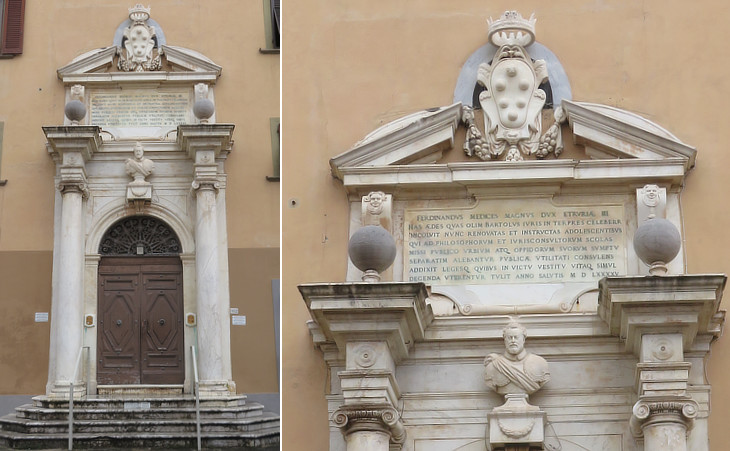
Collegio Ferdinandeo; portal and bust of Ferdinand I by Raffaele Pagni
The most remarkable things we took notice of in this City were: (..) The house of Bartolus now made a College for Students in Law and Philosophy, and thereon this Inscription, Ferdinandus Medices magnus Dux Etr. III. has aedes quae olim Bartolus Juris interpres celeberr. incoluit nunc renovatas & instructas adolescentibus qui ad Philosophorum -& Juris consultorum Scholas missi publico urbium atque oppidorum suorum sumptu separatis alebantur, publicae utilitati consulens addixit, legesque quibus in victu vestitu vitaque simul degenda uteretur tulit. Anno salutis MDLXXXXV.
John Ray - Observations topographical, moral, and physiological: published in 1673.
Dear Milnes, When I left England, I bade my Sister at Home open all letters sent to me. (..) I got a little note of your writing and very pleasantly your voice sounded, in the few words of it, as I read them here under the grim Campanile - the top of which, when the earth next quakes in these parts, will just hit the roof of this huge old Collegio Ferdinando, "where Bartolo," of crabbed memory, "once taught" - as an inscription states - and where I now write.
Robert Browning to Richard Monckton Milnes - March 31, 1847.
The college was part of the effort by the first Grand Dukes of Tuscany to renovate the University of Pisa. Ferdinand I wanted its access to be open also to those who lived in other towns of the Grand Duchy and who could not pay for their studies. The Bartolus referred to in the inscription is Bartolo da Sassoferrato (1313-1357) who taught Civil Law at the Universities of Pisa and Perugia and whose treatises fostered the rediscovery of Roman Law. The College housed 40 students.
Today the University of Pisa together with Scuola Normale Superiore and Sant'Anna School of Advanced Studies, forms one of the most renowned and largest educational centres in Italy.
Move to
The Ancient Town
Piazza dei Miracoli
The Baptistery
The Camposanto
The Cathedral
The Knights of Pisa
The Walls and the Lungarni
A Walk along the southern Terziere
Churches of Terziere S. Maria
Churches of Terziere S. Francesco
S. Maria della Spina
S. Matteo and its Museum
S. Piero a Grado
An Excursion to Vicopisano