All images © by Roberto Piperno, owner of the domain. Write to romapip@quipo.it.


Notes:
Page added in December 2025.
All images © by Roberto Piperno, owner of the domain. Write to romapip@quipo.it.
Notes:
Page added in December 2025.
 The Camposanto
You may wish to see a page on Piazza dei Miracoli first.

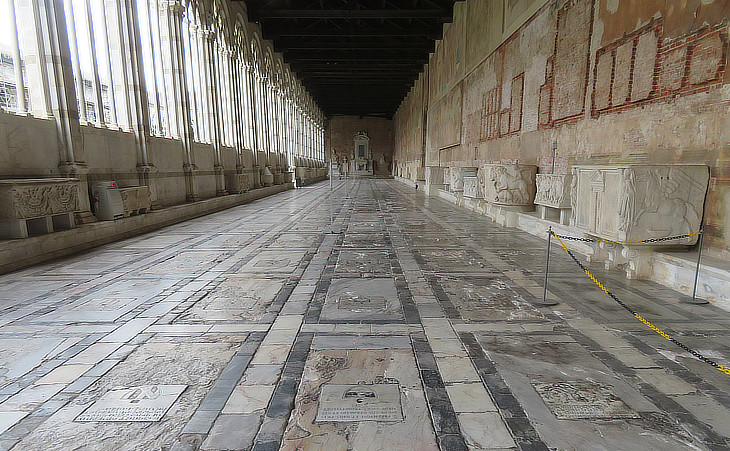
View of the central section with the main entrance
Not farre thence is a yard used for common buriall, called the holy field, vulgarly Campo Santo. In which the Emperour Fredericke Barbarossa, returning from Hierusalem, did lay great store of that earth, which he had used for ballast of his ships; and they say, that dead bodies laid there, doe consume in a most short time.
Fynes Moryson - An Itinerary: Containing His Ten Years Travel Through .. Italy (in 1594)
October 1644. The cemetery called Campo Santo, is made of divers galley ladings of earth formerly brought from Jerusalem, said to be of such a nature, as to consume dead bodies in forty hours.
John Evelyn - Diary and Correspondence related to his stay in Italy in 1644
The three edifices which I have described, stand in a line, and appear together in full view; but the cemetery lies on the north side of the cathedral and baptistery, and seems rather a grand boundary than a detached edifice. It is raised like the others on steps, and is adorned like the undermost story of the cathedral, with pillars and arches and a similar cornice. The gate is decorated with high pinnacles.
John Chetwood Eustace - Classical Tour of Italy in 1802 (publ. 1813)
(1873) The Campo Santo presents a long, blank marble wall to the relative profaneness of the Cathedral close, but within it is a perfect treasure-house of art.
Henry James - Italian Hours - 1909
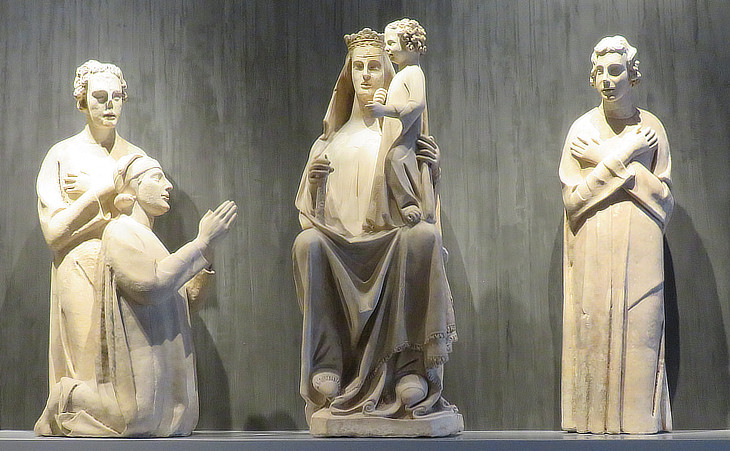
Museo dell'Opera del Duomo (in a building near the Leaning Tower): statues above the portal: Madonna and Child, two angels and the donor (of the same size of the other statues) by Lupo di Francesco (ca 1320); the Madonna is portrayed in the same posture as those by Giovanni Pisano in the Cathedral and the Baptistery
On the other side of the Duomo, is the Campo Santo a great square place cloistered about with a low Cloister curiously painted. Its callled the Campo Santo, because therein is conserved the Holy Earth brought from Jerusalem in 50 Gallies of this Republick: Thiese Gallies were sent by the Republick of Pisa, to succour the Emperour Aenobarbe (Barbarossa), in the Holy Land, but hearing of his death when they came thither, they returned home again loaded with the earth of the Holy Land, of which they made this Campo Santo.
Richard Lassels - The Voyage of Italy, or a Compleat Journey through Italy in ca 1668
The Campo Santo. This celebrated cemetery, which has given its name to every similar place of interment in Italy, was founded by Archbishop Ubaldo (1188-1200). The prelate, retreating from Palestine, whence he was expelled by Saladin, found some compensation for his defeat by returning with his 53 vessels laden with earth from Mount Calvary. This earth was said to reduce to dust within 24 hours dead bodies buried in it. He deposited it in ground which he purchased; but the present structure, enclosing it, was not begun until 1278, by Giovanni Pisano.
John Murray - Handbook for travellers in Central Italy - 1861.
In 1284 the Pisan fleet was defeated by the Genoese one at the Meloria rocks near Leghorn, an event which caused the decline of the Republic and halted the construction of the Camposanto. The traditional attribution of the statues above the portal to Giovanni Pisano proved to be not consistent with the timing of the completion of the building and today they are attributed to Lupo di Francesco, a young assistant of Giovanni who in 1315 was appointed "Operaio dell'Opera del Duomo", i.e. supervisor of all activities concerning the Cathedral and the adjoining buildings.
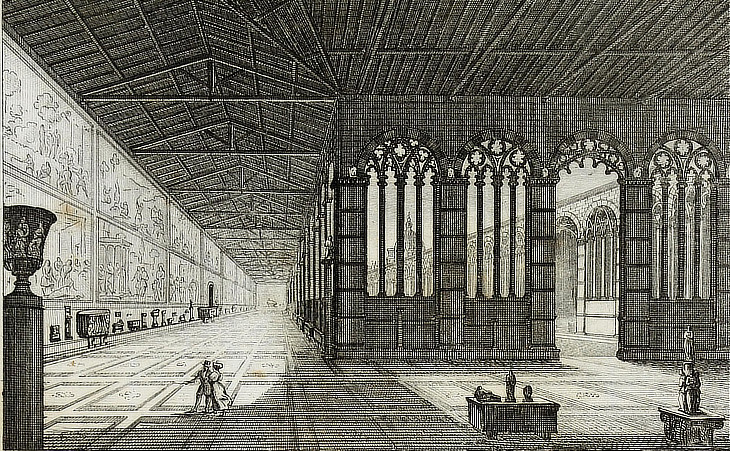
Illustration from "Ranieri Grassi - Descrizione Storica e Artistica di Pisa e de suoi Contorni - 1836" which shows the ancient vase on a column, a copy of which is now near the Leaning Tower
At one side of this church, stands an ample and well-wrought marble vessel, which heretofore contained the tribute paid yearly by the city to Caesar. It is placed, as I remember, on a pillar of opal stone, with divers other antique urns. Evelyn
Within is an oblong square, enclosed in a most magnificent gallery or cloister, formed of sixty-two arcades, or rather windows, of the most airy and delicate Gothic work imaginable. This gallery is both lofty and wide, flagged, and built entirely of white marble, adorned with paintings almost as ancient as the edifice, and highly interesting, because forming part of the history of the art itself. It is also furnished with many Roman sarcophagi and inscriptions, and ennobled by the tombs of several illustrious persons, natives of Pisa, and foreigners. The space enclosed is or rather was, the common burial place of the whole city; it is filled to the depth of ten feet with earth brought from the Holy Land by the gallies of Pisa in the twelfth century, and is supposed to have the peculiar quality of corroding the bodies deposited in it, and destroying them in twice twenty-four hours; an advantage highly desirable in such crowded repositories of putrefying carcases. Eustace

Western wing of the burial ground
This yard is compassed with a building all of Marble, which lies open like a Cloyster, (we call it a terras) and the same is covered with lead very sumptiously, having in bredth 56 pillars, and in length 189, each distant from the other thirteene walking paces. So as (in my opinion) this yard for buriall is much more stately, then that most faire yard for the same purpose, which I formerly discribed at Leipzig in Germany. Moryson
The Campo Santo is built of the same length and breath, they say as Noah's Ark was. Its inner area is encompassed with a curious Cloyster of white Marble, and is filled With Earth Which was brought' from Jerusalem, as Ballast in the Gallies of the Pisans. (..) It is a most delightful Structure, tho Gothick.
Edward Wright's Observations made in France, Italy &c. in the years 1720, 1721 and 1722.
The Campo Santo. The portico of this vast rectangle is formed by such arcades as we find in Roman architecture. Every arch is round, and every pillar faced with pilasters; but each arcade includes an intersection of small arches rising from slender shafts like the mullions of a Gothick window. This, however, looks like an addition foreign to the original arcades, which were open down to the pavement.
Joseph Forsyth - Remarks on Antiquities, Arts, and Letters in Italy in 1802-1803
The tracery of the arches is Gothic and speculation was occasioned by the supposition that it was coeval with the arcade; but it is in fact of the later half of the 15th century, having been completed in 1463; and it was originally intended to have introduced stained glass. The dimensions of the building within are - length 415 ft. 6 in.; width 137 ft. 10 in.; from the pavement to the roof of the corridors 46 ft. Murray
This quadrangular defence surrounds an open court where weeds and wild roses are tangled together and a sunny stillness seems to rest consentingly, as if Nature had been won to consciousness of the precious relics committed to her. Something in the quality of the place recalls the collegiate cloisters of Oxford, but it must be added that this is the handsomest compliment to that seat of learning. The open arches of the quadrangles of Magdalen and Christ Church are not of mellow Carrara marble, nor do they offer to sight columns, slim and elegant, that seem to frame the unglazed windows of a cathedral. James
The Pavement which is all of Marble, with Divisions of several Colours, has under it the sepulchres of the then noble Families of Pisa, And if departed Souls have any pleasure in the Position of the Carcasses they have left behind them, sure those of this place have A large proportion of it. All along the Wall of the Cloysters near the Area, under the Windows, are antique sarcophagi of White Marble, with Basso-Relievo's. The other Walls are all painted in Fresco, quite round, and from top to bottom, by some of the first Restorers of Painting in Italy, after the terrible shock all Arts Had there, by the incursions of the barbarous Nations. Wright
It is I hope, no breach of my resolution not to be tempted into elaborate descriptions, to remember the Campo Santo; where grass-grown graves are dug in earth brought more than six hundred years ago, from the Holy Land; and where there are, surrounding them, such cloisters, with such pleasing lights and shadows falling through their delicate tracery on the stone pavement, as surely the dullest memory could never forget. On the walls of this solemn and lovely place, are ancient frescoes, very much obliterated and decayed, but very curious.
Charles Dickens - Pictures from Italy - 1846
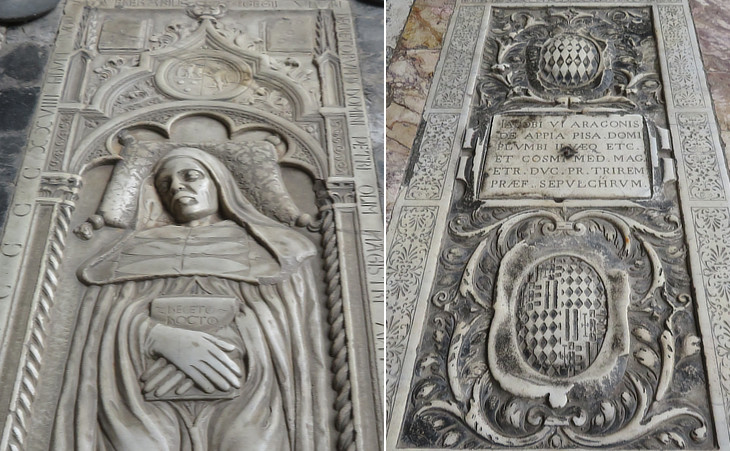
(left) Tombstone of a dean of the Cathedral (d. 1428) by Antonio, a sculptor from Carrara; (right) tombstone of Jacopo VI Appiani d'Aragona (d. 1585), Lord of Piombino, a port south of Leghorn, and commander of the fleet of Grand Duke Cosimo I de' Medici
The Ambulatory is paved with slab tombs, said to be 600 in number, of the Pisan families who had the right of interment here. They are mostly in low relief, much worn by the feet of generations who have trodden them; and are interesting as specimens of costume of different classes of citizens, doctors, knights, merchants, bishops, abbots. The dates of these figures are generally between 1400 and 1500. Burials rarely take place here now. Murray
The wide pavement is a mosaic of sepulchral slabs, and the walls, below the base of the paling frescoes, are incrusted with inscriptions and encumbered with urns and antique sarcophagi. The place is at once a cemetery and a museum, and its especial charm is its strange mixture of the active and the passive, of art and rest, of life and death. James
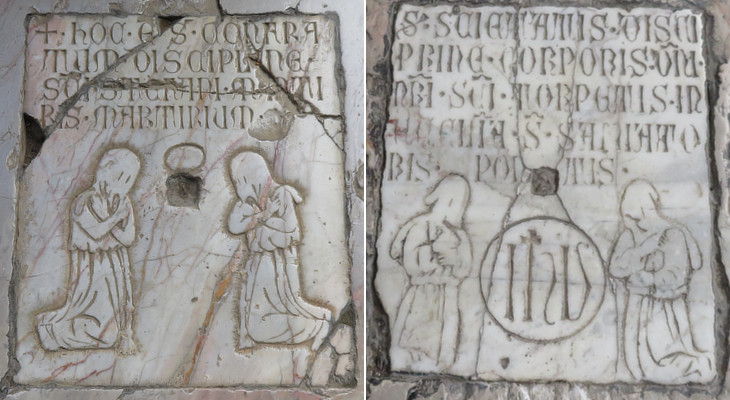
Tombstones of members of brotherhoods wearing the traditional hooded uniform (see an example at Volterra): (left) Confraternita di Santo Stefano martire; (right) Confraternita del SS. Salvatore
To be buried in the Campo Santo of Pisa, I may however further qualify, you need only be, or to have more or less anciently been, illustrious, and there is a liberal allowance both as to the character and degree of your fame. James
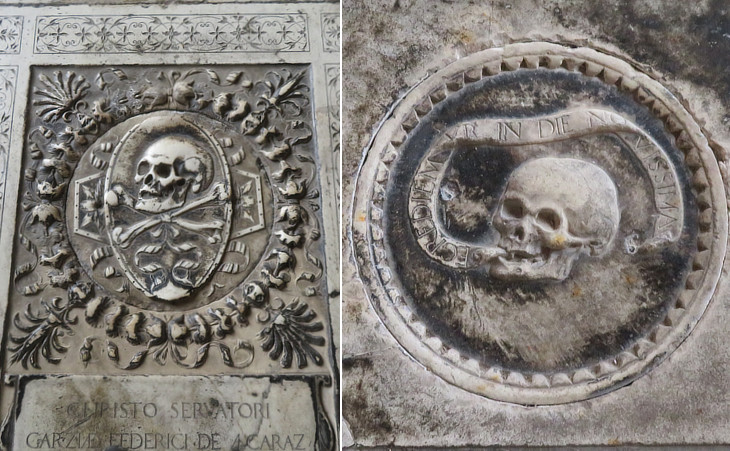
Memento Mori tombstones: (left) Garzia di Federico di Alcaraz, a magistrate of Pisa of Spanish origin in 1557; (right) Dean Gregorio Leoli (d. 1527) "Egrediemur in die novissima" (We will get out in the last day)
The peculiar devotional spirit of the olden time, which placed a higher confidence in outward forms of worship than in the watchful guarding of the heart against sinful thoughts and the hands against sinful deeds, and which believed in the protecting virtues of inanimate objects made holy by contact with holy things, is illustrated in a striking manner in one of the cemeteries of Pisa. The tombs are set in soil brought in ships from the Holy Land ages ago. To be buried in such ground was regarded by the ancient Pisans as being more potent for salvation than many masses purchased of the church and the vowing of many candles to the Virgin.
Mark Twain - The Innocents Abroad - 1869
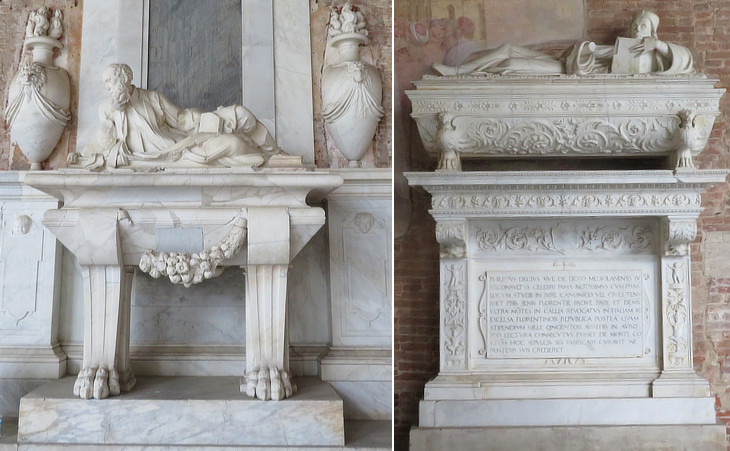
Renaissance monuments: (left) Monument to Matteo Corte (philosopher and physician) by Antonio di Gino Lorenzi and Pierino da Vinci, based on a drawing by Nicolò Tribolo, a celebrated sculptor and architect (see a fine relief by him at Loreto); (right) Monument to Filippo Decio (Law professor) by Stagio Stagi (1527)
Here I did see another sepulcher with this inscription in Latin; To Mathew Curtius Physitian. Duke Cosmo made this at his owne charge, in the yeere 1544. Moryson
'Tis cloistered with marble arches and here lies buried the learned Philip Decius, who taught in this University. Evelyn
There are several fine monuments of Good Sculpture; one of them is of Philippus Detius Mediolanensis; who (according to the Inscription) not willing to trust those Who were to come after him, took care himself to have a Sepulchre made for him.
Wright
The other tombs in the Campo Santo that may be particularised as fine examples are (..) of Philip Decio, the urn of the finest style of the fifteenth century, of the school of B. da Settignano, or Rossellino. Murray
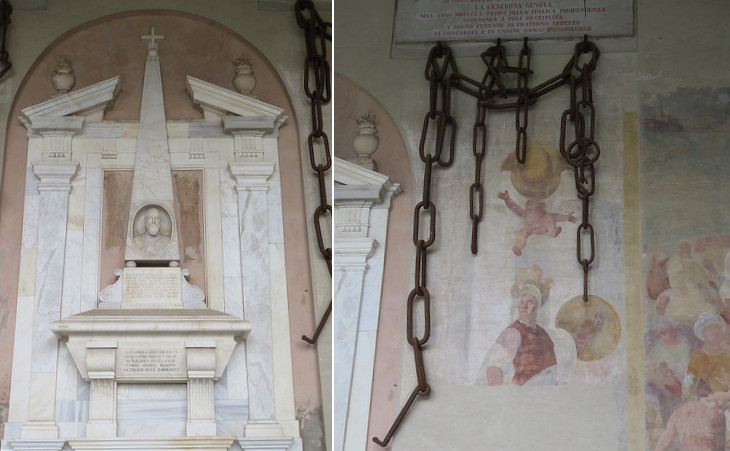
(left): Monument to Bartolomeo Medici by Giovanni Bandini and Valerio Cioli (1573), similar to that to Matteo Corte; (right) chains from the Port of Pisa given back by Genova
The portion of the chains of the port of Pisa taken by the Genoese in 1362, and by them given to the Florentines, and for so long a period suspended over the doors of the baptistery in Florence they were restored to the Pisans in 1848, and are now hung up in the W. ambulatory as a "pegno e segnacolo di un era novella" (symbol of a new era) as the inscription beneath informs us, as well as those which hung on the Porta Vacca at Genoa, still more recently restored. Murray
No one could have been sad in the company of our cheerful and patient cicerone, who, although visibly anxious to get his fourteen-thousandth American family away, still would not go till he had shown us that monument to a dead enmity which hangs in the Campo Santo. This is the mighty chain which the Pisans, in their old wars with the Genoese, once stretched across the mouth of their harbor to prevent the entrance of the hostile galleys. The Genoese with no great trouble carried the chain away, and kept it ever afterward till 1860, when Pisa was united to the kingdom of Italy. Then the trophy was restored to the Pisans, and with public rejoicings placed in the Campo Santo, an emblem of reconciliation and perpetual amity between ancient foes.
Dean Howells - Italian Journeys - 1867
Learn more about the Pisan struggle with Florence and Genoa and see the remains of the medieval arsenal.
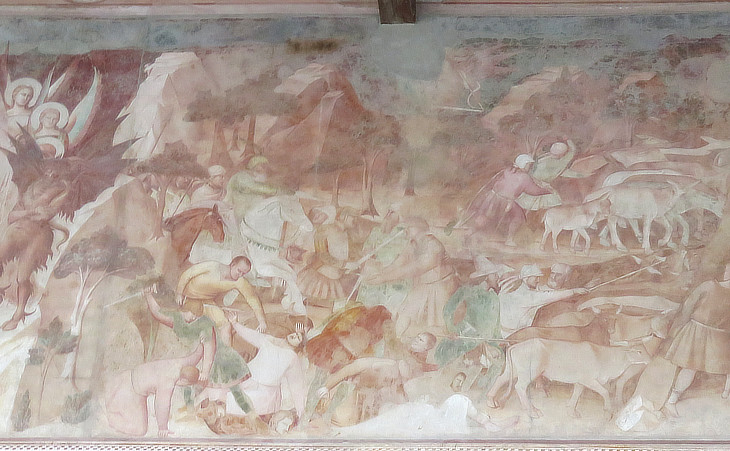
Misfortunes of Job: The Invasion by the Sabeans by Taddeo Gaddi (for a long time his frescoes were attributed to Giotto - see one of his paintings at Castiglion Fiorentino and read Vasari's comments about him)
Such cloistered cemeteries as this were the field where painting first appeared in the dark ages, on emerging from the subterranean cemeteries of Rome. In tracing the rise and genealogy of modern painting, we might begin in the catacombs of the fourth century, and follow the succession of pictures there (..); then, passing to the Greek image-makers of the tenth and eleventh centuries, we should soon arrive at this Campo Santo which exhibits the art growing, through several ages, from the simplicity of indigence to the simplicity of strength. Here the immensity of surface to be covered forbade all study of perfection, and only required facility and expedition. The first pictures shew us what the artist was when separated from the workman. They betray a thin, timid, ill fed pencil; they present corpses rather than men, sticks rather than trees, inflexible forms, flat surfaces, long extremities, raw tints, any thing but nature. Forsyth
About the time when the structure was completed Giotto had just finished a painting of St. Francis receiving the stigmata from which he acquired great credit. It was placed in the church of St. Francis, which then was one of the most favourite places of devotion in Pisa; and the citizens, little as they loved Florence, yet did not reject the advantage which they could derive from the skill of a citizen of the rival city. Of the paintings executed by Giotto, A.D. 1296-1298, which comprehended the principal subjects of the life of Job, three remain in part. (..) As usual in compositions of this date, a series of subjects is included in one painting. The first portion shows the tempting demon pleading before the Almighty. Beneath, faintly indicated, is a wide perspective of the sea, with islands. The centre is formed by the invasion of the Sabeans, the bat-winged demon soaring above, and bearing the avenging sword. The whole is much injured. Murray
Vasari says (..) that Pope Benedict XI was led to inquire respecting Giotto's talent, because the fame of his illustrations to the life of Job in the Campo Santo of Pisa had reached him. The reader may note, as he proceeds with these pages, that Vasari blundered here as in other places, and that the series of the frescos of Job are by another and feebler hand.
J. A. Crowe and G. B. Cavalcaselle - A new history of painting in Italy - 1864
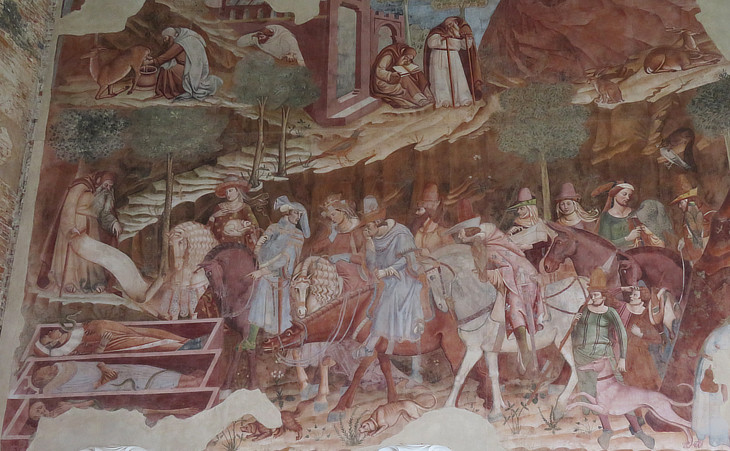
The Triumph of Death: the three kings come upon three corpses by Buonamico Buffalmacco (his frescoes were attributed to Andrea Orcagna until 1974); see this subject in a XIIIth century fresco in the Cathedral of Atri
In an Instance of the Triumph of Death lie three Carcasses, in so many several Sarcophagi and there is one Who shews them to three great Persons who come towards them on horseback: One of them leans back with much dislike; and holds his Nose; the Horse pokes out his Head, as frighted and snorting. On this piece is written: "Nor: Wisdom's Guard, nor Riches join'd / Nor noble Birth, nor valorous Mind / Avail-against Her Blow". Wright
The Triumph of Death. This has been considered as one undivided composition; but it seems rather a series of allegories bearing upon the theme of the destiny of mankind; quaint and almost uncouth. The subject on the l. of the spectator was suggested by the once popular legend of the three kings, who, hunting in a forest, were conducted to three open tombs, in which they beheld the ghastly corpses from which they were the to receive the warning calling them to repentance. Orgagna has represented the bodies in three stages of decay; and the three leaders of the proud cavalcade equally display three gradations of sentiment - light unconcern, earnest reflection, and contemptuous disgust. It is said by Vasari that the second is the portrait of the Emperor Louis V. or the Bavarian; and the third of Uguccione della Faggiuola, the Signore of Pisa. Murray
The fragments of painting that remain are fortunately the best; for one is safe in believing that a host of undimmed neighbours would distract but little from the two great works of Orcagna. Most people know the "Triumph of Death" and the "Last Judgment" from descriptions and engravings; but to measure the possible good faith of imitative art one must stand there and see the painter's howling potentates dragged into hell in all the vividness of his bright hard colouring; see his feudal courtiers, on their pal freys, hold their noses at what they are so fast coming to; see his great Christ, in judgment, refuse forgiveness with a gesture commanding enough, really inhuman enough, to make virtue merciless for ever. (..) For direct, triumphant expressiveness these two superb frescoes have probably never been surpassed. James
Ghiberti affirms that Bonamico, or Buffalmacco, was an excellent master; that his colour was fresh; and that, when he set his mind to a task, he surpassed every other painter. Vasari, who copies Ghiberti, repeats after him, that:
at Pisa, Buffalmacco painted many pictures for the town and in the Campo Santo, and that he executed important works. Crowe

The Triumph of Death: Fight between Angels and Demons by Buonamico Buffalmacco
The Subjects are chiefly Scriptural, with an Addition of some of their own Legends, and other Fancies, Which have some Particulars which are whimsical and extravagant enough. To begin with the South Side; The first Design is what indeed more particularly suits a Caemeterium; they call it the Triumph of Death. (..) Angels are taking the Souls the Just out of the Mouths in the shape of little naked Infants: Devils those of the Reprobate; which are represented more gross. An Angel and a Devil have got that of a fat Friar between them, in the Air, tugging Hard, one at each end, which shall have him. Wright
The Triumph of Death: the departing souls, represented as new-born babes, seized by angels or demons as they issue with the last breath of the departed. In one of these Orgagna has effectively depicted the horror of the soul at finding itself in the grasp of a demon. The sky above is filled with angels and demons bearing off the souls to bliss or punishment: the group of an angel and a demon, pulling an unfortunate fat friar by the legs and arms, to obtain possession of him, shows with what liberty artists were allowed to deal with the religious orders in the 14th century. In other parts the demons are bearing off their prey to a volcano, probably Mount Etna, which, according to the legends, was considered as the entrance of the infernal regions. Murray
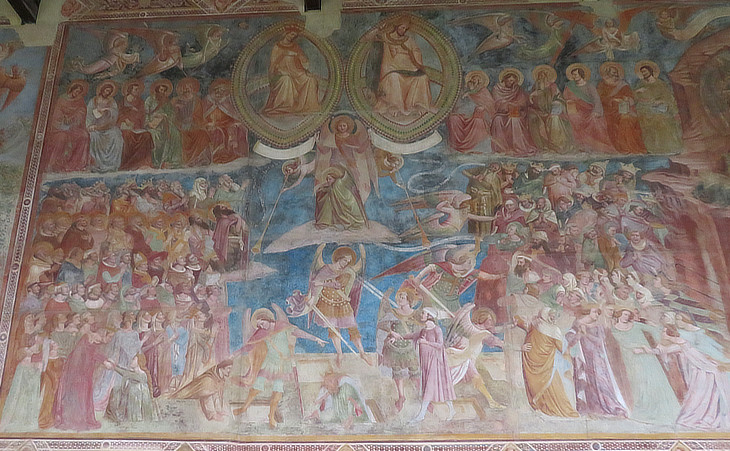
The Last Judgement by Buonamico Buffalmacco
The two great masses of the blessed and the condemned are divided by the ministering archangels. In both are seen an equal proportion of the several ranks and orders of men, the first receiving the invitation to join the Lord with joy, the latter listening to their condemnation with horror, shame, and despair. There are here some touches of satirical spirit: kings, queens, and monks are amongst the damned; and a Franciscan friar, who had risen amongst the good, is stopped by the archangel, and carried to the other side; and one, in the abito civile of Florence, who has risen on the side of the condemned, is led to the side of the blessed. The angels dividing the two companies are good. St. Michael, distinguished by a cross on his cuirass, is one of the three archangels executing vengeance. King Solomon is represented as rising exactly between the good and the bad, and apparently uncertain as to where he should place himself. An archangel in the centre holds the sentences "Come ye blessed" and "Depart from me" in either hand; beneath are the angels sounding the trumpets; and in front a third, clothed in a long garment, and half concealing his countenance. It has been supposed that this figure represents the guardian angel grieving at the loss of so many who had been committed to his charge. Higher still are the Twelve Apostles. Murray
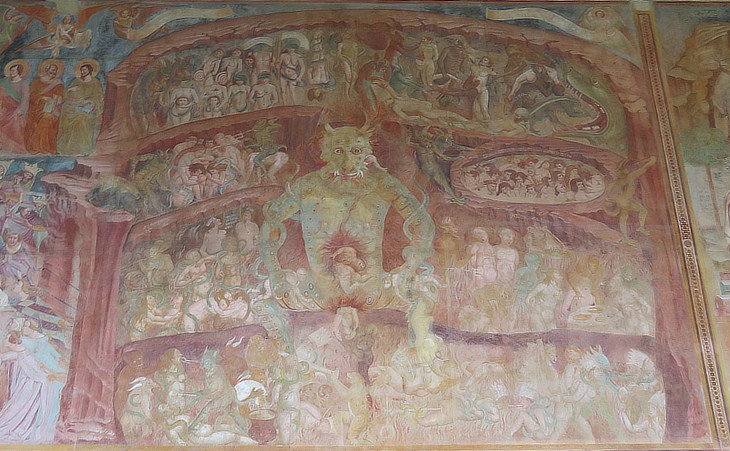
Hell by Buonamico Buffalmacco
In the Representation of Hell a great monstruous Devil sits in the middle, with Flames as it Were shooting from Him each way: His Underlings are variously employed in inflicting Torments, some with Scourges, which they call Disciplines, and several other ways: They are roasting one before the fire with a great spit run up through him; A little Devil is turning the Spit at one end, the other end of it is in the Mouth of one of the tormented. (..) Several other ludicrous Fancies there are, which I forbear repeating. Wright
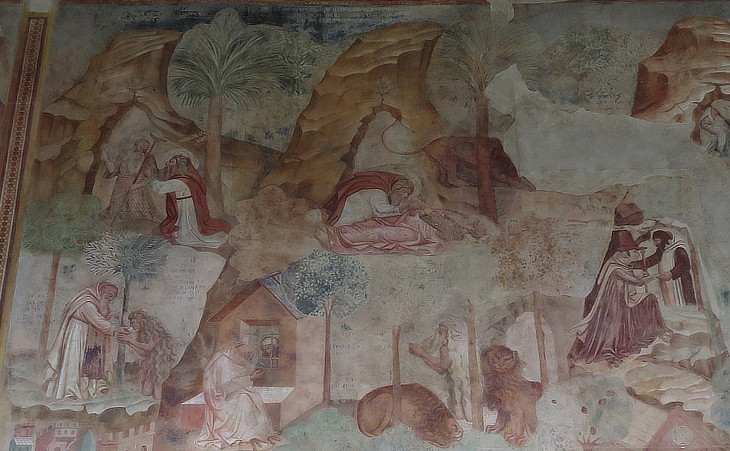
The Thebaid (The Hermits of the Egyptian Desert) by Buonamico Buffalmacco - detail (see the frescoes in the Cloister of S. Onofrio in Rome which depict similar scenes)
Some of these frescos have been exposed to the open air for 500 years, and the earliest works are mouldering away from moisture. What pity that a country full of antiquaries and engravers should let such monuments perish without a remembrance! How superiour these to the coarse remains of Anglo-Gothick art. Forsyth
This compartment is filled with groups, representing the labours and conversation of these anchorites, as well as their temptations. One is lodged in a tree; another recluse receiving food through the window of the cell in which he is immured; some busily employed in basket-making. Sturdy demons are assaulting and scourging St. Anthony. Panutius is resisting the temptation of a fair fiend, by putting his hands into the flame. (..) The groups are jotted over the wall, as in a Chinese paper-hanging. Murray
If it was awful once to look upon that strange scene where the gay lords and ladies of the chase come suddenly upon three dead men in their coffins, while the devoted hermits enjoy the peace of a dismal righteousness on a hill in the background, it is yet more tragic to behold it now when the dead men are hardly discernible in their coffins, and the hermits are but the vaguest shadows of gloomy bliss. Howells
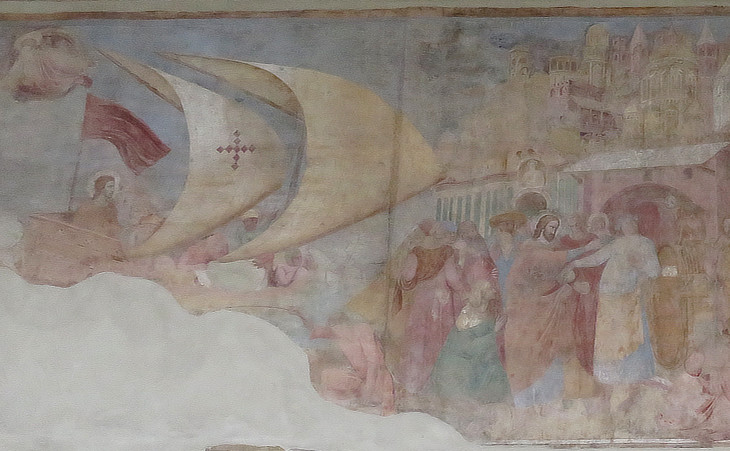
St. Ranieri returning to Pisa on a Pisan ship by Antonio Veneziano
The series illustrates the life of St. Ranieri, who was held in great veneration in Pisa, his native town. They are painted in six compartments - the three uppermost are by Memmi only, the others by Antonio Veneziano, who died in 1384. (..) St. Ranieri embarks upon a Galleon for the Holy Land. It is not easy, however, to make out what is the subject of this picture. It seems to be St. Ranieri returning in a Pisan vessel, bringing the relics of some saint. Murray
As you follow the chronology of the wall, you catch perspective entering into the pictures, deepening the back ground, and then adjusting the groups to the plans. You see the human figure first straight, or rather stretched; then foreshortened, then enlarged: rounded, salient, free, various, expressive. Throughout this sacred ground, painting preserves the austerity of the Tuscan school: she rises sometimes to its energy and movement, she is no where sparing of figures, and has produced much of the singular, the terrible, the impressive; but nothing that is truly excellent. All the subjects are taken from Scripture, the Legends, or Dante; but in depicting the life of a patriarch or a saint, the artists have given us the dress, the furniture, and the humours of their own day. Forsyth
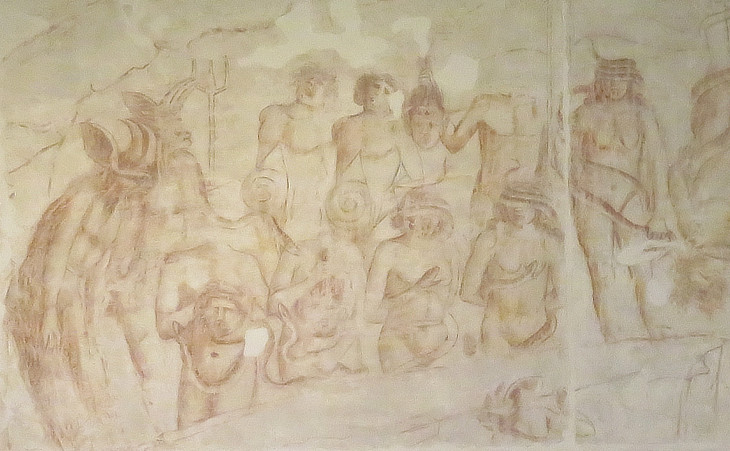
Museo delle Sinopie: Sinopia (preparatory drawing) of the upper left part of Hell by Buonamico Buffalmacco.
Originally its walls were one vast continuity of closely pressed frescoes; but now the great capricious scars and stains have come to out number the pictures, and the cemetery has grown to be a burial place of pulverised masterpieces as well as of finished lives. James
We were glad to hurry away to the serenity and solemn loveliness of the Campo Santo. Here are the frescoes painted five hundred years ago to be ruinous and ready against the time of your arrival in 1864. (..) It is most worthy celebration. Those exquisitely arched and traceried colonnades seem to grow like the slim cypresses out of the sainted earth of Jerusalem; and those old paintings, made when Art was - if ever - a Soul, and not as now a mere Intelligence, enforce more effectively than their authors conceived the lessons of life and death; for they are themselves becoming part of the triumphant decay they represent. Howells
On July 27, 1944 the Camposanto was bombed by the Allies and a fire caused great damage to some of the frescoes, especially because the lead tiles of the roof melted down over the walls. The frescoes which had not entirely perished were stripped from the walls and they revealed very detailed preparatory drawings which were considered a work of art worth of being displayed to the public.
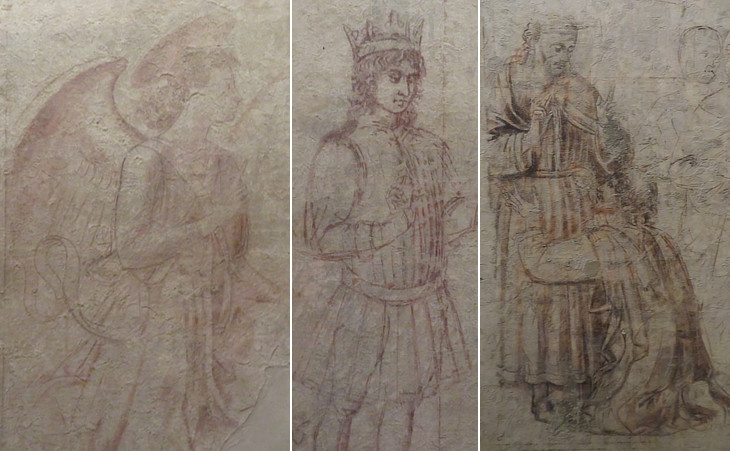
Museo delle Sinopie: preparatory drawings by Benozzo Gozzoli: (left) angel of the Annunciation; (centre) one of the Magi (see The Magi (the retinue of Emperor John VIII), his masterpiece in Florence (it opens in another window) and another of his paintings at Musei Vaticani; (right) the Marriage of Isaac and Rebekah: Abraham sending forth Eleazar
All are more or less spoiled by damp. Damp sea-air, damp walls, and, an "intonaco", or plaster, which, probably from the nature of the lime employed, appears to have been peculiarly absorbent of humidity, have all contributed to the decay. Hence the colours are generally faded; some of the paintings have almost entirely scaled off from the wall, and others in large portions. When the "intonaco" has been thus removed, the design is often seen drawn upon the wall in a red outline. Murray
There are charming women, however, on the other side of the cloister - in the beautiful frescoes of Benozzo Gozzoli. If Orcagna's work was appointed to survive the ravage of time it is a happy chance that it should be balanced by a group of performances of such a different temper. The contrast is the more striking that in subject the inspiration of both painters is strictly, even though superficially, theological. But Benozzo cares, in his theology, for nothing but the story, the scene and the drama - the chance to pile up palaces and spires in his backgrounds against pale blue skies cross-barred with pearly, fleecy clouds, and to scatter sculptured arches and shady trellises over the front, with every incident of human life going forward lightly and gracefully beneath them. Lightness and grace are the painter's great qualities, marking the hithermost limit of unconscious elegance, after which "style" and science and the wisdom of the serpent set in. His charm is natural fineness; a little more and we should have refinement - which is a very different thing. (..) Benozzo has suffered greatly. The space on the walls he originally covered with his Old Testament stories is immense; but his exquisite handiwork has peeled off by the acre, as one may almost say, and the latter compartments of the series are swallowed up in huge white scars, out of which a helpless head or hand peeps forth like those of creatures sinking into a quicksand. James
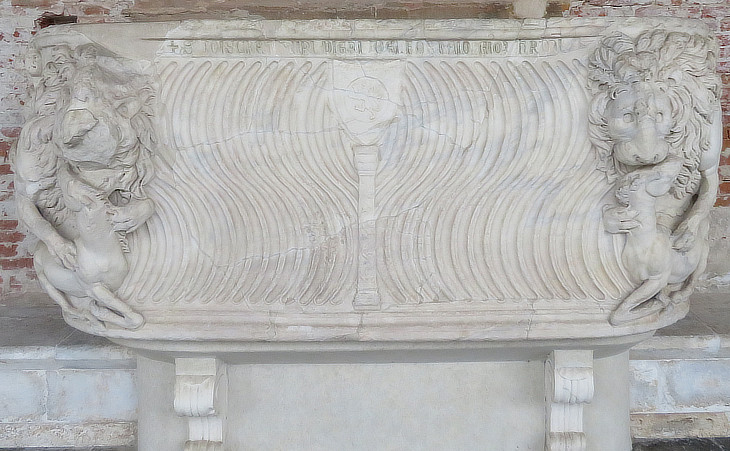
Sarcophagus 34 "lenos" (tub-shaped): Lions devouring a horse and a "strigiles" decoration (see a similar sarcophagus from Porto); it was reused in the XIVth century when a coat of arms was added
The collection of sepulchral monuments is interesting. The greater number, however, do not belong to the place, having been brought from the Duomo and other churches in the Pisan territory. The Pisans began collecting at an early period not merely for curiosity, but for use; interring their departed friends in the sarcophagi - of pagan times. The Campo Santo was already a museum in the days of Queen Christina of Sweden. It owes its present rich collection to the exertions of the late Cavaliere Lasinio, who in 1807 was appointed Conservatore of the edifice which he rescued from destruction, and illustrated by his engravings. Of the sarcophagi appropriated by the Pisans, the finest in point of workmanship, as well as the most interesting as a monument of history, is that which contains the body of the Countess Beatrice. (..) It was much studied by Nicola Pisano. (..) Several Roman sarcophagi are nearly of one pattern, the front covered a with a curved fluting; the flutings much closing upon tablet in the centre with figures at the angles. They have generally, with more or less alteration, been adapted as mediaeval sepulchres: sometimes armorial bearings are inserted in the ancient wreaths or tablets, or inscriptions in Gothic capitals running along the mouldings or amidst the imagery. Murray
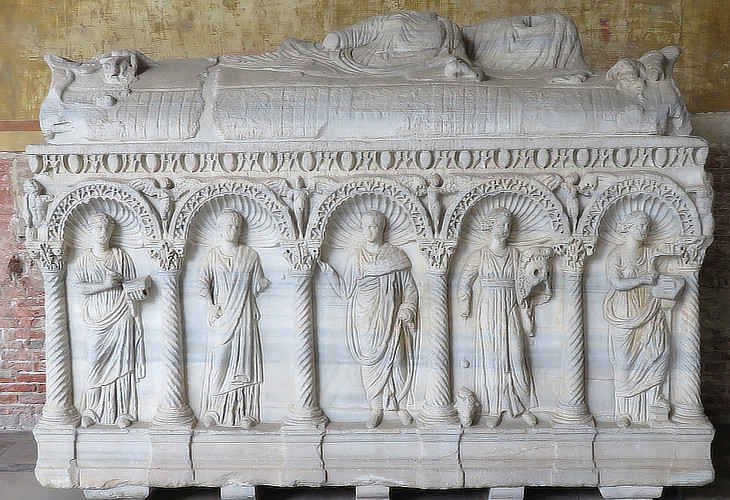
Sarcophagus 27 Sidamara type: Muses inside niches (IIIrd century AD) and lid portraying a couple at their funerary banquet on a finely embroidered cushion. It shows the use of drill in the execution of the niches of the Muses (see the same subject in a sarcophagus of the Mattei collection)
The collection of Roman sarcophagi at the Camposanto includes examples of the most popular subjects and techniques. We know that sarcophagi were made at workshops in towns near quarries or where a school of sculptors had developed. They were then shipped to the four corners of the Empire. See a page on the manufacturing and trading of Roman sarcophagi and directories of sarcophagi shown in this website from Rome and its environs and from other locations of the Empire.

Sarcophagus 26 depicting a wedding ceremony (IIIrd century)
The veiled bride and the groom are portrayed in the central niche. Behind them a goddess (Juno or Concordia) who protected the marriage and at their feet Hymen holding a burning torch. The mother and the father of the bride are portrayed in the adjoining niches and Castor and Pollux appear in the niches at the extremities of the box as symbols of human life because allegories of the River Acheron and of the Earth stand at their feet. You may wish to see other sarcophagi depicting Roman wedding ceremonies at Orvieto and in Rome and a large fresco in Rome.
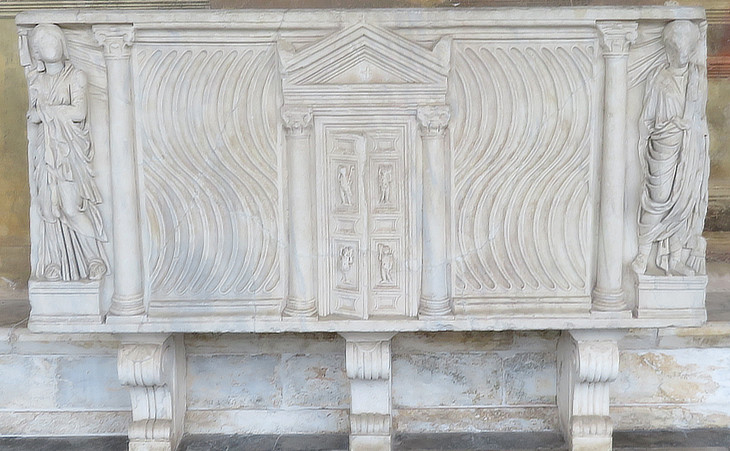
Sarcophagus 36 portraying a couple at the sides of the Gate of Hades: it is depicted ajar as an indication that the dead could return to life (see a sarcophagus in Rome portraying Hercules returning from Hades)
This sarcophagus was not made to order and its box left the workshop in half-finished condition. The portraits of the dead were expected to be completed at a later time, after they had reached their final destination, by local skilled workmen, but in this case the heirs did not care to pay someone to actually portray the dead (see another example of "unsold" sarcophagus in Rome).
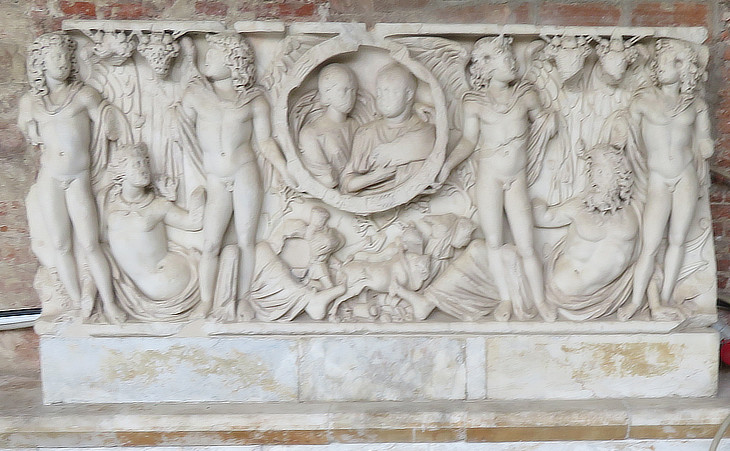
Sarcophagus 31 (IIIrd century AD) portraying the dead in a "clipeus" (a round shield) held by two of the Four Seasons; the "clipeus" is decorated with worn out zodiacal symbols (see a similar sarcophagus from Porto); the two reclining figures portray Earth and Oceanus (with crab horns), an unusual subject in sarcophagi but very frequent in floor mosaics
The representation of countryside scenes or symbols became very frequent in sarcophagi of the late Empire. The depiction of men and more often children working in a vineyard (e.g. those found at la Garbatella in Rome and near Narbonne) was perhaps the most popular subject of this kind of sarcophagi. In this sarcophagus the reference to agriculture is entrusted to a relief showing a scene of ploughing (see it in a floor mosaic in Algeria).
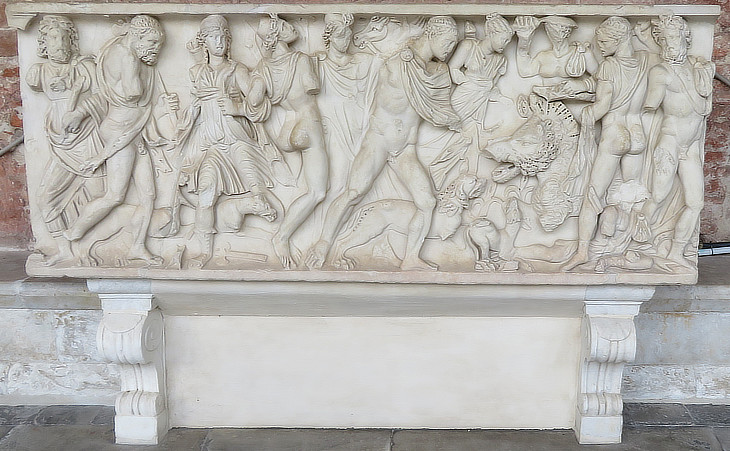
Sarcophagus 24 (IIIrd century AD) depicting the myth of Meleager who together with Atalanta, Artemis and others hunts the Caledonian wild boar
Indeed, few churches in Italy are free from the incongruous. Here in Pisa are Bacchanals and Meleager's hunt incrusted on the sacred walls, an ancient statue of Mars, worshipped under the name of St. Potitus, and the heads of satyrs carved on a cardinal's tomb! Forsyth
A large sarcophagus has a pair of figures on its lid, and the hunt of the Calydonian boar in relief below.
George Dennis - The Cities and Cemeteries of Etruria - 1848 Ed.
It is very similar to one at Musei Capitolini (see a fine statue of Meleager with his trophy at Musei Vaticani).

Sarcophagus 29: box depicting a "thiasos", satyrs and maenads, both followers of Dionysus/Bacchus at the sides of the god; lid of another sarcophagus with inscription and scenes most likely depicting Orpheus being torn to pieces by the maenads
A thiasos is one of the most popular scenes which were depicted on the box of sarcophagi. In some instances satyrs and maenads were replaced by tritons and Nereids (see a list of sarcophagi in Rome with a thiasos). Thiasos and in general depictions of Dionysus/Bacchus were a popular subject; of particular interest are the sarcophagi depicting the god conquering India (see an example at Lyon) and also in floor mosaics (see an example in Tunisia).
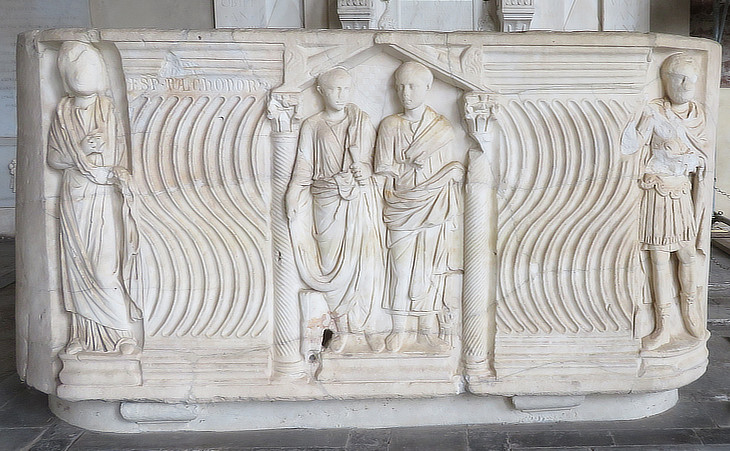
Sarcophagus 188: "The Brothers' sarcophagus" (ca 220 AD) which was re-used as a tomb by the Falconi family in the XIVth century
The figured scenes show a couple in the centre and a man and
woman individually in the corners. (..) Neither the man nor the woman is shown engaged
in any activity, such as sacrifice, while the central scene contains the portrait
figures of two young men. This is a deviation from the conventional
iconography, and may have been specially commissioned to commemorate the
premature death of the couple's sons: that is the suggestion. (..) Although it is a monumental piece, the carving of the figured scenes is not of
the highest quality: the woman is sculpted on the front of the sarcophagus and
the man on its curved corner, so that their plinths and also the adjacent panels of
fluting are of different dimensions.
Jas Elsner and Janet Huskinson - Life, Death and Representation. Some New Work on Roman Sarcophagi - 2011 Walter de Gruyter GmbH & Co. KG, Berlin/New York
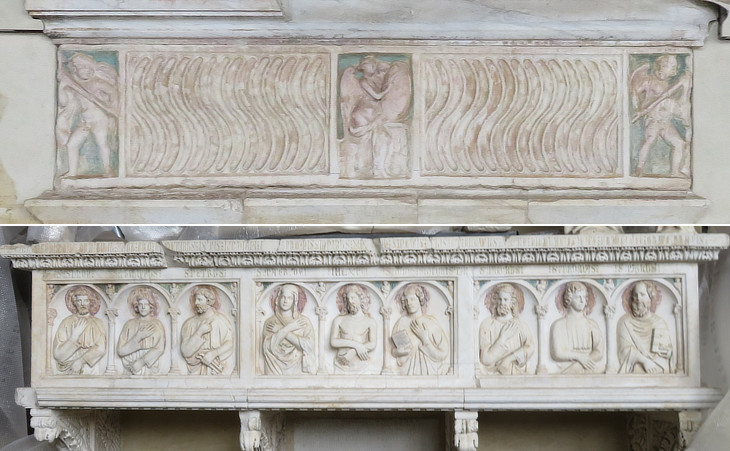
(above) Sarcophagus 62: a depiction of Victory writing on her shield (see a relief of Colonna Traiana) IIIrd century AD but re-used for Blessed Giovanni della Pace (d. 1325); (below) Monument of the della Gherardesca family by Lupo di Francesco (1320 ca)
Numerous relics of the 14th centy. are interesting . The sepulchre of Count Bonifazio della Gherardesca, and his family, is amongst the most worthy of notice; it was removed from the suppressed church of San Francesco; but it has lost many of the statues which adorned it where it originally stood. Murray
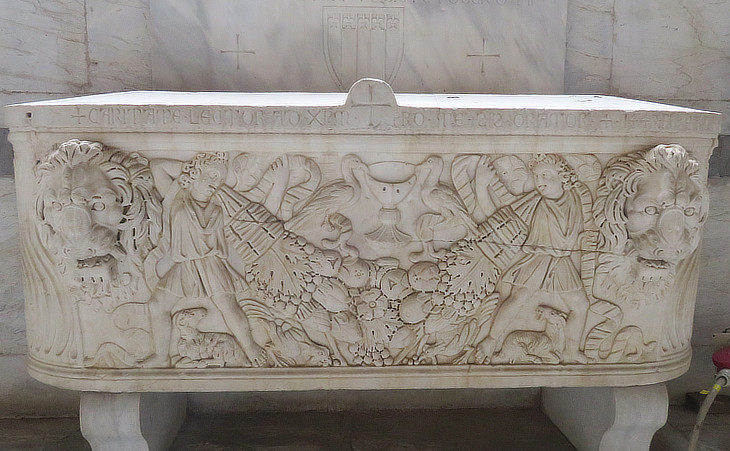
Sarcophagus of Abbot Benedetto, with festoons held by genii and lion masks, very similar to Roman models (see two sarcophagi at Palazzo Barberini), but with some Christian symbols (see a mosaic at S. Costanza) by Andrea di Francesco Guardi (1443)
For many wealthy families in Pisa at
that time, to be buried in an ancient Roman sarcophagus was a symbol of their
status. The attraction lay in its commercial value as an expensive import
(possibly purchased direct from Rome), in its aesthetic qualities, and above all in
its symbolism, as a Roman antiquity. Since the eleventh century Pisa had
consciously identified itself with Rome, using Roman inscriptions and reliefs as
spolia in the Duomo and other major buildings to reinforce the historical
reference; by choosing Roman sarcophagi for their tombs the elite were also
allying themselves to the past from which their city claimed authority. Until the
Camposanto was built in the early 1300s, these sarcophagi were placed around
the outer walls of the Duomo, on public view in the heart of the city. This was
a fitting burial-place for the Pisan elite, who were identified by inscriptions on
the wall above. Elsner and Huskinson
Andrea di Francesco Guardi is best known for his reliefs portraying virtues at S. Maria della Spina.
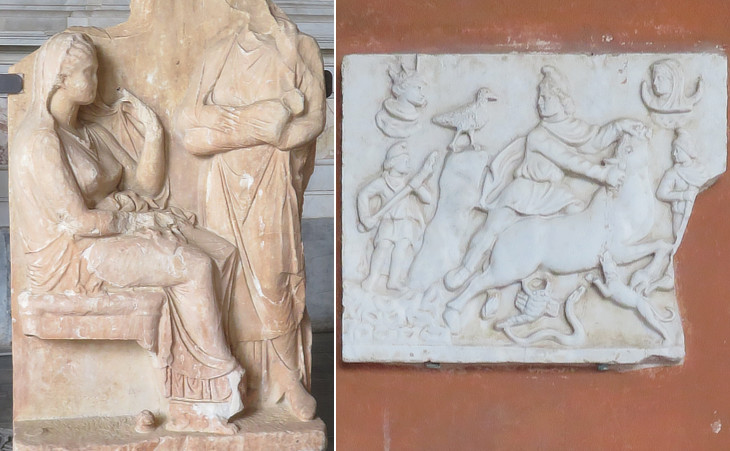
Additions to the sarcophagi collection of the Camposanto: (left) fragment of a IVth century BC funerary relief from Athens (acquired in 1826); (right) small relief depicting Mithra slaying the bull (see other similar reliefs)
The Campo Santo is kept shut, but will be opened by the custode, who attends for about six hours in the day: he lives close by; a fee of one paul for each person is amply sufficient, and less in proportion when there is a party; the keeper being paid by the academy. No drawings of any kind can be made in it without the permission of the Conservatore; but this is readily granted. The Conservatore lives near the Piazza, not five minutes' walk from the Campo Santo. Murray
The image used as background for this page shows a flying Victory holding a clipeus.
Move to
The Ancient Town
Piazza dei Miracoli and the Leaning Tower
The Baptistery
The Cathedral
The Knights of St. Stephen
The Walls and the Lungarni
A Walk along the northern Terzieri
A Walk along the southern Terziere
Churches of Terziere S. Maria
Churches of Terziere S. Francesco
S. Maria della Spina
S. Matteo and its Museum
S. Piero a Grado
An Excursion to Vicopisano