All images © by Roberto Piperno, owner of the domain. Write to romapip@quipo.it.


Notes:
Page added in May 2026.
All images © by Roberto Piperno, owner of the domain. Write to romapip@quipo.it.
Notes:
Page added in May 2026.
 at Museo dell'Opera del Duomo - page 1
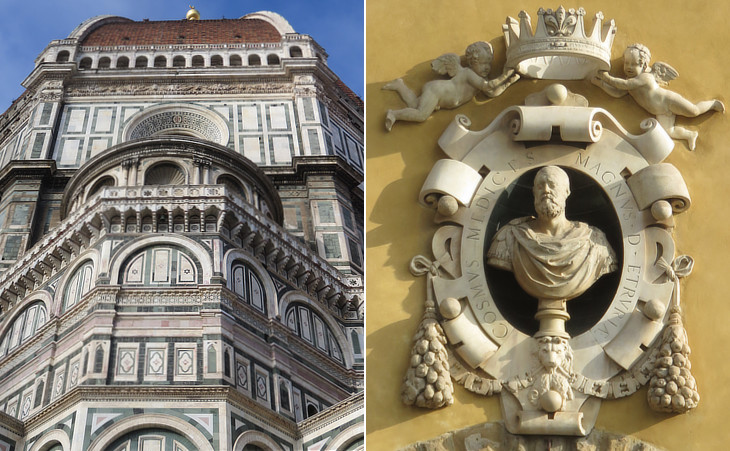
(left) Rear side of the Duomo (Cathedral of S. Maria del Fiore); (right) bust of Grand Duke Cosimo I with the Collar of the Order of the Golden Fleece by Giovanni di Benedetto Bandini (1572) at the entrance of Museo dell'Opera del Duomo opposite the rear side of the Cathedral
Giovanni di Benedetto of Castello, a disciple of Baccio Bandinelli and an Academician, who is executing for the Wardens of S. Maria del Fiore the works in low-relief that are going round the choir, which is now near completion. In these he is closely imitating his master, and acquitting himself in such a manner that an excellent result is expected of him; nor will it fall out otherwise, seeing that he is very assiduous in his work and in the studies of his profession.
Giorgio Vasari - Lives of the most eminent painters, sculptors & architects - transl. by Gaston Du C. De Vere
The "Lives" were limited almost entirely to Italian artists and especially those of Tuscany. (..) The charm of Vasari's work is inherent in the narrative of the individual lives. He could tell a story as a good Florentine should, and if he did not always distinguish too critically between the "vero" (true) and the "ben trovato" (good to believe), the fault has endeared him to generations of casual readers. (..) Vasari's conception of the history of Renaissance art has remained such a vital force in modern thought that he is often criticized as though he were a contemporary historian. (..) The defects of his work from the modern point of view are clear. His method was "unscientific." He was frequently credulous and prejudiced, though seldom consciously untruthful (but) the "Lives" served as the foundation for all histories of Renaissance art.
Wallace K. Ferguson - The Renaissance In Historical Thought - 1948
The Offices of the Wardens of S. Maria del Fiore, i.e. Opera del Duomo, the foundation in charge of the construction and the maintenance of the Cathedral were located behind the building and today they house a museum where many of its masterpieces have been relocated to ensure they are properly preserved from damage, similar to what occurs at Siena, Pisa and Orvieto.
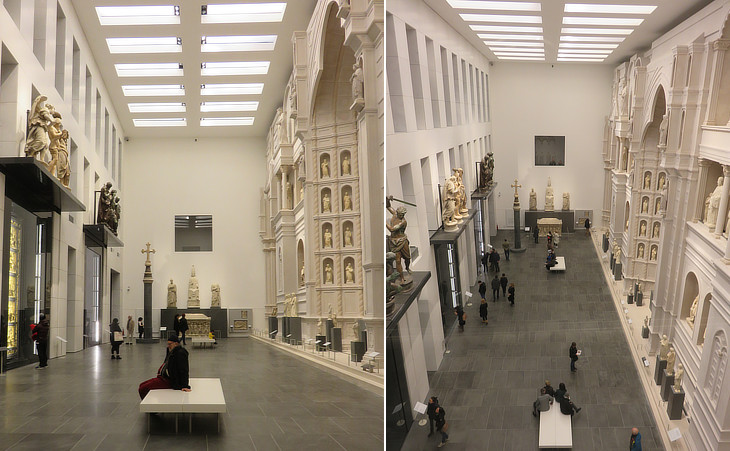
Museo dell'Opera del Duomo: Sala del Paradiso: the bronze doors of the Baptistery and the statues at their top on the left side of the images and a reconstruction of the medieval façade on the right side
In 1999 the management of the museum bought an adjoining building which in origin was a theatre, thus greatly expanding its premises. The new space available was designed in order to recreate the space between the Baptistery and the Cathedral which was called "paradise" because of the joy of the newly-baptized who would cross it to enter the Cathedral and attend the ceremonies for the first time. The medieval façade of the Cathedral was never completed but there were enough descriptions and drawings of it to allow for its tentative reconstruction. The new set up of the museum was inaugurated in 2015.
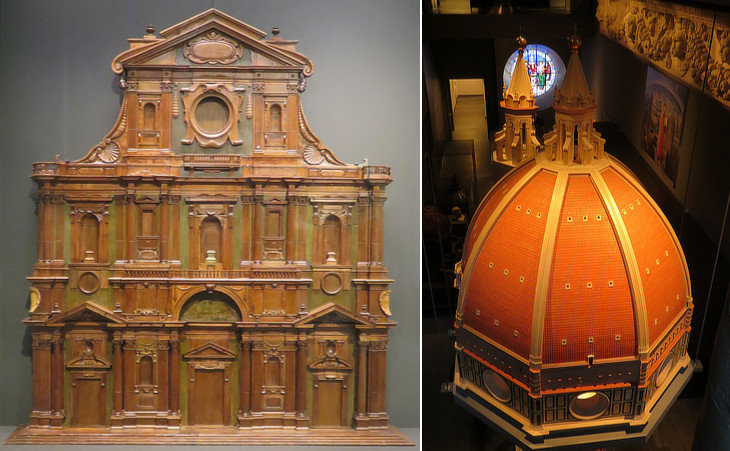
Cathedral: (left) 1587 Project for the façade by Bernardo Buontalenti; (right) model of the dome
A beautiful genius, also, universal and abundant in fine fantasies, has been shown by Bernardo Timante Buontalenti, who had his first principles of painting in his youth from Vasari, and then, continuing, has made so much proficiency that he has now served for many years, and still serves with much favour, the most illustrious Lord Don Francesco de' Medici, Prince of Florence. (..) And if this man, when he was a youth (although even now he is not past thirty), had given his attention to the studies of art as he gave it to the methods of fortification, in which he spent no little time, he would be perchance now at such a height of excellence as would astonish everyone; none the less, it is believed that he is bound for all that to achieve the same end, although something later, for the reason that he is all genius and art, to which is added this also, that he is continually employed and exercised by his sovereign, and in the most honourable works. Vasari
In 1587 Grand Duke Francis I ordered the demolition of the existing façade and its covering with bricks. Bernardo Buontalenti (1531-1608) and other architects developed projects for a new façade which were never implemented, also because they did not match with the overall design of Cathedral. Ephemeral façades and plaster statues (see below) covered the bricks on special occasions, e.g. in 1589 for the marriage of Grand Duke Ferdinand I with Christina of Lorraine.
A new plan is now likely to be carried into effect; although nothing has been yet commenced (Sept 1867).
John Murray - A handbook for travellers in central Italy - 1867
The Cupola built by Filippo di Ser Bruneleschi is the largest, and the utmost Stretch of Art in its kind that ever has been produced in the World.
Jonathan and Jonathan Richardson - Account of Some of the Statues, etc. in Italy - 1722
The cupola is the largest dome in the world; for though the summit of the cross of St. Peter's is at a greater distance from the ground than the summit of the cross on the cathedral of Florence (in consequence of the greater dimensions of the whole building), yet, dome separately compared with dome, that of Brunelleschi is the higher. The Florentine dome has also a greater circumference. Murray
The ceremonies for the completion of the dome in 1436 were attended by Pope Eugenius IV who realized that because of the size and beauty of S. Maria del Fiore, the Basilica of St. Peter's needed to be rebuilt.
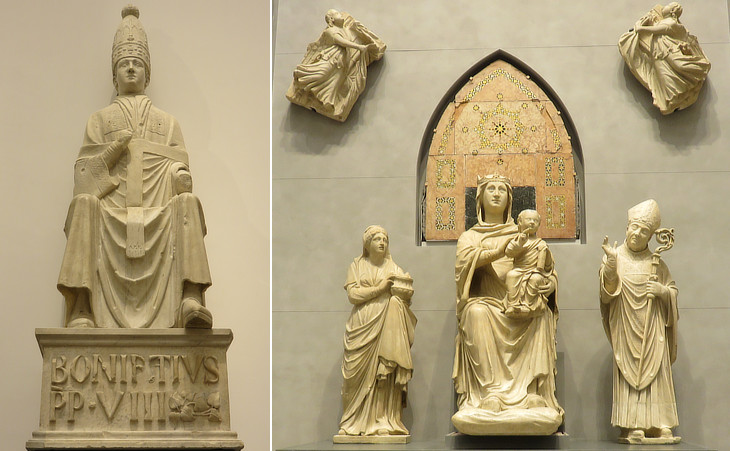
Arnolfo di Cambio - statues from the main portal of the medieval façade: (left) Pope Boniface VIII; (right) Madonna between St. Reparata, a legendary martyr, and St. Zanobi, the Vth century first bishop of Florence
The laying of such foundations for so great a church was celebrated with much solemnity, for on the day of the Nativity of Our Lady, in 1298, the first stone was laid by the Cardinal Legate of the Pope, in the presence not only of many Bishops and of all the clergy, but of the Podesta as well, the Captains, Priors, and other magistrates of the city, nay, of the whole people of Florence, calling it S. Maria del Fiore. (..) The Pope and the Legate granted very great indulgences to those who should make them offerings thereunto. (..) And because the Florentines desired at that time to gain the friendship and love of Pope Boniface VIII, who was then Supreme Pontiff of the Church of God, they wished that, before anything else, Andrea should make a portrait in marble of the said Pontiff, from the life. Wherefore, putting his hand to this work, he did not rest until he had finished the figure of the Pope, with a S. Peter and a S. Paul who are one on either side of him ; which three figures were placed in the facade of S. Maria del Fiore, where they still are. Vasari
Palazzo Strozzi. There is nothing in the house worthy of notice; but the gardens are handsomely laid out: in one part is a (..) statue of Pope Boniface VIII., by Andrea Pisano, which was intended originally for the facade of the cathedral; it is a work of the 14th cent., as shown by the tiara with a single crown, like on the statue in the crypt of St. Peter's at Rome, by Arnolfo. Murray
The statue is no longer attributed to Andrea Pisano but to Arnolfo di Cambio whose activity as a sculptor was overshadowed by that as an architect. The statues of the medieval façade were dispersed in other churches, palaces and even gardens.
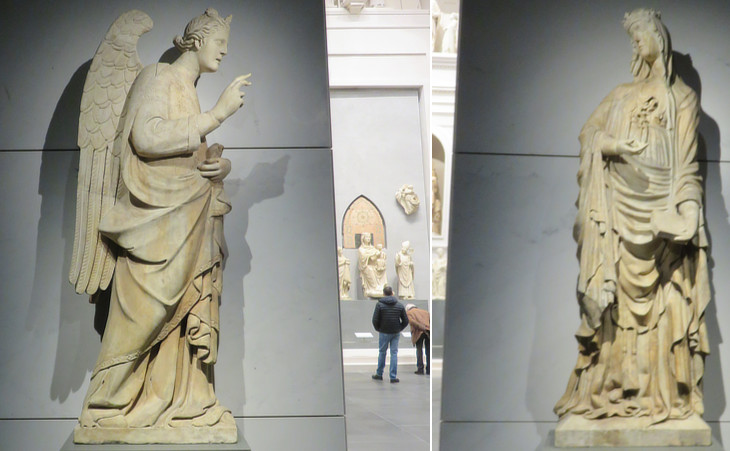
Annunciation by Jacopo di Piero Guidi (Angel ca. 1380) and Giovanni di Balduccio (Virgin Mary ca. 1350) from a side entrance of the Cathedral opposite the Campanile
On the S. side the Madonna over the door nearest to the campanile is attributed to Niccolo Aretino, and that over the door more towards the E. to Giovanni Pisano Murray
The Cathedral being named after the Virgin Mary, the statues of the portals were all dedicated to Her. These two monumental statues, actually two high reliefs, depicting the Annunciation, come from the sides of the Bell Tower Door, on the southern side of the Cathedral.
A widespread need for public records in late medieval Italy led to the development of practices for the preservation of records and the appointment of the first archival staff were implemented throughout the peninsula towards the end of XIIIth century. Opera del Duomo kept records of all the payments made for the construction and maintenance of the Cathedral. Based on this documentation today art historians attribute the Madonna to Giovanni di Balduccio. It remained in the Opera's deposits for a period until around 1380, when a sculptor, identified as Jacopo di Piero Guidi, created the Announcing Angel as its companion. Both figures were then placed above the portal. The figure of the angel makes an opposite, advancing movement, with his right hand blessing and his other hand holding the edge of his long, finely embroidered dress. The figure of Mary is also regal in appearance, wearing a long cloak and a crown. Her figure has a movement very different from the quiet harmony of the angel.
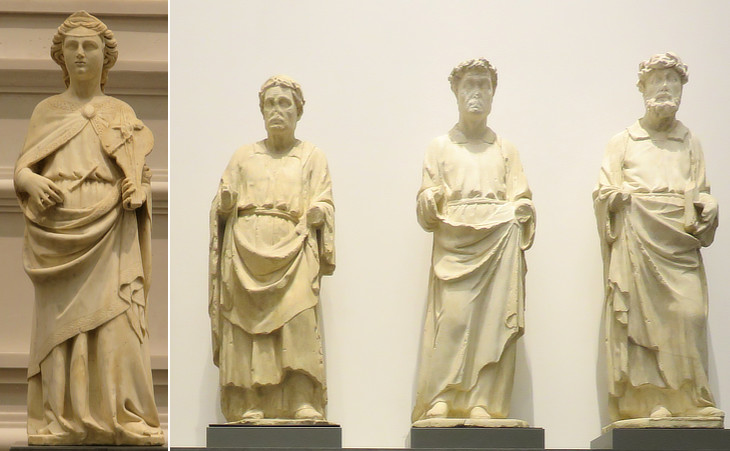
Statues from the medieval façade: (left) angel playing a musical instrument 1383-1388; (right) Doctors of the Church by Piero Tedesco (Pietro di Giovanni) 1395
The only other sculptural works by Andrea which we know are
the statues of the Four Doctors of the Church, made for the facade of the Duomo, which now stand, transformed into poets, at the foot of the hill leading up to Poggio Imperiale
Charles Perkins - Tuscan Sculptors - 1864
The statues of the Doctors of the Church (Sts. Jerome, Ambrose, Augustine and Gregory) are no longer attributed to Andrea Pisano, although their current state of preservation makes both the attribution of the sculptors and the identification of the figures uncertain. A group of white marble statues depicting musician angels was sculpted to embellish the central portal of the medieval façade. After it was dismantled, these sculptures were dispersed. The group was originally composed of at least eight angels: six of them were relocated to the gardens of Villa Medici di Castello and in 1936 they were moved to the museum of the Cathedral. Some of the angels, typically late Gothic, are portrayed in abstract contemplation.
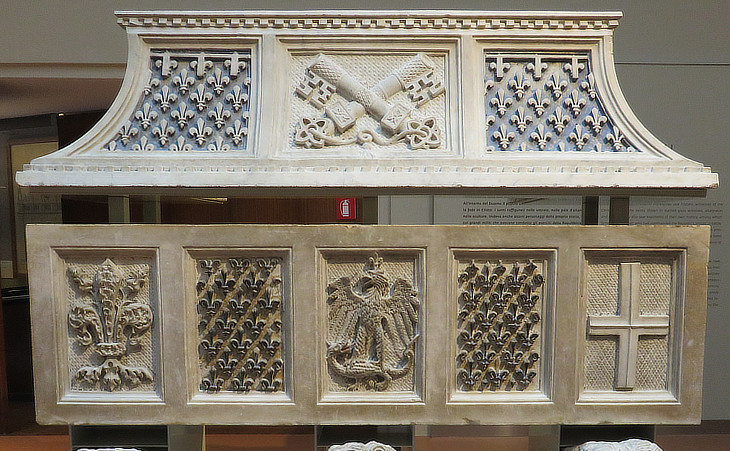
Sarcophagus of Pietro Farnese (d. 1363) in origin above the side door of the Cathedral towards the Campanile; at its centre an eagle upon a dragon represents the victory of Florence over Pisa
Over the side door, near the picture of Dante, is a marble tomb, ornamented with a cross between two shields bearing eagles. Tradition gives it to Conrad, the son and rival of the Emperor Henry IV.; but history rather negatives this. Murray
The description was not entirely accurate because the eagle is placed between the symbol of Florence and the Cross of the Church (the small lilies are the symbol of the Farnese). Pietro Farnese fought at the order of Cardinal Albornoz to restore authority in the Papal State. In 1363 he was sent to Florence which was at war with Pisa, a Ghibelline city. Farnese defeated the Pisans near Vicopisano, but shortly after he died of plague. The Republic commissioned a monument which has a very novel design, although its unknown sculptor made use of a Roman sarcophagus. The Farnese, a noble family of Northern Latium, acquired a great importance when Cardinal Alessandro Farnese was elected Pope Paul III in 1534.
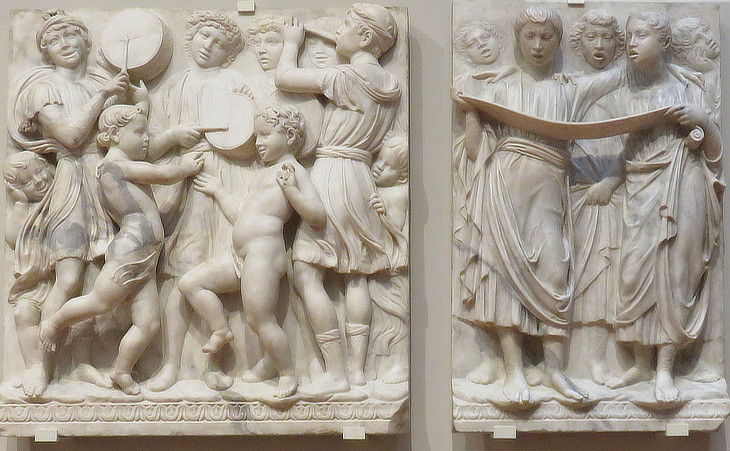
Panels from the Cantoria by Luca della Robbia (1432-1438)
Wherefore the said Wardens of Works (..) commissioned Luca to make the marble ornament for the organ which the Office of Works was then having made on a very grand scale, to be set up over the door of the sacristy of the said church. In certain scenes at the base of this work Luca made the singing choirs, chanting in various fashions; and he put so much zeal into this labour and succeeded so well therein, that, although it is sixteen braccia from the ground, one can see the swelling of the throats of the singers, the leader of the music beating with his hands on the shoulders of the smaller ones, and, in short, diverse manners of sounds, chants, dances, and other pleasing actions that make up the delight of music. (..) He recognized that he had gained very little and that the labour had been very great and he resolved to abandon marble and bronze and to see whether he could gather better fruits from another method. Wherefore, reflecting that clay could be worked easily and with little labour, and that it was only necessary to find a method whereby works made with it might be preserved for a long time, he set about investigating to such purpose that he found a way to defend them from the injuries of time; for, after having made many experiments, he found that by covering them with a coating of glaze, made with tin, litharge, antimony, and other minerals and mixtures fused together in a special furnace, he could produce this effect very well and make works in clay almost eternal. For this method of working, as being its inventor, he gained very great praise, and all the ages to come will therefore owe him an obligation. Vasari
Today Luca della Robbia is best known for having developed a glaze which made his terracotta sculptures more durable; his nephew Andrea improved the technique by adding the use of colour. The glazed terracottas of the Della Robbia were soon popular also outside Florence: see the three portals of S. Maria della Querce near Viterbo and another portal at Urbino.
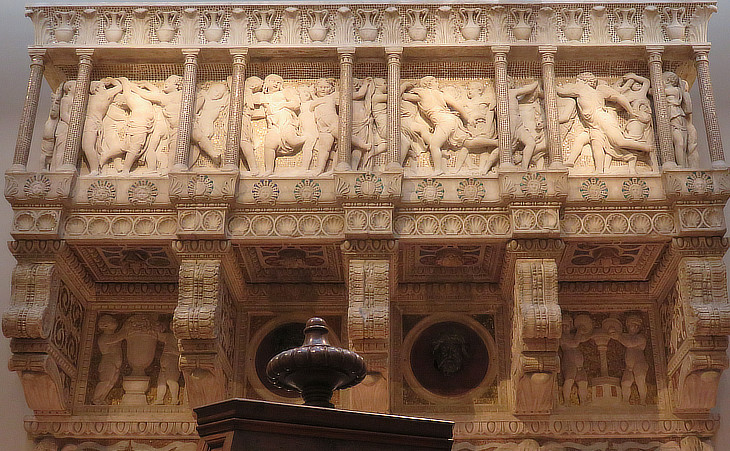
Cantoria by Donatello (1433-1439 - a copy is at the Victoria and Albert Museum)
Donatello, who made the ornament of the other organ, which is opposite to the first, made his with much more judgment and mastery than Luca had shown, will be told in the proper place; for Donatello executed that work almost wholly with bold studies and with no smoothness of finish, to the end that it might show up much better from a distance, as it does, than that of Luca, which, although it is wrought with good design and diligence, is nevertheless so smooth and highly finished that the eye, by reason of the distance, loses it and does not grasp it well, as it does that of Donatello, which is, as it were, only sketched. (..) He made the ornament for the organ, which stands over the door of the old sacristy, with those figures so boldly sketched, as it has been said, that they appear to the eye to have actual life and movement. Wherefore it may be said of this man that he worked as much with his judgment as with his hands, seeing that many things are wrought which appear beautiful in the rooms where they are made, and afterwards, on being taken thence and set in another place, in a different light or at a greater height, present a different appearance, and turn out the contrary to what they appeared ; whereas Donatello made his figures in such a manner, that in the room where he was working they did not appear half as good as they turned out to be in the positions where they were placed. (..) But if one were to give a complete account of his life and of the works that he made, it would be a far longer story than it is our intention to give in writing the Lives of our craftsmen, seeing that he put his hand not only to great things, of which there has been enough said, but also to the smallest things of art. Vasari
The cantoria shows that Donatello had in mind ancient sarcophagi which depicted children (see one which was found at Porto) and dancing figures (see a sarcophagus found in Rome). The decoration with palmettes, shells, amphorae, etc. and the fluted columns contribute to give the cantoria a classical aspect. Vasari says that his works were held to approach more nearly to the marvellous works of the ancient Greeks and Romans than those of any other craftsman whatsoever. See other works by Donatello at the Campanile di Giotto, at Piazza della Signoria, at Museo del Bargello, at Pisa and at Siena.
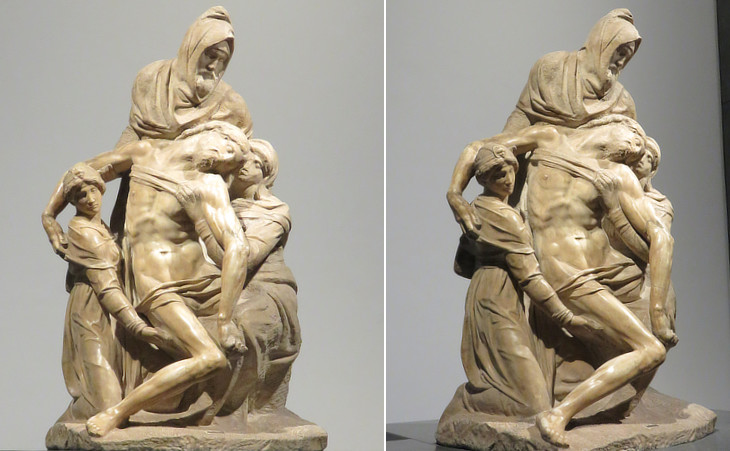
Pietà Bandini by Michelangelo (1547-1555)
Behind the high altar is a Pietà or group of the Virgin, Mary Magdalen, and Nicodemus entombing the body of our Lord, left unfinished, by Michael Angelo, who is said to have worked at this group during the later years of his life intending to have it placed upon his tomb. The inscription beneath states that it was the Postremum Opus of the great sculptor, who did not complete it in consequence of a defect in the marble. Murray
The spirit and genius of Michelagnolo could not rest without doing something; and, since he was not able to paint, he set to work on a piece of marble, intending to carve from it four figures in the round and larger than life, including a Dead Christ, for his own delight and to pass the time, and because, as he used to say, the exercise of the hammer kept him healthy in body. This Christ, taken down from the Cross, is supported by Our Lady, by Nicodemus, who bends down and assists her, planted firmly on his feet in a forceful attitude, and by one of the Maries, who also gives her aid, perceiving that the Mother, overcome by grief, is failing in strength and not able to uphold Him. Nor is there anywhere to be seen a dead form equal to that of Christ, who, sinking with the limbs, lies in an attitude wholly different, not only from that of any other work by Michelagnolo, but from that of any other figure that was ever made. A laborious work is this, a rare achievement in a single stone, and truly divine; but, as will be related hereafter, it remained unfinished, and suffered many misfortunes, although Michelagnolo had intended that it should serve to adorn his own tomb, at the foot of that altar where he thought to place it. (..) Michelagnolo used to work almost every day, as a pastime, at that block with the four figures of which we have already spoken; which block he broke into pieces at this time for these reasons, either because it was hard and full of emery, and the chisel often struck sparks from it, or it may have been that the judgment of the man was so great that he was never content with anything that he did. A proof that this is true is that there are few finished statues to be seen out of all that he executed in the prime of his manhood, and that those completely finished were executed by him in his youth, such as the Bacchus, the Pieta in S. Maria della Febbre, the Giant of Florence, and the Christ of the Minerva, which it would not be possible to increase or diminish by as little as a grain of millet without spoiling them; and the others, with the exception of the Dukes Giuliano and Lorenzo, Night, Dawn, and Moses, with the other two, the whole number of these statues not amounting in all to eleven, the others, I say, were all left unfinished, and, moreover, they are many, Michelagnolo having been wont to say that if he had had to satisfy himself in what he did, he would have sent out few, nay, not one. For he had gone so far with his art and judgment, that, when he had laid bare a figure and had perceived in it the slightest degree of error, he would set it aside and run to lay his hand on another block of marble, trusting that the same would not happen to the new block; and he often said that this was the reason that he gave for having executed so few statues and pictures. This Pieta, when it was broken, he presented to Francesco Bandini. Now at this time Tiberio Calcagni, a Florentine sculptor, had become much the friend of Michelagnolo; and being one day in Michelagnolo' s house, where there was the Pieta, all broken, after a long conversation he asked him for what reason he had broken it up and destroyed labours so marvellous, and he answered that the reason was the importunity of his servant Urbino, who kept urging him every day to finish it, besides which, among other things, a piece of one of the elbows of the Madonna had been broken off, and even before that he had taken an aversion to it, and had had many misfortunes with it by reason of a flaw that was in the marble, so that he lost his patience and began to break it up; and he would have broken it altogether into pieces if his servant Antonio had not besought him that he should present it to him as it was. Whereupon Tiberio, having heard this, spoke to Bandini, who desired to have something by the hand of Michelagnolo, and Bandini contrived that Tiberio should promise to Antonio two hundred crowns of gold, and prayed Michelagnolo to consent that Tiberio should finish it for Bandini with the assistance of models by his hand, urging that thus his labour would not be thrown away. Michelagnolo was satisfied, and then made them a present of it. The work was carried away immediately, and then put together again and reconstructed with I know not what new pieces by Tiberio; but it was left unfinished by reason of the death of Bandini, Michelagnolo, and Tiberio. At the present day it is in the possession of Pier Antonio Bandini, the son of Francesco, at his villa on Monte Cavallo. Vasari
In 1674 the Pietà was bought by Grand Duke Cosimo III and in 1722 it was placed inside the Cathedral. In 1981 it was moved to the museum.
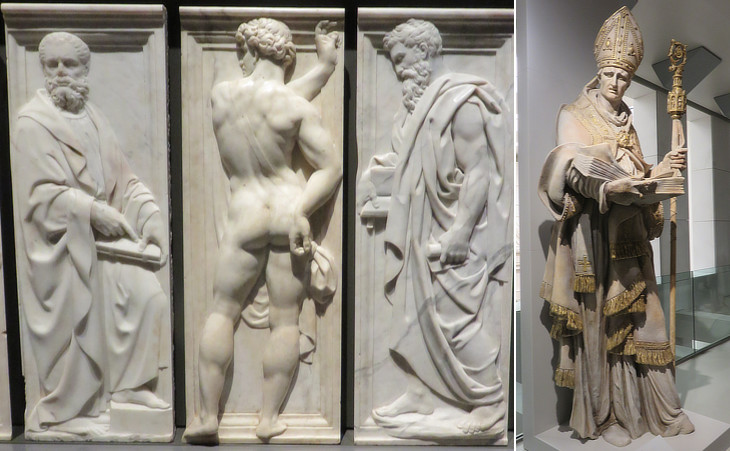
(left) Marble reliefs by Baccio Bandinelli (see his gigantic statue of Hercules in Piazza della Signoria), Giovanni Bandini and Vincenzo de' Rossi depicting patriarchs and prophets (1547-1572); (right) cast of an ephemeral statue of St. Podio (Bishop of Florence in 985-1002) by Pierre de Francqueville aka Pietro Francavilla (1589)
The Tribuna is a large Chapel in the midst of the Church, built of Marble, and adorn'd all round with Bas-reliefs of almost all the old Florentine Masters, Donatello, Bruneleschi , etc.
Richardson
Baccio reflected, besides the considerations mentioned above, that in this choir he would have occasion to make many statues and scenes in marble and in bronze for the high-altar and all around the choir, and also for two pulpits of marble that were to be in the choir, and that the base of the outer side of the eight faces might be adorned with many scenes in bronze let into the marble ornamentation. (..) With these designs and these words Baccio so moved the Duke, that, consenting that such a structure should be erected, his Excellency commissioned him to make a model of the whole choir. (..) On the outer side of the choir there ran lengthways along the base a space about three braccia long, which was to contain the story of the Creation, either in marble or in bronze; and this was to be pursued along the faces of the base of the whole work, to the number of twenty-one stories, all from the Old Testament. And for the further enrichment of this base he had made for each of the socles upon which stood the columns and pilasters, a figure of some Prophet, either draped or nude, to be afterwards executed in marble - a great work, truly, and a marvellous opportunity, likely to reveal all the art and genius of a perfect master, whose memory should never be extinguished by any lapse of time. (..) Vincenzio de' Rossi of Fiesole, likewise a sculptor, architect, and Academician of Florence, is worthy to have some record made of him in this place, in addition to what has been said of him in the Life of Baccio Bandinelli, whose disciple he was. Vasari
The statue of St. Podio was made for the 1589 marriage of Grand Duke Ferdinand I with Christina of Lorraine. On this occasion an ephemereal façade was created in wood and plaster which was decorated with six large statues portraying the principal saints of Florence. Pietro Francavilla, a disciple of il Giambologna sculpted marble statues of Ferdinand at Pisa and Arezzo.
Move to page two: Museo dell'Opera del Duomo: Exhibits from the Campanile di Giotto and the Baptistery or go to Piazza della Signoria and Museo del Bargello or go to Cappelle Medicee.
See other pages on monuments of Florence: Florentine Recollections, An Italian Piazza and A Fortress with a View.