All images © by Roberto Piperno, owner of the domain. Write to romapip@quipo.it.


Notes:
Page added in May 2026.
All images © by Roberto Piperno, owner of the domain. Write to romapip@quipo.it.
Notes:
Page added in May 2026.
 at Museo dell'Opera del Duomo - page 2
You may wish to see a page with a short introduction and exhibits from the Cathedral first.
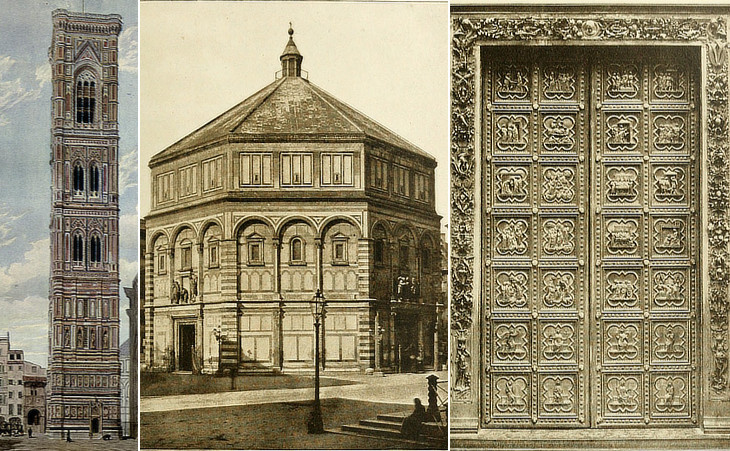
(left) Campanile di Giotto from "Thomas Graham Jackson - Gothic architecture in France, England, and Italy - 1915"; (centre/right) Baptistery and Southern Door by Andrea Pisano from "Grant Allen - Florence - 1897"
Near to the Domo stands the Campanile, or high Steeple of Florence made by Giotto. Its a hundred and fifty Braccie, or little yards high, and half as deep in the ground. It is crusted all over with curious little polished Marble stones, Marble pillars, and Statues so that, (as Charles the V said of it) if it had a use to cover it and hinder it from being seen too frequently, men would flock thither at the taking off of this cover, as to see a wonder. Indeed its a kind of wonder to see, that in three hundred yers space, not the least part of the Steeple (all crusted overwith Marble,) is perished.
Richard Lassels' The Voyage of Italy, or a Compleat Journey through Italy in ca 1668
The Baptistery was a Temple of Mars, now 'tis dedicated to St. John Baptist. (..) The Church has three Entrances. (..) The Gates of Andrea are in the Gothic Style of his time; but the other are of a much better Taste than one would expect to find in a Work 100 Years before Raffaele.
Jonathan and Jonathan Richardson - Account of Some of the Statues, etc. in Italy - 1722
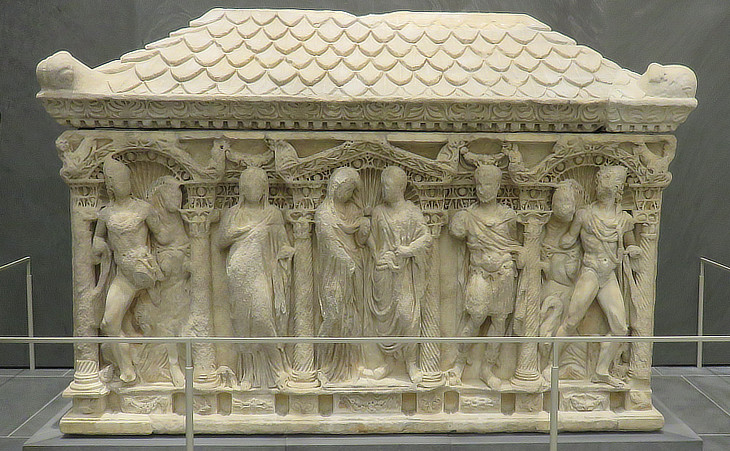
Sala del Paradiso: Sarcophagus of the Spouses with Castor and Pollux (IInd century AD)
Up to 1293 the Baptistery was surrounded with graves, which are spoken of by Boccaccio. (..) (Palazzo Medici Riccardi) several Roman inscriptions, busts, and bas-reliefs are deposited here; amongst which 3 fine sarcophagi, having been used like those of Pisa for mediaeval tombs, and formerly built into the walls of the baptistery of S. Giovanni.
John Murray - A handbook for travellers in central Italy - 1867
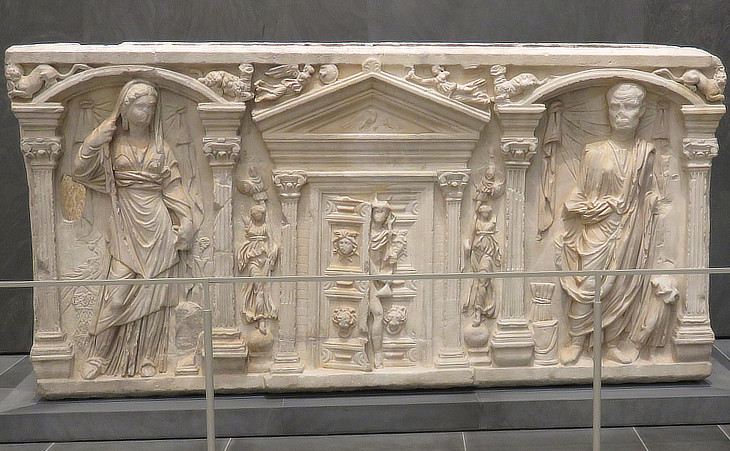
Sala del Paradiso: Sarcophagus of the Spouses with Hermes (in his psychopomp function) at the Gate of Hades (IInd century AD - see one showing Hercules in the same posture)
Ancient sarcophagi played a major role in the development of medieval sculpture, in particular of reliefs. While many ancient statues had been destroyed because they were regarded as idols, this occurred to a much lesser degree for sarcophagi, even those which depicted a thiasos, a Dionysiac procession. Their influence on the work of Niccolò Pisano and his followers, including some who were active in Florence, is ascertained.
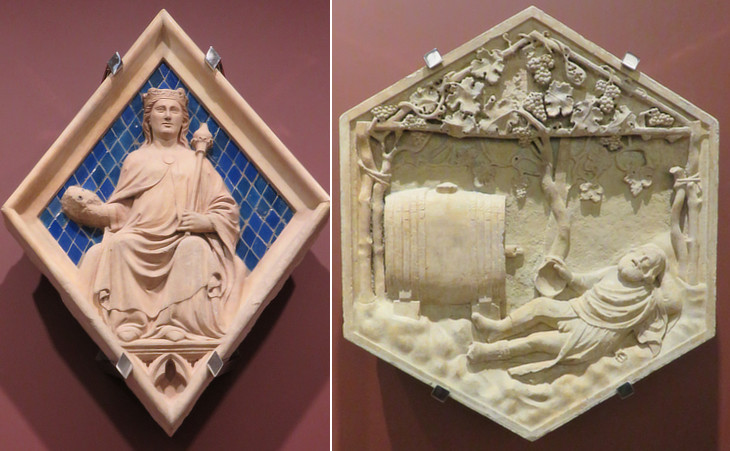
Reliefs by the school of Andrea Pisano from the Campanile di Giotto: (left) The Sun / Apollo; (right) The Making of Wine
Andrea Pisano, practising sculpture in the time of Giotto, made so great improvement in this art, that both in practice and in theory he was esteemed the greatest man that the Tuscans had had up to his times in this profession, and above all in casting in bronze. Wherefore his works were honoured and rewarded in such a manner by all who knew him, and above all by the Florentines, that it was no hardship to him to change country, relatives, property and friends. (..) He also made, after the design of Giotto, those little figures in marble that act as adornment for the door of the Campanile of S. Maria del Fiore, and round the same Campanile, in certain oval spaces, the seven planets, the seven virtues, and the seven works of mercy, little figures in half-relief that were then much praised.
Giorgio Vasari - Lives of the most eminent painters, sculptors & architects - transl. by Gaston Du C. De Vere
Of the representations of human art under heavenly guidance, the series of bas-reliefs which stud the base of this tower of Giotto's must be held certainly the chief in Europe. At first you may be surprised at the smallness of their scale in proportion to their masonry; but this smallness of scale enabled the master workmen of the tower to execute them with their own hands.
John Ruskin - Mornings in Florence - 1880
The Campanile di Giotto has a very elaborate external sculpture decoration that was made over a hundred years (1334-1436), arranged on three levels and on each of the four sides. The first two levels of these decorations are the XIVth century reliefs by Andrea Pisano and his workshop depicting the human sciences and the celestial powers that govern them. The sculptor started his career at Pisa and he returned there after his stay at Florence; see his works in the Cathedral and at S. Caterina in that town. He had a very active workshop which was continued by his sons Nino and Tommaso.
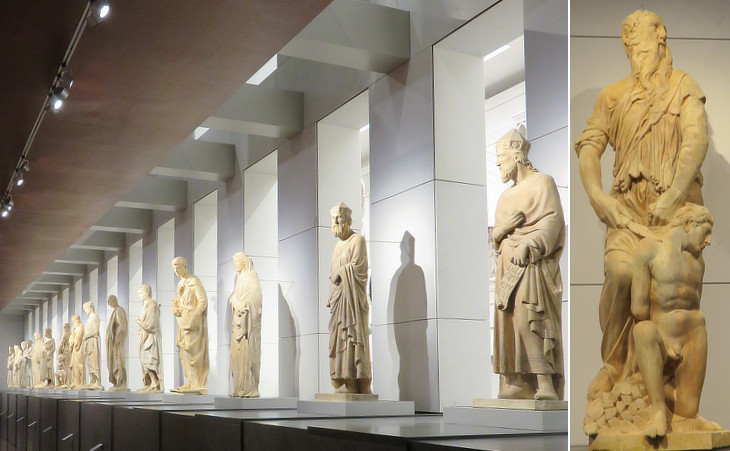
(left) Statues from the Campanile di Giotto; (right) The Sacrifice of Isaac by Donatello and Nanni di Bartolo (1421)
Over the door of the campanile, on the side facing the Canon's house, he made Abraham about to sacrifice Isaac, with another Prophet: and these figures were placed between two other statues. Vasari
The third level of the Campanile was decorated by sixteen niches, inside which were placed marble sculptures in high relief and in the round, four on each side, depicting sibyls, prophets and patriarchs.
The Sacrifice of Isaac was the first monumental group carved in the Renaissance consisting of two figures sculpted in the round and from a single block of marble; the figure of Isaac is also the first example of a life-size nude since ancient times. It is also the first time in sculpture that a third figure (the angel) is only alluded to and not represented.
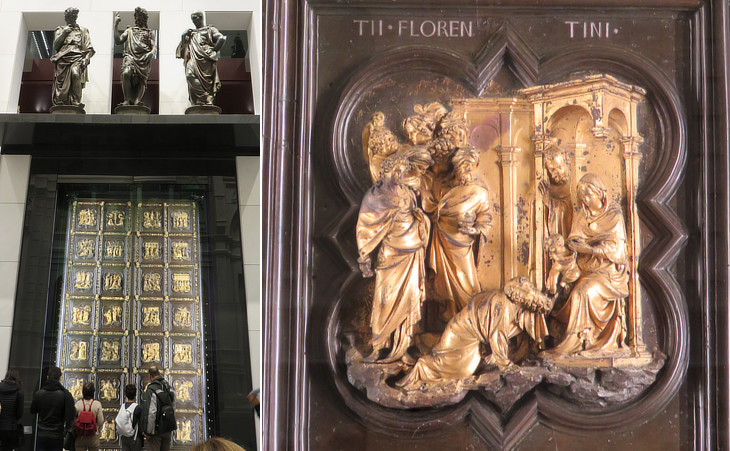
(left) Northern Gate of the Baptistery by Lorenzo Ghiberti; (right) The Arrival of the Magi and part of the inscription "Opus Laurentii Florentini"
Here are the famous Gates of Lorenzo Ghiberti Which Michael Angelo said deserv'd to be the Gates of the Paradise. The gates were made by Andrea Pisano: Lorenzo was afterwards employ'd to make those for another; and lastly, those of Andrea were remov'd to make room for others, by Lorenzo: they are very large, all of Brass, of a very high Relief; some of the Principal Figures being almost round: the Brass is almost turn'd blackish, excepting where it has been accidentally rubb'd, as below, where Peoples Clothes are continually brushing against it. (..) There is a little Gothicism in the Draperies, but the Naked has a Beauty and Excellency like the Antique, not much Inferior to, Mich.Angelo's and of a Purer and more Pleasing Style. One Pair of these Gates is divided into 20 Squares, in each of which is a History of our Saviour, with Ornaments and Borders round them; and at the bottom the four Evangelists, and the four Doctors of the Church. Richardson
In the scene next to the Nativity on the other half of the door, on the same level, there follows the story of the coming of the Magi, and of their adoration of Christ, while they give Him their tribute; and their Court is following them, with horses and other equipage, wrought with great genius. (..) And in truth the composition of each scene is so well ordered and so finely arranged, that he rightly deserved to obtain that praise which Filippo (Brunelleschi) had given him. And in like manner he gained most honourable recognition among his fellowcitizens, and was consummately extolled by them and by the native and foreign craftsmen. Vasari
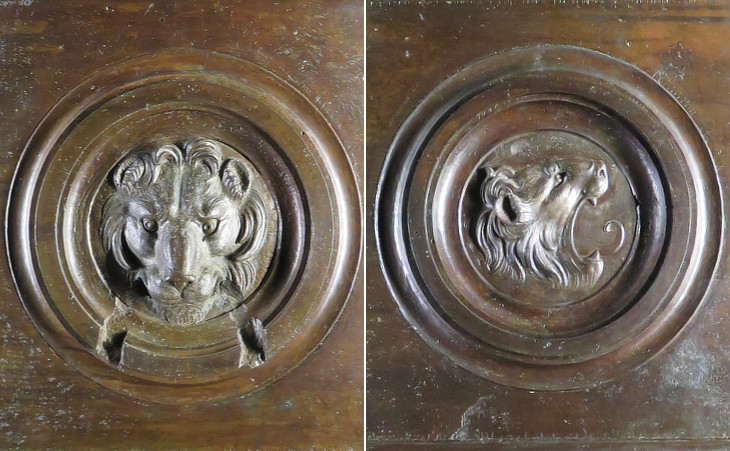
Rear side of the Northern Gate by Lorenzo Ghiberti which is decorated with heads of lions in different postures which testify to his goldsmith background
Lorenzo, then, was the son of Bartoluccio Ghiberti, and from his earliest years learnt the art of the goldsmith from his father, who was an excellent master and taught him that business, which Lorenzo grasped so well that he became much better therein than his father. (..) Beginning the work of that door, then, for that entrance which is opposite to the Office of Works of S. Giovanni, Lorenzo made for one part of it a large framework of wood, of the exact size that it was to be, with mouldings, and with the ornaments of the heads at the corners, round the various spaces wherein the scenes were to be placed, and with those borders that were to go round them. Having then made and dried the mould with all diligence, he made a very great furnace (..) and he cast the said framework in bronze. But, as chance would have it, it did not come out well; wherefore, having realized the mischief, without losing heart or giving way to depression, he promptly made another mould and cast it again, without telling anyone about it, and it came out very well. Whereupon he went on and continued the whole work in this manner, casting each scene by itself, and putting it, when finished, into its place. The arrangement of the scenes was similar to that which Andrea Pisano had formerly made in the first door, which Giotto designed for him. In the framework of the border surrounding the scenes in squares there is a frieze of ivy leaves and other kinds of foliage, with mouldings between each; and on every corner is the head of a man or a woman in the round, representing prophets and sibyls, which are very beautiful, and demonstrate with their variety the excellence of the genius of Lorenzo. Vasari
The image used as background for this page shows one of the heads mentioned by Vasari.
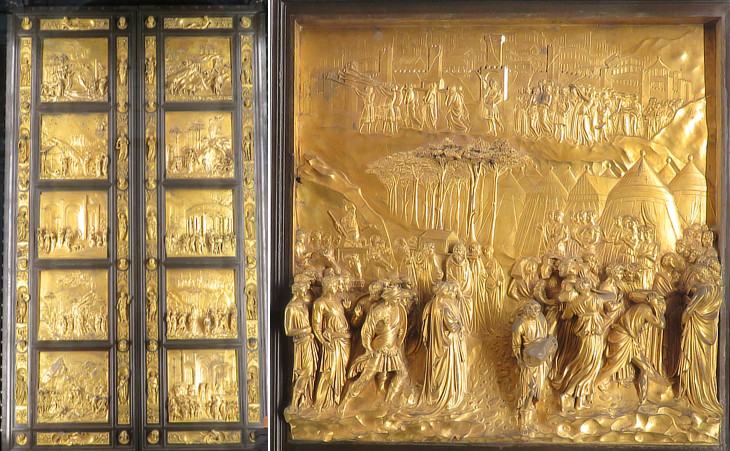
(left) Eastern Gate (aka Porta del Paradiso) by Lorenzo Ghiberti; (right) Stories of Joshua
The other, which was the last done is divided into ten Squares, in each of which is four Stories of the Old Testament, relating however to one another. The Borders of these are full of Figures, and Ornaments, and more Rich than those of the other Gates. Richardson
Florence had received so much praise by reason of the excellent works of this most ingenious craftsman, that the Consuls of the Guild of Merchants determined to commission him to make the third door of S. Giovanni, likewise in bronze. Now, in the door that he had made before, he had followed their directions and had made it with that ornament which goes round the figures, and which encircles the framework of both parts of the door, as in the one of Andrea Pisano; but on seeing how greatly Lorenzo had surpassed him, the Consuls determined to remove that of Andrea from its position in the centre, (..) and to commission Lorenzo to make a new door to be placed in the centre, looking to him to put forth the greatest effort of which he was capable in that art. And they placed themselves in his hands, saying that they gave him leave to make it as he pleased, and in whatsoever manner he thought it would turn out as ornate, as rich, as perfect, and as beautiful as it could be made or imagined; nor was he to spare time or expense, to the end that, even as he had surpassed all other sculptors up to his own time, he might surpass and excel all his own previous works. Lorenzo began the said work, putting therein all the knowledge that he could; wherefore he divided the said door into ten squares, five on each side, so that the spaces enclosing the scenes were one braccio and a third in extent. (..) He showed diligence and great love in the eighth square, wherein he made Joshua marching against Jericho and turning back the Jordan, and placed there the twelve tents of the twelve Tribes, full of very lifelike figures; but more beautiful are some in low-relief, in the scene when, as they go with the Ark round the walls of the aforesaid city, these walls fall down at the sound of trumpets, and the Hebrews take Jericho; and here the landscape is ever diminished and made lower with great judgment, from the first figures to the mountains, from the mountains to the city, and from the city to the distant part of the landscape, in very low relief, the whole being executed with great perfection. Vasari
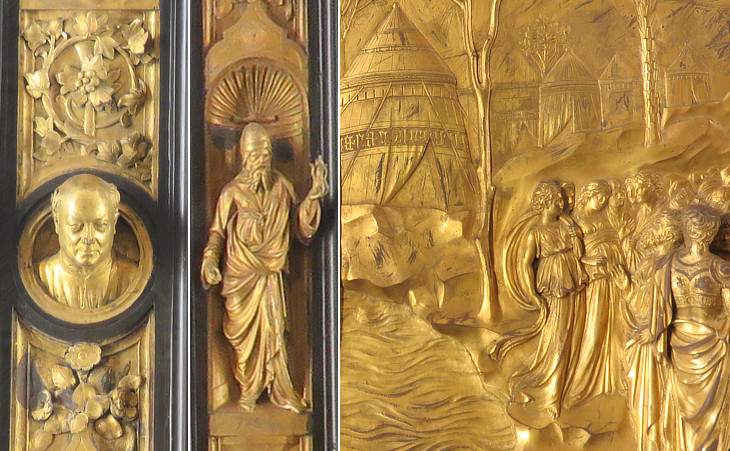
Porta del Paradiso: (left) self-portrait of Ghiberti; (centre) a prophet; (right) detail of the Stories of Moses depicting the Jewish camp
To adorn the framework that surrounds the scenes, there are niches - upright, in that part of the door - containing figures in almost full-relief, twenty in number and all most beautiful. (..) At the intersections of the corners, in certain medallions, he made heads of women, of youths, and of old men, to the number of thirty-four; (..) besides an infinite quantity of foliage, mouldings, and other ornaments, made with the greatest mastery. (..) In this work, both in detail and as a whole, it is seen how much the ability and the power of a craftsman in statuary can effect by means of figures, some being almost in the round, some in half-relief, some in low relief, and some in the lowest, with invention in the grouping of the figures, and extravagance of attitude both in the males and in the females; and by variety in the buildings, by perspectives, and by having likewise shown a sense of fitness in the gracious expressions of each sex throughout the whole work, giving to the old gravity, and to the young elegance and grace. Vasari
See two bronze reliefs which Ghiberti made for the Baptistery of Siena.
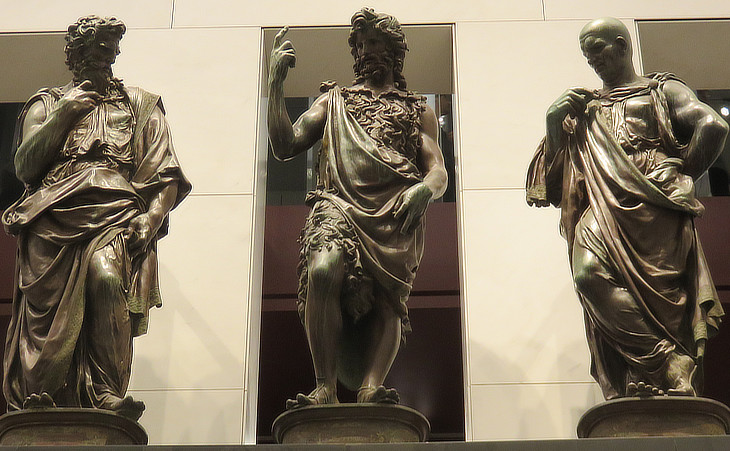
Northern Gate: The Preaching of the Baptist by Giovan Francesco Rustici (1505-1511)
By these works Giovan Francesco came into great credit, and the Consuls of the Guild of Merchants, who had caused to be removed certain clumsy figures of marble that were over the three doors of the Temple of S. Giovanni (..) allotted to Rustici those that were to be placed over the door that faces towards the canonical buildings of that temple, on the condition that he should make three figures of bronze of four braccia each, representing the same persons as the old ones - namely, S. John in the act of preaching, standing between a Pharisee and a Levite. That work was much after the heart of Giovan Francesco, because it was to be set up in a place so celebrated and of such importance. (..) Having therefore straightway set his hand to it and made a little model, which he surpassed in the excellence of the work itself, he showed all the consideration and diligence that such a labour required. When finished, the work was held to be in all its parts the best composed and best conceived of its kind that had been made up to that time, the figures being wholly perfect and wrought with great grace of aspect and also extraordinary force. In like manner, the nude arms and legs are very well conceived, and attached at the joints so excellently, that it would not be possible to do better; and, to say nothing of the hands and feet, what graceful attitudes and what heroic gravity have those heads!
Giovan Francesco, while he was fashioning that work in clay, would have no one about him but Leonardo da Vinci, who, during the making of the moulds, the securing them with irons, and, in short, until the statues were cast, never left his side; wherefore some believe, but without knowing more than this, that Leonardo worked at them with his own hand, or at least assisted Giovan Francesco with his advice and good judgment. In addition to the S. John, which is a spirited and lively figure, there is a bald man inclined to fatness, beautifully wrought, who, having rested the right arm on one flank, with part of a shoulder naked, and with the left hand holding a scroll before his eyes, has the left leg crossed over the right, and stands in an attitude of deep contemplation, about to answer S. John; and he is clothed in two kinds of drapery, one delicate, which floats over the nude parts of the figure, and over that a mantle of thicker texture, executed with a flow of folds full of mastery and artistry. Equal to him is the Pharisee, who, having laid his right hand on his beard, with a grave gesture, is drawing back a little, revealing astonishment at the words of John. Vasari
The scene represents the episode in which John the Baptist is asked by a group of priests and Levites wether he is the Messiah awaited by the people. John replies that he is merely the forerunner of Jesus Christ.
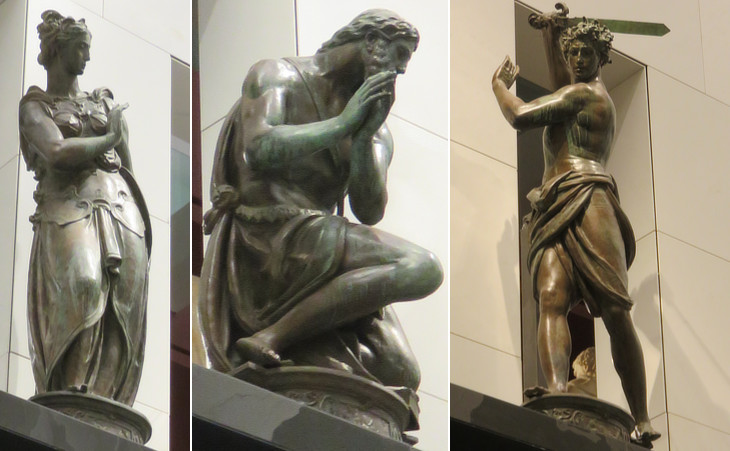
Southern Gate: Beheading of the Baptist by Vincenzo Danti (1571)
Not less than Giovan Bologna and his friends and other sculptors of our Academy, Vincenzio Danti of Perugia, who under the protection of Duke Cosimo has adopted Florence as his country, is a young man truly rare and of fine genius. Vasari
When Vasari wrote his book Vincenzo Danti already shown his talent in the bronze statue of Pope Julius III at Perugia. In this group the sculptor the executioner ready to deliver the fatal blow, while Salome stands on the left, waiting for John's head to roll so she can place it on a tray and take it to her mother Herodias (see reliefs and a painting by Vasari at S. Giovanni Decollato in Rome).
Return to Museo dell'Opera del Duomo: Introduction and exhibits from S. Maria del Fiore or go to Piazza della Signoria and Museo del Bargello or go to Cappelle Medicee.
See other pages on monuments of Florence: Florentine Recollections, An Italian Piazza and A Fortress with a View.