
All images © by Roberto Piperno, owner of the domain. Write to romapip@quipo.it.


Notes:
Page added in January 2026.
All images © by Roberto Piperno, owner of the domain. Write to romapip@quipo.it.
Notes:
Page added in January 2026.
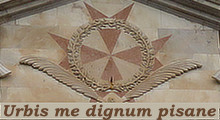 The Knights of St. Stephen
You may wish to see pages on the monuments of Piazza dei Miracoli first.

Piazza dei Cavalieri (seen when coming from Piazza dei Miracoli) from "Descrizione Storica e Artistica di Pisa e de suoi Contorni
by Ranieri Grassi - 1836"
The palace of the knights of S. Stephen, and the church adjoining to it, adorned with the trophies taken from the Saracens, are worth seeing.
Thomas Nugent - The Grand Tour - 1749
The Duomo group and the Lung'arno form two of the principal features of Pisa. The Piazza de' Cavalieri is the third. This was the centre of ancient Pisa, and in the days of the Republic was the Piazza degli Anziani, the Forum of the Pisans; but when Cosimo I. established his order of St. Stephen (1561), he granted the piazza, with its surrounding buildings, to this institution.
John Murray - Handbook for travellers in Central Italy - 1861

Piazza dei Cavalieri seen from the opposite side, when coming from Borgo, the main street of Pisa
The Piazza has almost entirely retained the aspect it had at the end of the XVIth century, chiefly because its palaces were assigned to public institutions, e.g. schools and tribunals, after the Order lost its military relevance in the XVIIIth century and was eventually dissolved in 1859.

(left) Torre della Fame (Hunger) detail of an illustration from Ranieri Grassi's book based on an old engraving; (right) Palazzo dell'Orologio which incorporates the medieval tower
Palazzo dell'Orologio was given its current aspect in 1605-1608: the two parts were connected by a passageway over the vault, and the façade was decorated with frescoes. In 1696 the small bell tower was added, accentuating the vertical axis of the building and concealing the original irregularities.
During the great disorders of the Guelfs and the Ghibelins, Anno 1282. this town was governed by Ugolin a proud man, who ruled here despotically. This man inviting one day all his friends to a great feast began in the midst of it to brag, that nothing was wanting to him.- "Yes (said one of his best friends, because one who flattered him not) there's one thing yet Wanting to thee, Ugolin, to wit the Anger of God, which is not farr from thee". And it proved true, for presently after, the Ghibelins rushing into the Pallace of Ugolin (chief of the Guelfs) killed in his fight, one of his Sons and his nephew, and taking him with two other of his Sons and three nephews they shut him up in a strong Tower, and threw the Keys into Arno: where the poor man that bragged even now in a feast, dyed soon after of hunger; having first seen his children and nephews dye of hunger in his armes. A rare example to teach proud men, that there's often but one day between a powerful man and a poor man; between a great Feast and a great Fast.
Richard Lassels - The Voyage of Italy, or a Compleat Journey through Italy in ca 1668
The Torre della Fame, rendered so celebrated by Dante for Count Ugolino della Gherardesca's torture, stood nearly on the spot where the modern clock-tower in the Piazza dei Cavalieri now rises: it bore its poetical name until its destruction in 1655. Murray
And said they: 'Father, much less pain 'twill give us
If thou do eat of us; thyself didst clothe us
With this poor flesh, and do thou strip it oft'.'
I calmed me then, not to make them more sad.
That day we all were silent, and the next.
Ah! obdurate earth, wherefore didst thou not open?
When we had come unto the fourth day, Gaddo
Threw himself down outstretched before my feet.
Saying, 'My father, why dost thou not help me? '
And there he died; and, as thou seest me,
I saw the three fall, one by one, between
The fifth day and the sixth; whence I betook me,
Already blind, to groping over each,
And three days called them after they were dead;
Then hunger, did what sorrow could not do.
(Inferno XXXIII - Translation by Henry Wadsworth Longfellow)

S. Stefano: (left) façade; (right) bell tower
Ch. of San Stefano. St. Stephen, the protector of the order, must not be confounded with the protomartyr. The Conventual Church of this order is partly from the designs of Vasari, and was begun in 1565; but the interior was not completed till 1594-96; the front was added, according to Milizia, from the designs of Buontalenti. (..) The details of the architecture are good; but the principal decoration of the building consists in the paintings of the ceiling, executed by the best artists of the later period of the Tuscan school and enclosed in richly ornamented compartments. Murray
The Order was named after Pope Saint Stephen I who died in 257 during a persecution by Emperor Valerian. According to a medieval account (The Golden Legend) Stephen was sitting on his pontifical throne celebrating Mass for his congregation when the emperor's men came and beheaded him. The medieval account was later on dismissed as wanting real documentary evidence and today the Pope is no longer regarded as a martyr by the Catholic Church.

S. Stefano: celebratory inscriptions on the façade by Grand Dukes Cosimo I (1566 for the erection of the church) and Ferdinand I (1596 for the marble façade)
The church of St. Stefano (where the order of knighthood called by that name was instituted) drew first our curiosity, the outside thereof being altogether of polished marble; within, it is full of tables relating to this Order; over which hang divers banners and pendants, with other trophies taken by them from the Turks, against whom they are particularly obliged to fight; though a religious order, they are permitted to marry.
John Evelyn - Diary and Correspondence related to his stay in Italy in 1644
The order was framed in imitation of that of Malta. The knights bear the same cross as to form, but gules in a field argent, being Malta counter-changed; and in like manner they performed carovane, or expeditions, against the Turkish infidels. Murray

2025 Temporary exhibition at Museo delle Sinopie on the relationships between the Islamic world and Pisa: Ottoman and Barbary corsair banners from Chiesa di S. Stefano
Their Church is beautified without with a handsome Facciata of white Marble, and within with Turkish Ensigns and divers Lanterns of Capitanesse Gallies. Lassels
The general effect of the interior, a single nave, is impressive. On either side are the little Turkish trophies won by the knights, banners, shields, toughs (or horse-of tails), scimitars, poop lanterns, picturesquely arranged against the walls; and which, we are told, were taken by the Pisans from the Saracens. Murray
The use of the term Saracens is not proper because it designates the Arabs who raided and partially invaded Italy in the Xth century. In the XVIth century the people of Northern Africa (Barbary) were called Moors and those of the Anatolian peninsula Turks. From a formal point of view they both were under the suzerainty of the Ottoman Sultan, but the Moors acted in an almost independent way when they attacked the coastal towns of Italy and Spain.

Temporary exhibition at Museo delle Sinopie: XVIIIth century engraving of a fresco by Baldassarre Franceschini at Villa della Petraia near Florence depicting Grand Duke Cosimo II, successor of Ferdinand I, receiving the Knights returning from the expedition to Bona at S. Stefano
Bona, ancient Ippona or Hippo Regius, today's Annaba was a fortified port in Algeria which was raided by the Knights of St. Stephen in 1607. They captured a large boot and some 1500 prisoners who were sold as slaves or employed as oarsmen on the galleys of the Order. The event was celebrated as a major achievement and led to the erection of an equestrian bronze statue of Grand Duke Ferdinand I at Piazza della SS. Annunziata in Florence (by il Giambologna and Pietro Tacca).

Palazzo della Carovana
We hastened to the House of the Knights of S. Steven. This is the only Order of Knights that I perceived in Florence and its very common. They wear a Red Cross of Satin upon their Cloaks, and profess to fight against the Turk. For this purpose they have here a good House and Maintenance. In this House the Knights live in common, and are well maintained. (..) In fine, these Knights may marry if they will, and live in their own particular houses, but many of therm choose celibate, as more convenient for brave Soldiers; wives and children being the true "impedimenta exercitus". Lassels
The Carovana, or Palazzo Conventuale of the order of S. Stefano, stands close by the church of that name, on the site of the Palazzo degli Anziani. The architecture of the present building is by Vasari. (..) Busts of the first six granddukes, who were grand masters of order, are ranged below the uppermost story. The bust of Cosimo II. is by Pietro Tacca, the scholar of John of Bologna. This building has now been converted into a Normal School for the education of teachers. The fountain, by Francavilla, though small, displays fancy in the fish-monsters. By Francavilla also is the fine statue of Cosimo I. as grand master of the order, in front of the palace (see that which he made for Ferdinand I). Murray

Palazzo della Carovana and statue of Grand Duke Cosimo I
At the front of the palace, stands a fountain, and the statue of the great Duke Cosmo. Evelyn
The front is decorated with arabesques in the peculiar style called "graffito", executed by Alessandro Forzori, under the directions of Vasari. They are produced by scratching off the white coat which has been laid upon a black ground, and giving the middle tints by distemper. They are now nearly obliterated. Murray
The image used as background for this page shows a detail of the graffito decoration. You may wish to see Palazzo Vitelli alla Cannoniera at Città di Castello which was designed by Vasari and painted by Cristoforo Gherardi with a similar graffito decoration.

Palazzo del Consiglio dei Dodici and Cancelleria
They have in their Cancellaria a Catalogue of those Knights who have done notable Service against the Turks which serves for a powerful exhortation to their successors to do, and die bravely. Lassels
The Palazzo del Consiglio dell' Ordine, opposite, is another of the characteristic buildings of this piazza. It is of marble, and by Francavilla. The great hall is painted by Salimbeni (see paintings by Ventura Salimbeni at Siena and Perugia). Murray
Cosimo was a close ally of King Philip II of Spain to whom he owed the assignment of Siena which had been conquered by Spanish troops. Orbetello and other ports which belonged to Siena however were occupied by the Spaniards who regarded them as a detached section (Stato dei Presidii - Territory of the Fortresses) of the Kingdom of Naples and heavily fortified them. By founding the Order of St. Stephen Cosimo wanted to show that he could help Philip in his fight against the Ottomans and their Barbary allies.

Palazzo del Collegio Puteano (i.e. of dal Pozzo)
The Collegio Puteano, opposite to the Church of San Stefano, has some faint vestiges of good frescoes. The institution was founded in 1605, by Archbishop dal Pozzo, a Piedmontese, for the benefit of his countrymen studying in the University. Eight young men are maintained here for four years. Murray
Today all the historical palaces of Piazza dei Cavalieri, with the exception of Palazzo del Consiglio, belong to the Scuola Normale Superiore, a university institute of higher education, research and high-level training with a special status.

Arsenale Mediceo near the Citadel
At the West corner of the City, is the Armory, vulgarly called L'Arsenalo, where they build and keepe the Dukes Gallies, which were there at this time no more then seven in number; for the Duke used to send out in summer time some two or three Gallies, (and seldome any more) to spoile the Turkes, which he might doe more boldly, because the Florentines have no cause to feare the Turkes, since they use no traffick by sea, but send out their silkes and other commodities by strange ships, and onely take care to entertaine those Merchants well, who bring them corne and victuals by sea.
Fynes Moryson - An Itinerary: Containing His Ten Years Travel Through .. Italy (in 1594)
The River Arno is so ample that the Duke's galleys, built in the arsenal here, are easily conveyed to Livorno Evelyn

Arsenale Mediceo: (left) 1588 coat of arms of Ferdinand as both Grand Duke and Cardinal; (right) inscription celebrating 1602 successful raids by Jacopo Inghirami, commander of the Knights, in the ports of Alexandria and Nauplia in Greece with the capture of 320 Turks and the liberation of 145 Christian slaves
At the death of his brother Francesco, Grand Duke of Tuscany, the Cardinal ascended the throne as Ferdinand I in October 1587. He asked Pope Sixtus V to accept his resignation to the cardinalate in order to secure the succession; he submitted his resignation on November 28, 1588, so for more than one year he was both a cardinal and a grand duke (see the coat of arms of Cardinal Henri Benedict Stuart at S. Maria in Trastevere which has a similar religious and secular significance).
The raids of the Knights were in retaliation for those of Muslim corsairs on the coasts of Spain and Italy. When the Ottoman threat subsided in the XVIIIth century they started to be considered simple acts of piracy, without a more noble justification and similar to those of their enemies.

Temporary exhibition at Museo delle Sinopie: the fleet of the Order of St. Stephen in the harbour of Leghorn (XVIIth century - unknown painter)
21st October 1644. Leghorn is the prime port belonging to all the Duke's territories; heretofore a very obscure town, but since Duke Ferdinand has strongly fortified it (after the modern war), drained the marshes by cutting a channel thence to Pisa navigable sixteen miles, and has raised a Mole, emulating that at Genoa, to secure the shipping, it is become a place of great receipt; it has also a place for the galleys, where they lie safe. Before the sea is an ample piazza for the market, where are the statues in copper of the four slaves, much exceeding the life for proportion, and, in the judgment of most artists, one of the best pieces of modern work (see a similar, smaller statue at Marino, near Rome). Here, especially in this piazza, is such a concourse of slaves, Turks, Moors, and other nations, that the number and confusion is prodigious; some buying, others selling, others drinking, others playing, some working, others sleeping, fighting, singing, weeping, all nearly naked, and miserably chained. Here was a tent, where any idle fellow might stake his liberty against a few crowns, at dice, or other hazard; and, if he lost, he was immediately chained and led away to the galleys, where he was to serve a term of years, but from whence they seldom returned: many sottish persons, in a drunken bravado, would try their fortune in this way. Evelyn

Temporary exhibition at Museo delle Sinopie: three Muslim prisoners from the album of drawings of Ignazio Fabroni, a Knight of St. Stephen in the Tuscan fleet in 1664-1687
The Galley Slayes at Leghorn seem to fare much better than those at Marseilles, Genoa, etc. They are not confin'd to sleep a-nights upon their Benches, but have Lodgings on shore, such as they are in a place they call the Bagnio. They are exceeding close and must certainly be noisome in the hot Weather: The Beds lie as on shelves, one over another (with only room enough left between the Shelves for them to creep into the Beds as the bodies do in the Catacombs).
Edward Wright's Observations made in France, Italy &c. in the years 1720, 1721 and 1722.
To the west of Galata, on the north side of the port, is the publick arsenal or dock called Cassum-pasha, where there are covered buildings to lay up the galleys in winter; and here is what they call the bagnio for the grand signor's captive Christian slaves.
Richard Pococke - A Description of the East and Some Other Countries - 1745
"Bagnio" is an old Italian word which indicated a facility by the sea were prisoners/slaves were confined and subject to forced labour. It derived by the conversion of public baths into a prison at Constantinople in the XVIth century.

Temporary exhibition at Museo delle Sinopie: a "Chiaus" or "Cavus" (Ottoman governor) who was captured near Djerba on his way to Tunis in 1667 and his ship, drawing by Ignazio Fabroni
Cannon, jewellery, slaves were not the only boot of the Knights' raids. The capture of an important member of the Ottoman court could mean the collection of a huge ransom (and the same applied to the wealthy Christians who were captured by the Muslim corsairs). The Order of the Trinitarians was founded to free Christian slaves, but the ransom of important people was negotiated directly with their relatives and patrons in their home countries.

Temporary exhibition at Museo delle Sinopie: encampment of the Knights of St. Stephen at the 1686 siege of Modoni, drawing by Ignazio Fabroni
In 1684 Pope Innocent XI promoted a Holy League among the Christian Nations to repel the Ottomans after their failed attempt to seize Vienna in 1683. The Knights of St. Stephen joined the Venetian fleet, led by Francesco Morosini, in the campaign for the conquest of Morea and of Athens. It was the last major event in the history of the Order.

Arsenale Mediceo: views of the interior which was turned into stables
The sides of the river, lined with a sloping wall, form a commodious quay, where ships of burden formerly unloaded their merchandize; but, the mouth of the river being now choaked up, it is navigable only for smaller- vessels. Nugent
January 28, 1765. Pisa stands in the midst of a fertile plain, low and marshy: yet these marshes have been considerably drained by the new canal extending from hence to Leghorn. As for the Arno, it is no longer navigable for vessels of any burden. Except the little business occasioned by the emperor's gallies, which are built in this town, I know of no commerce it carries on.
Tobias Smollett - Travels through France and Italy
In the early XIXth century the Arsenal was closed and its halls were turned into stables. Today it houses Museo delle Navi Antiche di Pisa where ancient Roman ships are on display.
Move to
The Ancient Town
Piazza dei Miracoli and the Leaning Tower
The Baptistery
The Camposanto
The Cathedral
The Walls and the Lungarni
A Walk along the northern Terzieri
A Walk along the southern Terziere
Churches of Terziere S. Maria
Churches of Terziere S. Francesco
S. Maria della Spina
S. Matteo and its Museum
S. Piero a Grado
An Excursion to Vicopisano


