
All images © by Roberto Piperno, owner of the domain. Write to romapip@quipo.it.


Notes:
Page added in November 2025.
All images © by Roberto Piperno, owner of the domain. Write to romapip@quipo.it.
Notes:
Page added in November 2025.
 Spedale di S. Maria della Scala
You may wish to take a look at pages covering the Main Streets, the Cathedral and Piazza del Campo first.
This page covers also a hall housing reliefs from Fonte Gaia and Museo Archeologico Nazionale di Siena.
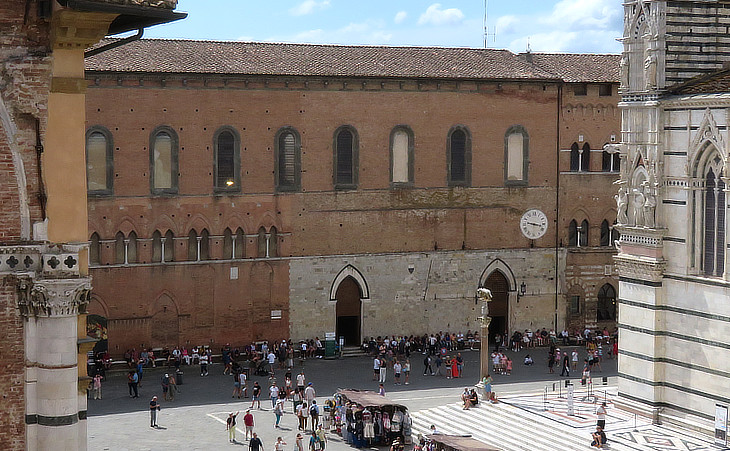
Spedale di S. Maria della Scala seen from Museo dell'Opera del Duomo
Just against the cathedral, we went into the Hospital, where they entertain and refresh for three or four days, gratis, such pilgrims as go to Rome. In the chapel belonging to it lies the body of St. Susorius, their founder, as yet uncorrupted, though dead many hundreds of years. They show one of the nails which pierced our Saviour, and St. Chrysostom's Comment on the Gospel, written by his own hand.
John Evelyn - Diary and Correspondence related to his stay in Italy in 1644
Over-against this church stands a large hospital, erected by a shoe-maker, who has been beatified, though never sainted.
Joseph Addison - Remarks on several parts of Italy, in the years 1701, 1702, 1703
The Hospital (Spedale di Santa Maria della Scala), a spacious Gothic building, is one of the most ancient hospitals in Europe; it was founded by Fra Sorore, an Augustin monk, in 832. In contains upwards of 300 beds, and has in late years derived great honour from the pathological discoveries of Paolo Mascagni (1755-1815), one of its most distinguished professors.
John Murray - Handbook for travellers in Central Italy - 1843
(1873) Opposite the church is an ancient hospital with a big stone bench running all along its front. Here I have sat a while every morning for a week watching the florid facade of the cathedral.
Henry James - Italian Hours - 1909
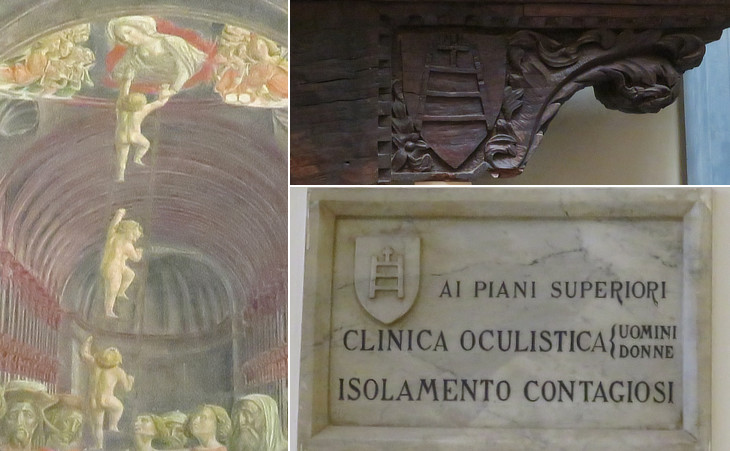
(left) Detail of a fresco by Lorenzo Vecchietta (ca 1441 in the "Pellegrinaio", the main ward of the hospital) depicting the dream of the mother of Sorore, the founder of the hospital; (right-above) symbol of the hospital on a wooden lintel; (right-below) the same on a XXth century plaque when the building was still used as a hospital; the symbol is also shown in the image used as background for this page (from the façade of Casa delle Balie, the old part of the building)
Lorenzo di Pietro kept a goldsmith's shop, and practised with varying success as an architect, sculptor, and painter. He was of the same age as Domenico di Bartolo, and he was nicknamed Vecchietta. He was born in 1412, but no records allude to him before 1439. (..) His frescos in the Spedale at Sienna were finished in 1441. These frescos are in part standing, and though we miss three scenes from the story of Tobit, and a crucified Saviour between the Virgin and S. John, in the hospital chapel, a companion subject to the series afterwards completed by Domenico still fills the arch above the door of the Pellegrinaio, and bears the inscription "Laurensius de Senis". A kneeling figure, no doubt intended for that of the founder of the hospital, occupies an advantageous position in the centre of a triple arched space, of which the vaulting retreats with some show of perspective. Near him, a ladder leads upwards to the presence of the Virgin, who awaits the hospital children climbing towards her.
J. A. Crowe and G. B. Cavalcaselle - A new history of painting in Italy - 1864
According to tradition the mother of Sorore had the vision of a ladder leading children towards the Virgin Mary. The scene calls to mind the ladders seen by Jacob or St. Bernard in their dreams or visions and more in general the redemption of the souls. See another fresco by Vecchietta in the Baptistery.
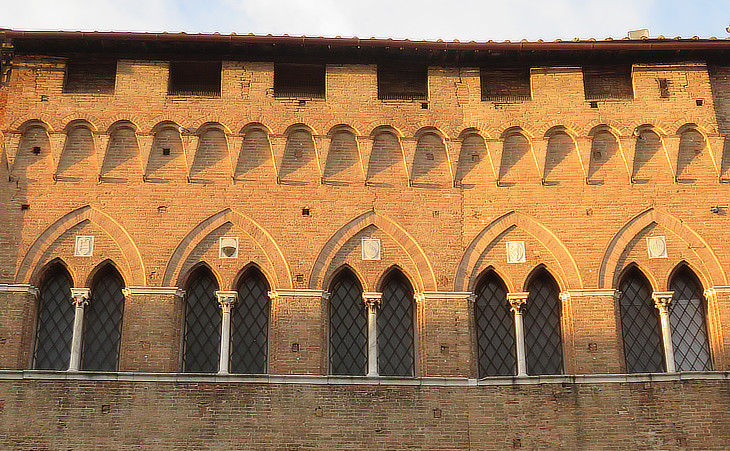
Spedale di S. Maria della Scala: façade of Casa delle Balie
The building was used as a hospital until 1995 and in the course of the centuries its aspect was modernized. The only section of the long façade opposite the Cathedral which retains its original medieval appearance belongs to Casa delle Balie (Wet-Nurses). The Hospital was also an orphanage where wet-nurses, nuns and other women were engaged in various tasks related to child care. See Spedale degli Innocenti in Florence and Spedale di S. Spirito in Rome where similar activities were carried out.
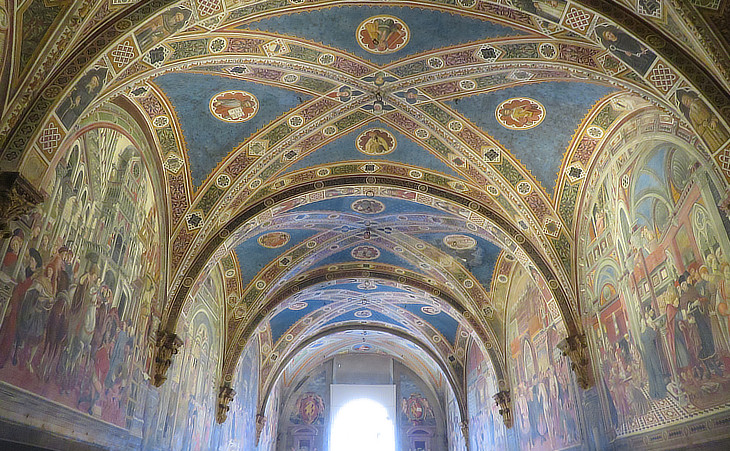
Renaissance ward aka Pellegrinaio
To one acquainted with the civil commotions which marked the decline of the Siennese republic during the fifteenth century, the absence of eminence in professors of painting will appear neither strange nor unexpected. Repeated changes, accompanied by violence, a constant renewal of governments in which the ambition of a few men invariably sought satisfaction at the expense of the masses, were necessarily productive of debility and languor. (..)
The period filled by the Domenicos, Vecchiettas, Sassettas, and their satellites, was one of retrogression, preparatory to the final absorption of the Siennese into the Perugian school. It is a period interesting chiefly to those who seek to fathom the causes or note the results of a transfusion of elements from an expiring and worn out body artistic into another nascent and growing. The painters who illustrate this last phase of Siennese art are numerous and prolific. They held a position in Sienna resembling that of the Florentines from Brunelleschi to Ghirlandaio's time; but, unlike them, they contentedly and leisurely followed ancient models of Siennese composition, as if repelled by the mere suggestion of innovation. Crowe and Cavalcaselle
In 1328, the hospital expanded its structure with the construction of a male pilgrim's hostel, achieved through the acquisition and demolition of surrounding houses to overcome a height difference of three stories. In the 1440s, the Pellegrinaio underwent a major change. The side walls and the rib-vaulted ceiling of the main ward were richly painted, thus turning the Pellegrinaio into a symbol of the prestige and wealth of the charitable institution. The leading painters of Siena were involved in this task.
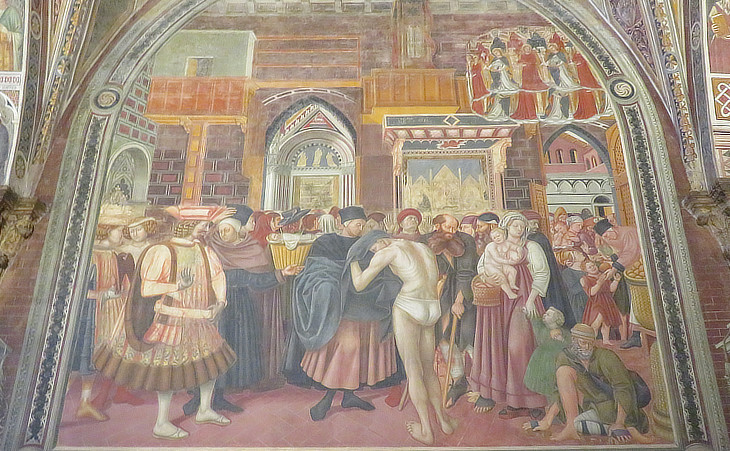
Pellegrinaio: Assistance to the pilgrims and the poor by Domenico di Bartolo
Domenico di Bartolo was born at Asciano in the early part of the fifteenth century, and was free of the guild of Sienna in 1428. The sphere of his activity is limited by that date and 1444, after which time his name has not been discovered in records. His productions justify in part the criticisms of Vasari, who assigns them to one taught in the school of Taddeo Bartoli. No knowledge is attainable respecting his occupations during 1440-2. In the middle of 1444, he had finished seven subjects on the walls of the Pellegrinaio in the Spedale di S. M. della Scala at Sienna: sick ward; alms-giving; marriage of the foundlings of the establishment; the Pope's indulgence for enlarging the hospital; the building of the annexes, and a Virgin of Mercy. A passing interest may be created by some of these injured pieces, in an archaeological sense, because the hospital, as represented in the fifteenth century, has undergone no change since then. Crowe and Cavalcaselle
This fresco depicts some of the corporal works of mercy, i.e. feeding the hungry, giving water to the thirsty, clothing the naked and sheltering the homeless (and the pilgrims). It shows the weekly distribution of bread to the poor and it features figures of pilgrims, sick individuals, and nobles, such as the Emperor Sigismund who spent some months in Siena before moving to Rome where he was crowned by Pope Eugenius IV.

Pellegrinaio: Assistance to the orphans, in particular the female ones by Domenico di Bartolo
In 2021 the ancient hospital reopened as a museum complex and the damaged frescoes of the Pellegrinaio appeared in their pristine splendour after a lengthy and careful restoration. In this fresco (on the left), a courtyard shows child care and a teacher leading some students, including a young girl. On the right, a wedding is being celebrated in a chapel, with the rector acting as witness holding the bride's dowry. The conclusion of the ceremony is accompanied by music played by young women. The marriage of young poor women was a practice that was part of the hospital's activities in providing assistance and social support during the medieval period (see a similar practice in Rome).
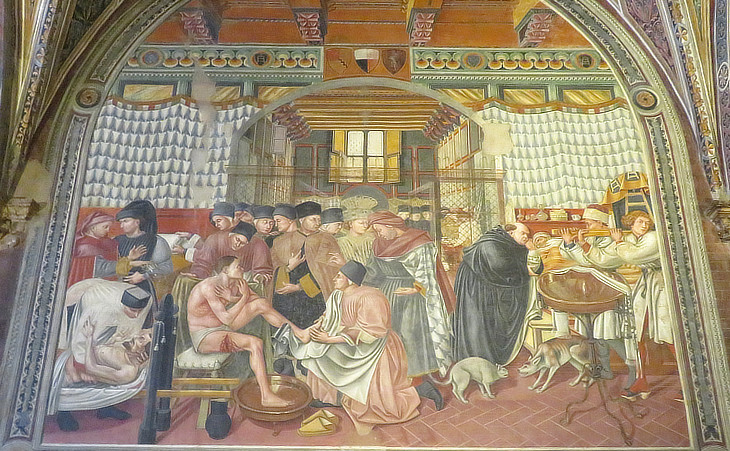
Pellegrinaio: Care of the Sick by Domenico di Bartolo
This is without doubt one of the most renowned frescoes among those painted on the walls of the Pellegrinaio, where the hand of Domenico di Bartolo indulges with extraordinary attention to detail. The scene unfolds in a large longitudinal space, covered by a beamed ceiling supported by large corbels. Near the center, above the keystone of the arch, are the coats of arms of the Capitano del Popolo, the Balzana (the black-and-white emblem of Siena), and that of Carlo d'Agnolino Bartoli, rector of Santa Maria and later bishop of the city. This detail has allowed scholars to confidently identify the setting as the Pellegrinaio, built in 1378, whose wooden ceiling was constructed during Bartoli's rectorship. At the far right of the fresco, two attendants are carrying a stretcher draped with a cloth bearing the symbols of the Scala. Behind them, a dying man is seen lying in bed, his head bandaged. A large Augustinian friar leans over the patient, likely hearing his confession. The central group features, in the foreground, a man wearing only a loincloth, with a large bleeding wound on his right thigh; one foot is soaking in a copper basin, while the other is being dried by a hospital friar. Near the centre of the scene stands a "cerusico" (a surgeon-physician), next to whom is the rector. Below, an orderly is laying a person onto a stretcher. In its extraordinary detail, the scene offers a vivid snapshot of medical care within the hospital. From the Museum website
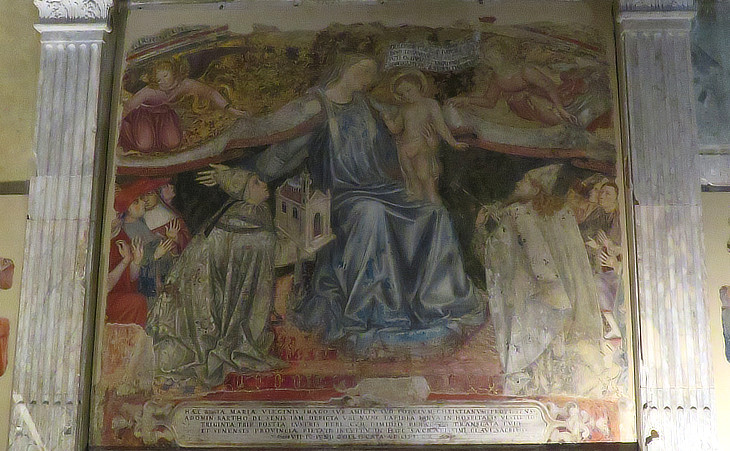
Sagrestia Vecchia: Madonna del Manto (the mantle which covers the whole scene) by Domenico di Bartolo
This fresco is the last work by Domenico di Bartolo for the Spedale. It was painted for the chapel where relics were kept, but in 1610 it was relocated to the Old Sacristy. Under the right side of the mantle, the fresco depicts the pope, the hospital rector, and representatives of various religious orders to the right of the Virgin, and the emperor and the lay community to her left. The figures of the pope, the rector, and the emperor can be identified as Eugene IV, the rector Francesco di Giovanni Buzzichelli, promoter of the intense artistic activity within the hospital during the 1440s and Emperor Sigismund, all figures previously portrayed by the artist in the Pellegrinaio frescoes.
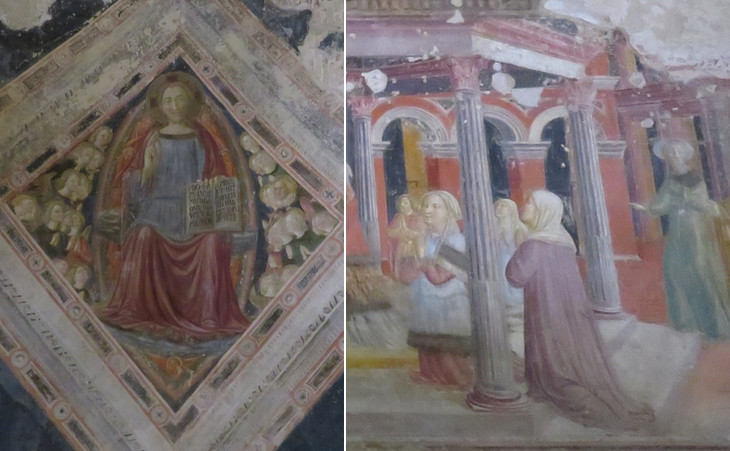
Sagrestia Vecchia: ceiling and detail of a fresco by il Vecchietta
Since the text was written the frescos of the sacristy have been cleared of white-wash. They represent ten scenes from the new and old Testament; Christ, Evangelists, and saints in the ceiling . (..) Two of these ceilings are by Michele Lambertini; four by Vecchietta. In the central one, by the entrance, are SS. James, Philip, John Evang., and Mathew. In the next central one, by the tribune, are: the Last Judgment; Christ in glory; the Limbo, and a symbolical picture of the communion. (..) Lorenzo, in spite of the poverty apparent in his works, held a high place in the estimation of his townsmen. To say that Vecchietta is better than Domenico in his last days, is curt but sufficient praise. Crowe and Cavalcaselle
The decorations of the sacristy were later overseen by Urbano di Pietro del Bello, Buzzichelli's successor, who commissioned the work to Il Vecchietta. The frescoes of the vault and walls were executed in 1446-1449.
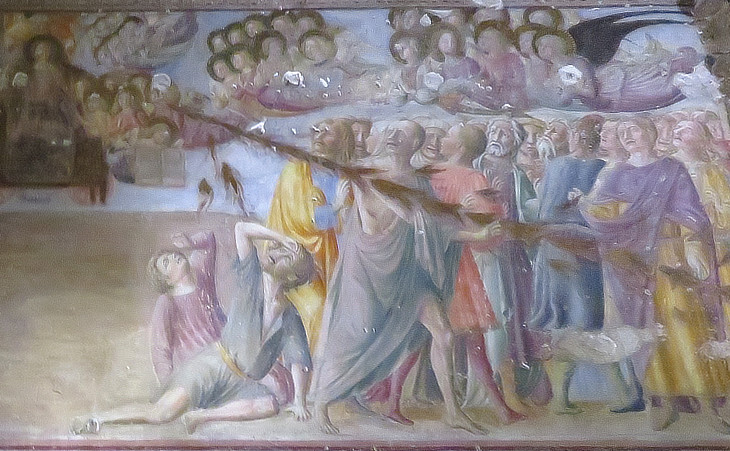
Sagrestia Vecchia: detail of the Last Judgement by Vecchietta showing fire being thrown towards the damned
The scene is reminiscent of a vision of Daniel: His throne was flaming with fire, / and its wheels were all ablaze. / A river of fire was flowing, /
coming out from before him.
Daniel 7 - Dream of the Four Beasts.
You may wish to see depictions of the damned in a lake of fire in Greek Orthodox churches at Constantinople (early XIVth century) and at Voronet in Northern Moldavia (XVIth century).
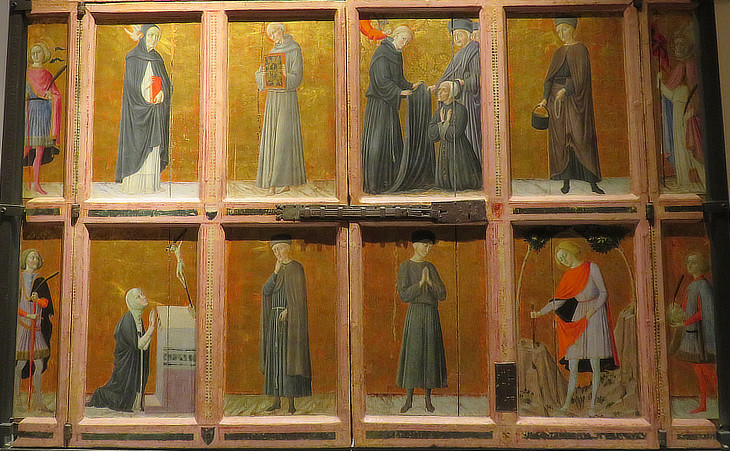
Reliquary by il Vecchietta with portraits of saints from Siena
The relic press in the Spedale, of which he painted the doors inside and out in 1445 with twenty-five different subjects serves to illustrate the decline of Siennese art since Duccio (see a similar painting by Duccio). Twelve panels in the next two courses contain (from left to right) SS . Ansano, Ambrogio Sansedoni (beato), Bernardino, Agostino Novello (beato giving the dress), Galerani (beato), Savino, Victor, Catherine of Sienna, unknown (Pier Pettinaio), unknown (Sorore), Galgano, and Crescenzio. Crowe and Cavalcaselle
In 1437 Vecchietta created the Arliquiera, a large two-door painted cabinet designed to house the sacra pignora (sacred relics). The Arliquiera had two large doors divided into compartments, today the only remaining element of the work. The two panels were entirely painted by Vecchietta. The inner side with the Stories of the Passion, arranged in eight panels, is a clear reference to the most precious relic the cabinet contained: the sacred nail of the cross. The outer side, instead, is divided into twelve compartments depicting local saints and blessed. All these figures are connected to the history of the hospital and to the brotherhoods that had settled there.
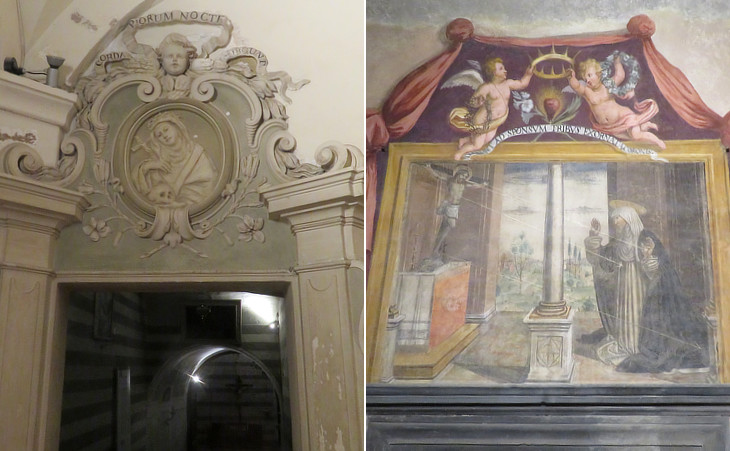
Oratorio della Confraternita di S. Caterina della Notte: (left) stucco decoration of the entrance with the inscription "CORDA PIORUM NOCTE SURGUNT"; (right) fresco depicting St. Catherine receiving the stigmata with the inscription "TRANSIT AD SPONSUM TRIBUS EXORNATA CORONIS", a quotation from Cornelius a Lapide, a Jesuit who wrote a Commentary to the Sacred Scriptures (1617) where he indicated that St. Catherine ought to be portrayed with three crowns; the depiction of the stigmata of St. Catherine was at the centre of a long debate which was settled in 1630 by Pope Urban VIII
The many activities which were required for the running of the Spedale were in part carried out by members of brotherhoods. Those of this brotherhood were primarily devoted to caring for the dead, something which was done at night. Their oratory stood in the lower level of the building on the site where St. Catherine used to pray for the sick, near the hospital cemetery and the carnaio, a mass grave into which remains were cast from an opening that dropped from the wards.
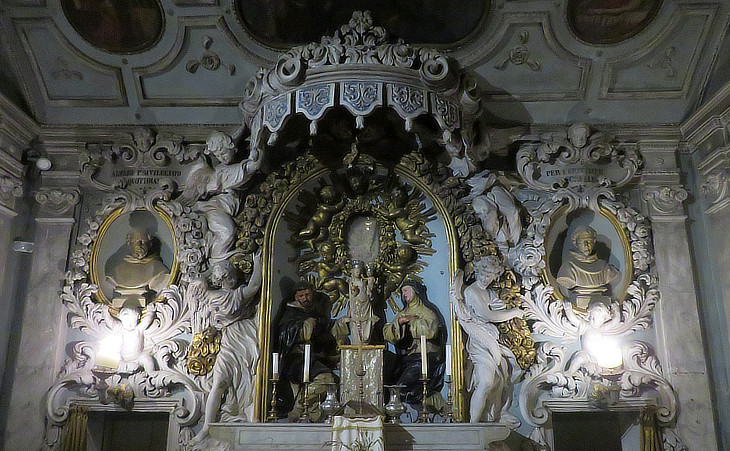
Oratorio della Confraternita di S. Caterina della Notte: altar
In the early XVIIIth century, the oratory was richly embellished with stuccoes and paintings. The altar houses a XIVth century marble Madonna, likely the oldest devotional image venerated by the brotherhood, between Sts. Dominic and Catherine in adoration. The statues are attributed to Giovanni Antonio Mazzuoli, a pupil of Gian Lorenzo Bernini.
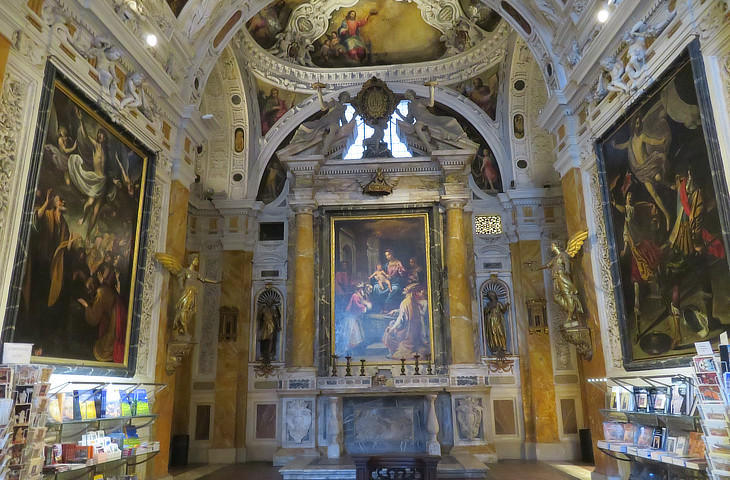
S. Niccolò in Sassso which belonged to S. Maria della Scala (access through Museo dell'Opera del Duomo)
This small church was part of a charity which took care of pregnant girls and their babies. In 1565 these activities were taken over by Spedale di S. Maria della Scala and in the following years the church was entirely redesigned in Mannerist style and decorated with paintings by Astolfo Petrassi (left - Ascension), Francesco Vanni (centre - Madonna and Saints) and Rutilio Manetti (right - Resurrection).
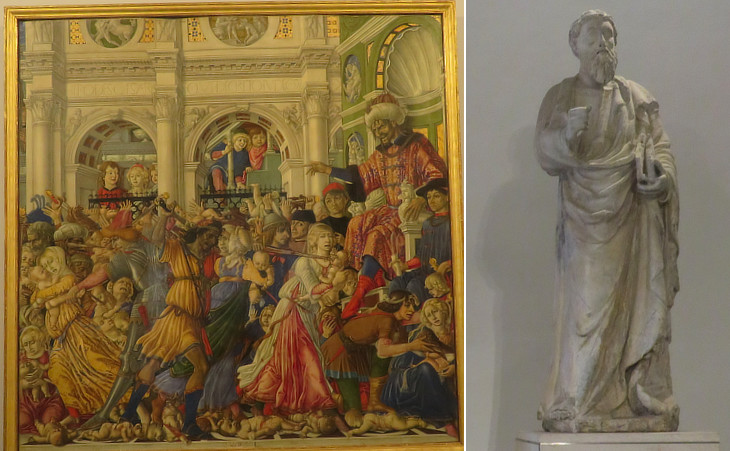
Works of art from other locations: (left) The Massacre of the Innocents by Matteo di Giovanni (1484) from S. Agostino; (right) St. Bartholomew by Lando di Stefano from Cappella di Piazza
The vast spaces of the former hospital house also works of art which are not directly related to the history of the building.
Matteo's fame and affluence increased at a later time; and his best works are of the close of the century. (..) He repeated the Massacre of the Innocents several times; once in the altarpiece of a chapel at S. Agostino of Sienna, dated 1482; again in S. Maria de' Servi of Sienna in 1491; a third time in a picture at the Naples Museum. In all these he combined incidents in a confused and unsatisfactory manner. The action is unnatural; the idea grotesque; the expression grimace. Architecture, studied from old models, is applied without knowledge of perspective; and the absence of systematic acquirements in this respect is perhaps the cause why Herod appears to exceed in stature the nearer figures of soldiers and of women. Anachronisms of costume are not compensated by taste, nor is the dry bone of form animated into any sort of life. Crowe and Cavalcaselle
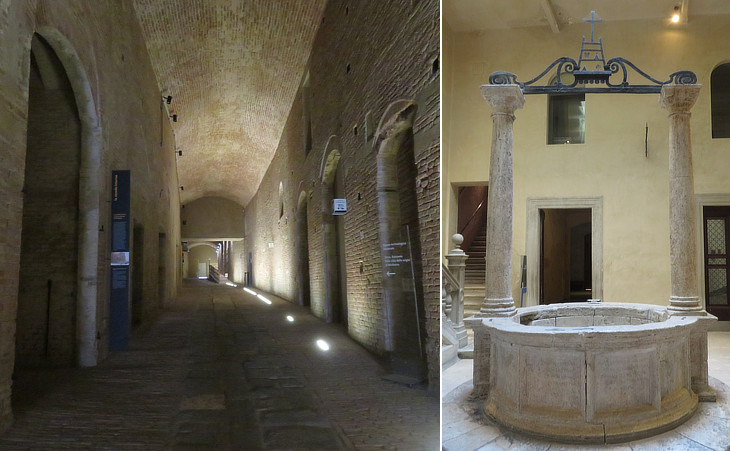
(left) Underground passages; (right) Renaissance well near the entrance to the complex
The lower levels of the complex where many ancillary facilities of the hospital were located are now used for the cultural purposes of the museum.

Fonte Gaia: (left) Statue of Rea Silvia; (right) Wisdom
Fonte Gaia was completed in 1419 by Jacopo della Quercia. The fountain, situated in the middle of the Campo, was decorated with reliefs of the Virgin Mary (patron of the city) and flanked by the Virtues. The poor quality of the marble and the daily life that took place in the square contributed to the degradation of the fountain. In 1743 a spectator of the Palio climbed the statue of Rea Silvia, breaking it into pieces. In 1859, it was decided to replace Jacopo's fountain with a copy made by the Sienese sculptor Tito Sarrocchi. In 1904 the remains of what had been one of the greatest sources of municipal pride were placed in a loggia of Palazzo Pubblico, where they remained until 1989 when the first phases of their long and complex restoration began. In the current display, the original marbles are accompanied by plaster models by Sarrocchi.
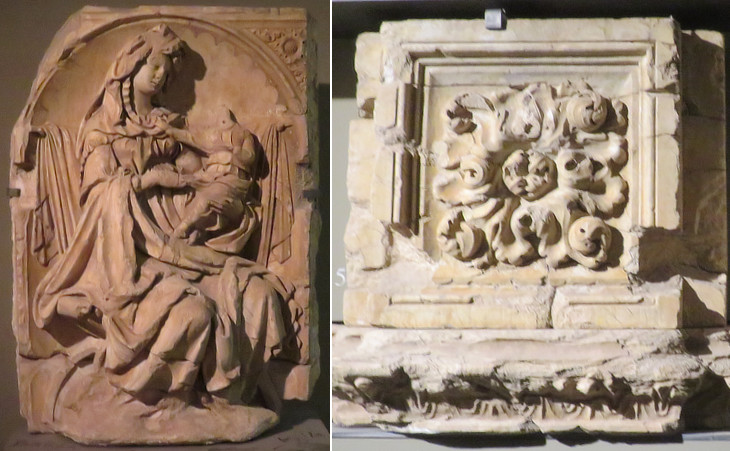
Fonte Gaia: (left) Madonna and Child; (right) decorative relief
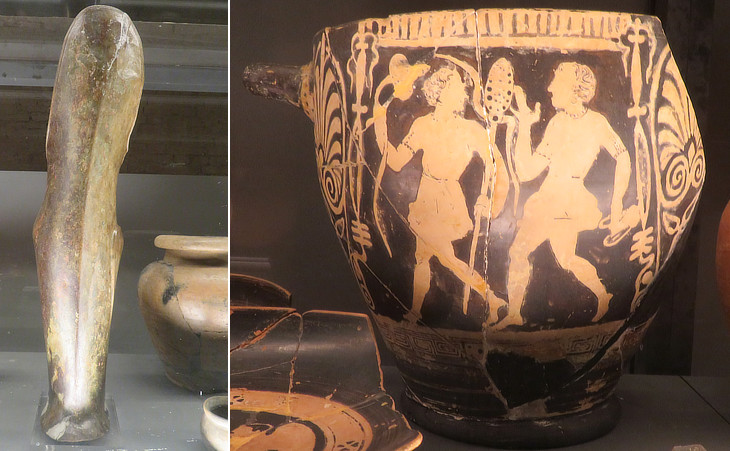
(left) Tomb at Monteroni d'Arbia: VIth century BC bronze leg protection; (right) IVth century BC vase
Siena can urge no pretensions to be considered an Etruscan city, that are founded either on historical records, or on extant remains. By ancient writers she is mentioned only as a Roman colony, and as there is no mention of her before the time of Caesar, and as she is styled Sena Julia by the Theodosian Table, the probability is that a colony was first established here by Julius Caesar, or by the Second Triumvirate. Nor is there a trace of Etruscan antiquity visible on the site, though there are a few shapeless caves in the cliffs around, which seem to have been mistaken for tombs.
Siena, therefore, would not have been mentioned among Etruscan cities, but that it is situated in a district which, at various periods, has yielded treasures of that antiquity; and from its position in the heart of Tuscany, and on the high road from Florence to Rome, it might be made a convenient central point for the exploration of this region.
George Dennis - The Cities and Cemeteries of Etruria - 1848
The idea of an archaeological museum began to take shape in Siena in the early XXth century, because the town housed a series of small collections of antiquities, either belonging to private antiquarians or to public institutions. The museum was formally established in 1941 after it was enriched in 1931 by the acquisition of a private collection from Sarteano, a town near Chiusi, the main centre of Etruscan civilization in the province of Siena, which already had a large museum (another archaeological museum existed at Grosseto, south-west of Siena).
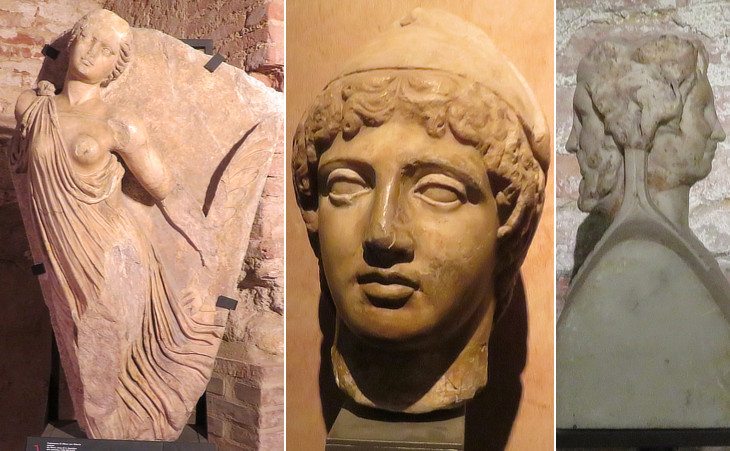
Exhibits of the Roman age: (left) IInd century AD fragment of relief from near S. Agostino; (centre) head of a young man (perhaps Paris); (right) herm
After WWII the collections continued to grow: in 1951, that of Bonaventura Chigi Zondadari was donated to the state; two years later, the state acquired the collection of Emilio Bonci Casuccini, which provided valuable documentation of the archaeological findings at Chiusi. The museum was enriched also by accidental discoveries from the area surrounding Siena and by excavations carried out by the Superintendence. In the late 1980s, the museum was transferred to the Santa Maria della Scala complex, occupying the spaces at the corner of the hospital, the female pilgrim area. In 2001 it was moved once more to the lowest levels of the complex, consisting of tunnels carved into sandstone and large brick-built spaces.
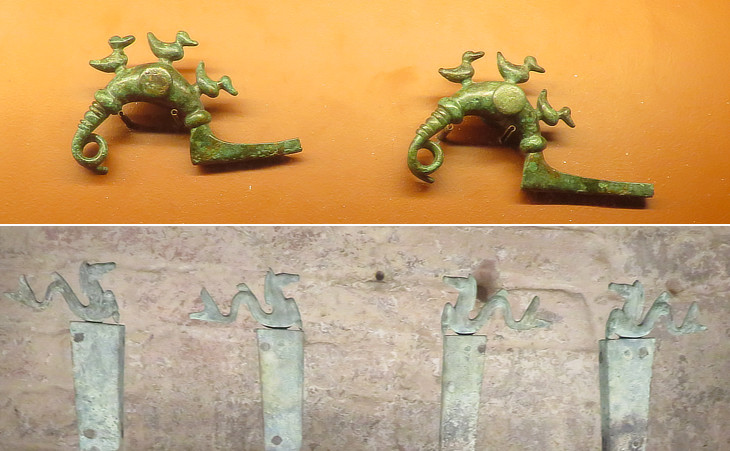
(above) Ancient bronze brooches (from Sovicille - Fondo Capitani - VIIth century BC); (below) bronze legs of a brazier (Vth century BC)
From Chiusi to Sarteano there are but four miles, and the road is full of beauty. It ascends a steep and lofty height covered with wood, and from the summit commands a magnificent view over the vale of the Chiana. (..) So rich is the soil around Sarteano in Etruscan treasures, that in the ordinary processes of agriculture articles are often brought to light, and the various proprietors of land come into the possession of antiquities without the trouble of research. In the hands of Gaetano Bernardini, a shopkeeper of Sarteano, I saw some very curious bronzes; indeed this necropolis is hardly less abundant in metals than in pottery. Dennis
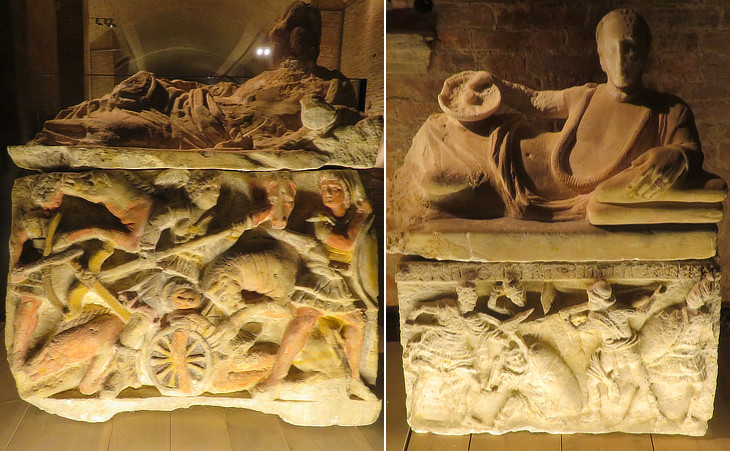
Cinerary urns from Le Tombe at Sarteano (IInd century BC): (left) Death of Hippolytus (learn more about this event); (right) Echetlus, an Athenian hero, fighting with a plough at the Battle of Marathon (490 BC)
Sarteano is a place of some importance, fully as large as Chiusi, surrounded by walls of the middle ages. At Sarteano there are three foci of interest to the antiquary - the collections of the Cavaliere Bargagli, the Dottor Borselli, and Signor Lunghini. The first of these gentlemen has some choice urns, found on his estate at a spot called Le Tombe, near the banks of the Astrone. One represents in its relief Hippolytus attacked by the sea-bull, which Neptune sent against him, and which caused his horses to take flight, so that they dashed him and his chariot to pieces - A female demon or Fury, holding a torch, bestrides the fallen youth, and a warrior seems about to attack her, sword in hand. Dennis
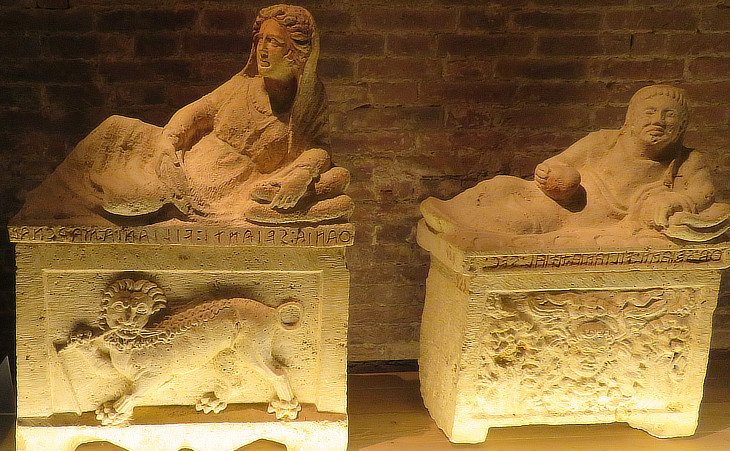
Cinerary urns from Le Tombe at Sarteano: (left) lion breaking a spear; (right) head of Gorgon
These urns, with others, fourteen in all were found in one tomb and the inscriptions indicate they belonged to the family of the Cumere. The door of the tomb was closed by a large tile, bearing the same name; it is also in this collection. Dennis
You may wish to read Dennis' description of his visit to the Tomb of the Volumni, an intact tomb outside the walls of Perugia.
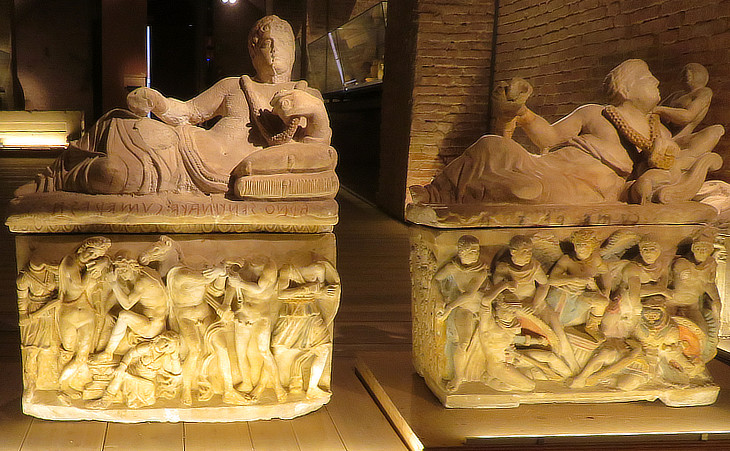
Cinerary urns of the Cumere: (left) Iphigenia and Orestes; (right) Fight between Eteocles and Polynices
Another relief represents Orestes in Tauris; and indicates the discovery by Iphigenia, that the stranger she is about to sacrifice to Diana, is her own brother. Orestes, naked, sits weeping on the altar; she, also naked, stands leaning on his shoulder in deep dejection. Pylades is being disarmed by a warrior, to be subjected to the same bloody rite; and the female attendants of the priestess fill up the scene. The execution of this relief is admirable (read Ovid's account of their escape from Tauris).
There is a very good urn with the trite subject of Eteocles and Polynices (see similar urns at Chiusi). The moment, as usual, is chosen when the brothers are giving each other the death-wound. A Fury rushes between them, not to separate them, but to indicate her triumph over both. This urn is worthy of notice, as having on the lid, beside the usual recumbent figure, which is here a male, a little child also, caressing its father. Dennis
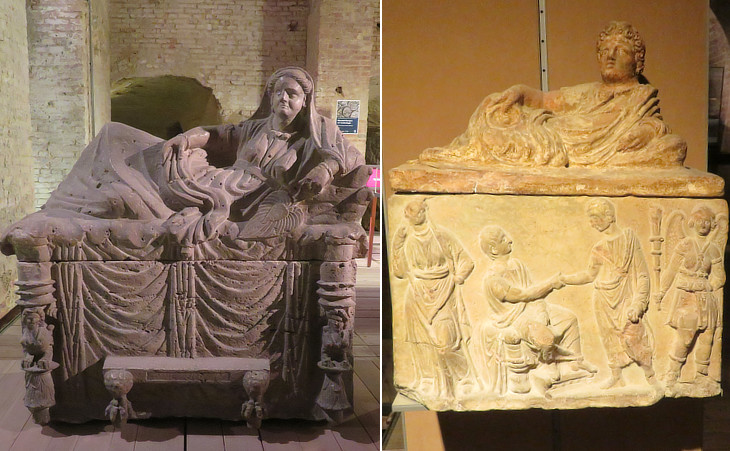
Travertine urn from Perugia with the box having the shape of a "kline", a funerary bed (see some exhibits of the Archaeological Museum of Perugia); (right) urn from Chiusi which belonged to an academy of Siena: the box depicts a man taking leave while Vanth, a female demon with a torch is waiting for him (see a similar scene in a tomb at Tarquinia)
You may wish to visit Museo Etrusco Guarnacci at Volterra, the oldest and perhaps the largest Etruscan museum in Italy.
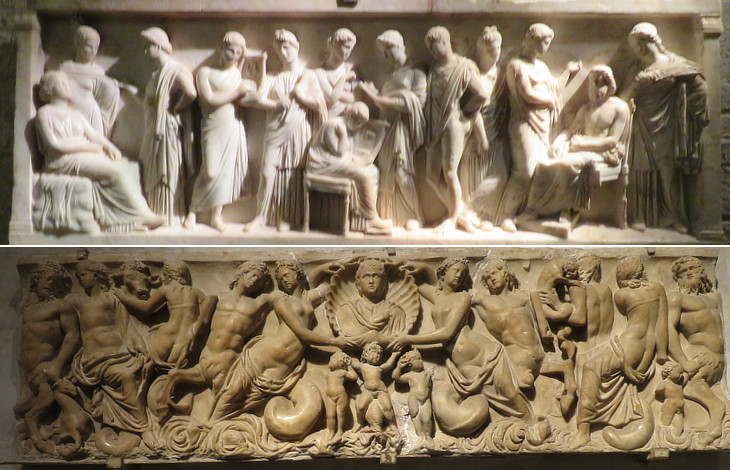
(above) "Muse Chigiane", it most likely depicts the poetess Sappho being greeted by the Muses (IInd century AD); (below) Museo dell'Opera del Duomo: sarcophagus from the sacristy of the Cathedral depicting a sea thiasos, a Dyonisiac procession of mermaids and tritons (see a list of similar sarcophagi in Rome)
Move to
From Porta Camollia to S. Domenico
From Porta Romana to S. Francesco
Piazza del Campo
Cathedral - The Building
Cathedral - Interior
Opera del Duomo


