All images © by Roberto Piperno, owner of the domain. Write to romapip@quipo.it.


Notes:
Page added in June 2026.
All images © by Roberto Piperno, owner of the domain. Write to romapip@quipo.it.
Notes:
Page added in June 2026.
 Assisi - page four: St. Francis and Giotto
You may wish to see a page on St. Francis and Assisi first.
In April 2026 Galleria Nazionale dell'Umbria dedicated a temporary exhibition to the early depictions of St. Francis (1181-1226) and to the influence Giotto (1267-1337) had on the development of Italian painting. On this occasion it was possible to see some polyptychs the panels of which are dispersed in different museums e.g. a triptych from Maestro di Paciano.
Both St. Francis and Giotto were celebrated by Dante (1265-1321).
Paradiso, Canto XI (St. Francis) Nel crudo sasso intra Tevero e Arno | Transl. by Henry Wadsworth Longfellow On the rude rock 'twixt Tiber and the Arno |
Purgatorio, Canto XI (Giotto)
Credette Cimabue ne la pittura | Transl. by Henry Wadsworth Longfellow In painting Cimabue thought that he |
The quote about St. Francis refers to the stigmata he received two years before his death, which became a distinctive feature of his iconography. The earliest portrayal of St. Francis is a fresco at Sacro Speco, a Benedictine monastery near Subiaco, which the saint visited in 1223 before receiving the stigmata.
Francis, the most lovable of the saints, was the son of a merchant in Assisi, where he was born about 1182. Seized by an impulse of fanatical devotion in the midst of a profligate career, the youth threw aside fine clothes, gold, and possessions, and, despising the world, clothed himself in rags. He was mocked at, he was called insane. But after a time reverent crowds listened to his marvellous eloquence, and youths, intoxicated by his charm, followed his example. The call of Christ, "Leave what thou hast and follow me," uttered by the mouth of a mendicant apostle, was re-echoed on the highways by enthusiasts for poverty, who hastened literally to fulfil the command. The mysterious impulse towards a mystic brotherhood, whose principle was the absence of all property, whose support was alms, and whose ornament was the garb of the beggar, is one of the most curious phenomena of the Middle Ages. (..) S. Francesco with its two churches, one standing above the other is magnificent. The upper church, with its paintings by Cimabue and Giotto, all light and colour; the lower, with its innumerable sombre frescoes, all darkness and gloom. Below lies the hero of poverty in a vaulted chapel, radiant in gold and marble.
Giotto's frescoes over the high altar depicting Poverty, Obedience, Chastity, finally the glory of S. Francis, greatly
impressed me.
Ferdinand Gregorovius - History of the city of Rome in the Middle Ages and Roman Journal in 1864
The Master of Saint Francis was an anonymous Italian painter, working between 1250-1280. His work embodies aspects of the Italo-Byzantine style, but his portrayal of St. Francis has some novel features and it fixes the iconography of the saint as a rather young and fair man wearing a simple sack-cloth and holding a passage of his preachings. The painter might have been a Franciscan monk himself. See a painted cross attributed to him.
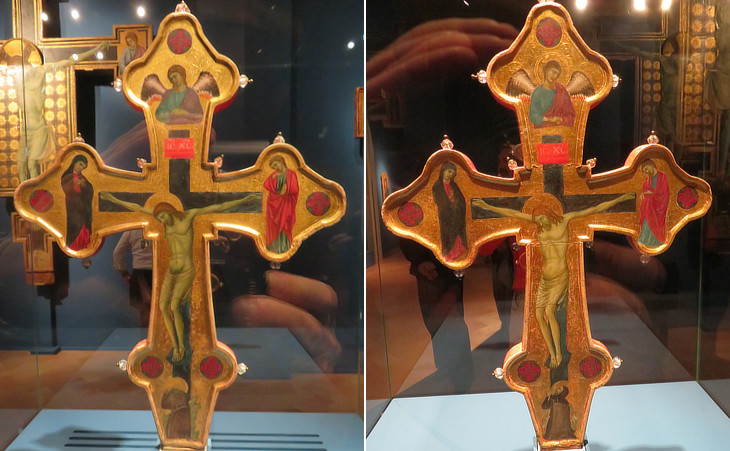
Even during his lifetime legend gathered around his path. (..) As early as the year 1219, at a general assembly at Assisi, Francis could count 5000 brethren, followers of his banner. The erection of convents for mendicant monks soon became an event of great importance. Gregorovius
The Master of the Gubbio Cross is the name given to an Umbrian painter active between about 1285 and about 1320. He appears to have been familiar with the artists who worked at the Basilica of San Francesco d'Assisi after Giotto and Cimabue, and some of his work bears a resemblance to that of Giunta Pisano.
Giotto aims at types which both in face and figure are simple, large-boned, and massive. (..) In his compositions, he aims at clearness of grouping, so that each important figure may have its desired tactile value. (..) Nothing here but has its architectonic reason. Above all, every line is functional; that is to say, charged with purpose. (..) A painter who, after generations of mere manufacturers of symbols, illustrations, and allegories had the power to render the material significance of the objects he painted, must, as a man, have had a profound sense of the significant. No matter, then, what his theme, Giotto feels its real significance and communicates as much of it as the general limitations of his art, and of his own skill permit.
Bernard Berenson - The Florentine painters of the Renaissance - 1909
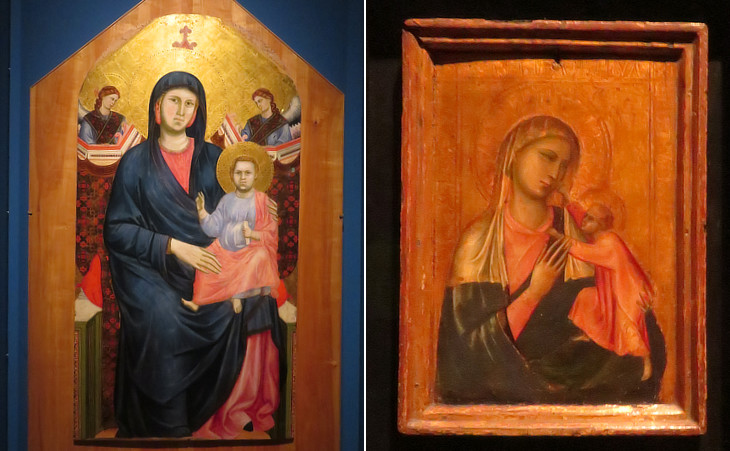
The Madonna di S. Giorgio was part of a polyptych and having being designed for a church it respects all the formal requirements of a sacred image. The Madonna which Giotto painted for a private collector shows a more intimate relationship between the Virgin Mary and the Child who look to each other and not to the viewer.
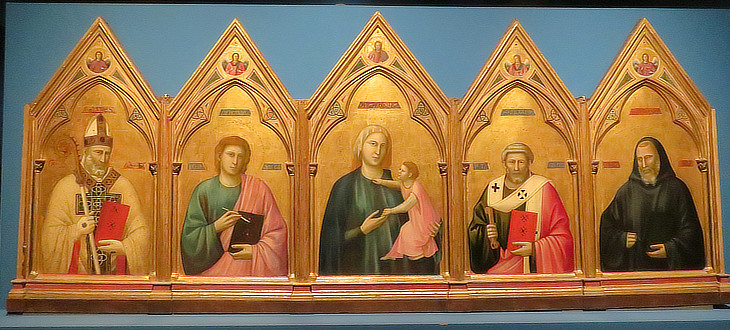
Polittico di Badia: St. Nicholas, St. John the Evangelist, the Madonna, St. Peter and St. Benedict by Giotto di Bondone (1295-1300) from Galleria degli Uffizi - Florence
The first pictures of Giotto were in the chapel of the high-altar in the Badia of Florence, wherein he made many works held beautiful.
Giorgio Vasari - Lives of the most eminent painters, sculptors & architects. Transl. G. De Vere - 1913
Obliged to get the
utmost out of his rudimentary light and shade,
he makes his scheme of colour of the lightest
that his contrasts may be of the strongest. (..) Note how the shadows compel
us to realise every concavity, and the lights
every convexity, and how, with the play of the
two, under the guidance of line, we realise the
significant parts of each figure, whether draped
or undraped. Berenson
In this polyptych the Madonna is portrayed in a mixture of the two postures shown before. The Virgin Mary watches the viewer, but the Child does not. In many works of art of the XIIIth and XIVth centuries St. John the Evangelist was depicted as the young man who attended the Last Supper, watched the Crucifixion and was entrusted with the care of Mary. He then set his residence at Ephesus and spent his last years in a cave at Patmos. Eventually his most common iconography became that of an old man writing his gospel at the presence of an eagle (see examples at S. Giovanni in Laterano and at S. Pietro).
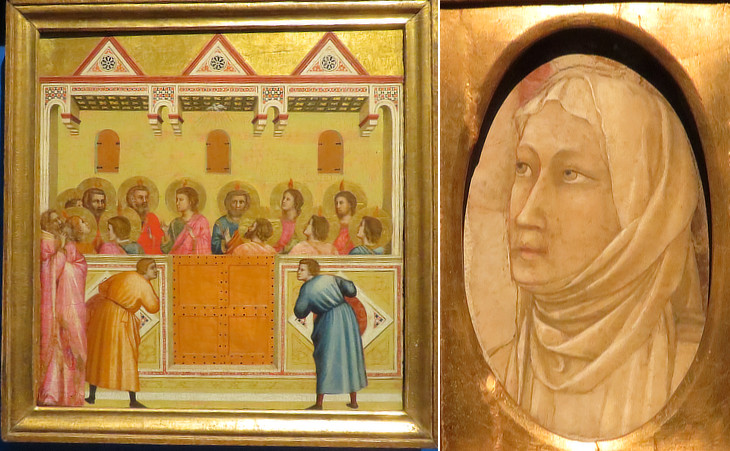
Giotto painted scenes from the Life of Christ is a series of seven small panels in gold and tempera which today are housed in five museums around the world. The Pentecost shows an attempt to apply perspective laws to obtain an effect of depth. Another interesting feature is the duplication of the depiction of a servant outside the hall which houses the Apostles.
The fresco fragment of a veiled woman was part of the decoration of the Lower Church of S. Francesco: it is the only surviving section of a composition entitled Celestial Glory, which once adorned the main apse. The woman looks upward in an ecstatic posture; it might have been painted by an assistant of Giotto under the direction of the master.
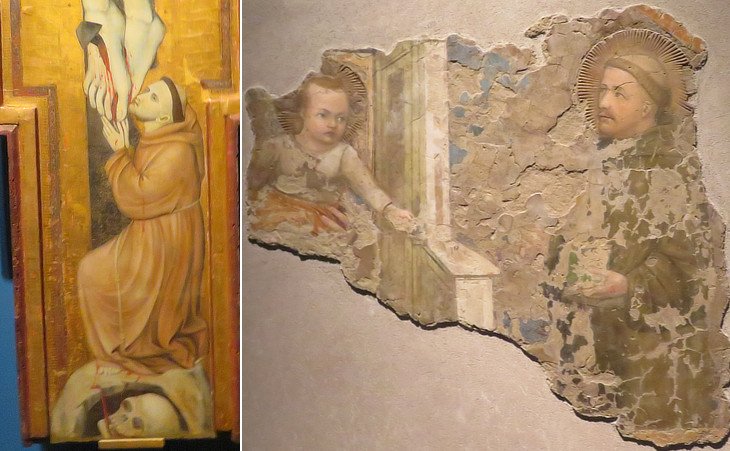
Giotto had a great influence on many painters of Tuscany and Umbria. Art historians name Maestro della... some of them of whom we do not have precise biographical data, after a work of art which best represents their style (this occurs also in other fields, e.g. ancient vases). Maestro della Croce di Trevi was most likely an assistant to Giotto at Assisi.
And in truth, in so far as it can be judged, Puccio had the manner and the whole method of working of his master Giotto, and knew how to make good use of it in the works that he wrought, even if, as some have it, he did not live long, having fallen sick and died by reason of labouring too much in fresco. Vasari
Puccio Capanna lived and worked at Assisi between 1341 and 1347. He is also called Puccio Campana. Vasari described him as one of Giotto's most important pupils, whom the inhabitants of Assisi considered to be a fellow citizen as he had done a lot of paintings in the churches there, e.g. frescoes with scenes from the Passion on the vaulting of the Lower Church of S. Francesco. Many of the works of art mentioned by Vasari do not exist any longer.
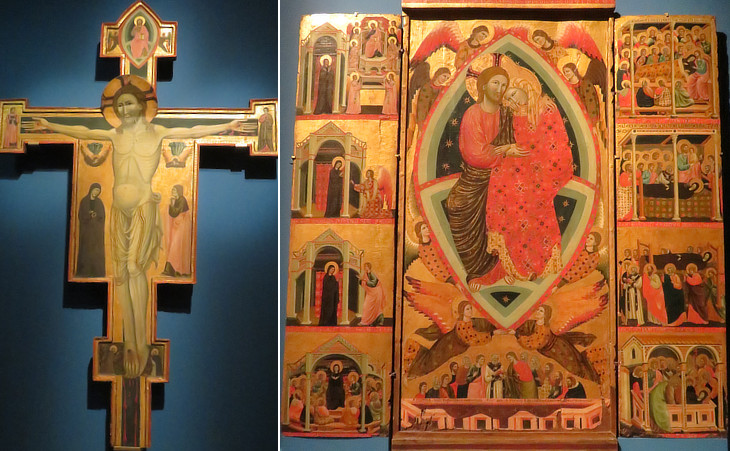
Maestro di Cesi is thought to have been a Roman painter who was influenced by the frescoes at Assisi, but not in particular by those of Giotto. His Coronation of Mary and his Crucifix reflect earlier paintings. The use of a mandorla shaped aureola surrounding Jesus can be noticed in other early medieval paintings at Galleria Nazionale dell'Umbria.
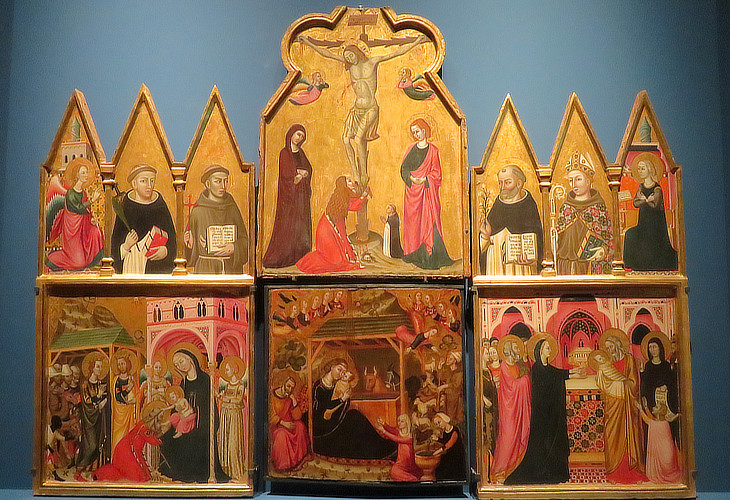
Not all the painters who came after Giotto were impressed by the realistic features of his work. In this triptych we can notice that the small scenes are similar to those painted by Giotto, but they rather depict fables because they are crowded by small figures and the buildings lack proportions and perspective. This type of paintings had a development of its own, known as the International Gothic style (see some paintings at Ancona).
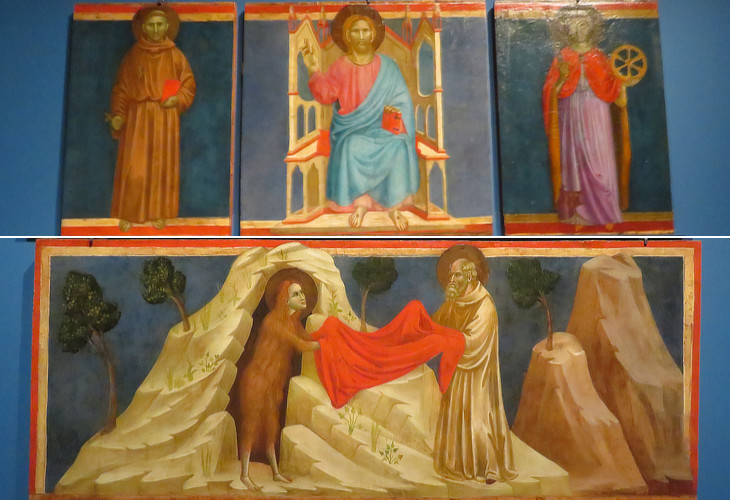
Art historians are still debating about the identity of the painter of these small paintings. He was no doubt a member of the "school of Giotto", but he departs from the master by increasing the dramatic aspects of his personages. A name which has been proposed is that of Palmerino di Guido who is mentioned as a close assistant to Giotto.
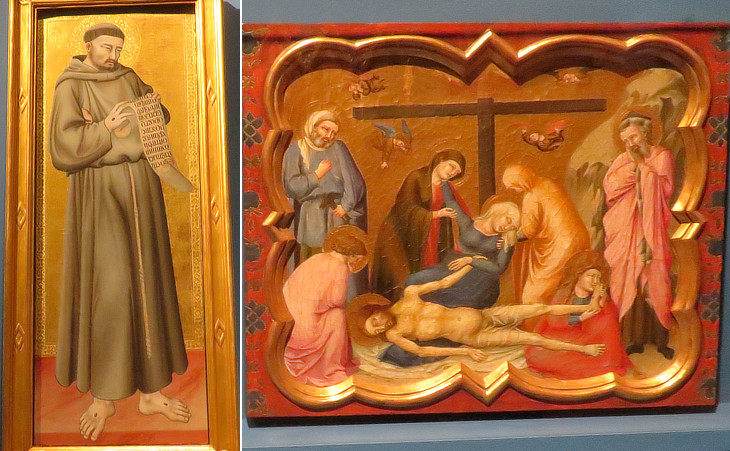
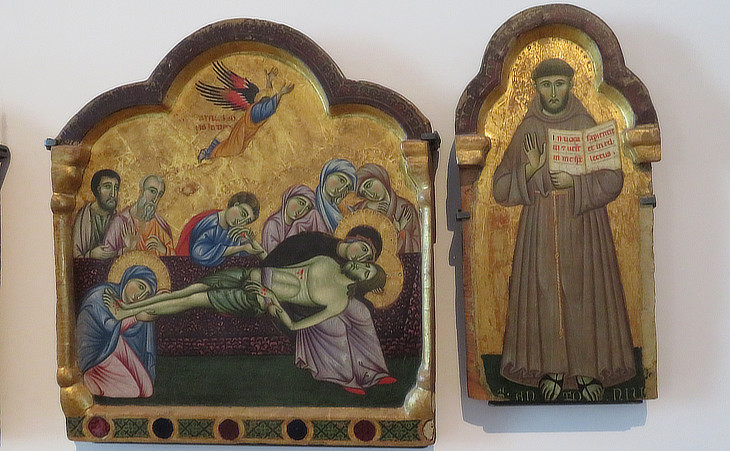
The painter is referred to also as The Master of the Fogg Pietà, after a small painting bought in 1927 by the Fogg Art Museum in Cambridge (MA). Art historians have attributed a number of works to this painter based on distinctive style aspects. We actually know virtually nothing about his life and identity. It is believed that he worked in Florence in 1330-1350 and he continued the tradition begun by Giotto in which the modelling of the figure helps to create a realistic depiction of form and space. St. Francis is portrayed according to the traditional iconography with much evidence given to the stigmata.
The Fogg Museum's 1927-28 annual report described the Pietà as "a beautiful little panel representing The Mourning over the Body of Christ, by an Italian fourteenth-century master, probably of the Florentine School." The panel most likely comes from the predella (lower part) of a polyptych of which some twelve panels have been identified in museums around the world.
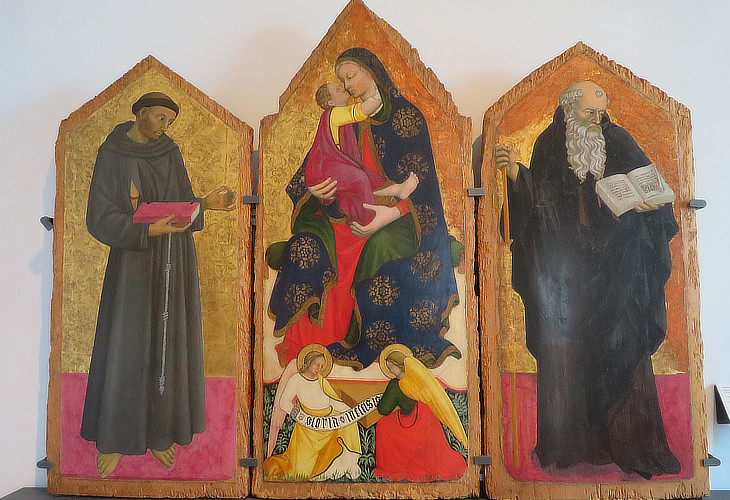
Farneto is the name of a hermitage on the summit of a hill surrounded by a farnie (oak) wood near Perugia where St. Francis used to pray. The triptych decorated the small church of the hermitage. The dating of the painting is the subject of great controversy because it spans from the late XIIIth century to the early XVth century. The Madonna in particular brings to mind a painting by Gentile da Fabriano at Perugia.
The image used as background for this page shows a detail of a painting by Giotto.
Return to page one (the fortifications) or page two (the town) or page three (St. Francis) or take the train and reach Perugia.