
All images © by Roberto Piperno, owner of the domain. Write to romapip@quipo.it.


Notes:
Page revised in February 2025.
All images © by Roberto Piperno, owner of the domain. Write to romapip@quipo.it.
Notes:
Page revised in February 2025.
 Monastero di Santa Lucia in Selci
Links to this page can be found in Book 8, Day 2, Map B3 and Rione Monti.
The page covers:
The plate by Giuseppe Vasi
Today's view
S. Lucia in Selci
SS. Gioacchino e Anna
Exhibits from the Museums
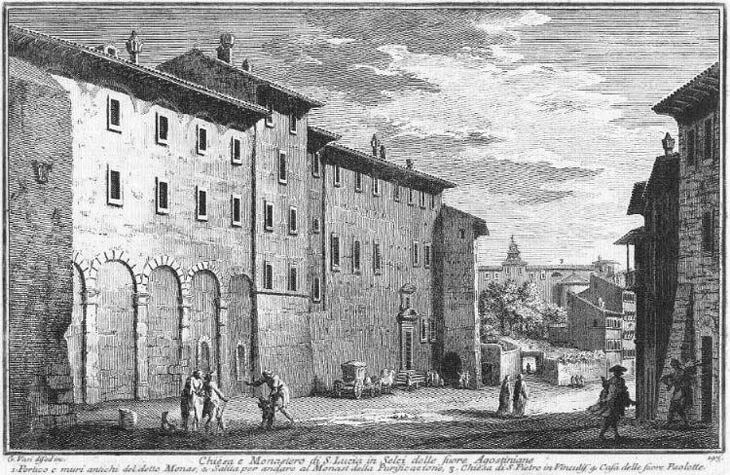
In 1587 Pope Sixtus V built the first modern aqueduct of Rome (Acqua Felice) to provide the Quirinal, Viminal and Esquiline hills with an adequate supply of water. Yet the three hills which made up Rione Monti did not see a major urban development; they remained rather unpopulated and continued to be characterized by the presence of villas and monasteries. In this plate which shows the Fagutal, the southern peak of the Esquiline, Vasi made reference to four monasteries/nunneries.
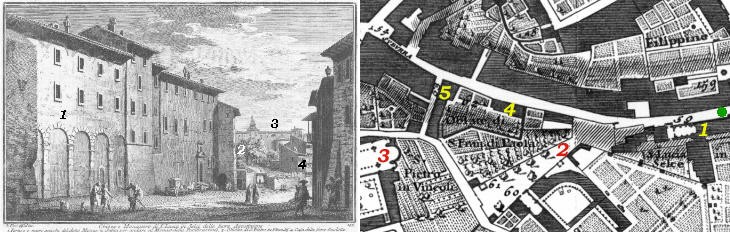
The view is taken from the green dot in the 1748 map below.
In the description below the plate Vasi indicated: 1) Ancient walls of S. Lucia in Selci; 2) Street leading to
Monastero della Purificazione; 3) S.
Pietro in Vinculis; 4) Casa delle Suore Paolotte. 3) is shown in another page.
The map shows also 5) SS. Gioacchino e Anna.
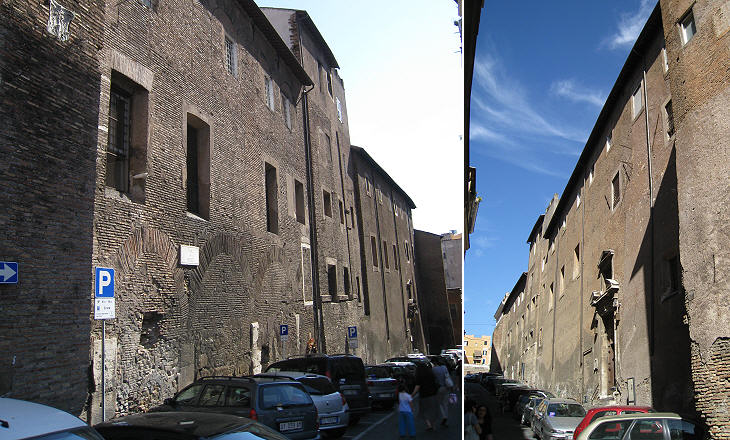
The view in June 2009: downhill (left) and uphill (right); the walled Roman capital which can be seen in the upper left corner of the first photo is shown in the image used as background for this page
Via in Selci and the severe looks of the nunnery make up one of the most interesting medieval sites of Rome; this because a large parallel modern street takes care of the traffic, but unfortunately cars are allowed to park alongside the old walls.
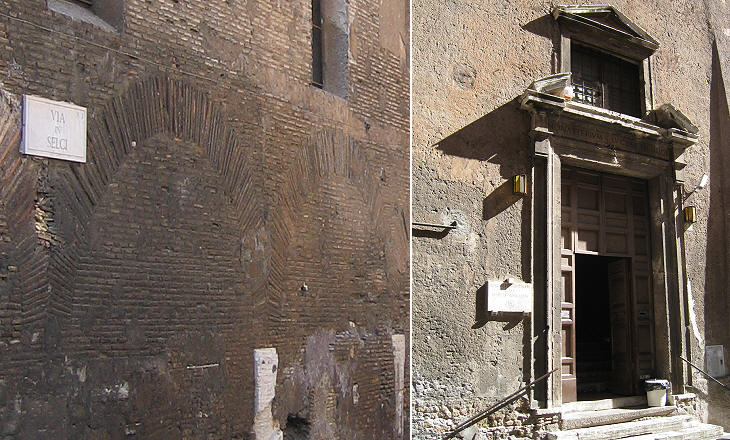
(left) Closed arches of the ancient Roman building; (right) entrance to the monastery
The nunnery was built on the site of Porticus Liviae, a square surrounded by porticoes built by Emperor Augustus
in 7 BC in honour of Livia, his third wife. The complex is shown in a fragment of Forma Urbis, a marble plan of Ancient Rome. The reference to in Selci most likely indicates that the street was paved with selci, large stones which could have been part of the ancient portico (see also Torre in Selci along Via Appia).
The closed arches near the entrance to the nunnery are part of a later building of
the IVth or Vth century which has not been identified with certainty: at a slightly later time the building became a diaconia, a Christian institution
caring for the poor and the sick. In the XIIIth century it was enlarged to house a Benedictine monastery and in 1568 it
was assigned to Augustinian nuns.
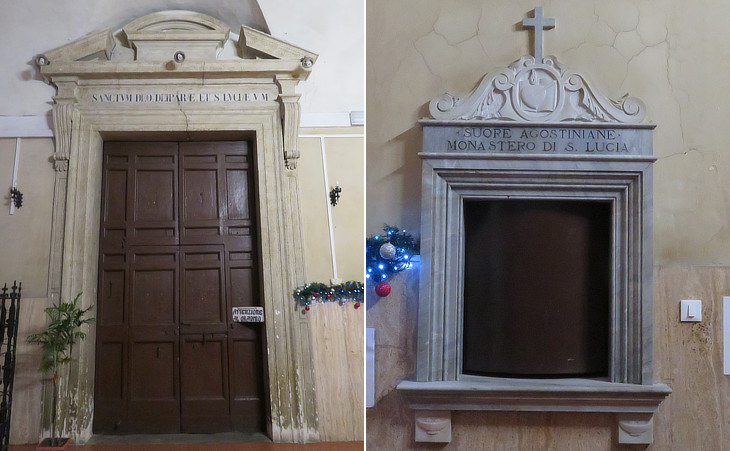
(left) Portal of the church which is dedicated also to the Virgin Mary by Carlo Maderno; (right) wheel of the nunnery which is still functioning
Both church and convent were remodeled by the nuns, the former after the design of Carlo Maderno; and the church has been recently put into excellent order by the nuns.
Rev. Jeremiah Donovan - Rome Ancient and Modern - 1843
S. Lucia in Selci was reserved to cloistered nuns who had contacts with the outside world only behind a grate and who could receive or hand over small packages (e.g. needlework) using a "wheel", a type of revolving till through which objects could be passed without any contact between the deliverers or recipients. Similar wheels allowed the safe and secret abandonment of babies at some hospitals or orphanages, e.g. at Spedale di S. Spirito.
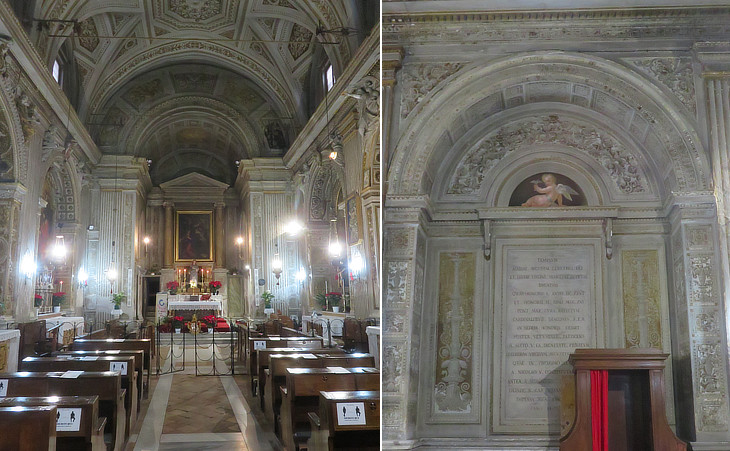
(left) Interior; (right) inscription summarizing the history of the site and an angel holding the eyes of St. Lucy
Rev. Donovan praised the nuns for having "recently put into excellent order" the church; he was referring to a partial redesign of the interior, in particular of the main altar, a work by Francesco Borromini, whom in the XIXth century was generally regarded as a poor taste architect.
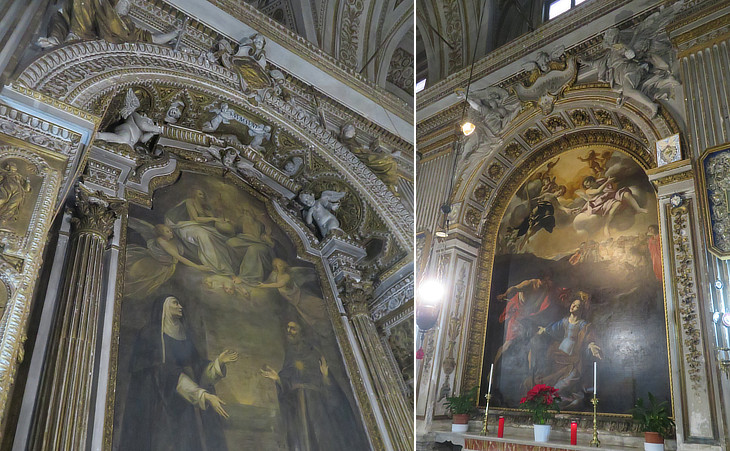
(left) Altar designed by Borromini with a painting by il Cavalier d'Arpino portraying the Holy Trinity with St. Monica and St. Augustine (her son); (right) The Martyrdom of St. Lucy by Giovanni Lanfranco (see the same subject by a pupil of Caravaggio)
Il Cavalier d'Arpino and Giovanni Lanfranco were among the most renowned painters of their time and the decoration of the altars is very rich. This was possible because some of the nuns came from noble families who provided them with a significant dowry when they joined the convent. The Tridentine Council in 1563 (Decretum de regularibus et monialibus), established, although not in an explicit manner, that each new nun should have a dowry.
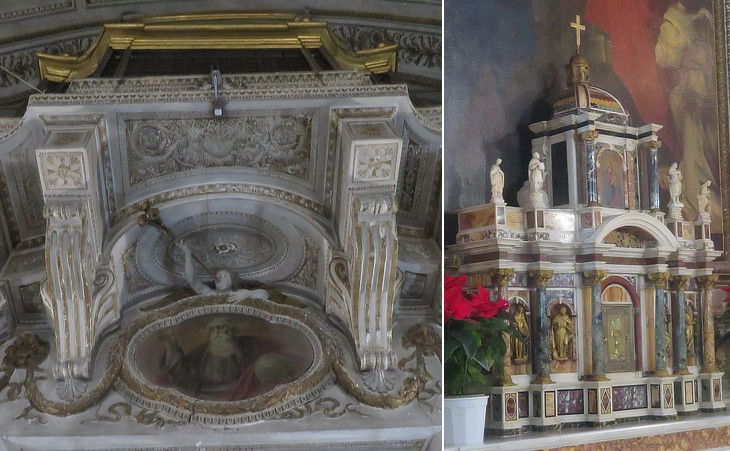
(left) Cantoria (see a page on this topic); (right) marble tabernacle
The cantoria is another joint work by il Cavalier d'Arpino and Borromini which testifies to the wealth of the nunnery together with the marble tabernacle with a painting and small statues of saints, perhaps a gift by a patron of the institution.
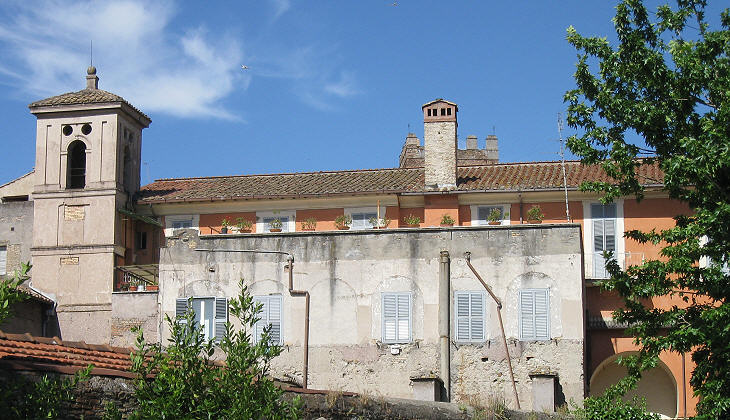
The nunnery seen from S. Maria della Purificazione and behind it the very top of Torre dei Capocci
The building is still a nunnery and notwithstanding the medieval appearance of its exterior it is a quite comfortable place in which to live.
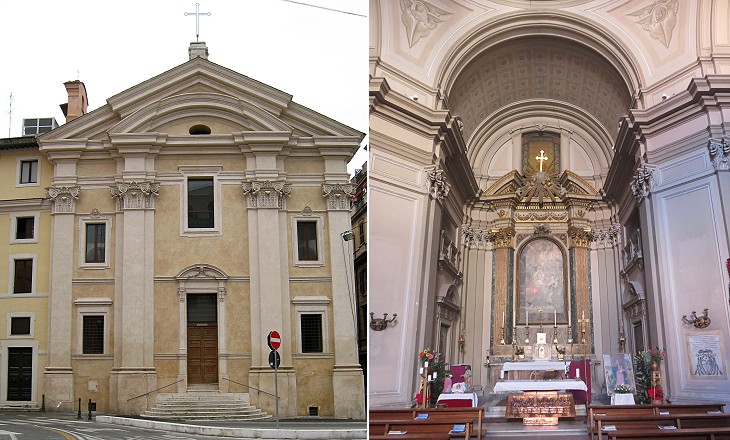
(left) Façade (today's level of the street is lower than it was in 1778); (right) interior
The plate shows (at the far right) Casa delle Suore Paolotte which housed nuns belonging to the order founded in 1453 by St. Francis of Paola (a church dedicated to this saint is not far away). When Vasi published this book in 1758 the nunnery was in the process of being completed and in 1770-1778 a church dedicated to Sts. Joachim and Anne was added to the complex.
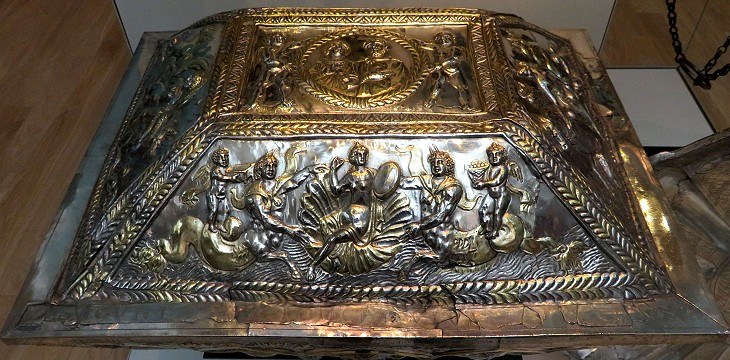
British Museum: silver casket of Projecta
In July, 1793, behind the choir of the nuns of S. Francesco di Paola (..) a room of a
private Roman house was discovered, and in a corner of it
a magnificent silver service, which had once belonged to
Projecta, wife of Turcius Asterius Secundus, who was prefect of the city in 362 A. D. (..) The objects were of pure silver, heavily
gilded, and weighed one thousand and twenty-nine ounces.
Besides plates and saucers, forks and spoons, candelabras
of various sizes and shapes, there was a wedding-casket with
bas-reliefs representing the bride and groom crowned with
wreaths of myrtle; she, with braids of hair encircling her
head many times, in the fashion of the age of the empress
Helena; he, with the beard cut square, in the style worn by
Julian the apostate, and Eugenius. The reliefs of the
body of the casket represented love-scenes, Venus and the
Nereids, the Muses and other pagan subjects; and just
under them was engraved the salutation:
"Secundus and Proiecta, may you live in Christ."
The casket was filled with toilet articles and jewels.
Rodolfo Lanciani - Pagan and Christian Rome - 1892
During the construction of the church a small treasure of silver and gold artefacts was found: they were part of the dowry of Projecta, a
Christian bride of the late IVth century; it is generally referred to as the Esquiline Treasure: a finely chiselled casket
is very interesting because its decoration is based on both Christian and pagan themes. You may wish to see a IVth century ivory casket at Brescia.
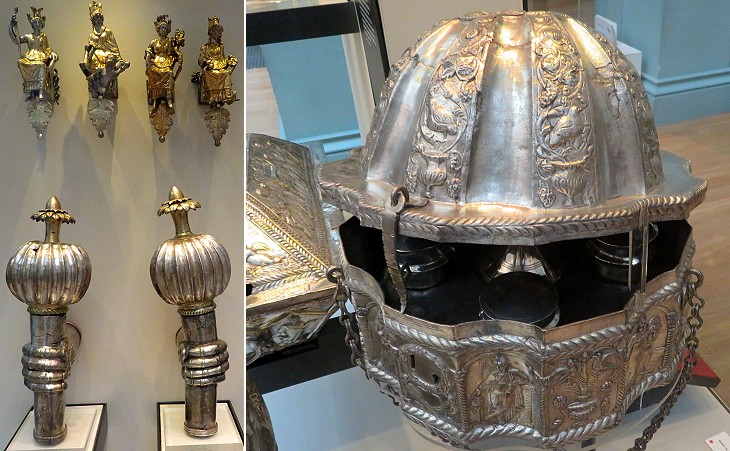
British Museum: other elements of the Esquiline Treasure
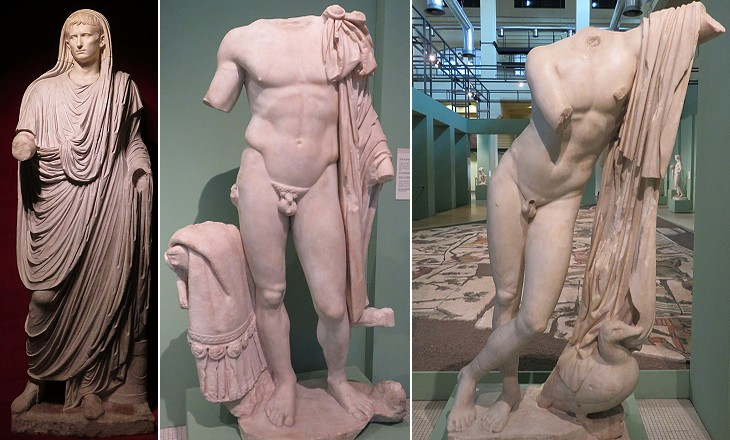
(left) Museo Nazionale Romano: statue of Emperor Augustus as Pontifex Maximus (see an enlargement and a similar one in the Borghese Collection); (centre) Centrale Montemartini: statue of a Roman general; (right) Centrale Montemartini: statue of Pothos, next to a goose, a symbol of Aphrodite
The statue of Augustus was discovered in 1910 not far from S. Lucia in Selci; it most likely stood in Porticus Liviae.
The emperor is portrayed as an aged man and while performing a religious ceremony in his capacity as Pontifex Maximus (High Priest). In many official portraits (e.g. in the statue found at Prima Porta) Augustus chose to be depicted as a military leader. In his last years he preferred to be represented as a pious man. Ara Pacis Augustae,
the altar built in 13 BC to celebrate the peace in the whole Empire, was decorated with a relief showing a religious procession, rather than with military trophies.
In 1940 excavations carried out near SS. Gioaccino ed Anna unearthed a IInd century AD domus (typical Roman house of the upper classes) where some fine statues were found.
That of Pothos is a copy of a lost statue by Skopas (IVth century BC). Pothos was one of the sons of Aphrodite and he symbolized the loving desire towards a distant person (see another statue of him at Viterbo).
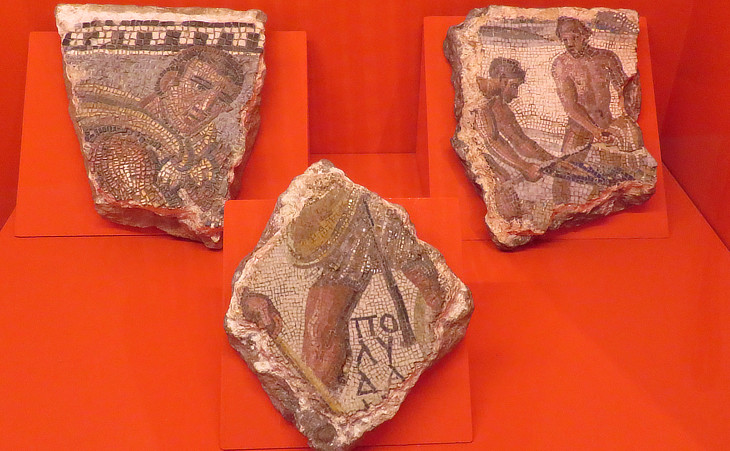
Centrale Montemartini: fragments of mosaics: (left) found in 1884 near S. Bibiana; (centre) found in 1888 near S. Lucia in Selci; (right) found in 1875 near SS. Pietro e Marcellino
Next plate in Book 8: Monastero delle Vergini.
Next step in Day 2 itinerary: Chiesa e Monastero della Purificazione.
Next step in your tour of Rione Monti: Chiesa e Monastero della Purificazione.
Excerpts from Giuseppe Vasi 1761 Itinerary related to this page:
Chiesa e Monastero di S. Lucia in SelciScendendo poco più in giù dalla divisata chiesa, evvi quella di s. Lucia, che anticamente dicevasi in Orphea, ed in oggi in Selci, a cui è unito un magnifico, ed antichissimo monastero, prima de' monaci Benedettini, poi de' Certosini, ed ora di religiose Agostiniane. Nella chiesa non vi è altro, che nel primo altare a destra la s. Titolare dipinta dal Lanfranchi, il s. Agostino dallo Speranza, il quale fece ancora il quadro d'incontro, e nell' ultimo evvi s. Monaca, del Cav. d'Arpino, il quale fece medesimamente il Dio Padre sopra la porta della chiesa. |


