
All images © by Roberto Piperno, owner of the domain. Write to romapip@quipo.it.


Notes:
Page revised in September 2024.
All images © by Roberto Piperno, owner of the domain. Write to romapip@quipo.it.
Notes:
Page revised in September 2024.
 Piazza di Macel de' Corvi
 Links to this page can be found in Book 2, Day 3 and Rione Monti.
The page covers:
The plate by Giuseppe Vasi
Today's view
Sepolcro di Caio Publicio Bibulo
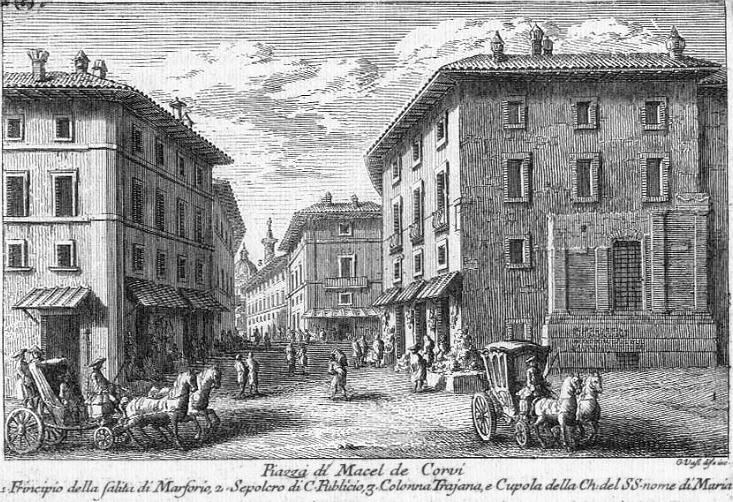
In 1752 Giuseppe Vasi included the slight widening of a street in his second book of etchings which was meant to show the "Main Squares with Obelisks, Columns and other Embellishments". Maybe he was puzzled by the name of the site and he wanted to show his erudition by reporting some of the explanations for it.
Macel de' Corvi literally means Slaughterhouse of the Ravens; according to Vasi, during the siege of Rome laid by the Gauls in 390 BC, a raven (Lat. corvus) helped a Roman warrior in a fight with a Gaul; in memory of his unexpected ally, the warrior added Corvinus to his name and he wanted to be portrayed in a statue with a raven on his helm in the location where the fight took place. The reference to the slaughterhouse was most likely due to the meat which was sold in the shops of this neighbourhood.
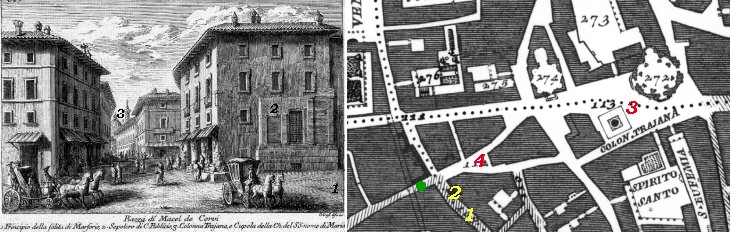
The view is taken from the green dot in the 1748 map here below. In the description below the plate Vasi made reference to: 1) Salita di Marforio. This street linked Piazza Venezia with the top of Campidoglio; Marforio, a talking statue, stood there until 1595 when it was moved to Piazza del Campidoglio; 2) Tomb of Caio Publicio Bibulo; 3) Colonna Trajana and Dome of SS. Nome di Maria.
3) is shown in more detail in another page. The small map shows also 4) Piazza di Macel de' Corvi. The dotted line in the small map
delineates the borders between Rione Pigna (upper left quarter), Rione Trevi (upper right quarter),
Rione Campitelli (lower left quarter) and Rione Monti (lower right quarter).
The view in August 2008
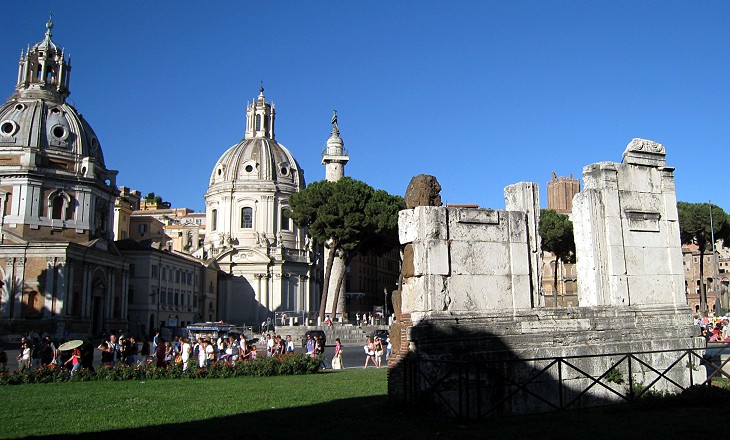
Macel de' Corvi does not exist any longer and now Colonna Trajana and SS. Nome di Maria are in full view. The construction of Monumento a Vittorio Emanuele II (late XIXth century) and the opening of Via dei Fori Imperiali, a large avenue leading to Colosseo (1932) required a toll to be paid and this neighbourhood which did not have famous churches and palaces was completely pulled down, with the sole exception of the tomb of Caio Publicio Bibulo.
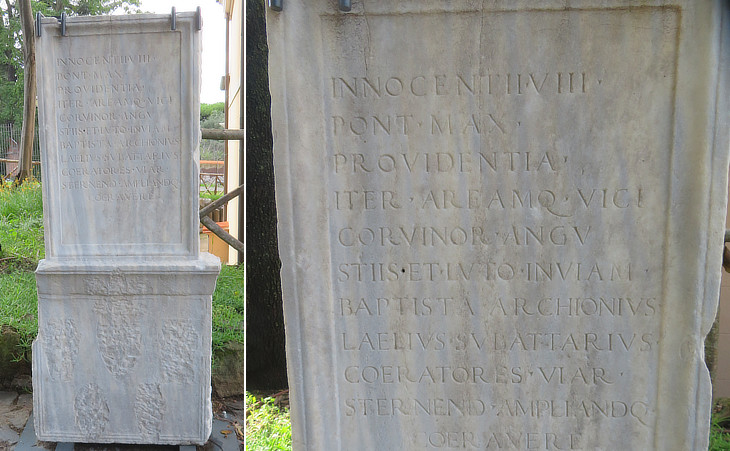
Parco Archeologico del Celio: inscription from Piazza Macel de' Corvi
The neighbourhood of Macel de' Corvi was developed in the second half of the XVth century. In 1489 Pope Innocent VIII approved the cleaning and enlargement of the square and of the street leading to Piazza della Colonna Traiana. His coat of arms and those of the curatores viarum, the magistrates in charge of the maintenance of the streets, were erased from the inscription celebrating this accomplishment, most likely during the French occupation of Rome. Michelangelo lived and died in a house near Piazza di Macel de'Corvi, because he preferred to stay away from the Papal court.
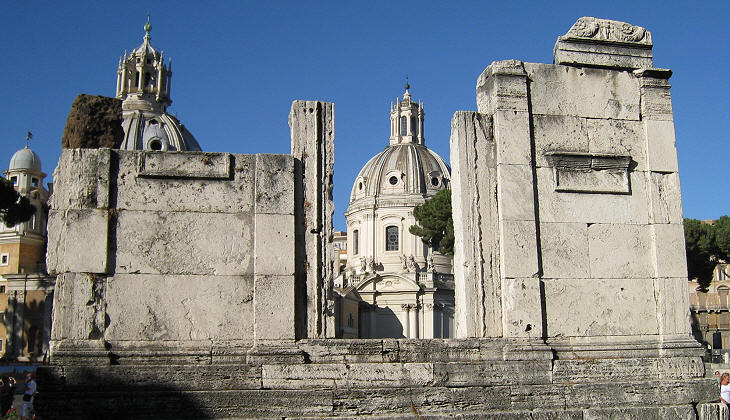
Remaining side of the tomb of Caio Publicio Bibulo; it is thought that what today seems a window was originally a niche housing a statue of Bibulo
Ancient Romans were not allowed to be buried inside the walls and the tomb of Caio Publicio Bibulo seems to contradict this statement, yet when the monument was erected (Ist century BC), the area at the foot of Campidoglio was not included in the pomerium, the sacred boundary of the City of Rome. It probably stood outside Porta Fontinalis, a lost Roman gate at the end of Clivus Argentarius, probably near the shop of C. Julius Helius, a shoemaker who is mentioned in a very interesting stela.
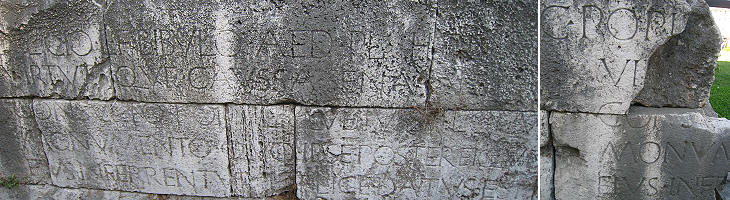
(left) Inscription in the lower part of the remaining (southern) side of the tomb; (right) fragment of the same inscription on the eastern side of the tomb
The inscription:
says that the monument was paid for by the Senate in recognition of the services provided by Caio Publicio Bibulo; in the lack of other historic references to him, the decision by the Senate is rather puzzling because "Aedile of the People", the only office held by Caio Publicio Bibulo, was a minor one in the political structure of the Roman Republic. The inscription was repeated on all four sides of the monument, the use of which was granted to Bibulo's heirs forever.
The image used as background for this page is based on a 1756 etching by Giovan Battista Piranesi.
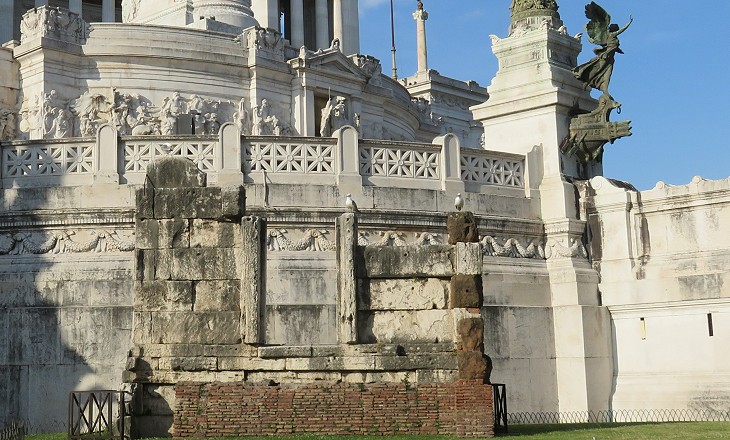
Northern side of the tomb and behind it the lower part of Monumento a Vittorio Emanuele II
Next plate in Book 2: Piazza alli Monti.
Next step in Day 3 itinerary: Chiesa e Monastero dello Spirito Santo.
Next step in your tour of Rione Monti: Chiesa e Monastero dello Spirito Santo.
Excerpts from Giuseppe Vasi 1761 Itinerary related to this page:
Macel de' CorviQuì sebbene non vi sia, che una piccolissima piazza, con tutto ciò evvi un abbondante mercato di tutte le sorte di viveri. E' notabile il sepolcro di Cajo Publicio, che si vede nell'angolo della salita, che dicesi di Marforio, con una antica iscrizione, che resta quasi perduta. |


