
All images © by Roberto Piperno, owner of the domain. Write to romapip@quipo.it.


Notes:
Page revised in April 2026.
All images © by Roberto Piperno, owner of the domain. Write to romapip@quipo.it.
Notes:
Page revised in April 2026.
 Spedale di S. Spirito in Sassia
Links to this page can be found in Book 9, Map D2, Day 8, View D3 and Rione Borgo.
The page covers:
The plate by Giuseppe Vasi
Today's view
Spedale di S. Spirito in Sassia
- Ruota degli Esposti (Orphanage)
Palazzo del Commendatore
- Biblioteca Lancisiana
S. Spirito in Sassia
S. Lorenzo in Borgo

When in 1759 Giuseppe Vasi published this etching, Spedale di S. Spirito, the main hospital of Rome, had been recently enlarged by Pope Benedict XIV with the addition of a new long ward (Braccio Nuovo) having the same design as that built in 1478 by Pope Sixtus IV (Braccio Vecchio aka Corsia Sistina). The two wards formed a very long front which Vasi accurately depicted with the analytical approach of an architect, rather than that of a painter.

Ward added by Pope Benedict XIV in a painting at the Vatican Library; the Pope in addition to building a new ward, asked Ferdinando Fuga to redesign the cemetery of the hospital
The view is taken from the green dot in the 1748 map below. In the description below the plate Vasi made reference to: 1) Palazzo del Commendatore; 2) Braccio Vecchio; 3) Braccio Nuovo; 4) dome of the chapel inside Braccio Vecchio. The map shows also: 5) Church of S. Spirito in Sassia; 6) S. Lorenzo in Borgo; 7) Spedale de' Pazzi (madhouse).


The view in June 2010
In the 1880s, in the frame of a general redesign of the River Tiber bed, high walls were built on its banks to prevent the occurrence of floods; Braccio Nuovo was pulled down and today's view shows in its place the trees of a small modern square at the western end of Ponte Vittorio Emanuele II.
Spedale de' Pazzi was added to Spedale di S. Spirito in 1725 by
Pope Benedict XIII who relocated there the lunatics who were previously housed in a building near
SS. Bartolomeo ed Alessandro; some of its former premises are shown in the page covering Porta S. Spirito, but most of it was demolished.

Reconstructed XVth century façade of Corsia Sistina
Corsia Sistina consisted of a very long rectangular hall (130x13 yd) having at its centre an octagonal dome; it had a façade at the eastern end of the hall which was reconstructed in 1938 based on a fresco in the interior of the building. On that occasion a long series of rooms which had been built above its portico were demolished and the windows were redesigned.

Northern side of Corsia Sistina along Borgo S. Spirito
Having thus seen the Vatican
Pallace, I went on with the rest of
the curiosities of the town. Hence going from S. Peter I came presently to the Hospital of Santo Spirito which is hard by. The situation of this Hospital near to
S. Peters Church, was not done
casually but without doubt, upon
design and for this end, that men
might learn by the very situation
of Hospitals near unto great
Churches, as observed in many
other places both in Italy (e.g. Siena and Pisa), and
France (e.g. Carpentras) that Christians after they
have performed their duties to God,
ought to pay in the next place their
duties to their neighbour and let
that faith, which they came from
exercising in the Church towards
God, be made appear by good
works, exercised presently in Hospitals toward men.
Richard Lassels' The Voyage of Italy, or a Compleat Journey through Italy in ca 1668
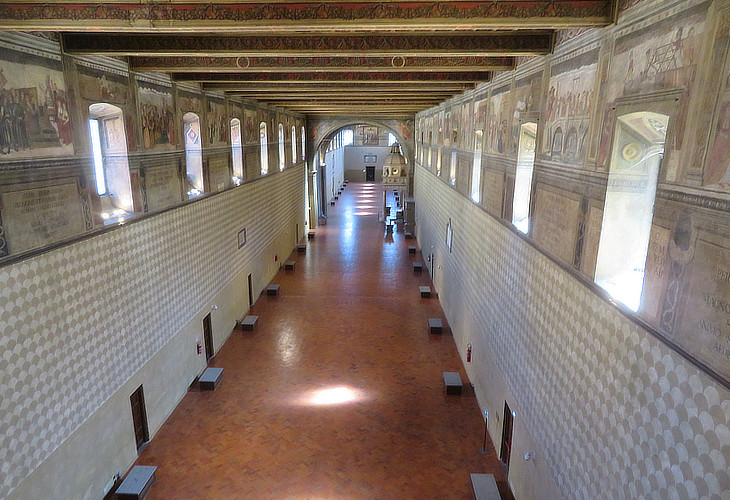
Corsia Sistina from a small opening at its western end inside Libreria Lancisiana
Hence, we went to see Dr. Gibbs (James Alban Ghibbes 1611-1677 *), a famous poet and
countryman of ours, who had some intendency in an
Hospital (..), which he showed us. The Infirmatory, where
the sick lay, was paved with various coloured marbles, and
the walls hung with noble pieces; the beds are very fair;
in the middle is a stately cupola, under which is an altar decked with divers marble statues, all in sight of the sick,
who may both see and hear mass, as they lie in their beds. The organs are very fine, and frequently played on to
recreate the people in pain.
John Evelyn's Diary and Correspondence - 1644-1645
* In 1644 he settled at Rome, where Evelyn visited him in that year and was shown by him over a hospital and orphanage of which he was physician. Evelyn spells his name Gibbs, but the latter had inserted h in it, apparently for the sake of pronunciation, and Italianised it into Ghibbesio. He passed the remainder of his life at Rome.

(left) Portal built by Pope Alexander VII and attributed to Gian Lorenzo Bernini; (right) tiburio (octagonal lantern tower) the design of which is attributed to Baccio Pontelli, an architect who often worked for Cardinal Giuliano della Rovere, nephew of Pope Sixtus IV
It is the oldest as well as the most extensive hospital in Rome, and is open to all sick male persons without distinction of age, country or creed, and without recommendation of any sort. It is situate between S. Peter's and the Tiber, and occupies the site of the hospitium called Schola Saxonum built by king Ina, in 717, for the reception of Anglo-Saxon pilgrims, and totally destroyed in the celebrated conflagration of the Borgo in 847.
Rev. Jeremiah Donovan - Rome Ancient and Modern - 1843
Sassia is a reference to Saxons because on this site was located Schola Saxonum,
a hostel for (Anglo-)Saxon pilgrims which according to tradition was founded by King Ine of Wessex who travelled to Rome to increase his chances of being welcomed in heaven. The hostel was rebuilt by Pope Leo IV after it had been destroyed by the Saracens and in 856 it was visited by King Ethelwulf of Wessex; after the 1066 Norman conquest of England the arrival of pilgrims greatly diminished and so did the donations for its maintenance; the hostel fell into abandonment.
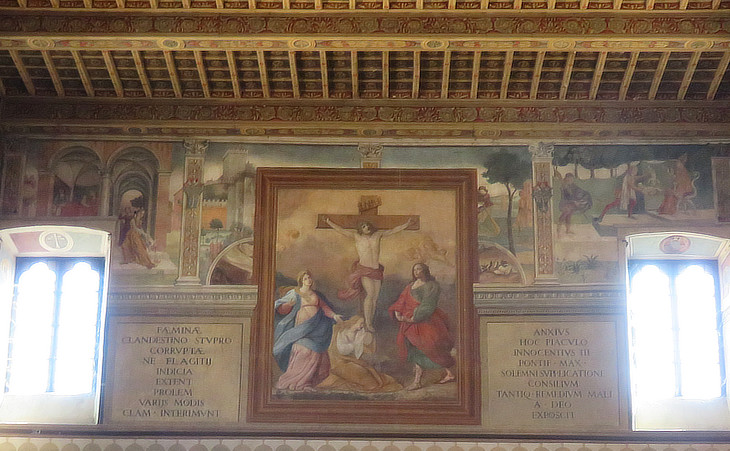
Corsia Sistina - eastern end: first three frescoes (of a series of 46) depicting the foundation of the hospital/orphanage which are partially covered by a 1750 Crucifixion and by the opening of windows; the frescoes were executed by several painters including Melozzo da Forlì, Antonio del Massaro, Antoniazzo Romano and Lorenzo da Viterbo
The hospital was founded by Innocent III. raised to the Pontificate in 1198, who placed it under the superintendance of Guido of Montpellier and his hospitallers of the Order of the H. Ghost; and that circumstance coupled with its locality gave to the establishment the name of S. Spirito in Saxia. To enlist the laity in its service the same Pontiff instituted the Confraternity of S. Spirito, which is the first on record in Rome. Donovan
The inscription below the first fresco says: "Faeminae clandestino stupro corruptae ne flagitij indicia extent prolem varijs modis clam interimunt" and the fresco portrays women of ill fame killing their own babies and disposing of their corpses. The second fresco depicted some fishermen showing Pope Innocent III the corpses they had found in the Tiber (this scene appears also in a fresco at Sala del Commendatore). In the third fresco the Pope decides to build the horphanage/hospital. He was granted permission by King John Lackland to build it on the site of the former hostel; the new institution was placed under the protection of the Holy Spirit and the management of Guy de Montpellier, a Templar Knight who designed the double cross which is the emblem of the hospital.
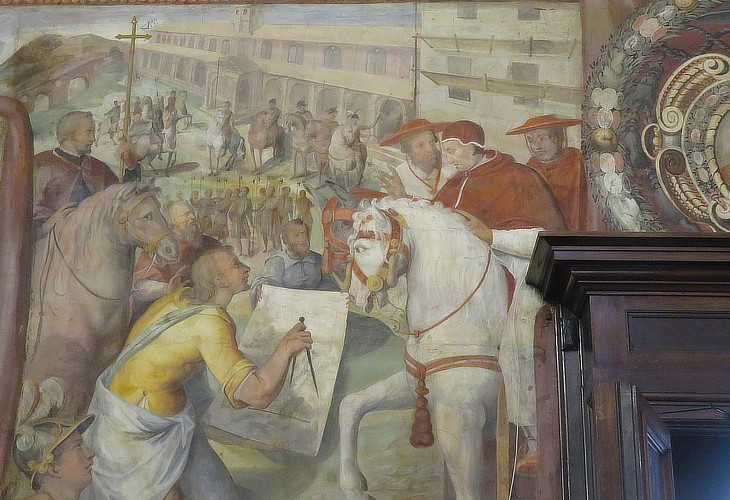
Sala del Commendatore: Pope Sixtus IV is shown the plan of the Spedale by Baccio Pontelli by Jacopo and Francesco Zucchi (1575-1582); the hospital can be seen as it was at that time whereas Palazzo del Commendatore is under construction
Spedale di S. Spirito knew a period of great development during the whole XIIIth century, but it declined after the move of the papal residence to Avignon. In 1409, during the Great Schism, it was turned into a fortified site by one of the factions which competed for supremacy in Rome; the patients were all killed.
In 1446 Pope Eugenius IV reorganized the hospital and its governance by establishing that the prior in charge of the institution should be chosen among the prelates of the papal court.
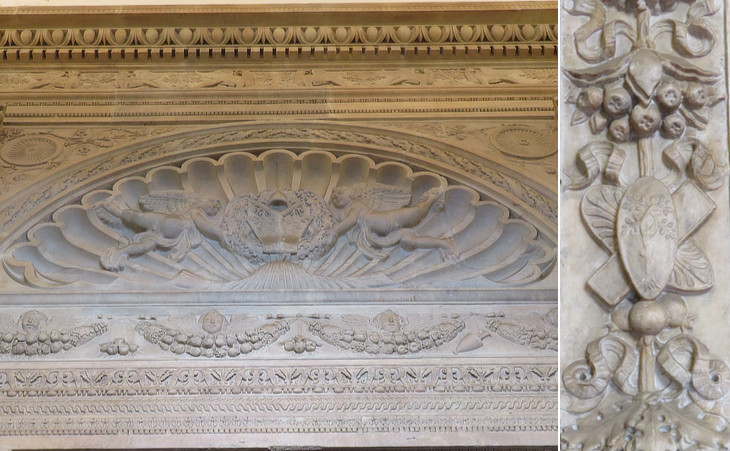
Portal of Pope Sixtus IV and a detail showing his heraldic symbol (an oak with intertwined branches) which is also shown in the image used as background for this page, by Baccio Pontelli or by one of his assistants
The existing edifices were however erected by succeeding Pontiffs. Its great ward was built hy order of Sixtus IV., in the XV. century, from the designs of Baccio Pontelli. The hospital was also enlarged by Gregory XIII. and Alexander VII.; and Benedict XIV. added its anatomical theatre or dissection-room and the wing towards the ponte S. Angelo. Donovan
In 1470 a fire damaged the hospital; Pope Sixtus IV realized that the old structure was more appropriate to a jail, than to a place where the sick could recover their health and he decided to build a brand new complex; the new hospital was completed in 1478.
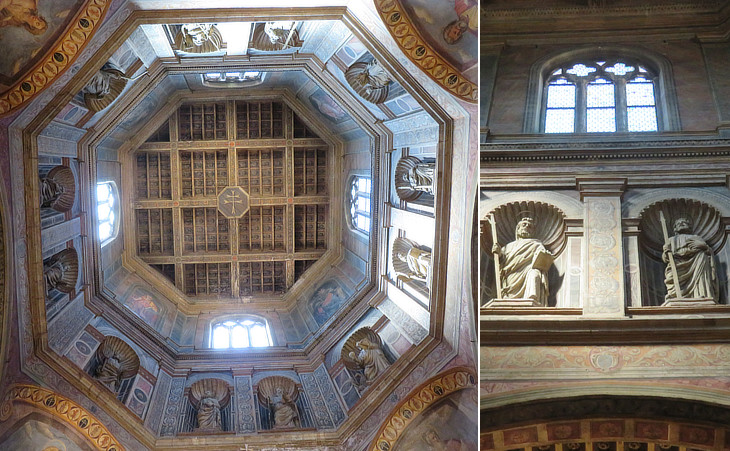
(left) Interior of the tiburio and ceiling with the symbol of the hospital; (right) stucco statues of the Apostles
The large octagonal tiburio serves as the central architectural element that divides Corsia Sistina into two wings, creating a visual connection with the surrounding structure through four supporting arches (see a page on the domes of Rome). The tiburio is illuminated in its upper section by large three-light windows, between which Solomon and various biblical figures are depicted. In the lower section, stucco statues of the apostles are placed inside shell-shaped niches. The internal architecture of the tiburio is attributed to Giovanni de' Gherarducci, who, with Andrea Bregno, assisted Pontelli in the design of the building.

(left) Altar attributed to Andrea Palladio at the centre of Corsia Sistina; (right) altar-piece by Carlo Maratta, late XVIIth century, the leading painter of his time
Among
all the masters of Vicenza he who most deserves to be extolled is the
architect Andrea Palladio, from his being a man of singular judgment
and brain, as many works demonstrate that were executed by him in his
native country and elsewhere. (..) But, since there is soon to come into the light of day a
work of Palladio, in which will be printed two books of ancient
edifices and one book of those that he himself has caused to be built,
I shall say nothing more of him, because this will be enough to make
him known as the excellent architect that he is held to be by all who
see his beautiful works; besides which, being still young and
attending constantly to the studies of his art, every day greater
things may be expected of him.
Giorgio Vasari - Lives of the Most Eminent Painters, Sculptors and Architects - Transl. G. De Vere
Its altar, added by Palladio, is the only specimen in Rome of Palladian architecture. The altar-piece, representing Job covered with ulcers, is by Carlo Maratta. Donovan
In 1570 Andrea Palladio published The Four Books of Architecture, a treatise illustrated with woodcuts which celebrated the purity and simplicity of classical architecture. It inspired many other architects in Italy and abroad, especially in the XVIIIth century. The appellation of Palladio was given to him by a friend and patron as a reference to Athena Pallas.
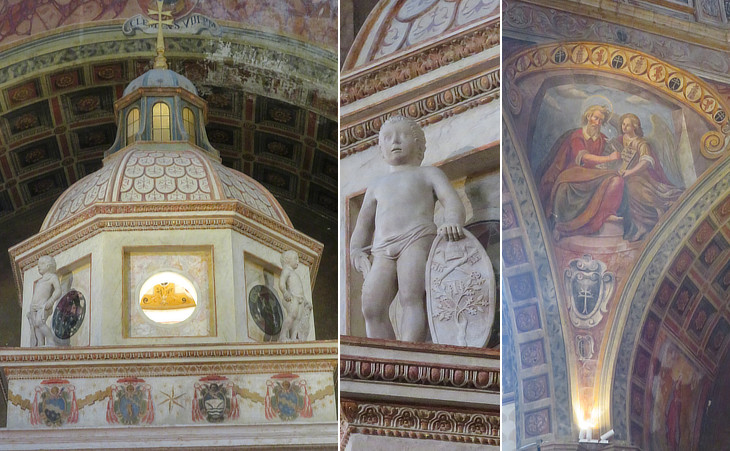
(left) Dome of the altar; (centre) a child holding the coat of arms of Pope Sixtus IV; (right) St. Matthew, one of the four frescoes portraying the Evangelists in the pendentives of the tiburio
Initially the altar was placed along the southern wall of the tiburio, but in the XVIIth century Alexander VII built an enlargement of the hospital which was accessed through a door in that wall and the canopy was moved at the centre of the tiburio. Its design was influenced by Tempietto del Bramante, rather than by an ancient temple.
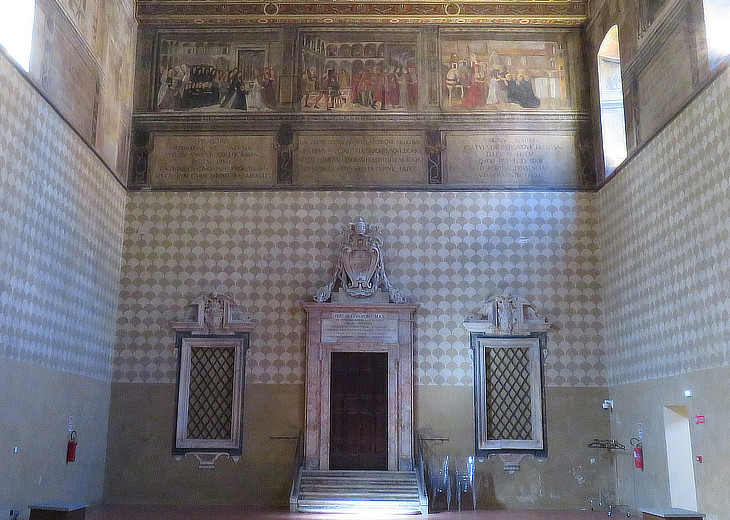
Corsia Sistina: western end with a coat of arms and inscription celebrating Pope Pius VI; the opening from which doctors could monitor what went on in the ward from Biblioteca Lancisiana is concealed between the first and the second fresco
Although principally a fever-hospital, the establishment admits surgical patients; and although possessing occasional accommodation for 2000, its nine medical and surgical departments are ordinarily confined to 1616 beds, which are principally occupied by the peasants and coast-guards from the Campagna. The convalescents are transferred to the Trinita de' Pellegrini: those who die remain two hours in their beds after they have expired , and are then removed to the mortuary chamber, where they remain for twenty-four hours, and whence, after the expiration of that time, they are conveyed with decent ceremony to the cemetery on the Janiculum by a lay confraternity, who visit the hospital every evening after the Ave Maria to devote their gratuitous services to that work of humanity and religion. Donovan
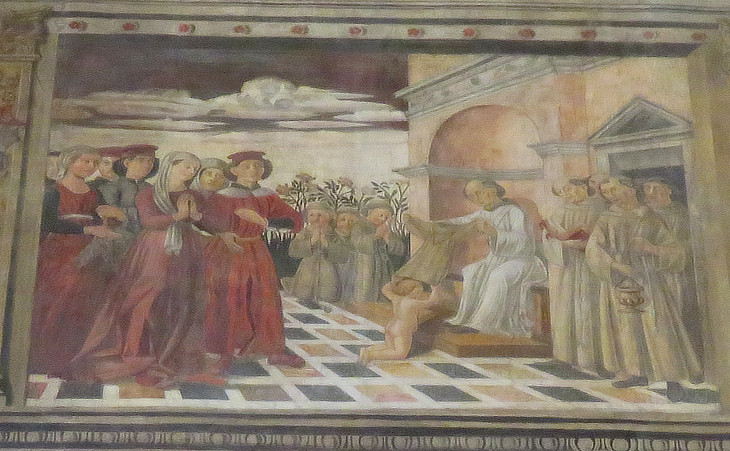
Frescoes at the top of Corsia Sistina: Sixtus IV enters the Franciscan order at the age of nine; he was one of the most important Franciscan Popes
The election of Cardinal Francesco della Rovere caused great joy throughout Rome, because the well-known piety and holiness of his life led all to hope that he would be an excellent Pastor for the Church and for the Christian Faith everywhere. (..) In consequence of his repeated sicknesses, Francesco's pious mother consecrated him by vow to St. Francis; and, in spite of the opposition of some worldly-minded relations, entrusted him, when nine years of age, to the care of the Minorite, Giovanni Pinarolo. Under the guidance of this excellent religious, the gifted boy learned to know and esteem the monastic life to which he was destined to devote himself. (..) The magnificent scale on which the reconstruction of this Hospital was carried out, (..) is an abiding memorial of the benevolence of Sixtus IV. Much pains were bestowed on the decoration of the interior; the spacious and airy hall for the sick was ornamented with frescoes as far as the tops of the windows, and above them with a broad frieze of pictures arranged in panels. Attention has recently been directed to these half-faded paintings, which are of the ancient Umbrian type. They portray the foundation of the Hospital by Innocent III., and, in a very attractive form, the life of Sixtus IV. from his birth. The inscriptions under them are from the pen of Bartolomeo Platina.
Ludwig von Pastor - History of the Popes - 1891
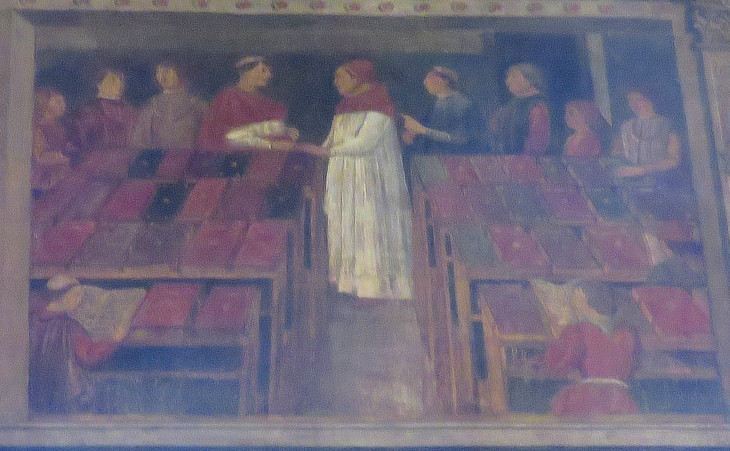
Frescoes at the top of Corsia Sistina: Sixtus IV promotes the enlargement and the reorganisation of the Vatican Library; you may wish to see Bartolomeo Platina (on his knees) and Pope Sixtus IV with his nephews in a famous painting by Melozzo da Forlì (it opens in another window), a detail of which can be seen in the icon of "Abridged History of Rome" at the end of this page
Now this Hospital of San Spirito, is one of the fairest in Europe both for bigness, and revenues. It hath a thousand beds in it for the sick: a Prelate to govern it; Priests, Physicians, and under Officers to attend on them, and a revenue of seventy thousand crowns a year. In the appartiments above stairs there is handsome accomodation for poor gentlemen, founded by the gentleman like charity of Pope Urban the VIII, to this end, that those whom fortune had priviledged by better birth might not be involved in common miseries. Lassels

Museo di Roma a Palazzo Braschi: St. Camillus de Lellis (canonized in 1746) helps saving the patients of the hospital during the 1598 flood by Pierre Subleyras
The hospital was pillaged by the troops of Emperor Charles V during the 1527 Sack of Rome
and it was flooded in 1598. These mishaps did not interrupt its enlargement with new wards and other facilities which eventually created a sort of small town having a triangular shape between the Tiber, the Janiculum and Borgo S. Spirito (see the entrances to these enlargements along Via dei Penitenzieri).
Modern facilities for Spedale di S. Spirito were built in 1928 on the side towards the river.
Corsia Sistina continued to be used as a ward hospital until the 1980s.

(left) Entrance to the ward added by Pope Alexander VII (today it houses Museo Storico Nazionale dell'Arte Sanitaria); (right) coat of arms of Pope Alexander VII on the portal designed by Bernini
Every day is divided into four watches: each large ward forms two divisions: over each ward are a student of medicine, two chaplains and a confessor; and over each division are another student, two infirmarians, a waterman and a common servant. To assist the memory of the medicinal men and attendants tablets are suspended from the wall between the beds, indicating by conventional signs the state and treatment of the invalid, his diet, whether he has received or is to receive the last sacraments etc. The hospital is cleansed four times a day! the floors are washed once a month; and the bedding and linen are changed without limitation. In spring, when the number of patients is comparatively small, the boards of the bedsteads are washed; the tables varnished; and the walls whitewashed. Through the whole length of the great wards runs a stream of pure water beneath the floor, to which is consigned all the uncleanness of the establishment, which is thus swept at once into the Tiber. (..) The spiritual attendance of the sick is confided to twelve chaplains and confessors, who celebrate Mass every morning in the different wards, administer the Sacraments, and assist the dying; and all the monastic communities in Rome are moreover obliged to send in turn, once a month, two priests of the Order, to hear confessions for five hours in the day. Donovan

Coat of arms of Pope Pius VI before and after being cleaned
Pope Pius VI placed a colossal coat of arms at the entrance of a new section he added (today it is in a courtyard); the comparison between the coat of arms before and after restoration is the icon of a page illustrating the changes which have occurred in
Rome in recent years; you can learn more about the initiatives of Pope Pius VI
in a page on his heraldic symbols. Incidentally he authorized the removal of some ancient columns from a courtyard of the hospital to embellish his family palace.
January 1787. In the great Lazaretto of San Spirito there has been prepared for the use of the artists a very fine anatomical figure,
displaying the whole muscular system. Its beauty is really amazing. It might pass for some flayed demigod, even a
Marsyas (it opens in another window). Thus, after the example of the ancients, men here study
the human skeleton, not merely as an artistically arranged
series of bones, but rather for the sake of the ligaments with
which life and motion are carried on.
J. W. Goethe - Italian Journey (during the pontificate of Pope Pius VI) - Translation by Charles Nisbet.

(left) Aedicule containing the revolving cupboard (you may wish to see a similar one at Spedale degli Innocenti in Florence); (right) alms-box
Here are also those children (..) which are called Expositi, that is immediately after their birth laid forth in the night by some frend in a place of the Hospital for that purpose, where they are found ordinarily in the morning and received as their owne children: these are such as the parents are either ashamed of as begotten in fornication, or not able to keepe them, and therfore but for this provision they should perish: wheras now whatsoever become of their lewd parents, which are not knowen, they are here brought up.
Gregory Martin - Roma Sancta - ca 1575
To this joins an apartment
destined for the orphans; and there is a school: the
children wear blue, like ours in London, at an hospital of
the same appellation. Here are forty nurses, who give
suck to such children as are accidentally found exposed and
abandoned. Evelyn
There is also a grate towards the street, where little Infants are
put into a square hole of a Turn, and so turned in by Night by their unlawful Mothers, who not
daring to own them, would otherwise dare to destroy them. (..) The person that brings the Child in the Night rings a little Bell,
whose Rope hangs at the outside of that grate, and an Officer within comes presently and receiveth it; and having first asked whether it be baptiz'd or no, carrieth it presently away, and recommends 'it to a Nurse. Lassels
To avoid the evils of infanticide or exposure, and to spare maternal delicacy, near the entrance of the edifice is placed a ruota or cylinder, which turns on a pivot, and in which the infant may be laid at any hour, and, upon ringing a bell, is received without enquiry by the person stationed in the lodge. Donovan
A revolving cupboard placed near
the entrance to the hospital allowed the safe and secret abandonment of babies; wet nurses were ready to take care of them; the cross of the institution was marked on their left foot.
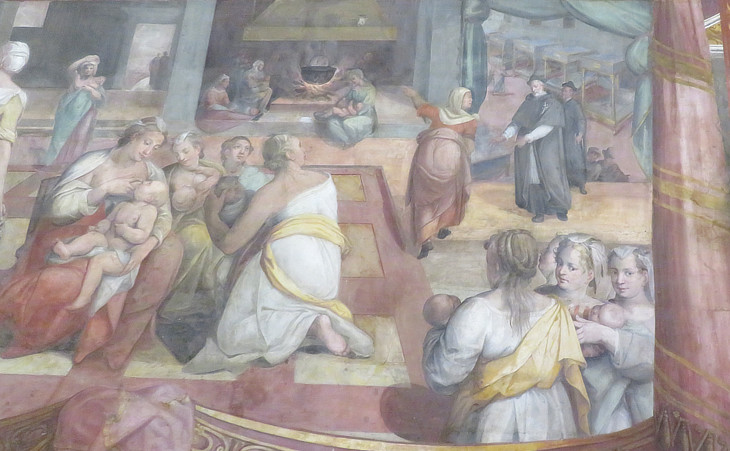
Sala del Commendatore: Activities of the orphanage by Jacopo and Francesco Zucchi (you may wish to see similar depictions at Spedale di S. Maria della Scala in Siena)
Should the parent be disposed to recognise its offspring at a future period, any intimation to that effect is carefully registered and the infant is consigned to a resident or country nurse. The resident nurses occupy three rooms with fifty beds each; and to each bed are annexed two cradles. The healthy infants are placed in two of the rooms; the unhealthy in the other. The foundlings received annually average 834: the mortality among them is immense, being more than 72 per cent, owing, in part, to their previous ill treatment, many of them being brought from all parts of the States, and some even from the kingdom of Naples. There are however 3 foundling hospitals altogether in the Pope's dominions (see one at Narni) which receive on an average 3000 children annually, all of whom are not illegitimate; and they average to the population as 1 to 841. The nurses on the establishment are paid two scudj. and 40 bajochs per month, besides good diet and lodging: the country wet nurses receive a scudo a month for the first fourteen months, which are called il baliatico a latte (milk), after which commences the baliatico a pane (bread) which lasts to the age of twelve for the boys, and of ten for the girls, during which the nurses are paid six pauls a month for the first six months and four for the remainder, besides thirteen pauls a year for clothing. Donovan
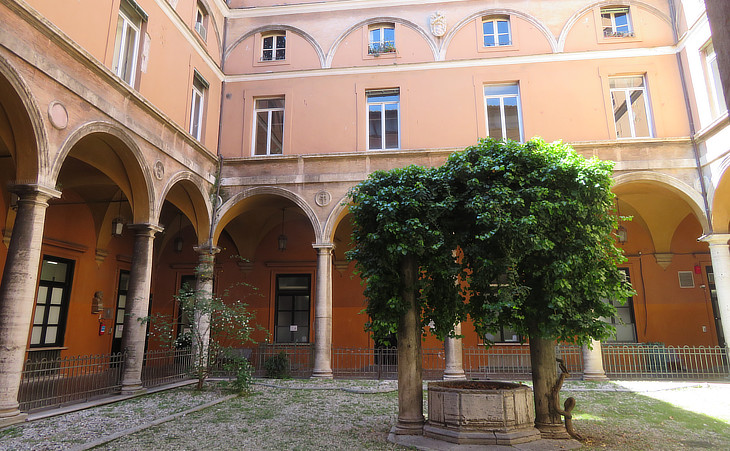
Cortile del pozzo (well) inside Conservatorio di S. Tecla which was mainly built by Pope Alexander VII
In another quarter, are children of a bigger
growth, 450 in number, who are taught letters. In another,
500 girls, under the tuition of divers religious matrons, in a monastery, as it were, by itself. I was assured there were
at least 2000 more maintained in other places. Evelyn
There is also a monastery of women
in it, in a place separated from
the rest, capable of 500 young girls. When
the children are grown fit for instruction, they are let to trades. The girls are carefully brought up by
religious women there, till they be fit for marriage or a Nunnery, according to their vocation. Lassels
The males who return from the nurses are sent to an orphan-house in Viterbo, where they are brought up to some useful trade, and dismissed at the age of twenty-one with two scudj each. The females are placed in a spacious conservatory, adjoining the hospital, in which they amount to nearly 600, and are employed in making, mending and washing for the whole establishment of S. Spirito, in various sorts of needle work, embroidery etc,; and each of them, is entitled to a dowry of 100 scudi. Donovan
In Florence left babies were given the Innocenti surname or a similar one; in Rome they were more commonly called Esposti; the first name was often that of the saint of the day on which they were found.
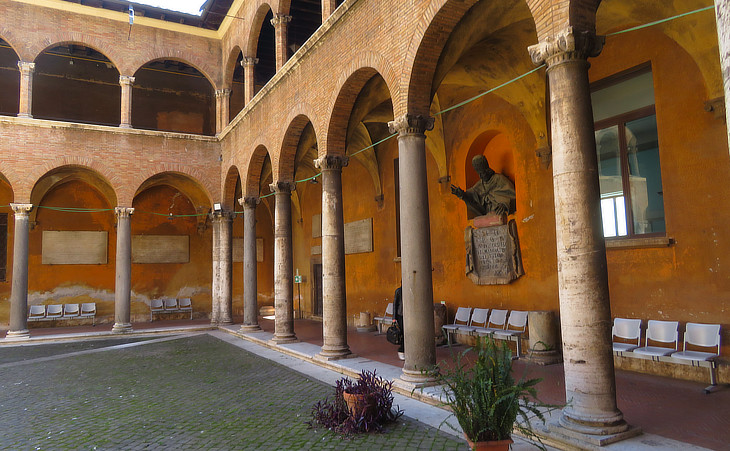
Courtyard of the friars with a 1739 bronze statue of Pope Clement XII, another benefactor of the institution
I was told a pleasant Story at Rome upon the Occasion of a Marriage out of one of these Places, and by a Party concern'd,, at least as he pretended. The Gentleman had had a ManServant, who had quitted his Service, and gone into the Country: After some time spent there, he bethought himself of Marriage and came to Rome on a Day when the Damsels were let forth of view in one of the Hospitals; I think 'twas that of S. Spirito. The Man comes to his old Master, and tells him he had a mind of a Wife, and was come to look out for one among the Girls in that Hospital; and having a great Opinion of his Master's judgment, desir'd he would go along with him, and assist him in the Choice of one: The Master would have excus'd himself, that none could choose so well for another as any Man might do for himself - every one to his own Gout. The Servant still importun'd and the Master at last consents. Away they went to the Hospital; and the Master was not long e'er he pitch'd upon one, and propos'd her to Johns Approbation. If you like her. Sir, I shall, so the Master was soon struck up,- for those Lasses don't stand much upon Courtship. As soon as the Knot was tied, the Master thought his Affair was over, wish'd 'em Joy, and was for taking his Leave. But John had another Favour to ask, which was, that his Master would be so good as to take the Bride home with him for a Day or two for that he must now go about, to look for some Goods to set up House withal; and he had no Place to bring his Sposa to in the meantime. Why, John, says the Master, I would do you all the Kindness I can: and your Spouse shall be welcome: But, what must we do a-nights? for I have got but one Bed. John submitted that Matter to his Wisdom, and did not doubt but he would some way or other contrive it very well. And so (said the Author of my Story) we did. In a Day or two John had made all his Purchases; came and fetch'd away his Spouse, and thank'd his Master for the good Offices he had done him.
Eduard Wright - Some Observations made in Travelling through France, Italy &c. - 1730.
We saw the ceremony at the Minerva, where his Holiness was carried on a magnificent
chair decorated with a figure of the Holy Ghost. (..) There was a procession of Roman girls who had received dowries from a public foundation, some to be married and others to become nuns. They marched in separate groups, the nuns coming last and wearing crowns. Only a few of them were pretty, and most of the pretty ones were nuns.
From James Boswell's letters on the Grand Tour related to his visit to Rome in 1765.
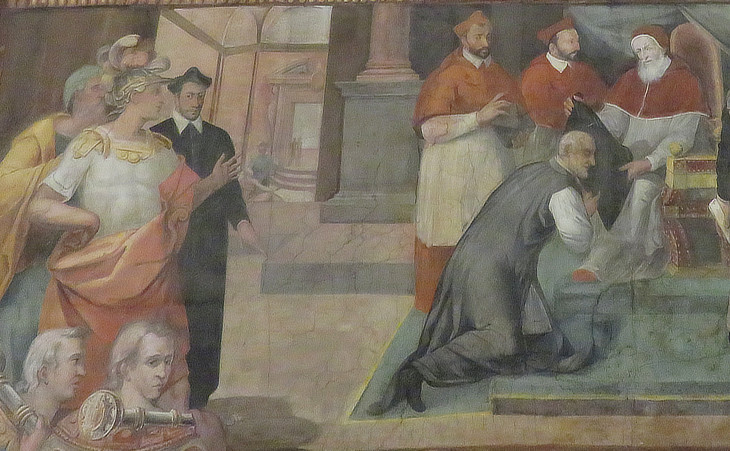
Sala del Commendatore - Pope Gregory XIII appoints Teseo Aldrovandi Commendatore di S. Spirito in 1575 (a personification of Rome is depicted to the left with two bearers of seals) by Jacopo and Francesco Zucchi
The revenues of San Spirito, including the foundling hospital and excluding the madhouse , are about 90,000 scudi, to which the Government adds 365,000 scudi annually, together with the produce of the Banco S. Spirito instituted by Paul V.; and these rich endowments have acquired for it the title of "il piu gran Signore di Roma". Of this revenue about 50,000 crowns go to the support of the foundling-hospital. The administration of the establishment is in the hands of a prelate, who is Commendatore of the hospital and Master-General of the Order of the Holy Ghost, whose members are Canons Regular, dress as secular clergymen, and are distinguished by a double cross of white silk on the right breast. They live in community, are bound by vow to attend the sick and also serve the parochial church of S. Spirito. Donovan
Teseo Aldrovandi, the husband of a cousin of the pope, promoted the decoration of Sala del Commendatore.

(left) Façade; (right) coat of arms of the hospital
To this building joins the house of the commendator,
who, with his officers attending the sick, make up ninety
persons. Evelyn
The Commendatore resides in the adjoining palace and is often raised to the purple. Donovan
The officer in charge of Spedale di S. Spirito was called Commendatore, a title which in origin indicated the
administrators of the properties of a large abbey (e.g. Subiaco). In 1565 Commendator Bernardino Cirillo started the construction of a palace to house
the administrative offices of the institution and a series of ancillary
facilities such as a medical library and a pharmacy.
The building has the appearance of a family palace; its architect was traditionally
assumed to be Ottavio Mascherino (and Vasi supported this opinion), but today this attribution is questioned.

Courtyard: (left) upper loggia decorated with a coat of arms of Pope Innocent XIII between Prudence and Strength; (right) highly complex 1743 clock placed by Commendator Antonio Maria Pallavicini which indicates the "Italian hour"
Pope Paul V provided the hospital with an adequate supply of water (from Acqua Paola); he also ensured the institution had a major source of income by founding Banco di S. Spirito in 1605; for a couple of years the activities of the new bank were carried out inside Palazzo del Governatore, then they were moved to a small palace in Rione Ponte and in 1667 to a palace which had housed the Mint. The bank continued to belong to the hospital until 1917.

Fountain built by Pope Paul V (and with his heraldic symbols) in the courtyard
The fountain was built in 1614 and it stood at the side of the new façade of S. Pietro. The inscription above it mentions Mons. Pietro Campori as Commendatore of the Archhospital and praeceptor of the Order of the Hospitallers. Mons. Campori was created cardinal by Pope Paul V in 1616. The fountain was relocated to Palazzo del Commendatore by Pope Alexander VII when he redesigned Piazza S. Pietro in 1667.

(left) Courtyard; (right) entrance to the pharmacy
Under the portico, the sick may walk out and take the air. (..) There is an apothecary's shop, fair and very well stored. Evelyn
In all the other hospitals of Europe the medical attendants are confined, in their prescriptions, to the hospital supply of medicines; but in Rome there is no limitation whatever in this important particular. Donovan
Spedale di S. Spirito owned many buildings in Rome and many farms in the countryside; the symbol of the hospital appears on a large number of property tablets around the city; Palidoro and S. Severa along Via Aurelia and Manziana near Lake Bracciano were villages
which entirely belonged to the hospital.
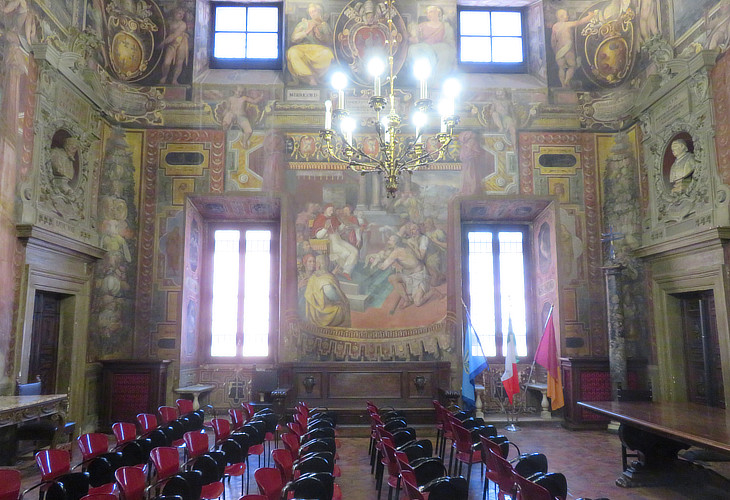
Sala del Commendatore: overall view with a fresco portraying fishermen showing corpses of babies to Pope Innocent III by Jacopo and Francesco Zucchi who were in charge of the whole decoration of the room
Francesco was the brother and assistant of Jacopo Zucchi (1541-1590), a Florentine painter who began his career as a pupil of Giorgio Vasari. He extensively worked in Rome in 1572-1589, especially for Cardinal Ferdinando de' Medici at Villa Medici and at Palazzo di Fiorenza. His works were highly praised also for his depictions of female nudities.
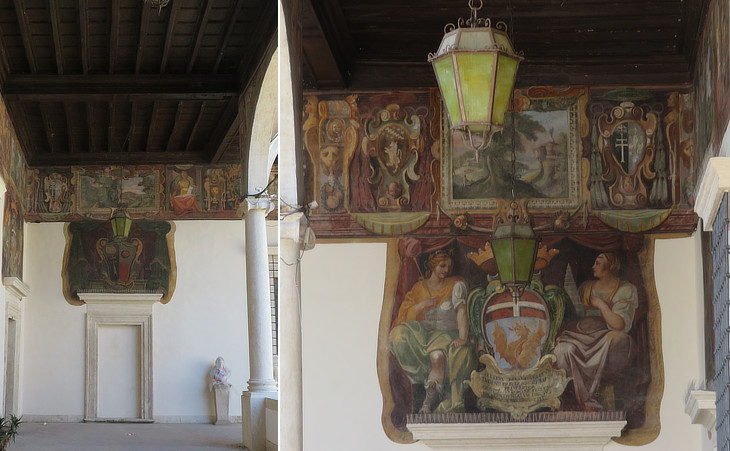
Details of the upper loggia of the courtyard which was decorated with coats of arms of the Commendatori and views of the properties of the hospital and depictions of virtues e.g. Prudence and Strength; some of the inscriptions celebrate past officers of the hospital, e.g. Cardinal Pietro Barbo who in 1445 was appointed Master general of the Order of Spirito Santo in Sassia and administrator of its hospital
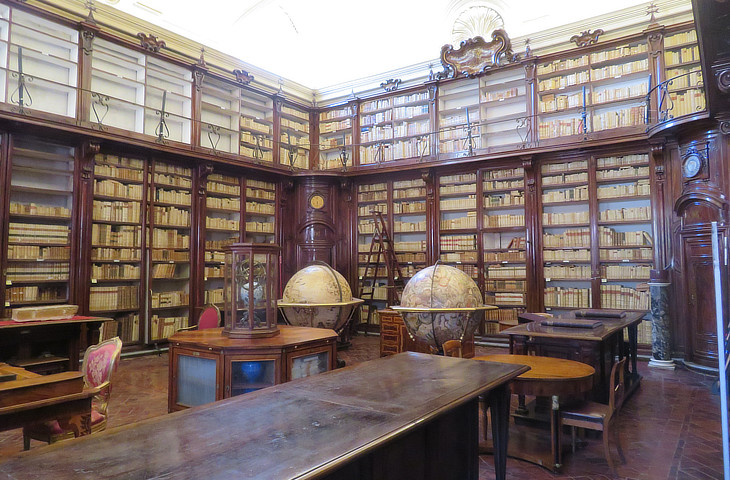
Biblioteca Lancisiana
Nor is the benefit small which divers young
physicians and chirurgeons reap by the experience they
learn here amongst the sick, to whom those students have access. Lassels
(A medical library) exists in the palace of the Commendatore, attached to the hospital of S. Spirito and takes its name from its founder G. Maria Lancisi, an eminent physician of the XVIII century, who had been medical adviser to the hospital, to which he bequeathed his library. The librarian is one of the Canons of S. Spirito; and the library is open to the Public from six to twelve, every morning, except thursdays, festivals, and vacation time. Donovan
The library is named after Giovanni Maria Lancisi (1654-1720), a physician who is still known for his studies of anatomy and for Acqua Lancisiana, a mineral spring which he recommended.
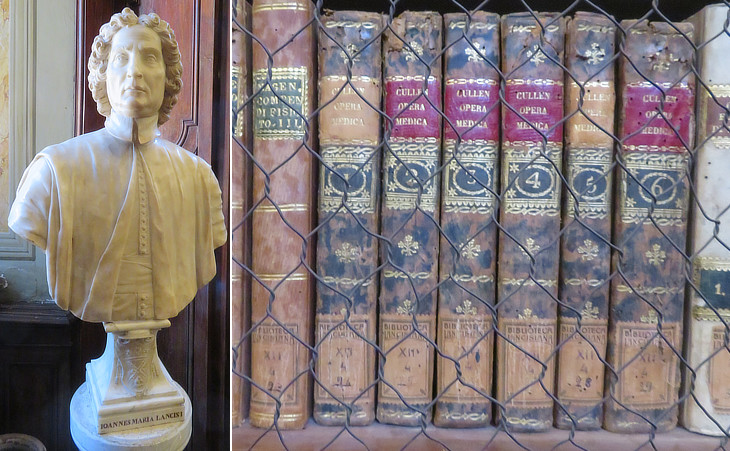
(left) Bust of Giovanni Maria Lancisi; (right) 1798 Italian translation of "A Treatise of the Materia Medica" by William Cullen, a professor at the Edinburgh Medical School; the library contains also illuminated manuscripts (one of which was on display at a temporary exhibition at Biblioteca Alessandrina)
Four head physicians and two head surgeons, besides the same number of medical and surgical resident assistants, visit the patients twice daily: when necessary the number is increased according to the exigency. About fifty medical and surgical students, who must have previously finished their studies, are also boarded and lodged in the establishment, and lend their assistance. Annexed to the establishment are baths, a pharmacy, a laboratory, an anatomical theatre, an operation room, mineralogical and zoological cabinets, and a library containing the collection of books and instruments of the famous Lancisi already mentioned. Donovan
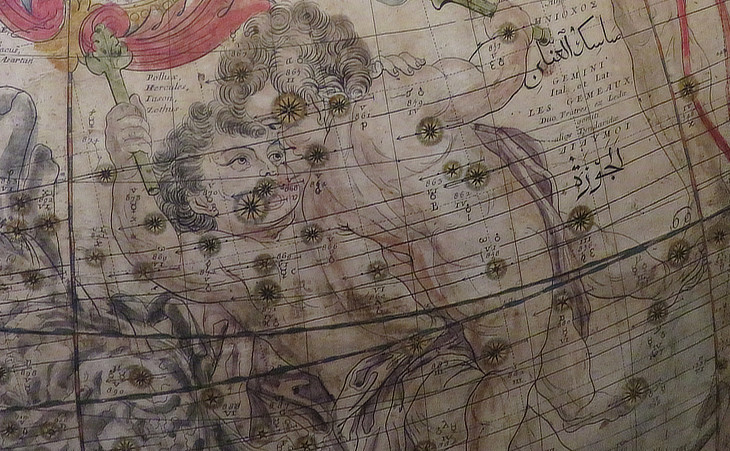
Celestial globe by Vincenzo Maria Coronelli (1650-1718), a Venetian Franciscan father known as a historian, a geographer and a cosmographer; detail depicting Gemini, the name of the constellation is written also in French, in Greek and in Arabic
The two globes complemented the knowledge available in the books. Similar globes can be seen at Biblioteca Casanatense and at Palazzo Spada.
Biblioteca Angelica, Biblioteca Gregoriana, Biblioteca Vallicelliana and Biblioteca Corsini are other historical libraries of Rome, in addition to Biblioteca Vaticana.
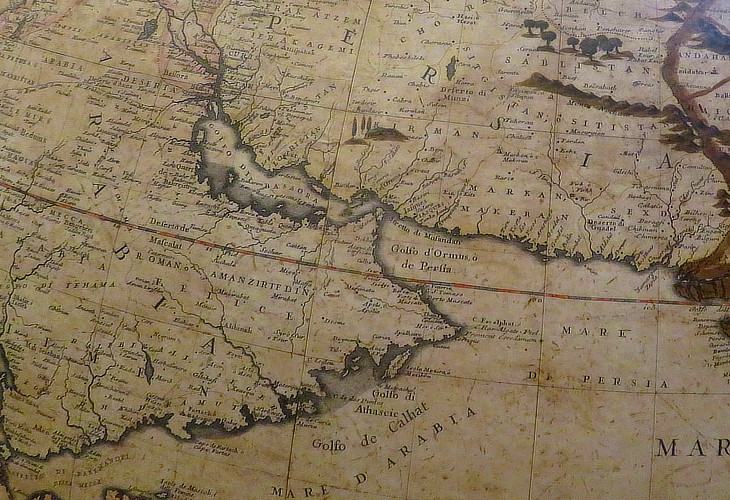
Detail of the Earth globe; Coronelli was very accurate in depicting the coastline, as he could rely on the many portolan charts which were drawn in Venice since the XIIIth century
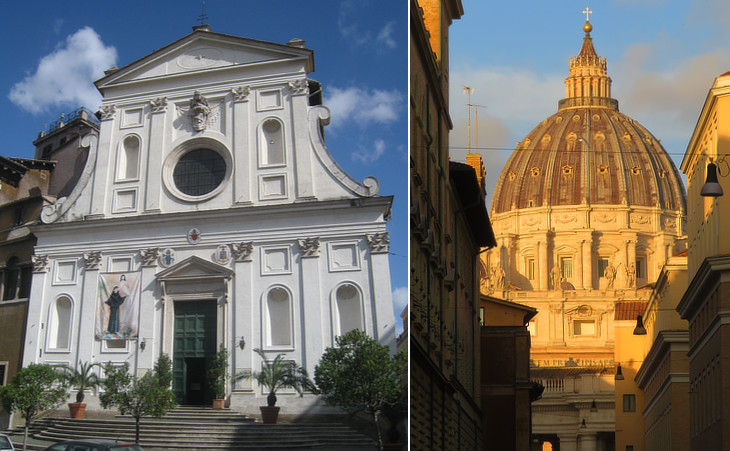
(left) Façade; (right) Dome of S. Pietro from the entrance to the church in Borgo S. Spirito
There is a convent and an ample church for the
friars and priests who daily attend. The church is extremely neat, and the sacristia is very rich. Indeed it is altogether one of the most pious and worthy foundations I
ever saw. Evelyn
This handsome church S. Spirito is attached to the hospital of S. Spirito, in the Borgo, and derives its name from an hospital built there. The church was rebuilt by Paul III ., after the design of Sangallo, except its front, which was erected by Mascherino, by order of Sixtus V, and has two ranges decorated with composite pilasters and crowned with a graceful pediment. Donovan
You may wish to see the church in a 1588 Guide to Rome.

(left) Interior; (right) Cappella della Vergine e di S. Agostino
The interior consists of a single nave , a transept and a tribune, and is in form of a Latin cross, adorned throughout, by Sangallo. (.. ) The ceiling is elegantly carved and richly gilt. (..) Over the altar of the next chapel the Coronation of the B. Virgin, with S. Augustin kneeling beneath, is by Cesare Nebbia, who also painted the martyrs of his Order at the sides, SS. Augustin and Jerom on the left and S. Nicholas of Bari and S. Bonaventure on the right pillar of the arch. Donovan
The small church of Schola Saxonum was originally dedicated to the Virgin Mary; its current name and dedication were established in the XVIth century; it was rebuilt several times until Pope Paul III ordered its reconstruction which was completed by 1545, but Commendator Bernardino Cirillo felt that the new layout and decoration of the church did not comply with the recommendations of the
Counter-Reformation and promoted a major redesign of its interior which lasted until the pontificate of Pope Sixtus V, whose coat of arms replaced that of Pope Paul III at the top of the façade. The beautiful ceiling and the organ were both built at the time of Pope Paul III.

(left) XVIth century baptismal font; (right) pulpit by Alessandro Castaldo, a joiner (1595 - you may wish to see a later pulpit at the Franciscan church of S. Maria in Aracoeli)
It may be said that, with the exception of the Venetians
and a few great individualists like the aged Michelangelo, most of the artists working
roughly between 1550 and 1590 practised a formalistic, anti-classical, and anti-naturalistic
style, for which the Italians coined the word "maniera" and which we now call "Mannerism" without attaching a derogatory meaning to the
term.
Rudolf Wittkower - Art and Architecture in Italy 1600-1750
The church retains almost entirely its original Mannerist features which can be noticed also in some minor details, e.g. the baptismal font.
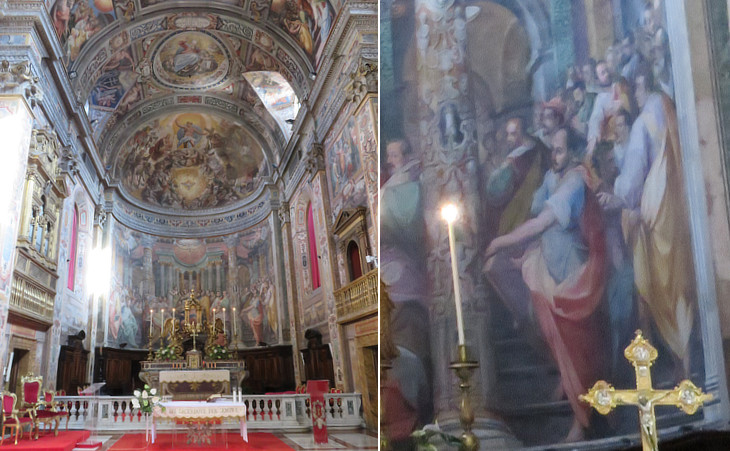
(left) Apse; (right) detail of The Descent of The Holy Spirit by Jacopo Zucchi, where several members of the Roman upper society were portrayed
The great altar stands isolated, and is decorated with porphyry, alabaster and gilt bronze: and above its tabernacle is a repository for the exposition of the B. Sacrament, adorned with eight small columns and sustained by two angels (..) and the whole richly gilt. Over the canopy of the great altar is a medallion with the Eternal Father: in the absis is the Redeemer, after his Ascension, sending the Holy Spirit; and beneath is the Holy Ghost descending, on the day of Pentecost on the Apostles and disciples and the three Marys, who are painted in the three compartments beneath the cornice, all forming one subject, and executed in fresco by Zucchi. Donovan

(left) Monument to Antonio Foderato (d. 1548, a distant relative of the Della Rovere) by Giacomo del Duca inside Cappella del Crocifisso; (right) Martyrdom of St. John the Evangelist by Marcello Venusti
To the right is S. John in the cauldron of boiling oil and to the left, the same Evangelist resuscitating a deceased woman, both by Marcello Venusti. Donovan
The monument to Foderato was paid for by Alessandro Guidiccioni, Commendatore in 1546-1552. Giacomo (or Jacopo) Del Duca assisted Michelangelo in the execution of many projects in the final years of the master's life, e.g. at the Certosa di S. Maria degli Angeli, and also Marcello Venusti was a pupil of Michelangelo.
The depiction of martyrdoms was recommended by Counter-Reformation theologists (you may wish to see the same subject at SS. Nereo e Achilleo with other similar paintings).
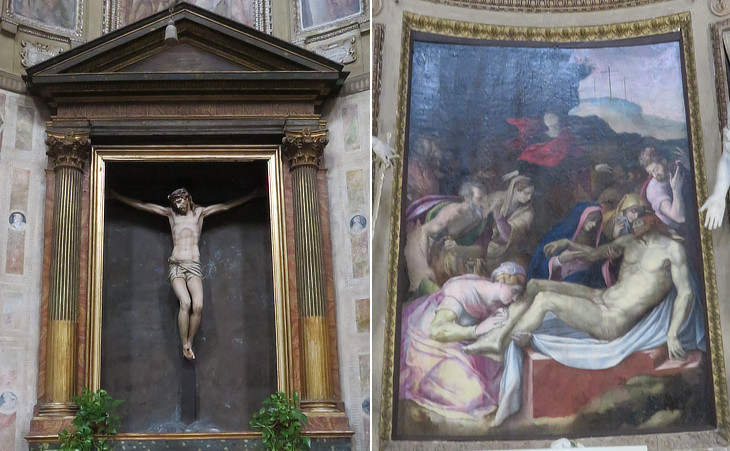
(left) Cappella del Crocifisso with a XVIth century wooden Crucifix; (right) Cappella della SS. Croce: Deposition (1557) by Livio Agresti, a painting which shows the influence of Michelangelo
Notwithstanding some imperfections in the depiction of the head of Jesus Christ, the painting by Agresti was highly praised and he was commissioned many other works in the church. With Cesare Nebbia he was involved in the decoration of Oratorio del Gonfalone. Many of the artists whose works embellish the church were recruited by Pope Sixtus V for the decoration of the Lateran Palace, of Cappella Sistina at S. Maria Maggiore and other buildings he erected or renovated.
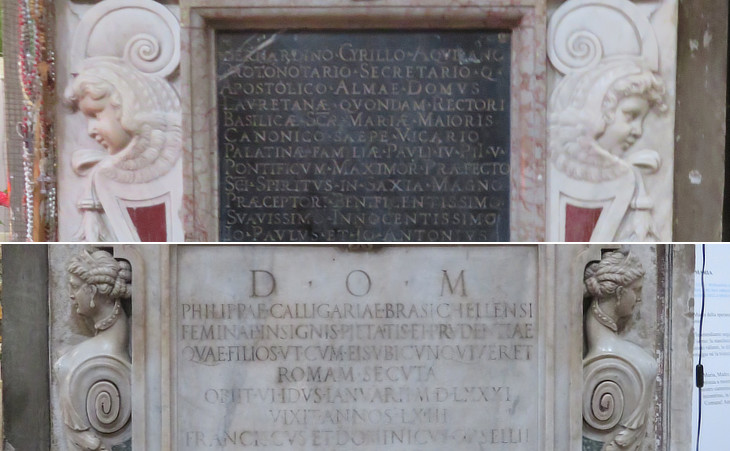
Tombstones: (above) Bernardino Cirillo; (below) Filippa Callegari from Brisighella, a town near Faenza
The church houses many funerary monuments, especially of prelates and officers who had a role in the administration of the hospital. The earliest ones are rather simple but show some very elegant details. Several of the physicians who worked in the hospital were also buried in the church; you may wish to see the monument to the anatomist Pietro Giavota.
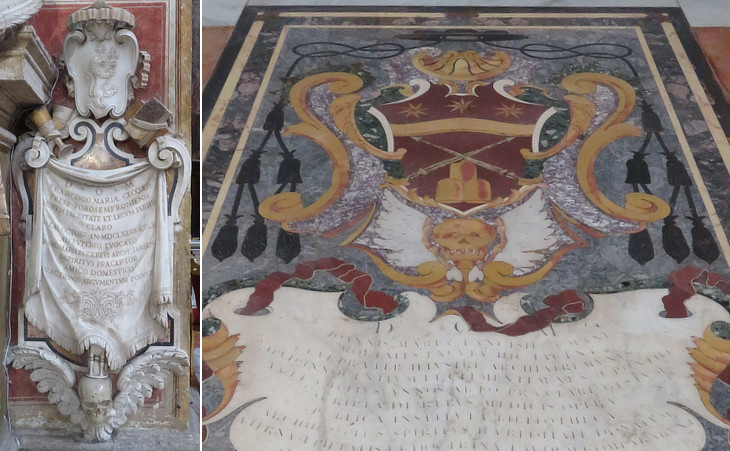
Funerary monuments with references to Death: (left) Francesco Maria Ceccolo (d. 1677) Praeceptor (one of the titles of the Commendatore) and Bishop of Tarso; (right) Antonio Maria Pallavicino (Commendatore in 1737-1749), Patriarch of Antiochia
The prelates in charge of the hospital were very busy, but this did not impair that ecclesiastical career. They were appointed bishops of sees in partibus infidelium, i.e. historical dioceses in Muslim countries of Africa or the Near East. It was a merely honorary title which gave a status in the religious hierarchy without the burden of actually ruling a diocese. See a similar case at Palermo.

(left) Apse; (right) bell tower
S. Lorenzo in Borgo (one of the many Roman churches dedicated to this martyr) was built in the XIIth century and in the XVth century Cardinal Francesco Armellini incorporated it into his palace, which was bought by the Cesi in 1565; the church was donated in the XVIIth century to the Piarist Fathers and it was redesigned by Francesco Navone in 1737. It was also known as S. Lorenzo in Piscibus, most likely after a nearby fish market.

Interior after the demolition of its XVIIIth century decoration
It is preceded by a long vestibule and a small atrium and its interior is divided into a nave and two aisles by twelve ancient columns, of which eleven are of marmo bigio, and one of granite. The painting of S. Anne, S. Joachim and the B. Virgin, over the altar of the first chapel to the right, is by Pietro Nelli, who also painted the S. Joachim and S. Anne, to the left instructing the B. Virgin; and the birth of the B. Virgin, to the right, is by Calandrucci, who also painted the Eternal Father on the ceiling. Over the altar of the next chapel is the portrait of S. Joseph Calasanctius, the Institutor of the Congregation of the Pious Schools: to the right is the same Saint, with S. Charles Borromeo and to the left, the death of the sainted Founder. Over the altar of the next chapel is a masterly but unfinished painting of the martyrdom of S. Laurence, by G. Brandi and the lateral paintings of the Baptist, to the left, and S. Sebastian, to the right, are by Nelli. The great altar is adorned with two columns of oriental agate: the marriage of the B. Virgin and S. Joseph, over the altar, is a good painting by Niccolo Berrettoni, a scholar of Maratta and the Nativity, to the left, the Adoration of the Magi, to the right, the angel awakening Joseph, in the lunette to the right, and the death of S. Joseph in that to the left, together with the Annunciation, outside over the arch, are all by Michelangelo Ricciolini. Over the altar of the first chapel to the left of the great altar is the Madonna della Salute, painted in oil on the wall and the two sainted bishops, at the sides, are by Cordieri. The marble Crucifix over the next altar is by Gio. Fiammingo; and the S. Nicholas of Bari, over the altar of the last chapel, is by Ricciolini, who also executed the paintings above the cornice, around the church, illustrative of the life of S. Laurence. Donovan
The opening of Via della Conciliazione led to pulling down the façade by Navone in the late 1930s. Eventually the church was deprived of all its altars and paintings and brought back to its
assumed medieval appearance with an overall very poor result.
Next plate in Book 9: Spedale di S. Giovanni in Laterano.
Next step in Day 8 itinerary: S. Maria in Traspontina.
Excerpts from Giuseppe Vasi 1761 Itinerary related to this page:
Spedale di s. Spirito in Sassia
Conserva questo Archiospedale l'antichissimo nome di quello, che quivi insieme con una chiesa dedicata alla ss. Vergine edificò Ina
Re de' Sassoni occidentali l'anno 717. per comodo de' pellegrini di sua nazione, e che chiamossi scuola de' Sassoni. Ma poi per un formidabile
incendio accaduto l'anno 817. ed altro nell'847. restando tutta questa contrada desolata, s. Leone IV. la riparò colli soccorsi de' Re di quelle
nazioni. Dipoi questa contrada essendo stata devastata da Arrigo IV. e da Federigo Barbarossa, il Pontefice Innocenzo III. nel 1198. ispirato
da Dio ordinò quivi la fabbrica di uno spedale per li poveri infermi, e per li projetti; e perchè si riconoscesse, che ciò fu per speciale ispirazione
divina, volle, che portasse il titolo di s. Spirito. Ne concedè la cura ad alcuni Preti regolari in quel medesimo tempo radunati in Francia per
servire gl'infermi, il fondatore de' quali chiamato Giulio Monpelieri fu da lui creato Commendatore di questo nuovo ordine di s. Spirito, che
dipoi si dilatò in benefizio de' poveri infermi, e projetti per tutta l'Italia, ed Europa. Perciò il medesimo Pontefice eresse appresso allo
spedale una chiesa dedicata allo Spirito santo, che poi nell'anno 1538 fu edificata di nuovo, ed ornata da vari Pontefici, e Cardinali, con
pitture, marmi, e stucchi dorati. Il disegno della chiesa è di Antonio da Sangallo, e quello del prospetto di Ottavio Mascherino; il ciborio
però è architettura di Andrea Palladio. Greg. XIII. vi fece col disegno del detto Mascherino il magnifico palazzo per il Commendatore, che
di ordinario è un Prelato, nel quale è una scelta libreria, aumentata da Monsig. Lancisi, e da molti Principi, fra' quali Lodovico XIV. Re di Francia.
|


