
All images © by Roberto Piperno, owner of the domain. Write to romapip@quipo.it.


Notes:
Page added in June 2026.
All images © by Roberto Piperno, owner of the domain. Write to romapip@quipo.it.
Notes:
Page added in June 2026.
 Anzio - Exhibits from the museums
You may wish to see a page on the town first.
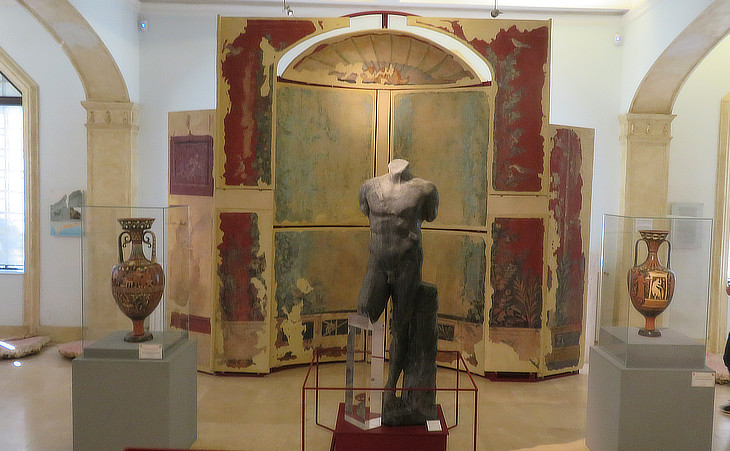
Museo Archeologico di Anzio (MAA) at Villa Adèle: Hall of the Painted Walls, the main hall of the museum
The Archaeological Museum of Anzio was inaugurated in 2002 and its collections include some evidence of the ancient town from its earliest beginnings, but its most impressive exhibits come from the Imperial villa (Villa di Nerone) which was decorated with statues, painted walls, floor mosaics and architectural artefacts. They are however only a part of those which were found at Anzio because the Apollo del Belvedere is in the Vatican Museums and the Borghese Gladiator is at the Louvre. The page shows also exhibits from Anzio which are on display in other museums or casts of them.
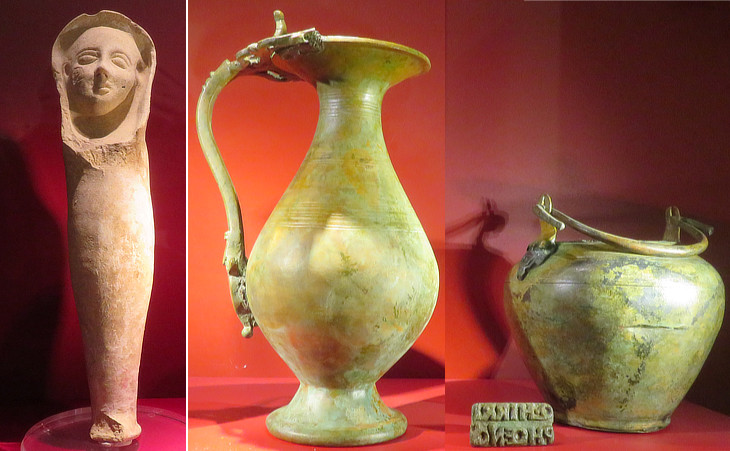
MAA: (left) Votive statuette (see those found at Lucus Feroniae, a small town north of Rome and at a shrine dedicated to Minerva in Rome); (right) bronze pitcher and situla (a well bucket - see another situla at the Colosseo Underground Station)
The development of modern Anzio led to the discovery of necropolises, shrines and other evidences of the ancient town which were not linked to the Imperial Villa and testified to a more ordinary lifestyle.
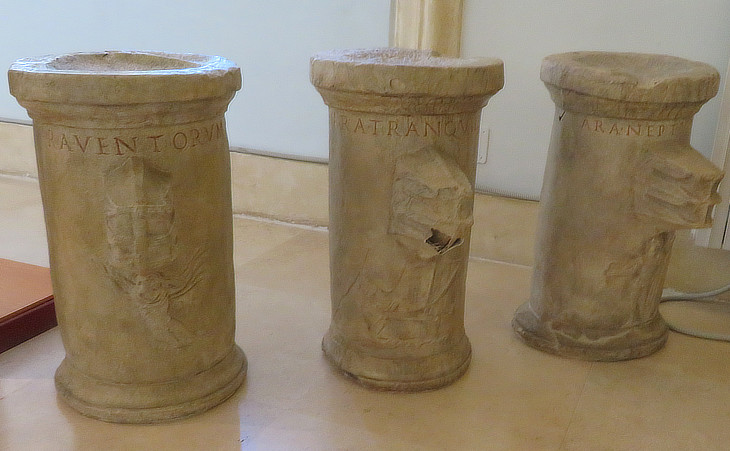
MAA: Casts of altars at Musei Capitolini
When the fleet was ready, Octavian performed a lustration for it in the following manner. The altars are erected on the margin of the sea, and the multitude ranged around them in a circle of ships, observing the most profound silence. The priests who perform the ceremony offer the sacrifice while standing at the water's edge, and carry the expiatory offerings in skiffs three times round the fleet, the generals sailing with them, beseeching the gods to turn the bad omens against the victims instead of the fleet. (..) Octavian sailed from Puteoli (near Naples), offering sacrifices and pouring out libations from the admiral's ship into the water to the propitious winds (Ventorum), and to Saviour Neptune (Neptuni), and to Waveless Ocean (Tranquillitatis), that they should be his allies against his father's enemies.
Appian - Roman History - The Civil Wars - Book V - Transl. by Edgar Iliff Robson
These three small altars were found at Anzio when digging for the new port at the end of the XVIIth century. The passage by Appian explains their purpose which was to celebrate the victory by Octavian and Agrippa, his admiral and son-in-law, against Sextus Pompeius, son of Pompey, who controlled the sea routes between Tunisia and Sicily. The battle was fought at Naulochus, between today's Milazzo and Messina in 36 BC. Because Augustus often sojourned at Anzio the altars might have been erected towards the end of the Ist century BC. They are decorated with a small rostrum, the ram of the Roman warships and a small relief which depicts a wind (Ara Ventorum), a ship (Ara Tranquillitatis) and Neptune (Ara Neptuni).

Museo Nazionale Romano - Palazzo Massimo - Rome: statues found at Anzio: (left/centre) Fanciulla di Anzio (Girl of Anzio) (IIIrd century BC);
(right) Apollo (discovered in 1937 - IInd century AD)
A discovery of high value was made in the spring of 1878 in Nero's villa at Antium. Part of the cliff on the edge of which the palace stood having collapsed after a great gale, a statue was found lying in shallow water at the foot of its original niche and pedestal. (..) It represents the draped figure of a maiden holding a plate in her left hand and looking intently at its contents. She has been named the Maiden of Mystery because archaeologists are as ignorant to-day of her origin, authorship, name, and place in the history of Greek art as they were thirty years ago, when she first emerged from the foam of the sea.
I have just paid her another visit in company with two leaders of the Italian and German classic schools. I have listened to their arguments and subtle controversy, and I have left Antium more fascinated than ever by the "bella incognita," but no nearer to the knowledge of the truth. She is not a mystery, but a tangle of mysteries. Must we consider her lovely face a portrait from nature, or is it simply due to the fancy of the artist? The twig which lies on the plate, is it from a laurel or an olive branch? Is she taking it up from the plate or laying it down upon it? The roll of thick stuff near the rim of the plate, is it a sacrificial band, or a scroll of parchment, or a strap of leather? The little claws which are seen near the twig, do they belong to a pet animal, or are they the feet of a candelabrum or of an incense box? What impression did the artist try to convey by treating her tunic and her shawl in such a peculiar style? That the shawl was made of wool and the tunic of plaited raw silk? Is the marble out of which she is carved Parian or Hymettian? To which epoch and to which school must such a work be assigned?
No definite answer has been given to these queries; no subject more shrouded in mystery has ever perplexed the student. Nameless the maiden will enter the gates of the Museo Nazionale, and nameless she will remain in spite of all the attempts on our part to wrest her secrets from her. One point, however, seems certain: she looks, or she has been made intentionally to look, untidy; her hair is not dressed; her shawl has just been thrown carelessly on her shoulders; her shoes look more like slippers than sandals. Such a slovenly appearance, certainly intentional, has given rise to the following conjecture: that she may be a "penitent" girl, chosen by her tribe or by her fellow-citizens to appease the wrath of the gods and to avert with her offerings and prayers an impending calamity. If this is the case, it is a pity that we cannot better identify the objects which the girl has gathered on her plate as a propitiatory offering to the gods.
Rodolfo Lanciani - Wanderings in the Roman Campagna - 1909
As of today the identity of the "Girl of Anzio" is yet to be determined. It is thought not to be a Roman copy of a Greek statue, but an original one and thus it is dated IIIrd century BC. She might have been part of a group of statues depicting a Dionysiac ceremony or a priestess herself.
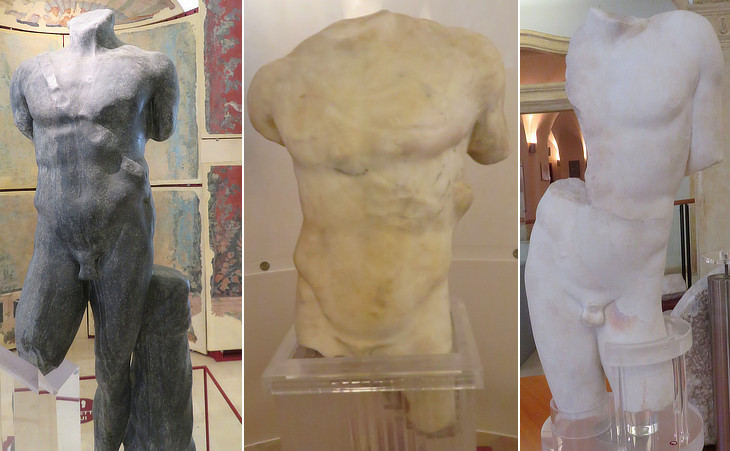
MAA: other IInd century AD statues found at Anzio: (left) a hero or a god wearing a "balteus", a belt worn over one shoulder that is typically used to carry a sword; (centre) male torso; (right) Apollo?
Precious marbles of every kind are found here. One might fill
carts with gleaming wave-polished marble, which is sprinkled over the
shore, go as far as one will.
Ferdinand Gregorovius - On the Latin shores - 1854
Here let me state one fact which redeems to a certain extent the memory of Nero, the lover of Antium: the fact is that, whenever excavations have been made in grounds known to have belonged to him, some genuine work of a Greek master has been sure to come to light; in other words, the only chance we have left of discovering lost masterpieces is to follow in the footsteps of Nero, and search every building or site that is known to have been inhabited by him, whether the Golden House at Rome, or the hunting-box at Sublaqueum, or the sea palace at Antium. Lanciani
Lanciani was right in his prediction because even without major campaigns of excavations, ancient works of art continuously come to light at Anzio. The grey marble statue was found in 1994 in the sea near the harbour. Underwater currents carrying sand and gravel have reduced its sharpness but enhanced its charm and most rightly it has been placed at the centre of a hall. Coloured marble statues were very much in fashion in the IInd century AD (see some of them from Villa Adriana).
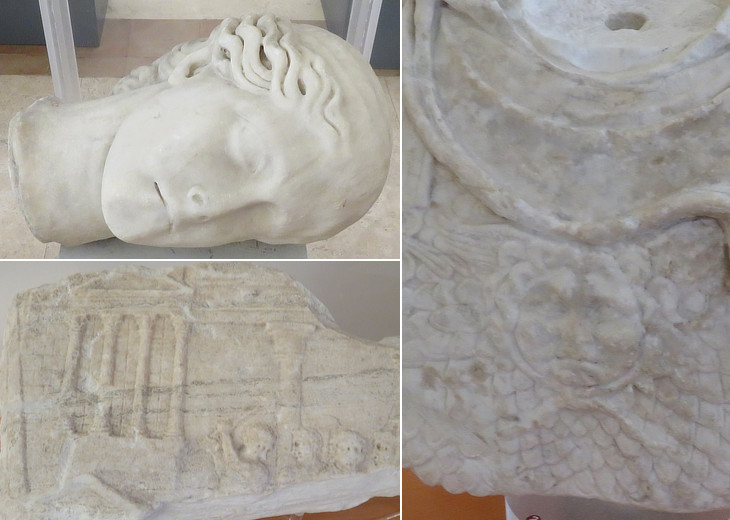
MAA: (left-above) head of a statue; (left-below) relief depicting a scene of sacrifice next to a temple (IIIrd century AD); (right) bust with a Head of Medusa
The museum houses a number of sculptural fragments which all have some features which attract the attention of the visitor. The head of a statue was found in the sea and it has lost some of its sharpness which makes it difficult to clearly identify it as that of a woman or of a man.
The scene of sacrifice brings to mind other similar ancient reliefs which decorated the façade of Villa Medici and which have been useful to identify the design of some temples. A similar relief of the time of Hadrian can be seen at the Uffizi Gallery of Florence.
The gorgoneion, Medusa's head, which Athena wore on her peplos or had on her shield as an amulet, was often depicted on the armours of Roman generals and emperors; that found at Anzio retains its scary power.

Centrale Montemartini: Fragment of a Roman floor mosaic discovered in 1749 between Anzio and Nettuno
In 1737 Giuseppe Alessandro Furietti, a prelate, found a fine small mosaic at Villa Adriana which fit a description by Pliny of a famous work by Sosus at Pergamum. Furietti in 1752 published De Musivis, a book on ancient mosaics which raised the general interest in this form of art. In line with the usage of the time the mosaic from Anzio was heavily restored: the man holding a distaff in the upper part of the mosaic was added to give a mythological significance to the scene; he represents Hercules who spent one year as slave of Queen Omphale and during that period was tasked with typical female activities. This because the lower (original) part of the mosaic showed a drunken lion (possibly a symbol of Hercules) being taken care of by cupids (symbols of love). According to Diodorus Siculus, Hercules led a life of pleasure and servitude in the arms of Queen Omphale.

Museo Nazionale Romano - Terme di Diocleziano - Hall XI - Rome: central detail of a very large floor mosaic from the Imperial villa (IIIrd century AD)
The floor mosaic was discovered in 1931, but because of its size it was kept in storage. In the 1990s Museo Nazionale Romano was rearranged into four locations and it was possible to display the mosaic inside a large hall of Diocletian's Baths. In line with the fashion which prevailed in Rome it is a black-and-white floor mosaic with a central scene portraying Hercules defeating Achelous, the river god his rival for the conquest of the beautiful Deianira. Hercules holds the horn he has just ripped from the bloody head of Achelous who during the fight had turned into a snake before and then into a bull (see a fresco at Herculaneum depicting the same scene). The worship of Hercules dates to the early times of Roman history and it kept growing until the end of the IIIrd century AD.
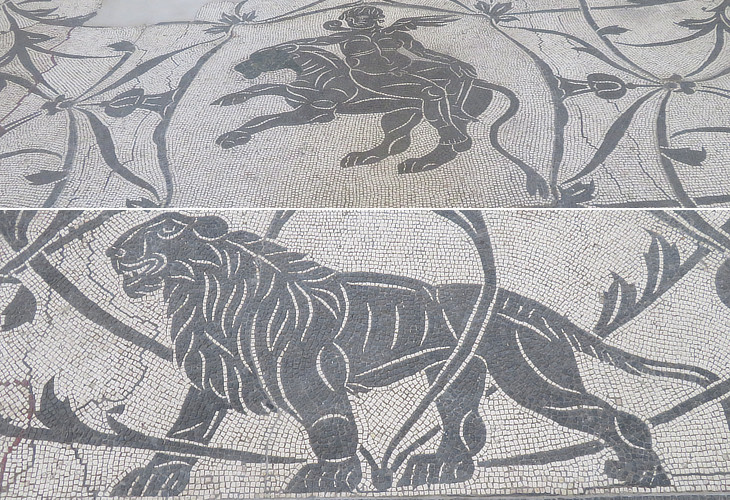
MAA - Sala delle Conchiglie: Details of a large floor mosaic (late IInd - early IIIrd centuries): (above) Eros riding a panther; (below) a tiger
In 1937 another large black-and-white floor mosaic was found near the villa. It was moved to Museo Nazionale Romano and eventually it returned to Anzio. The central scene shows Eros riding a panther in a posture which recalls that of Dionysus in a mosaic at Delos. The decorative leave branches create three spaces each of them housing a beast. These floor mosaics most likely decorated baths and are similar to those which can be seen at Ostia and at Terme di Caracalla.
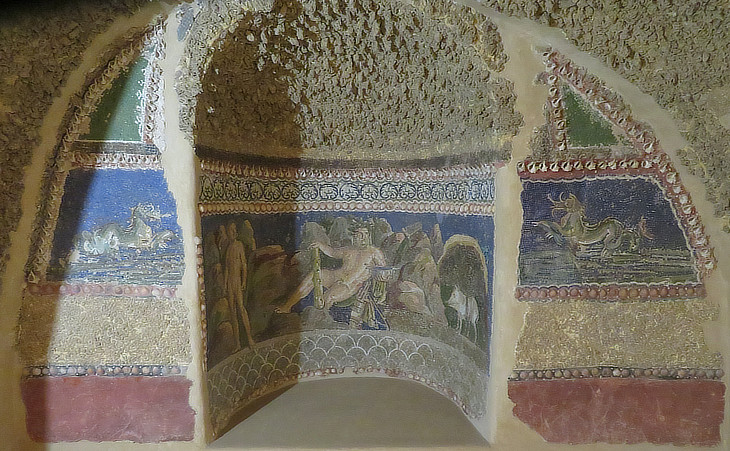
MAA: Nymphaeum
This decorated niche was found in 1930 near Villa Corsini. Its purpose is not clear, but the small hall where it was found was not part of a funerary monument or of a small public shrine. It was perhaps part of a nymphaeum, a fountain and it calls to mind a similar finely decorated niche at Herculaneum. The niche entered the collections of Museo Nazionale Romano, but in 2022 it was decided to loan it to the museum of Anzio.
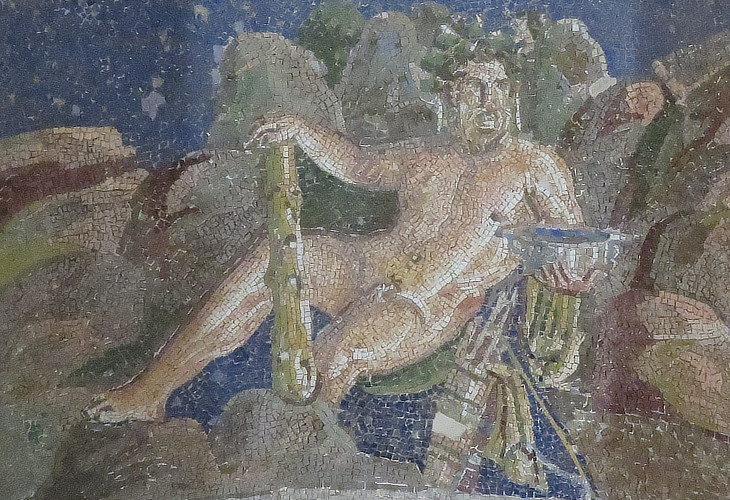
Nymphaeum: Hercules
The central scene is set in a sort of cave. The hero is portrayed in a moment of rest with an ivy wreath on his head and a skyphos, a ceremonial cup, in his left hand. These two elements indicate that he is about to attend a ceremony in honour of Dionysus, the god of wine. He holds also his club and his quiver lies next to him. Hercules was often portrayed in a drunken condition in association with events related to Dionysus (see a mosaic and a sarcophagus in France), but in this mosaic he has a rather noble aspect.
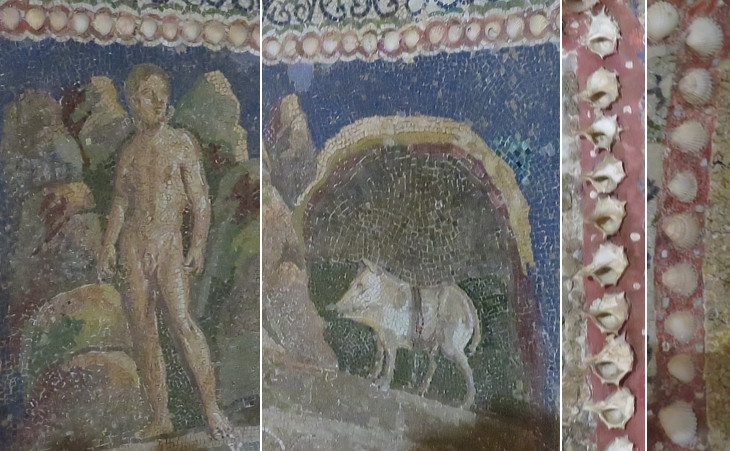
Nymphaeum: (left) a young athlete; (centre) a pig ready for being sacrificed; (right) shell decorations (these can be seen also at Herculaneum)
The presence of a young man, who initially was thought to have wings because the rocks behind him so suggested, has been associated with that of a pig with the ribbon which indicates it was ready to be sacrificed. The sacrifice is only hinted to, similar to what can be seen in a famous relief in Rome. Overall the scene is set in a suspended time: Hercules is yet to drink from the cup, the sacrifice is yet to start.
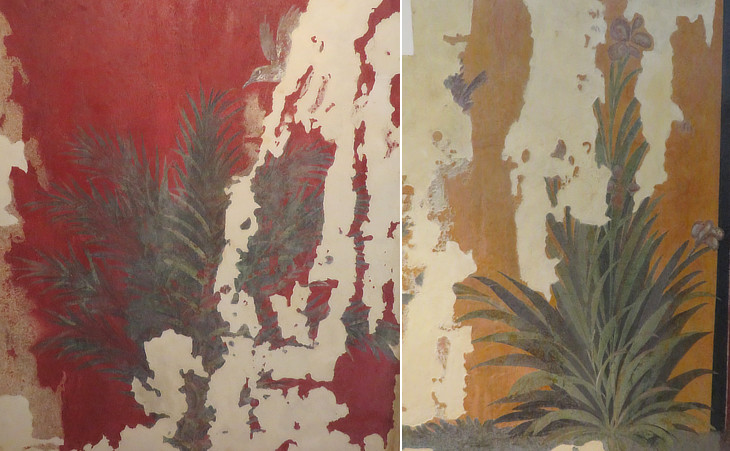
MAA: detached frescoes from the villa
"Villa di Nerone", immediately brings to mind Villa di Poppea, Nero's second wife at Oplontis, a suburb of Pompeii, which retains an impressive catalogue of Roman wall paintings. Among them depictions of fake gardens and birds (see also those at Villa di Livia near Rome), and of fountains and statues on yellow and red backgrounds. We can imagine that the villa at Anzio had a very similar decoration which speaks for the refined tastes of the emperors who lived there. Red and yellow, the background colours of most of the frescoes are typical of Roman painting and are prevalent also at Ostia.
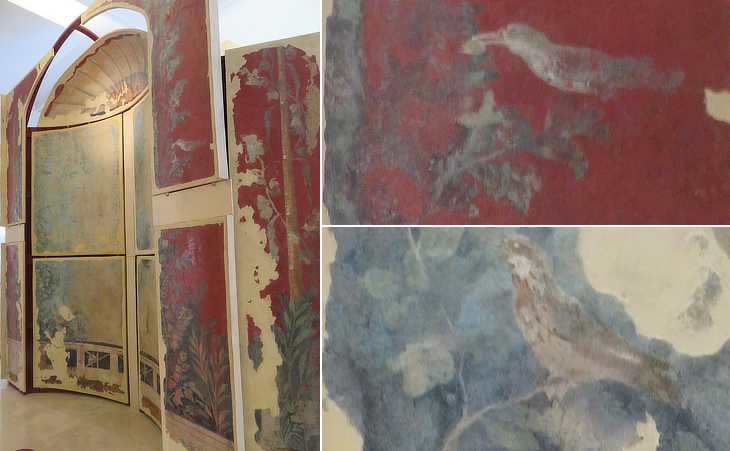
MAA: other detached frescoes forming a niche and details showing birds, perhaps a magpie and a dove; the image used as background for this page shows a swan
Many depictions of gardens and birds have been found at Pompeii; in some instances they decorated cubicula (very small bedrooms), in others the walls of a courtyard containing a garden in order to make it look larger. Birds were a favourite subject also for Roman floor mosaics, e.g. the House of the Aviary at Carthage and the House of the Birds at Italica. During the Renaissance villas and palaces were often decorated with fake aviaries.
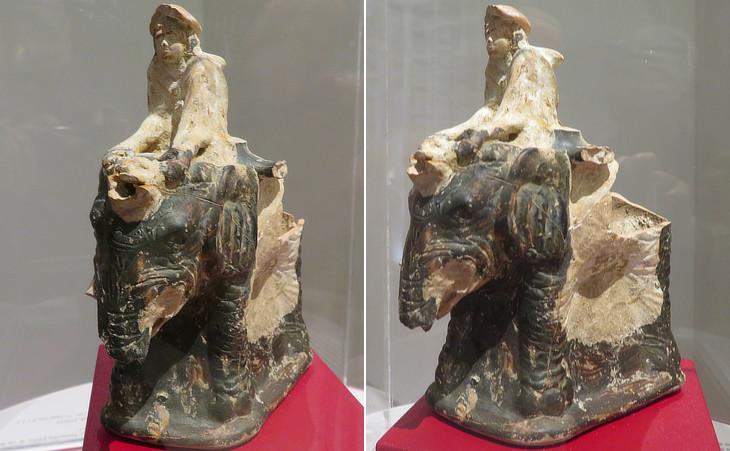
MAA: "Guttus", baby bottle
This almost unique object accurately depicts an Indian elephant and its rider. It is made of a black coated pottery which was made in Campania. Latin guttus means drop and the infant would drink from the small hole on the head of the elephant. This object was perhaps a guttus tintinnabula, i.e. it was also a baby rattle because it contained (in addition to the milk) small stones or metals. Once the milk was finished the infant could shake the guttus and make a noise (tintin). Usually gutta had the shape of a little pig which makes this exhibit extremely interesting.

Museo Lapidario Maffeiano di Verona: inscription celebrating the donation of statues to the temple of Ceres Antiatina by Claudia Attica, wife of Atticus, freedman of Emperor Domitian who was in charge of the treasury
These works unfortunately have been scattered to the four winds, and the student wishing to acquaint himself personally with the artistic decoration of the villa must undertake a pilgrimage through every country in Europe. Lanciani
The inscription is the only evidence of another temple at Anzio which was officiated by a priestess (Iulia Procula). It shows the wealth which a freedwoman could achieve at the court of Domitian, something which eventually led to the hostility of the Senate towards the Emperor.
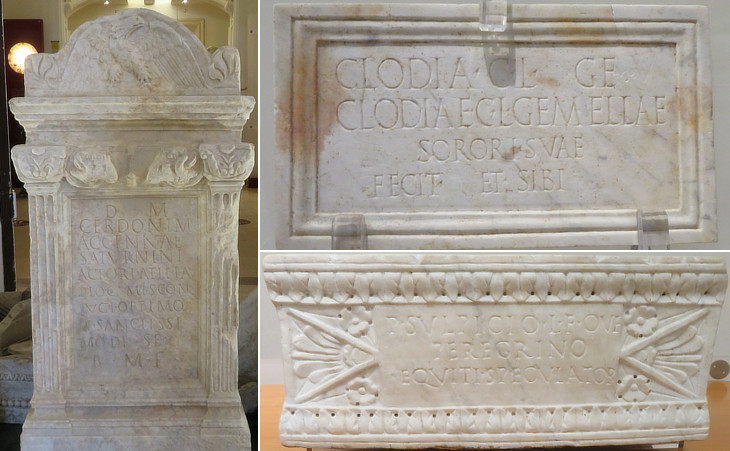
MAA: (left) tombstone of Cerdon from an unknown location; (right-above) funerary inscription for two sisters (found at Anzio in 1983); (right-below) cinerary urn of Publius Sulpicius Peregrinus (found near Anzio - late Ist century AD)
A finely decorated tombstone with typical Roman features (an eagle, two ram heads, pilasters and capitals) shows that the condition of slave did not always entail poverty. Cerdon, was the manager (actor) of an estate of M. Accenna Saturninus, a senator from Baetica who had properties in Spain and Italy. The tombstone was erected by Plocamis, his wife, a freedwoman of the Atilii family who had retained her original name. Cerdon, from Gr. Kerdon, is a typical name designating a servant or a low level artisan in Roman comedies.
The names of the two sisters were Ge and Gemella and they were both freedwomen of Caius Clodius. The inscription is simple, but finely cut and framed. Ge commissioned the inscription when she was alive. The Clodii were a branch of the Claudii, the family of the first Roman emperors.
The cinerary urn contains the ashes of P(ublius) Sulpicio L(uci) f(ilio) Ouf(entina) Peregrino
equiti speculator(i). The urn was made by Lucius, the father of the dead. It is likely that the two were both horseguards of the Flavian Emperors. The inscription on the stela which was found near the urn said that Peregrinus was born in Milan and that he died at age 28 after having served for nine years. The equites speculatores were eventually associated to the Praetorian Guard and became known as equites singulares. Oufentina was a Roman rural tribe who lived near Terracina.
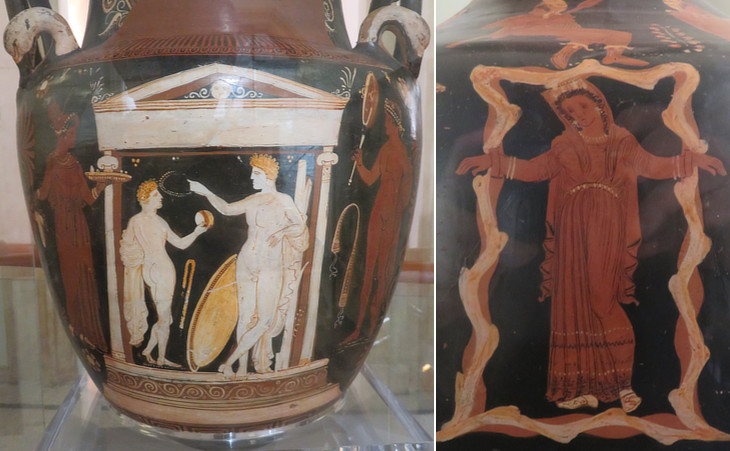
MAA: Apulian vases (ca 350 BC): (left) a hero in the act of crowning a younger man inside a "naiskos", an imaginary small temple; the vase is embellished by two swan heads; (right) a clothed Andromeda with her arms stretched out to either side and tied at the wrists to what appear to be a wooden structure
The museum displays some fine Apulian vases which are not specifically related to Anzio. They were found during "Operazione Teseo" a 14-year investigation by the Italian Carabinieri (Tutela Patrimonio Culturale) and Swiss authorities, culminating in 2014 in the historic recovery of 5,361 illegally excavated ancient artefacts. The recovered items were plundered by tomb robbers (tombaroli) in Southern Italy (Apulia, Sicily, Calabria, and Sardinia) and funnelled through an illegal international trafficking network to Switzerland and other countries. They included a very large number of Apulian vases of unknown origin which have been distributed among many museums, including that of Anzio (see some other Apulian vases at the Auditorium of Rome and other ancient artefacts which were recovered at Lanuvio and at Lucus Feroniae).
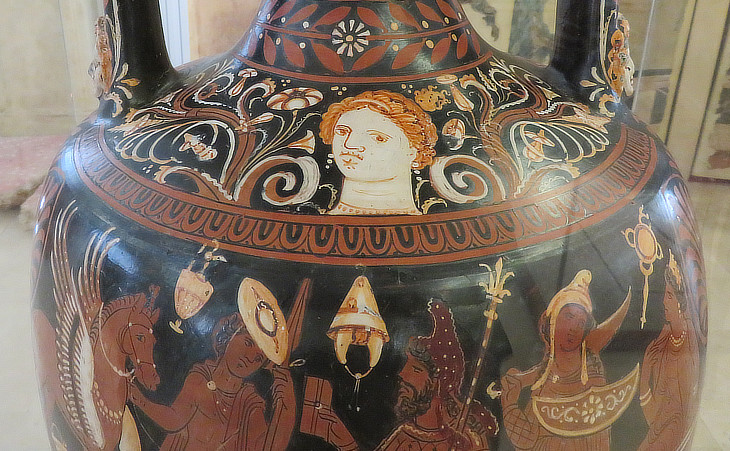
MAA: Apulian vase attributed to the Painter of Baltimora (340-320 BC)
The Apulian vases had a richer palette of the Greek ones with the use of white and half-tints resulting in some fine portraits. The subjects are always those of the Greek myth. That shown above portrays Iobates, King of Lycia asking Bellerophon (who is accompanied by Pegasus, his winged horse) to kill Chimera a fire-breathing monster. Bellerophon wears a petasus, a broad brimmed hat typical of Hermes, whereas Iobates wears a pileus, a brimless felt cap typical of Ulysses (see a temple to Bellerophon at Tlos in Turkey).
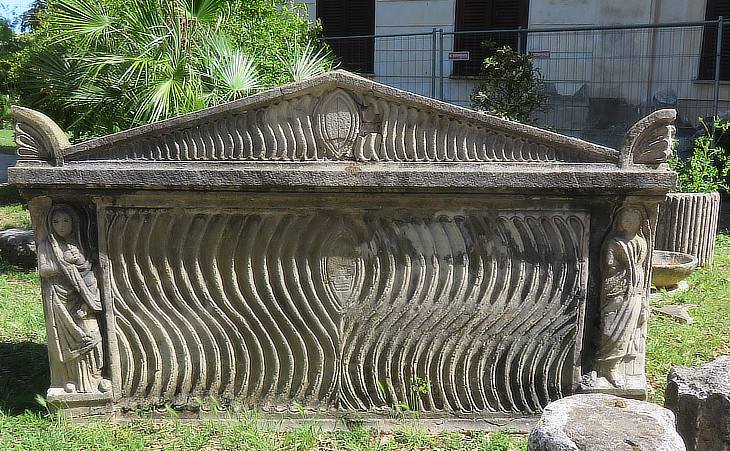
A "strigilato" sarcophagus in the garden of Villa Adèle (see a similar sarcophagus at Velletri)
Return to page one: the town or move on to Nettuno and Torre Astura or make an excursion to Pratica di Mare (Lavinium) or to Ardea.
Introductory page on Ferdinand Gregorovius
Other walks:
Roman Campagna: Colonna and Zagarolo, Palestrina, Cave, Genazzano, Olevano, Paliano and Anagni.
The Ernici Mountains: Ferentino, Frosinone, Alatri, Fiuggi (Anticoli di Campagna), Piglio and Acuto
The Volsci Mountains: Valmontone and Montefortino, Segni and Gavignano, Carpineto, Norma and Cori
Circe's Cape: Terracina and San Felice
The Orsini Castle in Bracciano
Subiaco, the oldest Benedictine monastery
Small towns near Subiaco: Cervara, Rocca Canterano, Trevi and Filettino.


