All images © by Roberto Piperno, owner of the domain. Write to romapip@quipo.it.


Notes:
Page added in June 2026.
All images © by Roberto Piperno, owner of the domain. Write to romapip@quipo.it.
Notes:
Page added in June 2026.
 Perugia - Cathedral: Interior & Museum
 You may wish to see a page on the piazza where the Cathedral is located first.
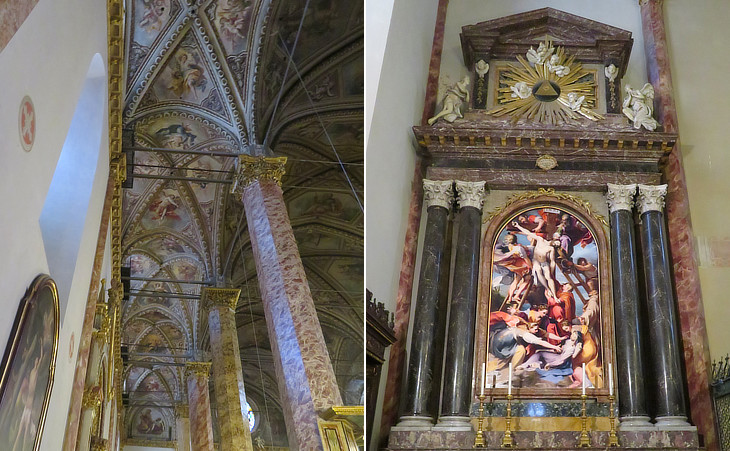
Cathedral - interior: (left) ceiling of a side aisle with frescoes of the late XVIIIth century; (right) Cappella di S. Bernardino in the right aisle which belonged to the guild of the merchants: Descent from the Cross by Federico Barocci (1569), a painter from Urbino
The two aisles have the same height of the nave, a characteristic of German Hallenkirche which departs from the design of a traditional basilica. The Cathedral does not have the usual series of chapels, but some of them were placed in the nave or in the aisles, similar to the chantries of Gothic cathedrals, e.g. that of Winchester.
The chapel of S. Bernardino stands to the right as one enters. It belonged to the
Merchants' Guild of Perugia, and by them it was magnificently decorated. The merchants purchased
their rights to the chapel in 1515, and they at once
began to adorn it with splendid woodwork. They were
naturally anxious to get a really good picture for their
altar, but they took their time to select a suitable
artist. Finally, they decided on Federigo Baroccio, of
whose skill they had heard great things, and they sent
their captain to Urbino where Baroccio lived, begging
him to come and paint their altar. The subject chosen
was the " Descent from the Cross." Federigo came and finished his picture between 1567 and 1568. (..) It gave the utmost satisfaction not only to the Merchants' Guild but also to "the whole city of
Perugia,". (..) The figures are full of action, and although
the colour is so warm and glowing, the atmosphere is
one of storm and tempest.
Margaret Symonds and Lina Duff Gordon - The Story of Perugia - 1898 (1912 ed.)
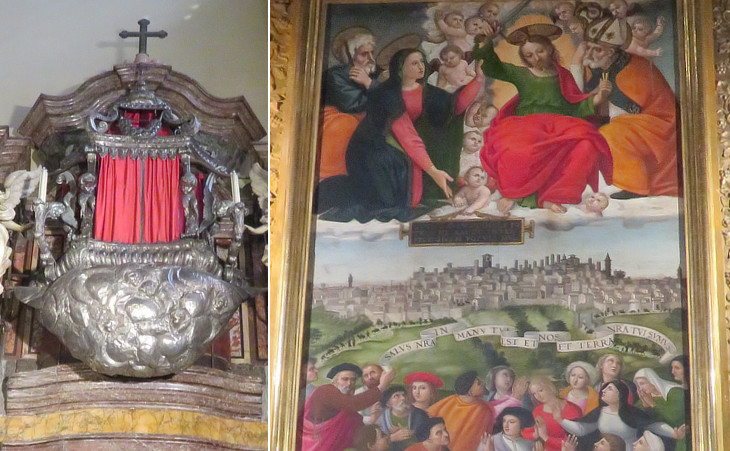
Cathedral - interior: (left) Cappella dell'Anello: reliquary of Mary's Ring; (right) altar in the left aisle: Mary pleads for the end of a plague, 1526 standard by Berto di Giovanni with a view of Perugia
Immediately opposite the chapel of S. Bernardino is
that of the Virgin's Ring. To the mere lover of art
the interest of this chapel is dead indeed. Perugino's
"Sposalizio": that wonderful design which Pietro created for his Duomo went, as so many of the very best Perugian
paintings went, to swell the galleries of Napoleon. The
poor picture has never travelled back across the
Alps as many of its contemporaries have done. (..) To the pious, a treasure of infinitely greater price
than Perugino's altar-piece is still shut safe and sure within the railings of the chapel, and this is the wedding-ring of the blessed Virgin Mary. It was brought to Perugia by a certain Winterio di Magonza, who
"piously stole it" from Chiusi in 1472. The Ring is kept in a wonderful and exquisitely worked silver
casket, but so extraordinary is its value, that it can only be seen five times a year, and during the rest of the time a monstrous silver cloud covers the spot where it is stowed away.
(..) There is charm in the purely imitative, nay
copied work of Berto di Giovanni. Berto was another
of Perugino's scholars. (..) It is evident that
he felt a passionate admiration for his fellow student,
Raphael. Symonds and Duff Gordon
A major pestilence hit Perugia in 1522-1528. Penitential processions were held in which the people walked praying for the end of the pestilence. The inscription of the standard says Salus nostra in manu tua est, et nos et terra nostra tui sumus! (Our salvation is in your hand and we and our land are yours!). The Virgin Mary is portrayed in the act of asking Jesus to sheath his sword, an indication that the pestilence is coming to an end, similar to what had occurred in Rome in 590.
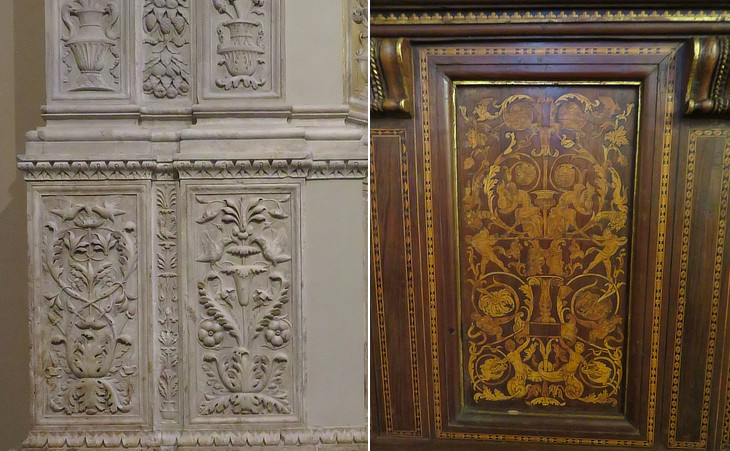
Cathedral - interior: (left) Baptistery chapel: 1479 marble frame; (right) Cappella dell'Anello: detail of a 1529 wooden inlay by Giovanni Battista Bancone which is based on grotesques (see other fine wood carvings at S. Pietro de' Cassinesi at Collegio della Mercanzia and at Cappella dei Priori)
The chapel of the baptistery has some good Lombard
stone work. Symonds and Duff Gordon
The decoration of the interior was completed in the XIXth century. Evidence of Renaissance works of art can be seen in some chapels, but in general the interior is rather bare.
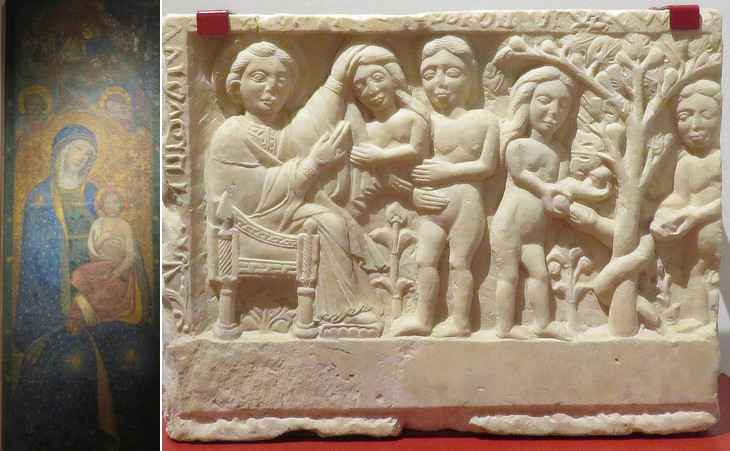
Museo del Capitolo (Deanery), in the rear of the Cathedral: (left) Madonna del Verde (Green - early XIVth century); (right) relief depicting the Creation of Eve and the Original Sin (XIIth century)
There is a fine "miraculous" picture on the third column to the right as one passes up the aisle of the
cathedral. A great many myths centre around it both
as a work of art and as a healing relic. Some say that
it is the earliest painting in Perugia, transferred to its
present place from the column of a Pagan temple where an early Christian painted it, others that it is the work of
Giannicola Manni. Concerning the miracles performed
by it, the strings of silver hearts and offerings bear ample
testimony. The painting is very charming, and we
hear that Perugino loved it as a boy and drew his
earliest inspirations from it. (..) She is so calm, young, and smiling, that one does not wonder at the
crowds of worshippers which linger round her shrine. Symonds and Duff Gordon
The altarpiece is named after the Virgin's green dress and in origin it was a fresco on a pilaster.
It was transferred to canvas in 1466 and it was heavily repainted. In 1979 it was moved to the museum.
The relief comes from the altar of the Madonna del Verde, but is an earlier work which was part of a series. The iconography of the Creation of Eve is unusual (see a IVth century sarcophagus and medieval reliefs at Rome, at Taormina and at Verona where Adam is portrayed while sleeping on the ground).
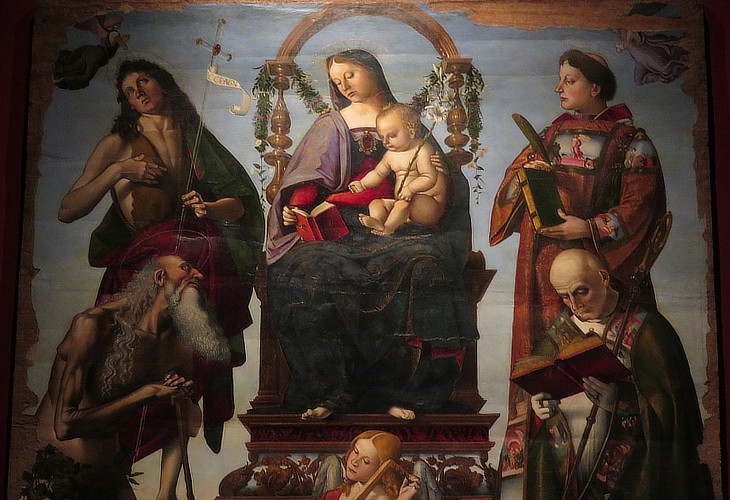
Museo del Capitolo: Pala di S. Onofrio by Luca Signorelli (see other works by him at Galleria Nazionale dell'Umbria and in the Cathedral of Orvieto
The first dated picture remaining is the altar-piece of the Perugia Cathedral, painted in 1484, of which Vasari writes: "Also in Perugia he painted many works; and among others in the Cathedral, for Messer Jacopo Vannucci of Cortona, Bishop of the city, a picture in which is Our Lady, Sant Onofrio, Sant Ercolano, S. John Baptist, S. Stephen, and an angel, most beautiful, who tunes a lute." (..) This is one of Signorelli's finest altar-pieces, the colour being especially rich and harmonious, and it shows, even more than the Loreto frescoes, the strength of Florentine influences. (..) I have pointed out the extreme realism with which the figures are treated, but this does not spoil the impressive grandeur of the painting, gained by the broad style and the stately simplicity of the composition. The Virgin sits firmly, with the mantle resting in heavy folds across her knees; the S. Stephen is overflowing with the vigorous life of youth; the splendidly - draped bishop is a powerful and majestic figure; and there is real tenderness and grace in the face of the angel. The painting has suffered from restoration, but on the whole is fairly well preserved, and may be seen to advantage in the quiet of this well-lighted winter-chapel. (..) One is at times conscious that, painting straight from the life, Signorelli's interest lay chiefly in a faithful reproduction of the body before him. (..) The S. Onofrio of the Perugia altar-piece, stood just so, a half-starved street-beggar, with baggy skin over rheumatic joints. (..) Each figure is a truthful study from life, and it was that which interested the painter, and not that he was representing saints and angels whose noble beauty was supposed to elevate the mind to a state of worship.
Maud Cruttwell - Luca Signorelli - 1899
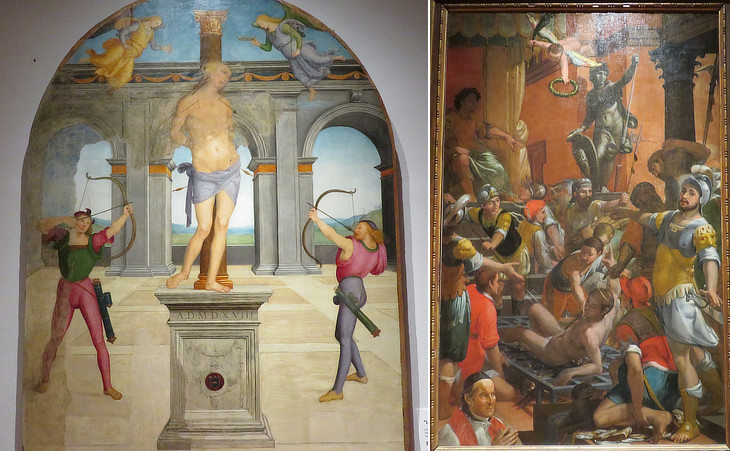
Museo del Capitolo: (left) Martyrdom of St. Sebastian by il Perugino (largely repainted); (right) Martyrdom of St. Lawrence by Anton Maria Fabrizi (early XVIIth century)
But if we can recognise the later weakness of
Perugino, the men who lived in his days and who
openly declared him to be the master of masters
never apparently recognised it. They seem to have
worshipped his decadence as they had worshipped his
dawn. They paid large sums for the feeble saints
which rose like ghosts beneath his brush. They desired no better man to save them in the time of
plague and bloodshed by the creation of a S. Sebastian
which they might carry in procession. (..) Il Perugino died of the plague in the year 1523 at Fontignano, a small village near Perugia, where he had
been called to paint a S. Sebastian in the time of pestilence. Symonds and Duff Gordon
St. Sebastian was invoked against the plague after the erection of an altar to him at S. Pietro in Vincoli ended a particularly virulent plague in 680. He was often associated in chapels and churches to St. Roch who also was invoked against the plague.
The Cathedral is dedicated to St. Lawrence, although there are no specific events which link the saint with Perugia. The altarpiece depicting his martyrdom followed the rules established in the XVIth century for the portrayal of the
ancient martyrs and their heroic sacrifices. In this altarpiece and in some others (e.g. at S. Lorenzo in Panisperna) St. Lawrence does not appear to be greatly suffering from his cruel martyrdom and the scene is more theatrical than realistic.
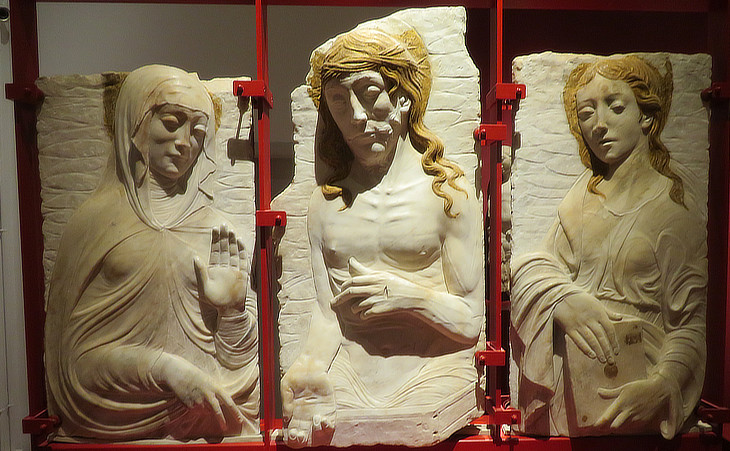
Museo del Capitolo: fragments of Altare della Pietà by Agostino di Duccio (another detail is shown in the image used as background for this page)
The Ranieri were an important family of Perugia (see the Annunciation by Perugino which is named after them). Nicolò Ranieri named the Ospedale di Santa Maria della Misericordia as his heir on the condition that they would erect a chapel in the Cathedral. The Prior of the hospice commissioned the work from Agostino di Duccio in 1473. The documentation specified reliefs of Christ "in pietà", between the Virgin and St John the Baptist. The altar was complete by 1474, when two local sculptors pronounced it to be well-executed and worthy of its cost. Agostino di Duccio was a Florentine sculptor and architect whose masterpiece is the Oratory of S. Bernardino in the western part of Perugia. Other works by him in Perugia are an altar to St. Lawrence in S. Domenico and Porta S. Pietro. The altar was not maintained and in 1792 it was demolished. The surviving fragments were restored and placed on display in the museum in 2013.
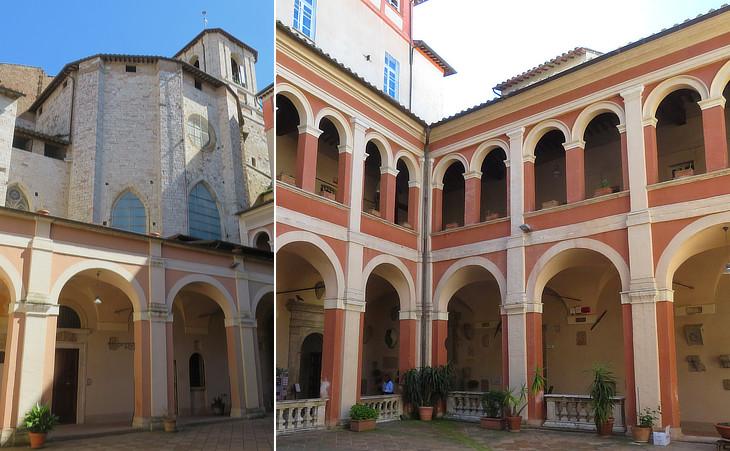
(left) Apse of the Cathedral; (right) main cloister
The main cloister was redesigned in the late XVIIth century. It stands on the highest point of the Etruscan Perugia and today it is possible to visit some of the ancient walls beneath it. The complex of these ancient structures is called Isola San Lorenzo, insula being the Latin word by which the Romans indicated an apartment block (see one at Rome), which has been adopted by archaeologists to designate a group of buildings, e.g. at Ostia and Pompeii.
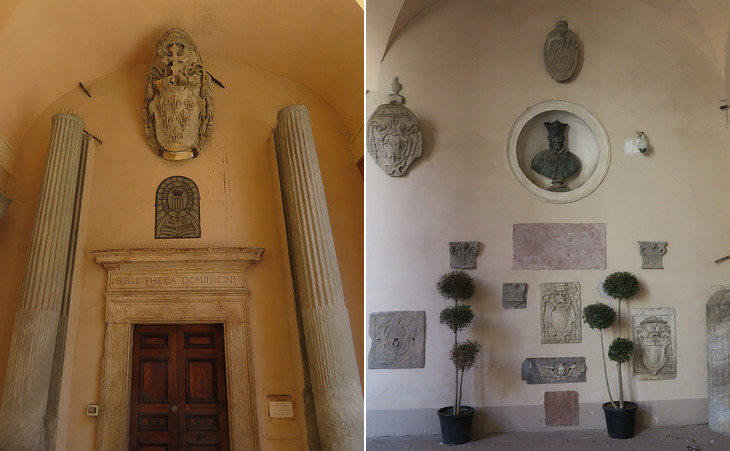
Details of the main cloister showing coats of arms, ancient columns and the entrance to Biblioteca Dominicini
We would mention also with grateful thanks
Dr Marzio Romitelli, Arcidiacono of the cathedral
of Perugia, who generously opened his library to
us. Symonds and Duff Gordon
The library of the Cathedral originates from a bequest made in 1693 by the Dean Antonio Dominicini. Not all the coats of arms on the walls of the cloister belong to Bishops of Perugia. Some of them relate to the governors of the town, e.g. that with three bees of Cardinal Antonio Barberini iuniore, governor in 1631-1634 or come from demolished buildings, e.g. the large one of a Farnese Cardinal. A number of columns and architectural decorations from the Cathedral are on display near the entrance to Museo del Capitolo.
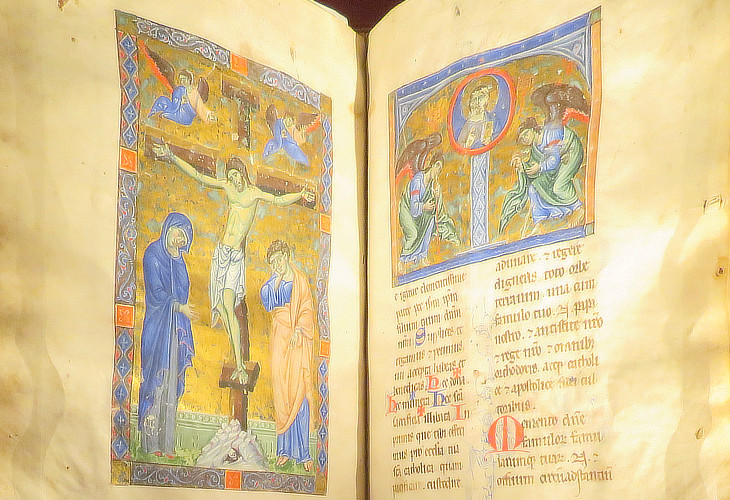
Museo del Capitolo: Missal from St. John of Acre: pages showing a Crucifixion and the letter "T"
A missal is a liturgical book containing instructions and texts necessary for the celebration of Mass. The book is recorded in Perugia at the beginning of the XIVth century while the last stronghold of the Crusaders in the Holy Land fell in 1291. It probably belonged to the Knights of the Holy Sepulchre, who, after quitting Acre, moved to Cyprus and eventually some of them reached Perugia where the Order run a hospital. You may wish to see other illuminated manuscripts at S. Pietro de' Cassinesi, Siena and in the Farnese Collection.
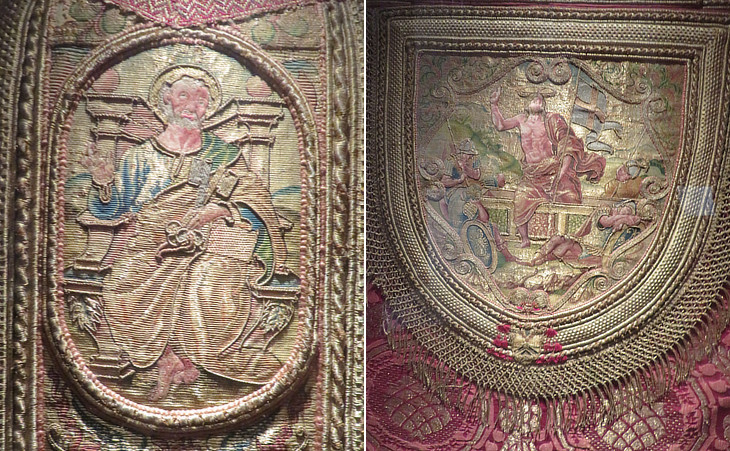
Museo del Capitolo: details of XVIth century liturgical vestments depicting St. Peter and the Resurrection of Jesus based on sketches made by painters
The clergy are rich
at Perugia; the people have never lost their strong religious sense, which the advance of civilisation has turned from a wild fanaticism to a tone of more sober devotion, and the services are always impressive in S. Lorenzo - the whole body of the choir
filled with choristers, the priests forming themselves
into splendid coloured groups around the bishop's chair. Symonds and Duff Gordon
See some XIIIth century embroidered liturgical vestments at Anagni.
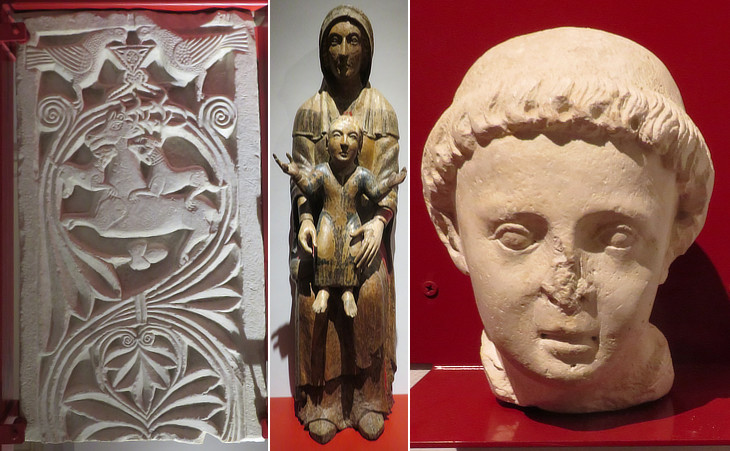
Museo del Capitolo: (left) medieval fragment from the Cathedral which calls to mind depictions of Actaeon turned into a stag and killed by his own hounds; (centre) a carved and painted XIIIth century wooden statue from a countryside church; (right) head of a deacon, maybe St. Lawrence, attributed to Arnolfo di Cambio
In the left transept of the cathedral three of the
popes are buried,. (..) The little porphyry urn holds all the earthly remains of the three
popes, Innocent III., Urban IV., and Martin IV., who all died at Perugia. Symonds and Duff Gordon
The head of the deacon might have been part of a funerary monument by Arnolfo di Cambio, who depicted two deacons in the Monument to Cardinal Guillaume de Braye at Orvieto. He is known to have worked at a lost fountain in Perugia.
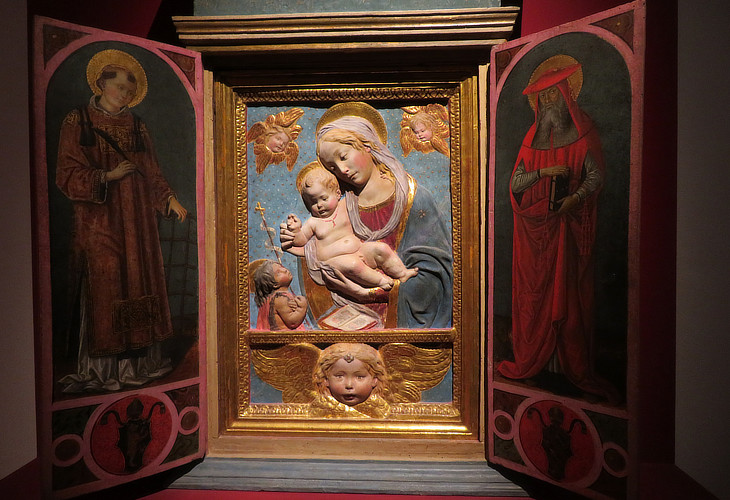
Museo del Capitolo: portable altar in stucco with Sts. Lawrence and Jerome, (1491-1492); the latter is portrayed as a savant (learn more about his iconography)
This fine portable altar was a gift to the Cathedral by Dionisio Vannucci, Bishop of Perugia in 1482-1491, and by Girolamo Balbano, his successor. The central panel is attributed to a local painter of the school of Pinturicchio or to Benedetto da Maiano, a Florentine, sculptor and carver who worked in the Cathedral. The coral necklace of the Infant Jesus can be noticed also in other paintings of that period, e.g. at Terni and at Urbino. Another fine portable altar by Annibale Carracci which belonged to Cardinal Odoardo Farnese can be seen at Palazzo Barberini.
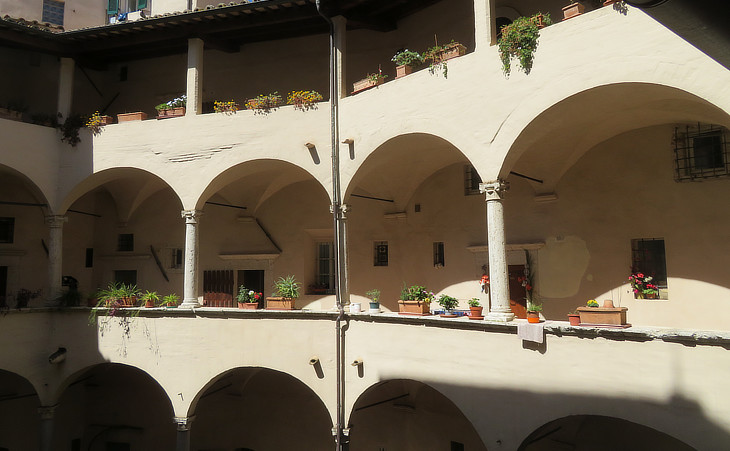
Inner cloister (end of the XVth century with three levels of arcades); it was the residence of the clergy in charge of the Cathedral
The building is still one of the finest relics of the mediaeval times the city boasts of. It stands to the left of the Duomo - a great mass of bricks, with huge cavernous rooms inside, and walls some six to eight feet thick in places. The cloister is comparatively modern, but the beautiful open-air staircase which leads from it down into the Piazza Morlacchi is probably very much the same as it was in the days when the popes arrived to take a holiday in their loved Umbrian city. Symonds and Duff Gordon
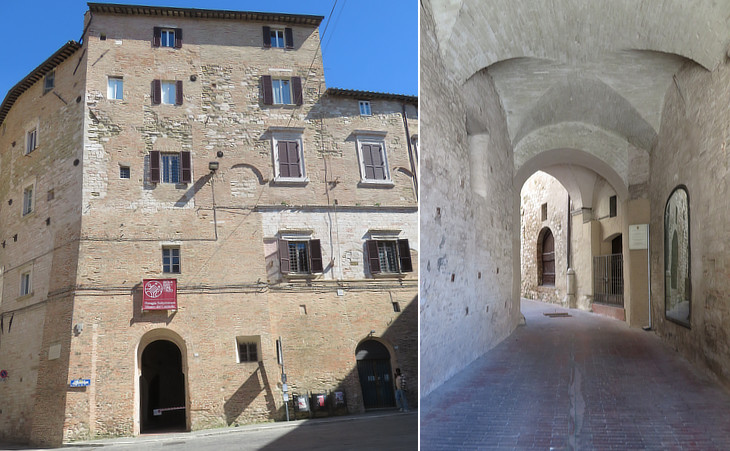
(left) Rear façade of "Isola S. Lorenzo"; (right) carriageway leading to the inner cloister
The evidence of the Etruscan walls follows the line of the high ground, beneath the houses of the city, in a serpentine course below the Cathedral.
George Dennis - The Cities and Cemeteries of Etruria - 1848
Where the present cathedral now stands there was only the
little old church of S. Lorenzo and a big and beautiful tower with a cock on the top of it. Symonds and Duff Gordon
Perugia Sotterranea, a separate section of Museo del Capitolo, gives access to remains of the ancient town which include a stretch of a Roman street, a fountain, an Etruscan wall and other exhibits (you may wish to see pages on the National Archaeological Museum of Perugia and on the Tomb of the Volumni).
Move to Walls and Gates, The Two Piazzas, Interior of Palazzo dei Priori, Galleria Nazionale dell'Umbria, The Papal Street (Borgo S. Pietro), S. Pietro de' Cassinesi, The Tomb of the Volumni, The Archaeological Museum or wander about to see other churches, palaces and fountains.