
All images © by Roberto Piperno, owner of the domain. Write to romapip@quipo.it.


Notes:
Page revised in July 2025.
All images © by Roberto Piperno, owner of the domain. Write to romapip@quipo.it.
Notes:
Page revised in July 2025.
 Morlupo and Leprignano (Capena)
You may wish to see an introduction to this section with a map of the area first.

(left) Street leading to the old town; (right) part of Palazzo Orsini
Morlupo has nine hundred and thirty inhabitants. It is very singularly situated, at a little distance from the Via Flaminia, to the right, at about eighteen miles from Rome. The lower part of the town stands on the brink of a precipice, and the whole is attached by a sort of isthmus to higher land above. The country is pretty and well wooded. This place very much resembles Castel Nuovo, scarcely two miles distant, and on the same road.

(above) Fragments of reliefs walled on houses of the historical part of Morlupo (a detail of one is shown in the background image of this page); (below) S. Giovanni Battista: funerary inscription of "Iohannis comi de Leo dux" (badly carved in poor Latin)
An inscription discovered in 1592 during the enlargement of the parish church indicates that it was built by Earl John, son of Duke Leo, who was buried there in the first year of the pontificate of John IX (898). At the time the Roman countryside and the City itself were subject to raids by the Saracens. The Popes promoted the formation of new fortified settlements in more defensible positions. Eventually Castrum Morilupo cum suis pertinensis (the Castle of Morlupo and its dependencies) was assigned to S. Paolo fuori le Mura, a fortified Benedictine monastery.
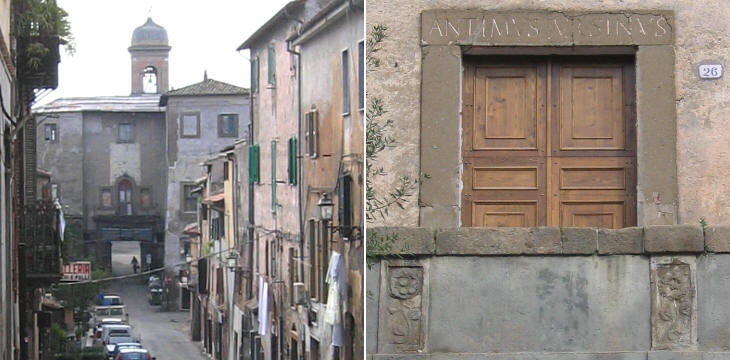
(left) Gate of the old town; (right-above) "Antimus Ursinus" on the lintel of an entrance to Palazzo Orsini; (right-below) a wolf (It. lupo) holding a cock, symbol of Morlupo and two eels and a compass, heraldic symbols of the Orsini and of Anguillara
The Orsini family filled the annals of Rome for almost half a millennium with the deeds and names of its countless members, among whom there were popes, cardinals and there were generals of great fame. (..) The Orsini, divided over time into many family branches. They called themselves after their possessions the Orsini of Monte Giordano and of Campo di Fiore in Rome, the counts and lords of Nola in Campania, of Tagliacozzo in Abruzzo, of Gravina and Manupello, of Monterotondo, Vicovaro, S. Angelo, Pitigliano, Anguillara and Bracciano. (..) The Orsini dominated the Sabine region on the Anio from Vicovaro to Nerola and Monterotondo, and the Etruscan country from Sutri downwards across the Lake of Bracciano to Galera and the sea shore of ancient Caere.
Ferdinand Gregorovius - Latian Summers - transl. by Dorothea Roberts - 1870
In the XIIIth century the Orsini of Pitigliano acquired some of the fiefdoms of Monastero di S. Paolo, including Morlupo and nearby Fiano, where they placed many other heraldic symbols. In 1425 Pope Martin V Colonna destroyed the castle of Morlupo and for a few years the town was assigned to his family;
it returned to the Orsini in 1432.

(left) S. Giovanni Battista; (right) its bell tower
In 1575 Orso Orsini killed his wife and her supposed lover, a Farnese of the Duchy of Castro. He was banished from Pitigliano and soon after he was murdered by the Farnese. He was succeeded by his brother who assigned the fiefdom of Morlupo to the ten children of Orso. Antimo, the eldest, became the new lord of the town and he relocated there in 1578 when he was nineteen. He spent the meagre resources of his fiefdom to enlarge the family palace and the parish church which both were redesigned in a Renaissance style in 1593-1598. Although one of his heraldic symbols was a compass, usually associated with the motto non errare (do not make mistakes), he ran into debt and in the early XVIIth century he was forced to sell Morlupo to the Mattei.

Palazzo Borghese: (left) portal and balcony; (centre) detail of the portal showing the crowned eagle of the Mattei; (right) coat of arms of the Borghese
The Mattei had another fiefdom (Giove) in the River Tiber Valley and after a few years they sold Morlupo to Cardinal Scipione Borghese who passed it to his cousin Marcantonio II Borghese, Prince of Sulmona. Both the Mattei and the Borghese were not interested in the palace of Antimo Orsini and they preferred to build a new small one outside the old town. The Borghese had plenty of other fiefdoms and villas and the Morlupo palace was usually the residence of their representative. Palazzo Orsini was turned into a granary.

Former nunnery and church of S. Caterina da Siena
An inscription inside the church indicates that it was consecrated in 1632 by the Bishop of Nepi and Sutri. The nunnery was created by buying some adjoining buildings at the initiative of the Venerable Suor Caterina Paluzzi (1573-1645), a Dominican nun who was credited with having performed miracles and having been tempted by the Devil. Her life was narrated in detail by Angela Anastasia Tosi, another nun, in a book published in 1731, but Suor Caterina Paluzzi was never recognized the status of Blessed.

S. Giovanni Battista: (left/centre) XVIIth or XVIIIth century altarpieces: The Virgin Mary between Saints Jerome and Francis and The Nativity; (right) modern statue of St. Anthony the Hermit aka the Abbot
The Borghese embellished the parish church with some fine altarpieces. It is not unusual to find a statue of St. Anthony the Hermit in a Roman countryside church (e.g. at Soriano and Montopoli). On January 17th the statue is carried outside the building to bless the domesticated animals of the nearby farms.

Strolling in old Morlupo

Countryside south of Morlupo: Strada della Valle leading to the site of ancient Capena and to the River Tiber
The city of Capena was the capital of a district of the same name, bordering upon the country of the Veientes on one side, and upon that of the Falisci on the other. (..) By following the cross-road from the Flaminian, after leaving the town of Morlupo on the right, it will be found to descend toward the valley of the Grammiccia. (..) The city was placed on one side of the crater of an extinct volcano, or at least of a hill, which has all the appearance of volcanic origin. (..) Capena has something in it altogether peculiar: the situation, though commanding, seems singularly secluded, the country is once more wholly in a state of nature; nothing of animated life, except here and there flocks of goats or sheep, feeding on some green eminence or in the valleys below, which are spotted with such innumerable patches of underwood, that, were it not for the browsing of these animals, it would soon become a forest. The desolation is complete: Silvanus, instead of Ceres, is in full possession of the soil.
George Dennis - The cities and cemeteries of Etruria - 1843
Leprignano, a large village of 754 inhabitants, situated nearly five miles to the left of the Via Tyberina, in the road to Fiano. It is in the territory of the Capenates, and little more than two miles from Capena, at Civitucola or San Martino. The country about Leprignano is extremely pretty, and most agreeably diversified with woods, valleys, and eminences. (..) At Leprignano, which is near the site of Capena, persons might be found, who are in some degree acquainted with the country. Gell

(left) Roman inscription in the Town Hall (it comes from the Forum of ancient Capena and it celebrates Varia Italia, a priestess of a Temple to Ceres and Venus); (centre) Roman column and statue; (right) fragment of a small ancient statue on the wall of a house in the historical part of the town
That Capena continued to exist as late as the time of Aurelian, is proved by scattered notices in ancient writers and by inscriptions. (..) When interest was again awakened in the antiquities of Italy, Capena was sought for, but long in vain. Cluver placed her site at Civitella San Paolo, not far from the Tiber; Holstenius, at Morlupo, while Galetti, from the evidence of inscriptions discovered on the spot has determined it to have been at Civitucola, an uninhabited hill, half-way between the two near Leprignano. (..) Dempster made the blunder, as others had done before him, of placing it in Latium, on the Appian Way, because the Porta Capena of Rome opened on that road, as Servius had said:- Porta Capena juxta Capenos est. There can be little doubt that the Gate derived its name, not from Capena, which lay in the opposite direction, but from Capua. Dennis
In 1952 evidence of Lucus Feroniae, an ancient shrine of the inhabitants of Capena, was found few miles east of Leprignano, and near it the remains of a small town and of Villa dei Volusii, a Roman villa.

(left) Palazzo dei Monaci; (right) stairs of Palazzo dei Monaci
The medieval town belonged to Monastero di S. Paolo fuori le Mura, similar to Morlupo and other nearby towns. The abbots leased the fiefdom for very long periods. The tenant gained most of the rights of the owner and generally did not care about the long term improvement of the site. Records indicate that in 1594 the inhabitants of Leprignano complained to the Pope for the poor management and lack of interest by the abbots of S. Paolo. The feudal property of Leprignano lasted until 1818.

(above) S. Leone, the church of the old cemetery: medieval relief; (below) inscription in old S. Michele Arcangelo celebrating Pope Sixtus IV
The inhabitants of Leprignano gradually moved away from the historical centre of the town. A new parish church and the Town Hall were built at the beginning of the XXth century in a site which was easily reached by a new road between Via Flaminia and Via Tiberina. Today the town has more than 10,000 inhabitants and it is located within commuting distance of Rome.

(left) New S. Michele Arcangelo (from the old church): Jesus in the act of blessing between St. Peter and St. Paul by Antonio del Massaro da Viterbo aka il Pastura (signed and dated 1452 - see another painting by him at Canino); (right) Madonna delle Grazie, an XVIIIth century chapel built on the site of an earlier one
The small church housed a painted medieval image (now lost) of the Virgin Mary which according to tradition performed miracles. Today it is dedicated to Madonna ad Rupes, a shrine near Castel Sant'Elia (both Capena and Castel Sant'Elia are part of the diocese of Civita Castellana).

(left) Coat of arms of Capena; (centre) hostel for Franciscan friars (1751); (right) detail of Torre dell'Orologio (XVIIth century); the clock shows the Italian Hour
In 1933 Leprignano was renamed Capena, but its coat of arms retains a reference to the old name: a small hare (in Italian: lepre). Leprignano however is thought to derive from fundus Apronianum, a latifundum (large estate) of the late Roman Empire.

Piazza del Popolo (opposite Palazzo dei Monaci) in 2025
Most historical buildings were badly modified or abandoned in the XXth century, but recently the very heart of the historical town was carefully restored and repainted. It is a lively place, full of atmosphere, where events are staged at different times of the year.

Strolling in Capena in 2008 (the house in the left image retains a small ancient relief and a fragment of the base of a column)

(left/centre) Modern statues at Piazza del Popolo in June 2025; (right) lateral view of Palazzo dei Monaci
Return to page one (Introduction, Riano and Castelnuovo di Porto) or move to Lucus Feroniae or to Villa dei Volusii.


