
All images © by Roberto Piperno, owner of the domain. Write to romapip@quipo.it.


Notes:
Page revised in October 2020.
All images © by Roberto Piperno, owner of the domain. Write to romapip@quipo.it.
Notes:
Page revised in October 2020.
 - How to Spend a Peaceful Day in Rome
In the last two centuries the introduction of effective and widely available means for producing light have changed the rhythm of daily life in most of the world. In general we tend to wake up and to go to bed later than our ancestors used to. We therefore often miss that part of the day which historically was regarded as the most important one: the rise of the Sun.

S. Giovanni in Laterano and Palazzo Lateranense
From an astronomical viewpoint dawn is marked by the presence of a weak light produced by the reflection of the sun (which is still below the horizon) on the atmosphere surrounding our planet.
Rome is located at a latitude of 41° 54' N (almost the same as that of Boston), so in winter one does not need to wake up very early to watch the monuments of Rome regain their natural colours.
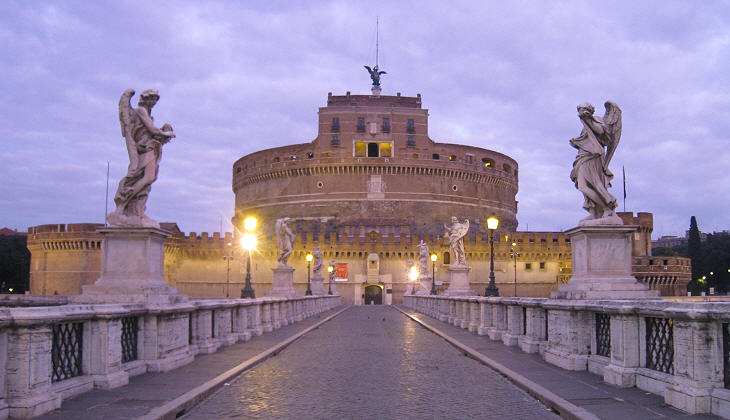
At dawn the many statues of Rome are already at their place to meet the first visitors; they probably miss the good old days when they did not have to wait so long to see a human being.
In the distant past the counting of the hours started at dawn (and finished at sunset): in Italy this way of counting the hours continued until 1847; it required frequent adjustments of the clocks,
but it better responded to the needs of activities based on daylight (more on the Italian hour).
At dawn, particularly on a Sunday or on a public holiday, there are very few cars around and one can stand at the centre of Via della Conciliazione to take a symmetrical long distance view of S. Pietro without risking one's neck. This picture was taken on January 6, which is a public holiday in Italy.
When the sun has just risen over the horizon monuments receive already quite a lot of indirect light: it is the right moment to take pictures without shadows. Public lights are not yet turned off, but they are already void of effect.

Colonna Traiana and SS. Nome di Maria
Roman Aurora and Greek Eos were the goddesses of Dawn, more precisely of sunrise, the moment the Sun appears above the horizon.
In Homer's Iliad Eos is called the rosy-fingered and many other poets after him have chanted the first appearance of the Sun; these literary memoirs come to mind when one sees
the monuments of Rome assume a reddish tone.
Dido, Queen of Carthago, discovered at dawn that Aeneas' ships had left the harbour:
Aurora now had left her saffron bed,
And beams of early light the heav'ns o'erspread,
When, from a tow'r, the queen, with wakeful eyes,
Saw day point upward from the rosy skies.
She look'd to seaward; but the sea was void,
And scarce in ken the sailing ships descried.
(Virgil - Aeneid - Book IV 1-6; translation by John Dryden)
... and then she cursed Aeneas and his descendants (the Romans).
The first sunrays have a special quality; they seem to be absorbed, rather than reflected and the very white stones of the Monument to King Victor Emmanuel gain from this property: later on full daylight will give the monument the appearance of a sugar-coated wedding cake.

Tempio di Venere e Roma and bell tower of S. Francesca Romana
There are no high mountains very near Rome and the first direct rays reach the buildings on the Palatine hill at an almost perpendicular angle: this favours the view of the grand niche of Tempio di Venere e Roma and of the shining ceramics
placed on the bell tower of S. Francesca Romana.
It is the moment our ancestors thanked God for the return of the Sun. The star around which the Earth orbits was regarded as a deity in many ancient religions. Temples were built on an east-west axis; when the faith in polytheism subsided, the Sun was regarded as the sole creator of
the world: the cult of Sol Invictus (Unconquered Sun) was predominant among the Roman legionaries towards the end of the IIIrd century. An echo of these beliefs survives in current religious practices: dawn is the main canonical hour of the Roman Catholic Liturgy: it is the time of the Lauds, the morning praises; for Muslims it is the time of Fajr, the first and the most important prayer of the day.
Gradually the rays of the Sun reach the lower parts of Rome; for some time the buildings to the west of the seven hills are still in the dark, while their domes and their loggias are already bathed in sunshine.

View from Terrazza Caffarelli

Other Days of Peace pages:
A Sunny Day in Villa Borghese
At the Flea Market
At the Beach
Voicing Your Views ..... and feeling better
Christmas in Rome
Eating Outdoors
Celebrating the Foundation of Rome
A visit to Roseto di Roma
The procession of La Madonna de Noantri
Running the Marathon
Visiting Multi-ethnic Rome
Finding Solace at the Protestant Cemetery
Attending 2007 July Events
Rome's Sleepless Night
Attending Winter Ceremonies
Jogging at Valle delle Camene
Sailing on the River to see the Bridges of Roma
An October Outing to Marino
A Special Spring Weekend
Watching the Parade
Attending a Funeral ...and enjoying it!
Embassy-hunting in Parioli
Visiting Rome on a Hop-on-Hop-off Bus
Visiting Rome in the Moonlight
Celebrating Eritrean Michaelmas in Rome
Baroque Fireworks
Playing in the Snow at the Janiculum
Watching the Pride Parade
Reading Ovid at St. Peter's
Reading Memoirs of Hadrian at Villa Adriana
Visiting the Movie Sets at Cinecittà
Looking up at the Ceilings of the Vatican Palaces
Spending the Last Roman Day at St. John Lateran's Cloister
Reading Seneca at Caracalla's Baths
Walking the Dog at Valle della Caffarella
Keeping up with new discoveries at Museo Ninfeo


