
All images © by Roberto Piperno, owner of the domain. Write to romapip@quipo.it.


Notes:
Page added in November 2026.
All images © by Roberto Piperno, owner of the domain. Write to romapip@quipo.it.
Notes:
Page added in November 2026.
 Via Balbi
You may wish to see pages on Palazzo Ducale and on Strada Nuova first.
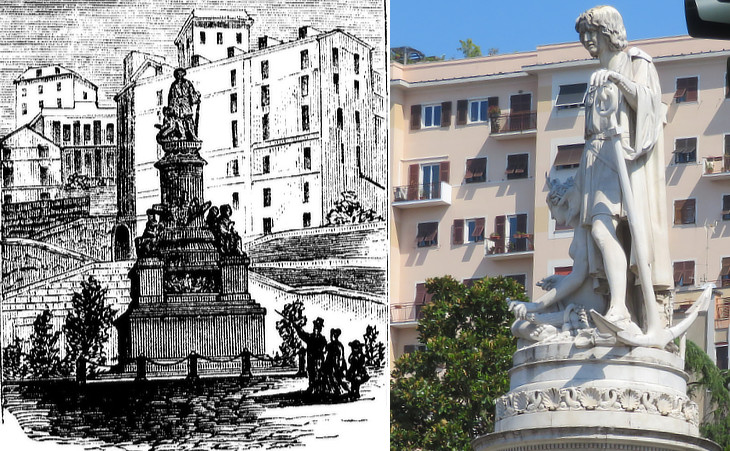
(left) Statue of Columbus at Piazza Acquaverde (from "Mark Twain - The Innocents Abroad 1869"); (right)
the statue today (the area was heavily bombed during WWII)
The Strada Balbi
commences from a square called the Piazza Verde surrounded with trees of no luxuriant growth; but at one end, a magnificent double
flight of stairs, and houses, gardens, and churches intermingled, rising in terraces one above the other give it a pleasing and
romantic appearance. The same street terminates in another square called the Piazza del Vastato, whence begins the
Strada Novissima,
which forms a sweep and joins the Strada Nova, that opens into a lesser square called Piazza delle Fontane Amore.
These three streets, though not sufficiently wide perhaps for our taste, especially considering the elevation of the buildings that
border them are, strictly speaking, composed of lines of lofty palaces, some of which are entirely of marble, and all ornamented with
marble portals, porticos, and columns.
John Chetwood Eustace's Classical Tour of Italy in 1802 (publ. 1813)
At the W. end of the Via Balbi is the Piazza Acquaverde, with the monument to Columbus, and the Railway Terminus, close to which is the
Palazzo Doria. (..) The monument was erected in 1862 and it consists of a huge square pediment,
at the corners of which are seated figures of Geography, Discretion, Steadfastness and Religion; higher up is a circular pedestal decorated
with prows of galleys, on which stands a marble group of Columbus and a woman representing America. On the pediment below are four reliefs,
representing events in the life of Columbus. The inscription is in excellent taste; it is simply "A Cristoforo Colombo la Patria."
The Italians are naturally proud of the discoverer of America, although they took no part in his voyages.
John Murray - Handbook for travellers in Northern Italy - 1897
The monument was designed by Lorenzo Bartolini, a leading Neoclassical Florentine sculptor (1777-1850).
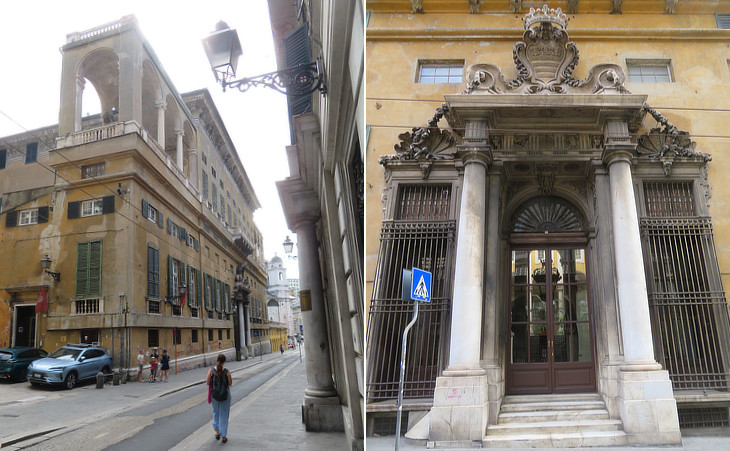
(left) Palazzo Gio. Agostino Balbi, the first at the eastern end of the street next to Piazza del Guastato or Vastato with SS. Annunziata;
(right) XVIIIth century portal with the coat of arms of the Durazzo which shows three fleurs-de-lis, a heraldic symbol of France
I saw also the two Palaces of the Signori Balbi, in the Street of the Annunciata. In one (on the left hand)
I saw, other rich things, a Looking Glass, valued at threescore thousand Crowns. (..) The round Pillars set in the Porch of this House,
and the Giuochi d' acqua in the Garden will make themselves be taken notice of.
Richard Lassels' The Voyage of Italy, or a Compleat Journey through Italy in ca 1668
The palace marks the beginning of the monumental Strada dei Balbi
who had another palace down the road (today's Palazzo Reale - see below). The design of the palace by Bartolomeo Bianco greatly resembles that of
Palazzo Doria Tursi, the most imposing building of Strada Nuova.
The Balbi became one of the wealthiest families of Genoa in the last quarter of the XVIth century also by marrying two daughters of
Giacomo Durazzo, Doge of Genoa in 1573-1575.
These marriages together with very successful business enterprises raised the status of the Balbi. They proposed the opening of a new street
to the Genoese government, which they committed to financing.
They owned the palace until 1709 when they sold it to Marcello Durazzo. The origin of the Durazzo family is uncertain; in general it is thought that the founder of the Genoese branch came from Durazzo, a small port in Albania,
but a more prestigious possibility is that they descend from a Neapolitan branch of the House of Anjou.
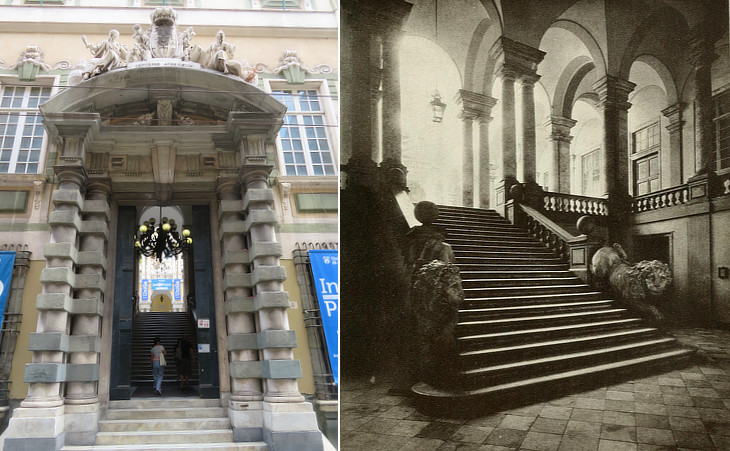
Palazzo dell'Università o del Collegio dei Gesuiti: (left) portal; (right) staircase from "Robert Walter Carden - The City of Genoa - 1908"
(the early XVIIIth century lions by Francesco Biggi were based on a design by Domenico Parodi - see below)
But it is not fair to speak as if at Genoa there were nothing but low-life to be seen, for the place is the
residence of some of the grandest people in the world. Nor are all the palaces ranged upon dusky alleys; the handsomest and most
impressive form a splendid series on each side of a couple of very proper streets, in which there is plenty of room for a coach-and-four to
approach the big door ways. Many of these doorways are open, revealing great marble staircases with couchant lions for balustrades
and ceremonious courts surrounded by walls of sun-softened yellow.
Henry James - Italian Hours - 1909 (this essay was written in 1878)
Due to the sloping ground, the typology of the palaces was adjusted
to the specific conditions of each site. The palaces have generally three or four stories, combining the entrance hall with spectacular
open staircases, courtyards, and loggias overlooking garden layouts, positioned at different levels in a relatively tight space.
As a result of the constraints, each palace has its own architectural solution and individual character.
UNESCO - documentation
supporting the inclusion of the "Strade Nuove di Genova" in the List of the World Heritage Sites (2006).
With the suppression of the Society of Jesus in 1773, the college underwent a change in management, but it did maintain its educational vocation.
It was the Democratic Republic
of Genoa, in spite of its short life (1797-1805), that reorganized the University inside the Jesuit college.
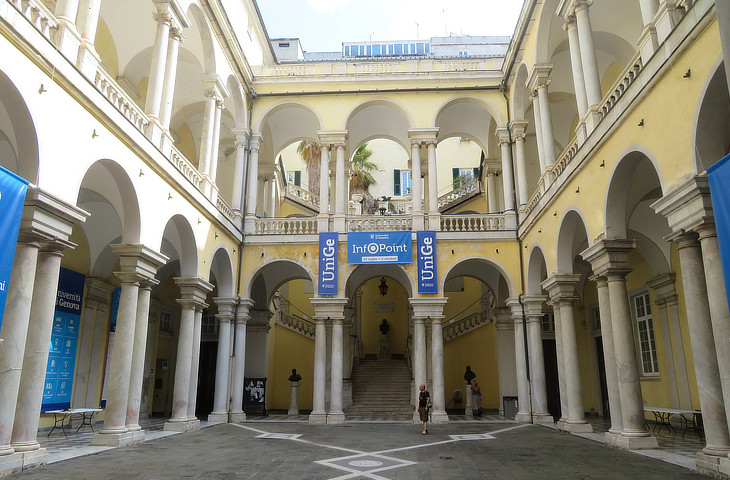
Palazzo dell'Università: courtyard
Palazzo della Università, Strada Balbi. The vestibule
and the cortile are amongst the finest specimens of the kind. Two huge lions are placed at the top of the staircase, whose walls
contain some curious inscriptions from destroyed churches. The halls are finely decorated with frescoes by Genoese painters and
oil pictures. The Hall of Medicine contains some bronze statues by Giovanni di Bologna, and in the Great Hall are six of the Cardinal
Virtues by the same sculptor, whilst in a third room above are a great number of his bas-reliefs in bronze.
The museum of natural history is interesting as containing a complete collection of the birds and fishes of this part of the world. (..)
The University consists of three faculties. Law, Medicine, and Humanities. In each faculty there is a senate composed of twelve doctors,
by whom the degrees are granted.
John Murray - Handbook for travellers in Northern Italy - 1843
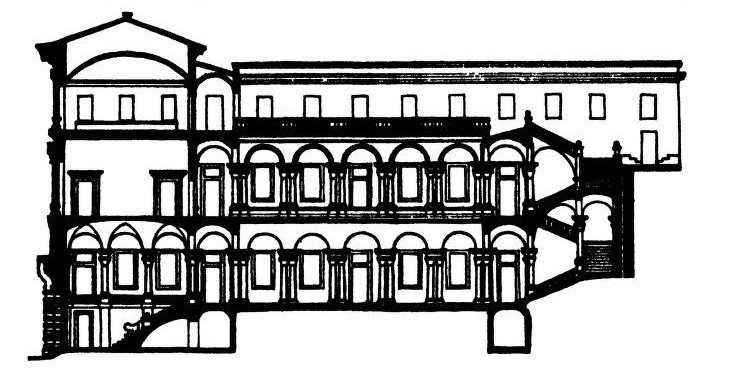
Palazzo dell'Università: plan of its section from "Rudolf Wittkower - Art and Architecture in Italy 1600-1750"
Bartolomeo Bianco, Genoa's greatest Baroque architect, followed the lead of the Palazzo Doria Tursi. His most accomplished structure is the present University, built as a Jesuit College; it presents an ensemble of incomparable splendour. For the first time he unified architecturally the vestibule and courtyard, in spite of their different levels; in the courtyard he introduced two tiers of lofty arcades resting on twin columns; and at the far end he carried the staircase, dividing twice, to the whole height of the building. Fully aware of the coherence of the whole design, the eye of the beholder is easily led from level to level, four in all. The exterior contrasts with the earlier Genoese palazzo tradition by the relative simplicity of the design without, however, breaking away from the use of idiomatic Genoese motifs. Wittkower
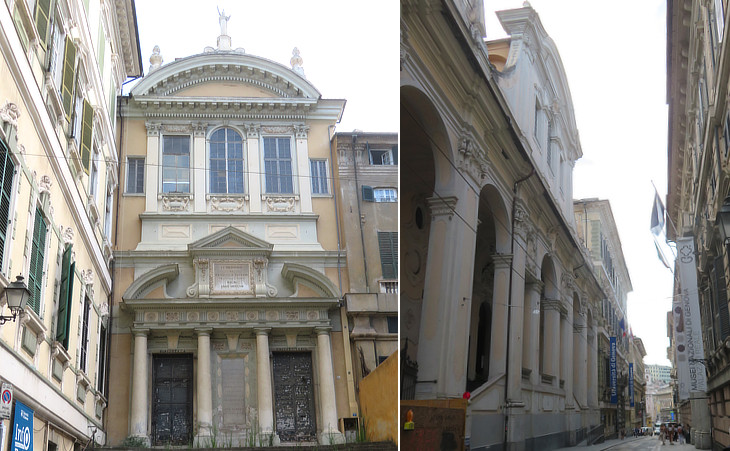
(left) SS. Gerolamo e Francesco Saverio, now housing the library of the University; (right) SS. Vittore e Carlo
In the church belonging to the University is a bas-relief in bronze, the Descent from the Cross, good, by Giov. di
Bologna, Behind the University Palace is the Botanic Garden. The library, which is open to the public, contains about 45,000 books, principally theological, but does not contain any book rarities. Murray - 1843
The façade was perhaps designed by Pietro Antonio Corradi, a pupil of Bartolomeo
Bianco. Its twin broken tympana show the influence of some façades of Roman churches designed by Gian Lorenzo Bernini, e.g. at
S. Maria del Popolo. The construction was financed
by Francesco Maria Balbi, who is celebrated in a 1658 inscription. At the time the Balbi had some motifs for showing their munificence because in 1650 an inscription had been placed at
Palazzo Ducale to chastise the crimes of Gianpaolo Balbi, who, dazzled by the prospect of becoming Arch-Duke of Liguria and Corsica,
plotted to hand over the city to the French. It said: To Gian Paolo Balbi, vilest of men and soaked in iniquity, a foul murderer and assassin, a clipper of good coin and an
utterer of false: a notorious thief and plunderer of the revenues; who was found guilty of a villainous plot against the majesty of the Republic
and his own country. His goods were sold by the State, and all his children made outlaws. This stone is erected in the year 1650 to the
eternal ignominy of his execrable memory.
SS. Vittore e Carlo was built at the initiative of Giovanni Agostino Spinola, a Discalced Carmelite friar.
The church was designed by Bartolomeo Bianco in 1635, whereas the façade was added in 1743 at the expense of Gerolamo Durazzo. It was
dedicated to St. Charles
Borromeo who was canonized in 1610; the reference to St. Victor the Moor, an early IVth century martyr, was added in the XIXth century when a church dedicated to him
was demolished.
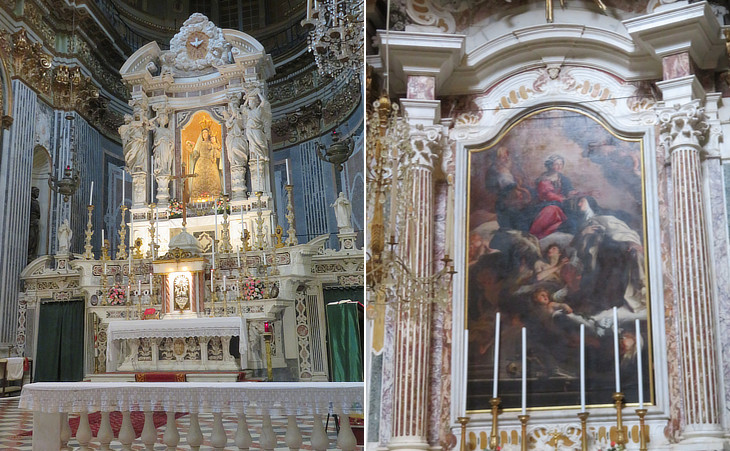
SS. Vittore e Carlo: (left) Main altar by Giovanni Battista Casella from the lost church of S. Domenico; (right) St. Teresa receives the necklace and the mantle by Giovanni Andrea Carlone
The few days we stayed at Genoa were employed in visiting the most remarkable churches and palaces. In some of the churches I found a profusion of
ornaments, which had more magnificence than taste. There is a great number of pictures; but very few
of them are capital pieces.
Tobias Smollett's Travels through France and Italy in 1765
Andrea Carlone was son of Giambatista, from whose style and that of Rome, and afterwards from that of Venice,
he formed a mixed manner. He painted much in Perugia and the neighbouring cities. (..) Returning to Rome, he improved his manner; and his works
after that period are much his best. Such are some passages from the life of S. Xavier, at the Gesu in Rome; and many poetical subjects at Genoa,
in the palaces Brignole, Saluzzo, and Durazzo. (..) He left so many fine works as to be ranked among the painters of Genoa most worthy of
commemoration.
Luigi Lanzi - The History of Painting in Italy - 1810
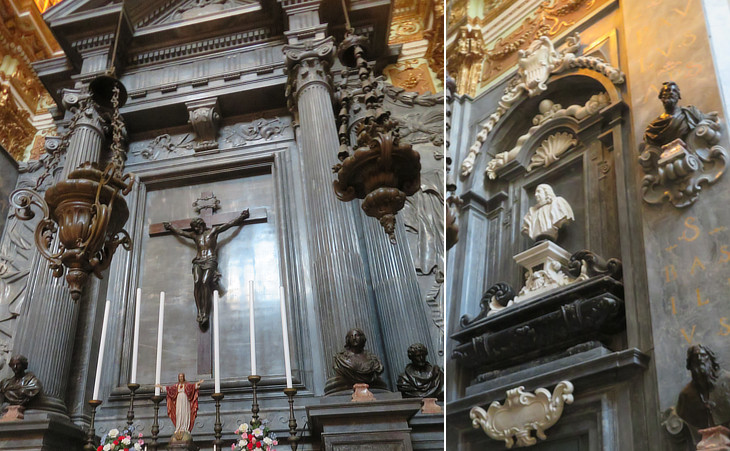
SS. Vittore e Carlo - Cappella Franzoni: (left) bronze crucifix by Alessandro Algardi; (right) bust of a
member of the Franzoni family by Domenico Guidi
The Altars on both sides of the Churche with their little Chapels, do each of them belong to some Nobleman of Genoa -,
and it seems as if each strove to out-do the other in Richness and Beauty of Ornament.
Edward Wright Some observations made in travelling through France, Italy, &c. in 1720, 1721, and 1722
This chapel is very different from those prevailing in the churches of Genoa. This because Cardinal Giacomo Franzoni (1612-1697) spent most of
his life in Rome where he arrived in 1639 and where he held important offices. During the pontificate of Pope Innocent X, he was named general treasurer of the Apostolic Chamber and the Pope offered him the cardinalate which he
declined. He was created cardinal by Pope Alexander VII in 1658. He decided that his family chapel at
Genoa should be designed and decorated by Alessandro Algardi, Innocent X's preferred
sculptor. The chapel was completed by Domenico Guidi, Algardi's best pupil. The Cardinal himself was buried at
S. Maria della Vallicella in Rome.
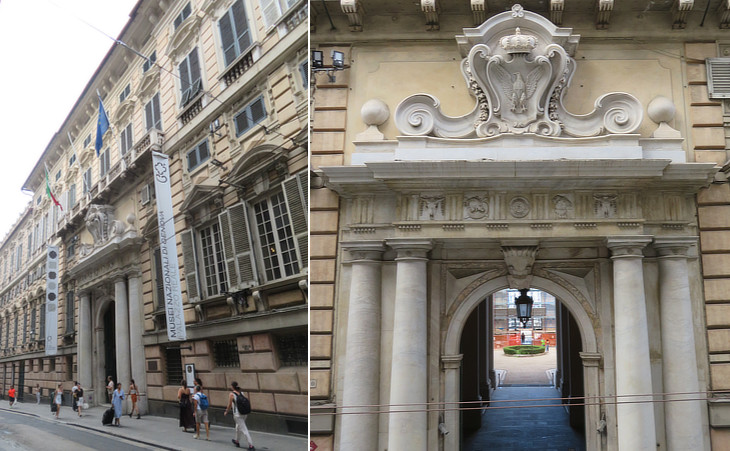
Palazzo Reale aka Palazzo Balbi Durazzo: (left) façade; (right) portal with the heraldic symbol of the House of Savoy, Kings of Sardinia and after
1861 of Italy
The palace of the Durazzo family was erected by the celebrated Fontana; the length and elevation of its immense front astonish the spectator, who perhaps can scarce find in his memory a similar edifice of equal magnitude. Besides the rustic ground floor, it has two grand stories, with mezzanine, and over the middle part consisting of eleven windows, an attic. The portal, of four massive Doric pillars with its entablature, rises as high as the balcony of the second story. The mezzanine windows, with the continuation of the rustic work up to the cornice, break this magnificent front into too many petty parts, and not a little diminish the effect of a double line of two and-twenty noble windows. The portico, which is wide and spacious, conducts to a staircase, each step of which is formed of a single block of Carrara marble. Eustace
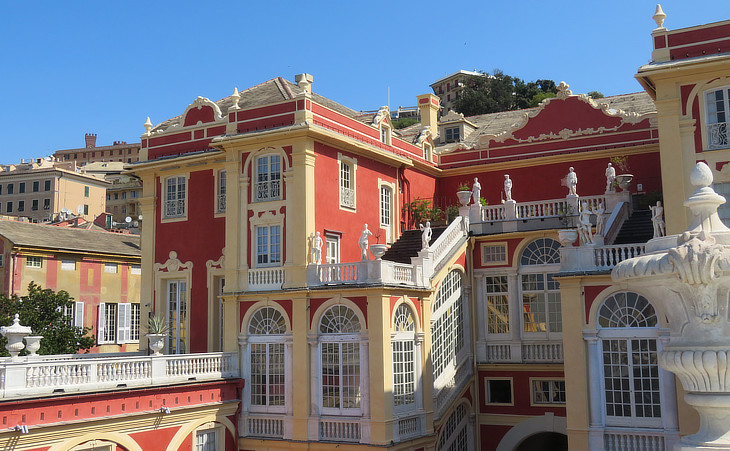
Palazzo Reale: view of its southern side
The interior of these mansions is seldom unworthy of their external appearance. Marble staircases with bronze balustrades, conduct to
spacious saloons, which open into each other in a long series, and are all adorned with the richest marbles and tapestries,
with valuable paintings and gilded cornices and panels. (..) These apartments open on a terrace, which commands an extensive view of the bay,
with its moles and lighthouse, and of the rough coast that borders it on one side. Eustace
These palaces are each built round a court, and the best apartments are on the third floor, for the benefit of light and air.
The roof being flat is adorned with shrubs and trees, as myrtle, pomegranate, orange, lemon, and oleanders twenty-five feet high,
growing not in boxes only, but in the open ground several feet deep, brought hither and supported on arches: fountains of water
play among these artificial groves, and keep up their verdure and shade during the heat of summer.
Some of the terraces on a level with apartments, paved with the same marble, decorated with the same plants, and lighted at night,
appear to be a continuation of the rooms; but looking up you see the stars over-head instead of a painted ceiling.
Louis Simond -
A tour in Italy and Sicily - 1828
Palazzo Reale. Formerly belonging to the Durazzo family, and called Marcello Durazzo, but purchased by the late king, and completely fitted
for a royal residence. The interior cannot be seen when the king is at Genoa. It contained a fine collection of pictures, amongst which were,
in the Salone, several portraits of the royal family of Spain, the Durazzo family, &c., interesting from their authenticity.
Murray

Palazzo Reale: busts of members of the Durazzo family: the brothers Giovan Luca (left - by Filippo Parodi) and Eugenio
(right- by Bernardo and Francesco Maria Schiaffino)
A large antechamber then leads to ten saloons either opening into one another, or
communicating by spacious galleries. These saloons are all on a grand scale in all their proportions, adorned with pictures and busts,
and fitted up with prodigious richness both in decorations and furniture. Eustace
Filippo Parodi (1630-1702) was Genoa's first
and greatest native Baroque sculptor; he had studied for six years with Bernini himself (see a bust of King Louis XIV
by Bernini). Some of his works of the 1660s and 70s still have a
High Baroque flavour. They correspond to the emotional and sensitive style of Melchiore Caffà and
Raggi; he often introduced a graceful note
which occasionally endows his work with an un-Roman, rather French elegance. (..) Filippo Parodi was the man of destiny for the further development
of Genoese sculpture. Among his pupils were (..) the two Schiaffino. Wittkower
The palace was bought in 1679 by the brothers Giovan Luca and Eugenio Durazzo.
The former died shortly after the purchase, whereas the latter lived until 1705 and promoted the redesign of the building.
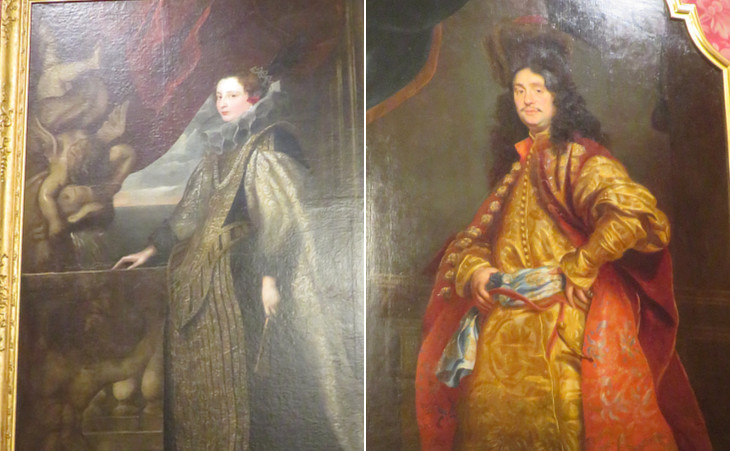
Palazzo Reale: (left) Caterina Balbi Durazzo by Anthony van Dyck, notice the very elegant dress which was made on purpose for the portrait; (right) Giovanni Agostino Durazzo in Ottoman attire by Frans Luycx
(1604-1668); see two 1622 portraits in Persian attire by van Dyck
Salone di Giordano, A portrait by Vandyke; and some other pictures worthy of observation are here. Murray
I say nothing of the immense pictorial treasures which hung upon the
walls of all the rooms through which we passed; for I soon grew so weary of admirable things, that I could neither enjoy nor understand them.
My receptive faculty is very limited, and when the utmost of its small capacity is full, I become perfectly miserable, and
the more so the better worth seeing are the things I am forced to reject. I do not know a greater misery; to see sights, after
such repletion, is to the mind what it would be to the body to have dainties forced down the throat long after the appetite was satiated.
Nathaniel Hawthorne - Passages from the French and Italian note-books - 1872
The collection of paintings which Hawthorne saw did not include some of those portraying members of the Durazzo family
which were moved to other palaces of the family when the building was bought by the Savoy in 1824. In 1915 the Savoy bequeathed the palace to the
Italian State which turned it into a National Museum and recovered some of the Durazzo paintings (Palazzo Spinola di Pellicceria is another
National Museum housing a collection of paintings).
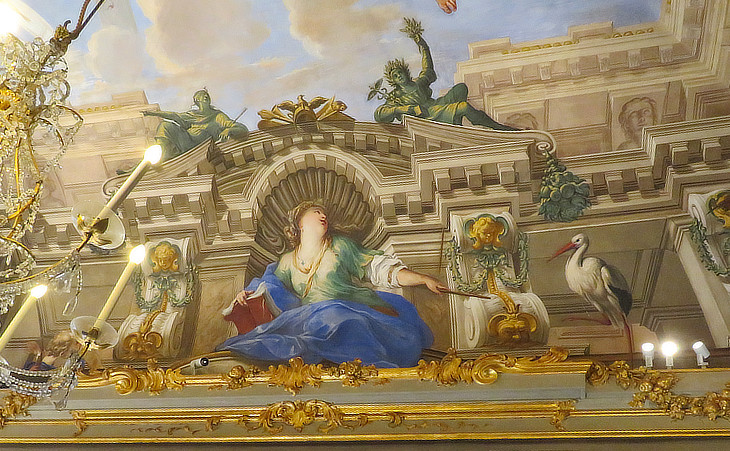
Palazzo Reale: Antechamber of the Duke of Genoa: ceiling depicting the Fame of the Balbi by Valerio Castello (1624-1659, son of Bernardo):
detail showing Vigilance, one of the Virtues of the Balbi; the crane symbolizes vigilance because it was said that cranes appointed one member to stand guard while the
rest of the flock slept
The painted ceilings in these palaces are a glorious adornment;
the walls of the saloons, incrusted with various-colored marbles, give an idea of splendor which I never gained from anything else.
The floors, laid in mosaic, seem too precious to tread upon. In the royal palace, many of the floors were of various woods,
inlaid by an English artist, and they looked like a magnification of some exquisite piece of Tunbridge ware; but,
in all respects, this palace was inferior to others which we saw. Hawthorne
Valerio Castello is one of the greatest members of the Genoese School. He no sooner made his appearance
amongst his fellow scholars than he distanced the oldest of them, and soon afterwards even rivalled his masters. (..) He is not however frequently met with, as he died early, and from the great celebrity he acquired, his works were in much request in all the first collections, and thus his productions were dispersed. Lanzi
Valerio Castello
soon set out on conquests of his own. Impressed by Correggio, Van
Dyck, and Rubens, he produced a few masterpieces of extraordinary intensity during a
career of hardly more than ten years. A real painter, he loved violent contrasts and fiery,
scintillating hues; he is dramatic, sophisticated, and spontaneous at the same time. Wittkower
In 1831 King Carlo Alberto gave the title of Duke of Genoa to Ferdinando, his cadet son and the palace was refurbished in line with
the fashion of the time. The ceilings however were not touched and they testify to the skill and talent of the Genoese painters
in a field which is typical of the Baroque style (see a page on some ceilings of Roman churches and another one on the
ceilings of Palazzo Pamphilj at Valmontone).
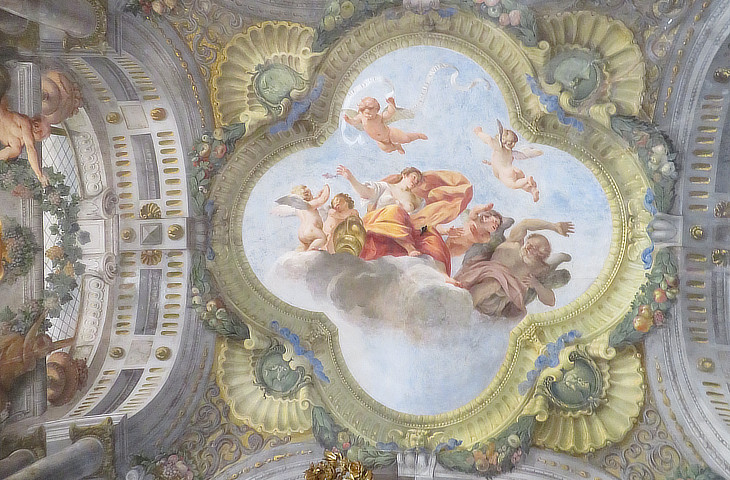
Palazzo Reale: Bedroom of the Duke of Genoa: Spring and Winter or Youth and Old Age, ceiling by Agostino Mitelli (1651-1653)
Bologna continued to be the acknowledged centre of quadratura painting, this tradition was handed on through Girolamo Curd, to Angelo Michele Colonna and Agostino Mitelli. These two artists joined forces and for a time almost monopolized quadratura painting, working together at Parma, Florence, Genoa, Rome, and even Madrid, where Mitelli died. Their rich scenographic views, foreshadowing the Late Baroque by virtue of the complexity of motifs, form a decorative court style in its own right rather than a mere framework for figure painting. They educated a large school, and since Mitelli claimed to have invented quadratura with more than one vanishing point, it is he who must be credited with having laid the foundation for the rich eighteenth-century development of this speciality. Wittkower
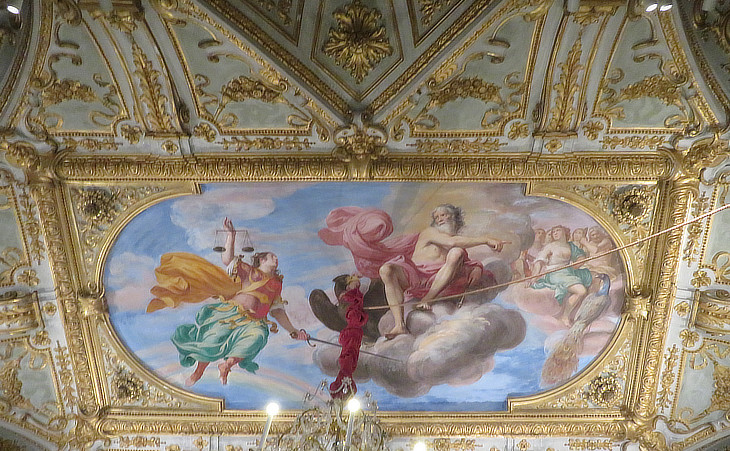
Palazzo Reale: Galleria della Cappella: Justice and Jupiter by Giovanni Battista Carlone (ca 1655)
The protagonists of the older Genoese fresco style are Giovanni Andrea and Giovanni Battista Carlone who
belong to that fertile Lombard family which had great decorators among its members for three centuries. Wittkower
In this ceiling the painted section is limited to the central part and the vaulting is decorated with gilded stuccoes, a technique which can
be seen also in some Roman churches, e.g. at S. Maria in Trivio. In the XVIIIth century another member of the Carlone family (Carlo Innocenzo)
adopted the fully illusionistic approach at the Belvedere Palace in Vienna (1721).
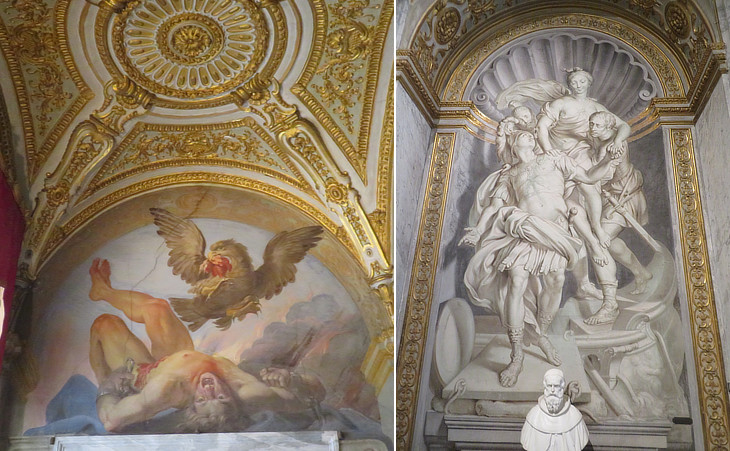
Palazzo Reale: Galleria della Cappella: (left) The Punishment of Prometheus for stealing fire from Olympus and giving it to humans by Giovanni Andrea Carlone (1694); (right)
Venus and Mars, monochrome painting by Lorenzo de Ferrari (1734)
And ready-witted Prometheus Zeus bound with inextricable bonds, cruel chains, and drove a shaft through his middle,
and set on him a long-winged eagle, which used to eat his immortal liver; but by night the liver grew as much again everyway as the long-winged
bird devoured in the whole day.
Hesiod - Theogony - Translated by Evelyn-White
The later fresco style is mainly represented by
Domenico Piola (1618-1703) and Gregorio de Ferrari (1647-1716). It is they above all who brought about the glorious climax of this art at Genoa. Wittkower
Lorenzo De Ferrari (1680-1744) was the son of Gregorio and the grandson of Piola.
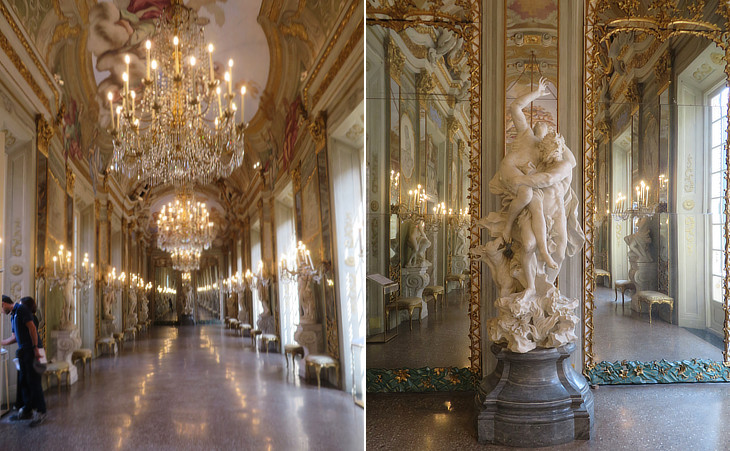
Palazzo Reale: (left) Galleria degli Specchi (Hall of the Mirrors, see that at Palazzo Doria Pamphilj in
Rome); (right) The Rape of Proserpina by Bernardo Schiaffino; the background image for this page shows a detail of the stucco decoration of this hall
One of saloons surpasses in the splendor of its gildings
any thing of the kind, I believe, in Europe.
In this palace the Emperor Joseph was lodged during his short visit to Genoa, and is reported to have acknowledged that it far surpassed any that
he was master of. The merit of this compliment is, that it is strictly true; for few sovereigns are worse accommodated with royal residences
than the Austrian princes. Eustace
Francesco went to Rome, studied with Rusconi, and after his return to Genoa executed from the
latter's model the celebrated Pluto and Proserpina group of the Palazzo Reale. Wittkower
Today it is uncertain whether Francesco or Bernardo was the author of the group. Its design builds upon
that by Bernini at Villa Borghese.
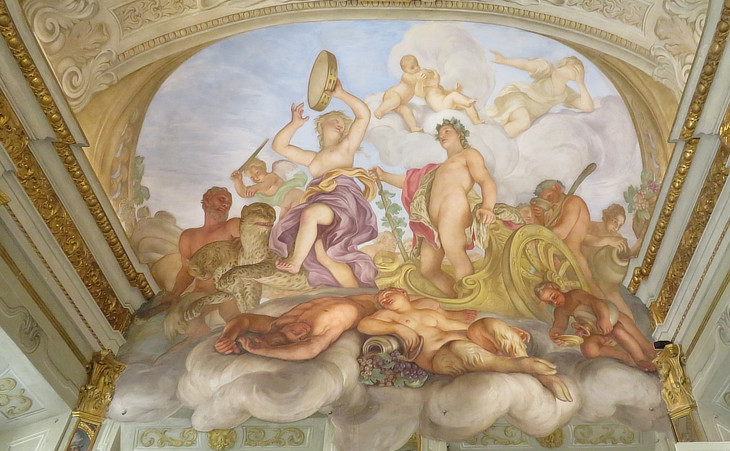
Palazzo Reale - Galleria degli Specchi: Triumph of Bacchus by Domenico Parodi (see that by Annibale Carracci at
Palazzo Farnese)
Domenico Parodi executed the
elaborate paintings and gildings which decorate the ceiling and walls of this gallery. Murray
Domenico Parodi was, like his father, a sculptor, and moreover an architect; but he owed his reputation to painting. Less equal to himself
than Piola, he enjoyed a greater fame; as he had a more enlarged genius, a more extended knowledge of letters and the arts, a more
decided imitation of the Greek design, and a pencil more pliable to every style. He first studied in Venice under Bombelli, and there remain,
in a casa Durazzo, some excellent copies of Venetian pictures made at that period; nor did he forsake this style during the many succeeding
years that he studied in Rome. He painted, in a good Marattesque style,
the noble picture of S. Francesco di Sales at the Filippini,
and several other pictures. (..) His most celebrated work is the Sala of the palace Negroni.
(..) Other noble houses were also ornamented by him in fresco;
and the gallery of the Sig. Marcello Durazzo, decorated with stories,
and fables, and chiariscuri, which might be taken for bassirilievi, is a work much resembling that at palace Negroni. Lanzi
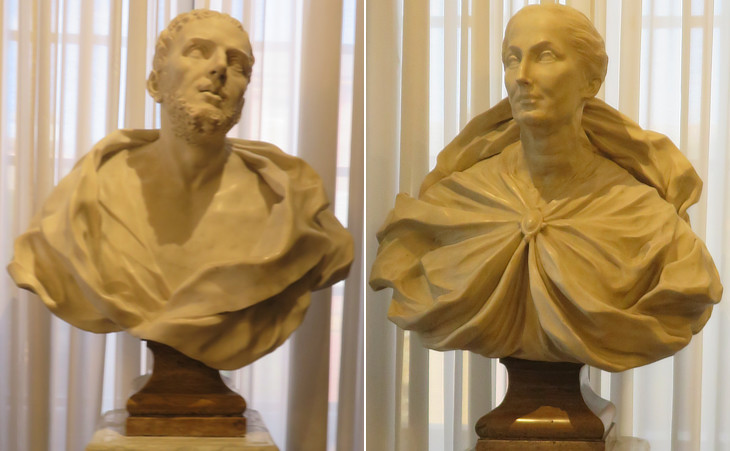
Palazzo Reale: Busts attributed to Giacomo Antonio Ponsonelli portraying an imaginary Roman emperor (or a saint) and an old lady
Filippo Parodi was the man of destiny for the further development of Genoese sculpture. Among his pupils were (..)
Giacomo Antonio Ponsonelli (1654-1735) who travelled with him to Venice and Padua. Wittkower
Old descriptions of the palace suggested that the lady portrayed in one of the busts was a member of the Durazzo family.
The bust calls to mind a masterpiece by Alessandro
Algardi, i.e. that of Donna Olimpia Maidalchini at Rome, because of the attention paid to the garments.
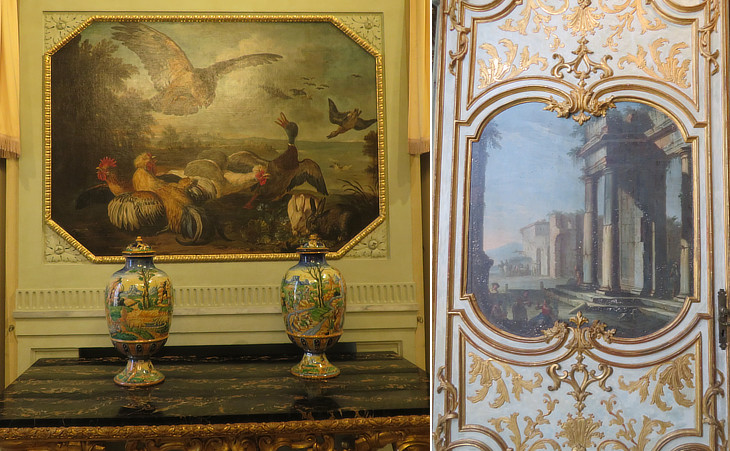
Palazzo Reale: (left) panel by David de Coninck (1636-1687) which was bought by the King of Sardinia in 1821; (right) painted door (see those at
Palazzo Corsini in Rome)
Move to
The Ancient Town
The Cathedral
The Doria's Palaces and Church
Palazzo del Principe
The Harbour
The Piazza Nuova (Palazzo Ducale)
The Strada Nuova
Via Balbi
Two Grand Churches
A Walk to Castello
In the Heart of the Old Town
Old and New Portoria
Museums: Exhibits from Churches
Museums/Palaces: Tursi and Bianco
Museums/Palaces: Rosso and Spinola
Some Environs of Genoa
Anthony van Dyck's 2026 Exhibition


