All images © by Roberto Piperno, owner of the domain. Write to romapip@quipo.it.


Notes:
Page revised in October 2020.
All images © by Roberto Piperno, owner of the domain. Write to romapip@quipo.it.
Notes:
Page revised in October 2020.
 in the Heart of the City
The skyline of Rome is characterized by domes, rather than by bell towers. Most of the largest churches do not have an eye-catching bell tower: this is especially true for those built during the Renaissance and afterwards.
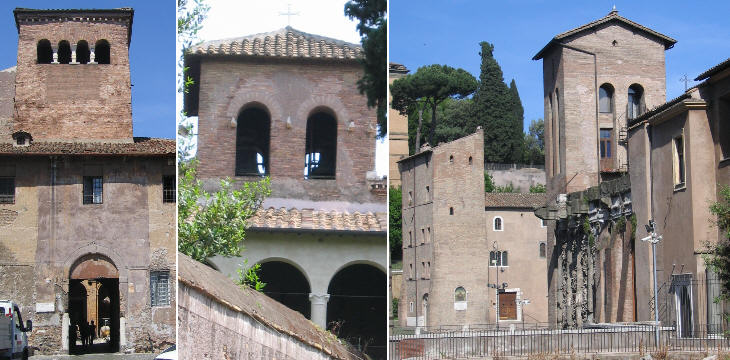
(left) Santi Quattro Coronati; (centre) San Saba; (right) San Nicola in Carcere
Some of the oldest Roman bell towers were built with a defensive aim:
both SS. Quattro Coronati and S. Saba stood in isolation at the top of a hill and were surrounded by walls: their
bell towers were thickly built and had very little decoration as if they belonged to a medieval castle,
rather than to a church.
The bell tower of S. Nicola in Carcere was originally part of the defensive system built by the Pierleoni family who controlled this part of Rome in the XIIth century.
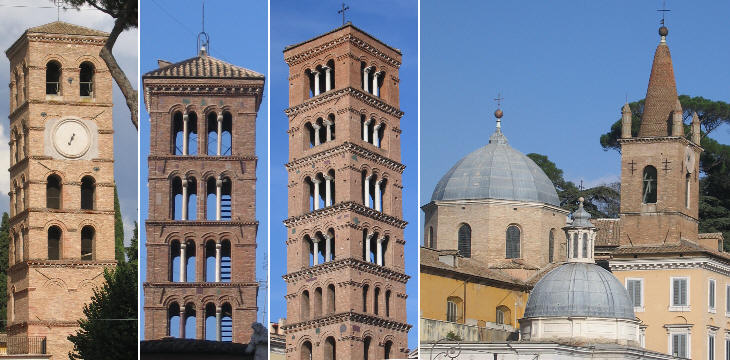
One characteristic and beautiful feature of the Roman
churches is the brick campanile. One finds these towers
in all parts of the city. They date from the 12th century
for the most part. (..) These campaniles are all built of dark brownish brick,
divided into many storeys by cornices of brick into which
are introduced little modillions or corbels of white marble
with a dentil course below them. The windows have two
lights grouped in pairs in the upper storeys, round arched,
with brick strings at the springing decorated with dentils.
Some of them have plaques of majolica let into the
walls, or discs of porphyry or green serpentino, and now
and then crosses of the same sunk in cruciform panels.
Thomas Graham Jackson - Byzantine and Romanesque Architecture - 1920
During the XIIth and the XIIIth century the popes acquired greater authority and many old churches were enlarged or
rebuilt: their bell towers follow a common Romanesque pattern: they are marked into clearly defined stages by horizontal courses. The narrow windows show the influence of Byzantine architecture.
The bell tower of S. Maria del Popolo was built at a later period and is more similar to bell towers of northern Italy (another bell tower of this kind can be seen at S. Maria dell'Anima).
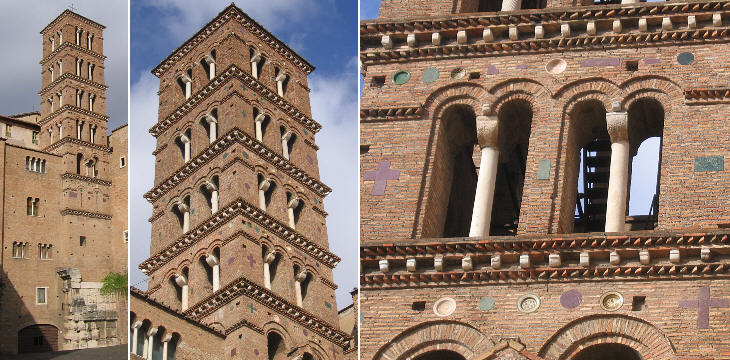
That of SS. Giovanni e Paolo on the
slope of the Celian hill is perhaps the most beautiful, and from its setting it has a quaint picturesqueness. It stands on the top of a Roman building, of which
a pier and the springers of an arch protrude from the
lower storey. Jackson
The bell tower of SS. Giovanni e Paolo is perhaps the finest Romanesque bell tower of Rome: the first two
storeys (above the ancient Roman stone structure) were completed by 1118 and in 1150 the other five storeys were added.
In 1190-1210 ca. the whole bell tower was decorated with porphyry slabs and Arab ceramics.
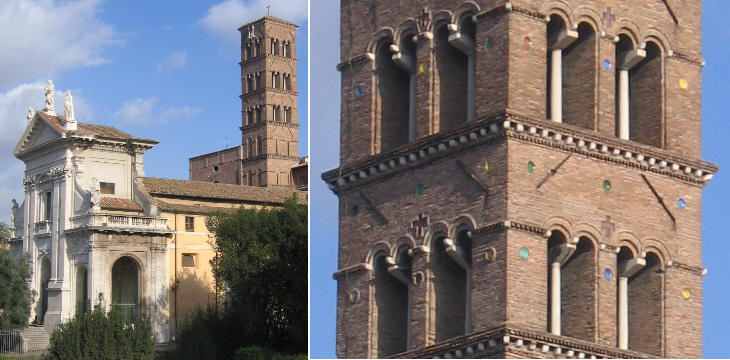
That of S. Francesca Romana,
on the platform of Hadrian's great temple of Venus and
Rome, is scarcely less beautiful. Jackson
The bell tower of S. Francesca Romana was built approximately in the same period and in the same style and
decoration as that of SS. Giovanni e Paolo. Other Romanesque bell towers were built at S. Alessio,
S. Bartolomeo all'Isola,
S. Benedetto in Piscinula, S. Cecilia, S. Grisogono, S. Croce in Gerusalemme, S. Eustachio, S. Giorgio in Velabro,
S. Giovanni a Porta Latina, S. Gregorio Nazianzeno, S. Lorenzo in Lucina, S. Marco, S. Maria in Monticelli,
S. Maria in Trastevere, S. Maria Maggiore, S. Pudenziana, SS. Rufina e Seconda, S. Sisto Vecchio, S. Spirito in Sassia and SS. Michele e Magno.
They are so many that one could say that the typical bell tower of Rome is a Romanesque one. Its design was always appreciated and when a church was largely
redesigned its Romanesque bell tower was not modified.
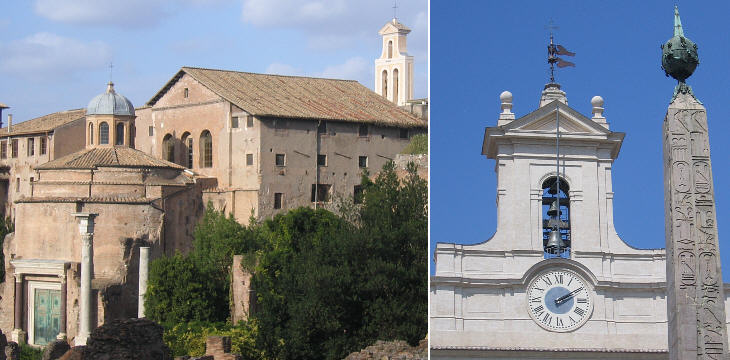
(left) SS. Cosma e Damiano; (right) Palazzo di Montecitorio
In 1251 the Franciscans started to build S. Maria in Aracoeli: the original
design included a bell tower, but in 1260 the Constitutiones Narbonensi, the rules established by the general chapter of the order in
the French town of Narbonne recommended that Franciscan churches should visually portray the modesty and poverty of the order: so the design of
S. Maria in Aracoeli had to be revised and the bells were placed in a simpler structure,
vaguely resembling a sail (in Italian it is called campanile a vela - sail bell tower).
This structure was adopted also in some non-Franciscan churches and in public buildings.

(left) Sant'Agnese in Agone; (right) Sant'Andrea delle Fratte (both by Francesco Borromini)
Gian Lorenzo Bernini designed two bell towers
for S. Pietro, but the project was abandoned
because they were too heavy for the once marshy ground near the Tiber: also his small bell towers for the Pantheon
must have been designed on an unlucky day because they were demolished in the XIXth century.
Francesco Borromini was more successful: the bell towers of S. Agnese in Agone are regarded as the finest ones of the Roman Baroque.
His bell tower for S. Andrea delle Fratte explains why his detractors regarded his works as extravagant ones.
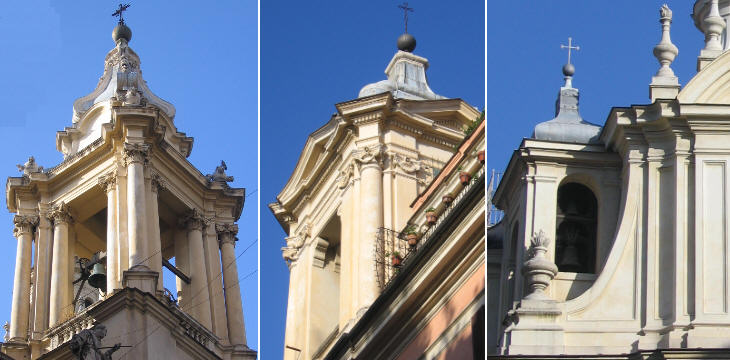
(left) Santa Maria dei Miracoli; (centre) Santa Maria in Montesanto;
(right) SS. Andrea e Claudio dei Borgognoni
The architects who came after Borromini did not follow the example of S. Agnese in Agone and their
bell towers were in general minor additions to the design of the churches.